
“Solo RPGs? Isn’t that just writing a book?” That’s what one gamer told me when I explained what The Soloist covers. It was said teasingly, but the truth is that most of us keep some sort of record of our play.
We call this “journaling,” but that word isn’t a perfect fit. It suggests polished writing when, in reality, solo players use all kinds of methods: notes in the margins, shorthand symbols, voice recordings, silly doodles. The point isn’t how it looks, but how it helps you play.
I asked solo players and designers on Bluesky and Substack what works best for them. Here are their strategies, in their own words:
Quick notes, scribbles, or half-sentences are fine. Use scrap paper, sticky notes, and index cards to explore concepts and prompts without the pressure to be neat in the moment.
“I think it’s genuinely important to accept you’re often writing notes, drafts, little scribbles of ideas as you journal. The game isn’t really in the writing, it’s somewhere between your pen and the book you’re reading from.” — C J Eggett
When you’re given a prompt or are trying to figure out how two words from a spark table can work together, write the first thing that comes to mind. You can always refine later.
“Start w/ your first reactions and note them down, then revisit the prompt after a short break to allow for more rounded thoughts to brew & possible reinterpretation. Your answers can change and that’s part of the fun.” — Finley
Some like to track stats, rolls, and inventory in one space, and keep story notes in another to reduce clutter. Others, like myself, keep the narrative and rolls in the same space, but use formatting to keep the story clear.
“I find it helpful to have separated areas where I track any ‘numbers’ stuff like stats, health, etc. and where I write my journal entries.” — Chris, Junk Food Games
Notebook, iPad, Google Doc, or Obsidian, choose whatever keeps you engaged and comfortable. I get distracted when playing a solo game on my PC, so I take my notes analog then polish on the PC. But many others find a computer faster. If you’re interested in using Obsidian for solo play, Kyward suggested this video.
“My handwriting becomes incomprehensible after half a page (plus ouch my hands). I think far too quickly for my writing speed. I’ve been using Scrivener recently, which works much better for the game I'm playing. It just *flows* with the right recording tool.” — Emma Grier
“I quite like the feeling of something that has a sense of the adventurer’s note book. So rough paper and cover. Pencil. I like drawing too.” — Andy ‘Onegraydot’ Gray
Icons, color codes, or abbreviations speed up play and make notes easier to scan later.
“When I journal I tend to establish some icons to use as shorthand for resources or nouns that come up often.” — Emily Entner
Doodles, maps, stickers, or pasted images can bring your story to life. Eleanor Hingley says she likes to “fancast” her NPCs using photographs or genre-related art because it makes them feel more real. I had no idea what fancast meant, so I asked her.
“It just means finding photos or images that you use to represent characters. Comes from the fan community that “fancasts” specific actors as characters in books in their ideal adaptation of a book.” — Eleanor Hingley
First-person can deepen immersion. And at the end of play, you have what feels like your character’s diary. Third-person works better for me when I’m playing a cast of characters.
“Third person when I’m freewheeling, first person when I’m feeling fancy!” — Cormac
Add pockets for index cards, sticky notes for quick ideas, or dedicated sections for NPCs and plot threads.
“I use a notepad that has a particularly wide left margin. On the left side, I track the moves, the oracle questions, and the rolls. On the right side, I jot notes about what’s happening in the fiction. In the back of the notepad, I have a section for NPCs: name, description, location, important notes and current status. Then, I have a section for story threads, plot seeds, and key locations.” — Susan Beneville
Thanks to everyone who contributed! You can read the original Bluesky thread here. Something resonate with you? Have another idea to share? Mention them in the comments.
I’ve just posted a new Solo Session, The Soloist’s play examples of recommended solo or solo-friendly RPGs, for Star Borg. Solo Sessions are journals combining “how-to” instructions and a full session write-up. In it you’ll see that I’ve separated the narrative from the mechanics. I write in the third-person and try to throw in cinematic camera language to help paint the picture. I’ve also included some of my silly illustrations. I had a great time playing Star Borg!
Blackwell Games just released three new games but they’re something different from who you might expect from the creator of solo staples like Apothecaria, Delve, and For Small Creatures Such As We. The Death & Pottery Collection are multiplayer games (though GM-less) now available individually on itch with print editions coming soon from Anna’s website.
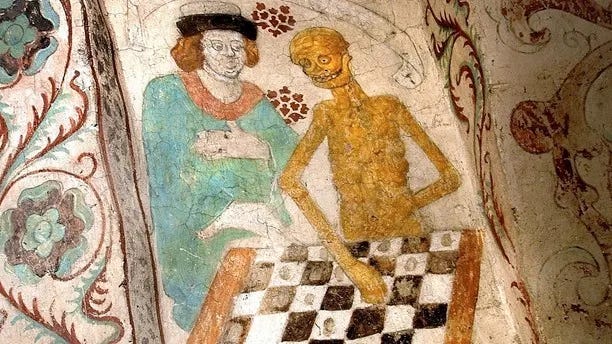
♟️ A Conversation With Death: This is a duet RPG where one player is Death and the other is someone who just died. A chessboard drives the roleplaying and may prompt questions when you take the other player’s pieces.
🏰 Our Once Proud House: A GMless RPG where you play squabbling spoiled heirs tearing apart their family’s noble legacy for their own selfish gains.
🖼️ Mistorical Museum: An improv party game where you’re curators of a weird museum and your job is to make the best exhibits by grabbing things from around the house or wherever you’re playing and make up what they are.
The fourth game in the set is still in the works.
YouTuber and game designer Man Alone has just released The Outer Darkness, a 112-page solo game about ritual, memory, and perilous travel. As a pilgrim with a forgotten past, you take up the Oath of Ether and vanish into the forest that borders the known and unknown.
The game draws on the psychology of Carl Jung, especially his idea of inner transformation, the concept that facing your hidden fears and flaws makes you whole. In The Outer Darkness, the foes you meet are symbols of your hidden self. Play becomes a way of exploring these shadows through imagination, story, and ritual. Progress is less about leveling up and more about uncovering and piecing together who you are, echoing Jung’s view that the path through darkness leads closer to wholeness.
The Outer Darkness is currently $4.99 (regularly $11.99) on DriveThruRPG. This includes all updates, 50% off Part 2 (The Inner Light), and $5 off the physical book. Man Alone will be polishing The Outer Darkness over the next month with fixes, examples, improved sheets, and a print-friendly edition.
Nate Whittington has launched Project Opulent, a collaborative RPG setting called Zemaryth. Instead of one author, Zemaryth will grow through community contributions (polls, stories, art, mechanics) curated by Nate into a usable whole.
Contributions can be as small as a proverb or as large as a myth, all gathered in ongoing chat threads and then curated into lore, tables, and play hooks. The goal isn’t a polished setting book but a raw collaborative archive.
Project Opulent lives on Nate’s Grinning Rat Substack.

The Play for Peace – Games for Palestine 2025 Charity Bundle brings together 382 PC and tabletop games (including solo RPGs) games to raise funds for humanitarian aid in Palestine. Organized by volunteer curators and partnered with UNRWA USA, all proceeds go directly to relief efforts, making the bundle both a showcase of global creativity and a fundraiser for an urgent cause. Runs through Sept. 21.
Beth and Angel Make Games are hosting the Free Zine Week! Bundle on itch. This is a collection of over 125 zines from 63 creators. The bundle is pay what you want (including free) and runs through Sept. 14.
DNGN CLUB GAMES is running an Emergency Moving Sale to help with the costs of a surprise move. Get 14 (nearly every paid PDF in the DNGN CLUB shop) for $14. Normally these games together would cost over $90. These are well produced supplements and games (including solo) with great content, layout and human-made art.
Final Days of the Solo D&D Adventure Sale: The Solo D&D Adventure Sale at DriveThruRPG’s Dungeon Masters Guild is almost over. Save up to 40% on almost 250 solo adventures, toolkits, and more. Sale ends Sept. 15.
DriveThruRPG is also running The Savage September Sale. For a few more days you can save up to 40% on more than two thousand Savage Worlds RPG and Fiction digital titles. Including Deadlands, Rifts, The Secret World, Scarred Lands, Pathfinder, Broken Earth, Titan Effect, and more. The Savage September Sale is on at DriveThruRPG and DriveThruFiction.
To celebrate his birthweek, ROLLINKUNZ has made all of the digital DUNGENERATOR content 50% off. I enjoyed DIE in a Dungeon, a solo or co-op game where your polyhedral dice are adventurers attempting to save and rebuild a village. The ROLLINKUNZ Birfday Bonanza! ends Sept. 20.
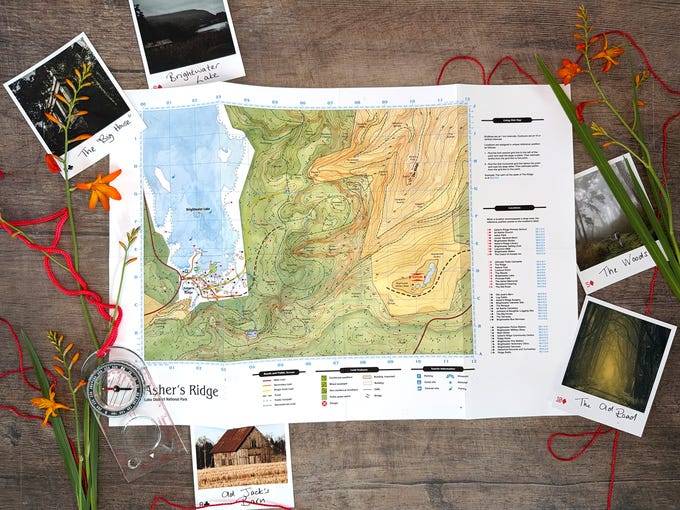
Asher’s Ridge is an RPG of paranormal drama television for 1 to 4 players, with no GM and zero prep, by the designer of The Almanac of Sanguine Paths and Dead Letter Society.
Create a character that suits the type of game you want to play. Their attitudes shape mechanics and evolve across multiple episodes.
Each episode begins with a logline (chosen or created), that guides tone and story direction.
Decide on the locations to use in the episode. Draft a 20-card deck or use a pre-set deck to get quickly into the game.
Play to find out what is happening. Create a web of interlinked plot threads using Scrabble tiles, and play out scenes at locations across the town and its surroundings.
The Kickstarter campaign closes Sept. 16.
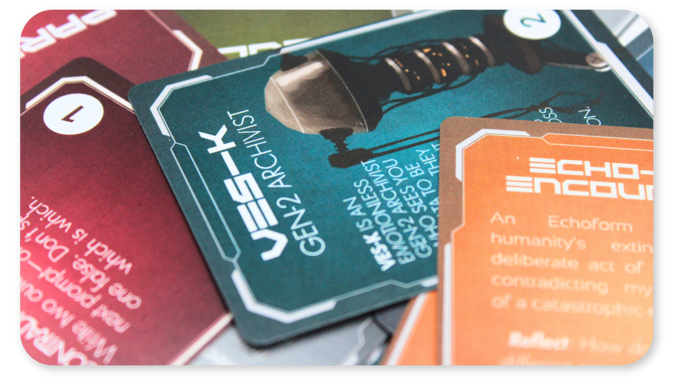
In the solo RPG You Were Made, you play an Echoform, a synthetic being built as a vessel of memory by humanity in its final days. You will uncover fragments of the past through narrative prompts (memories, questions, anomalies, etc). On your turn, you’ll choose one of five action types (Remember, Decipher, Explore, Connect, or Override) and roll a d20 to determine the results. Through each cycle, you’ll navigate themes of identity, memory, loss, and purpose.
A 40-page book provides instructions and lore.
The 50-card prompt deck is divided into five themes: Discovery, Echo-kin Encounters, Crisis, Philosophy, and Glitch Events.
Companions are recruitable Echoforms each with a distinct voice, perspective, and history.
Paradox Cards challenge your Echoform with contradictions. Emotional, temporal, or philosophical.
The Kickstarter campaign closes Oct. 2.
Comments
Nothing yet. Say the first thing.
Sign in to join the conversation.