
Every day, maybe even every minute or hour these days, someone will claim that students, and humans for that matter, no longer need to learn facts because AI can simply provide the information whenever they need it. Then a story like this comes along and we should be quickly reminded that knowledge still very much matters. In fact, it matters more than ever.
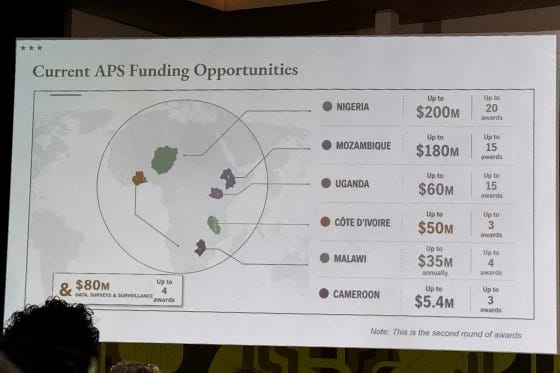
At a recent international conference on global health, a map of Africa displayed by the U.S. government mislabeled every country it highlighted on the continent. Countries appeared in the wrong locations, some were swapped with entirely different nations, borders were inaccurate, and the map quickly spread across social media as people pointed out the obvious, or what seemed obvious to some, errors.
The story has generated plenty of discussion about AI because the map appears to have been created using OpenAI. That is certainly an important part of this single story, but I believe the more important lesson here has little to do with AI itself. The real lesson is about the value of knowledge and knowing lots of things about the world you live in.
We all understand the power of AI. It can generate text, images, maps, lesson plans, emails, and presentations in seconds. Its use in that regard is endless. However, it can also generate critical mistakes that look remarkably accurate. The technology has become incredibly good at producing information that appears correct on the surface. It’s so fast and so sure that is must be right. Right? From my perspective, this makes the role of human knowledge more important, not less.
Someone prompted AI to create that map of Africa. Someone inserted it into a presentation. Someone, presumably, reviewed the presentation before it was shown to an international audience. At each step, the catastrophic mistakes remained invisible to these people. People in our government. Professional, educated people. The issue was not ultimately that incorrect information existed. That’s Al’s fault. The issue was that no one recognized it as incorrect. That’s our fault. That’s what humans can control but did not control because the humans did not know enough. That is where knowledge securely stored in long-term memory matters. To use AI effectively, humans need to know more than the AI.
When people possess a well-developed knowledge base, they don’t just do well at Jeopardy!. They notice a lot more things. They recognize when something does not fit with what they already know. They can effectively detect inconsistencies, question claims, and identify errors that might otherwise go unnoticed and remain invisible. Knowledge provides the framework against which new information can be assessed and evaluated with a critical eye. Without that framework, almost anything can seem plausible and real.
This is, in my opinion, one of the most important principles from cognitive science. Long-term memory is not merely a place where facts are stored for later use. It is the foundation that allows us to think, comprehend, solve problems, and make judgments of everything we pay attention to in our environment. Every new piece of information that enters our working memory is interpreted through what we already know in our long-term memory.
Cognitive science has also proved that much of comprehension, reading especially, depends on background knowledge. The same principle applies to evaluating AI-generated content whether it be maps, diagrams, charts, summaries, etc. If we lack sufficient knowledge about a topic or concept, a person or a place, we also lack the ability to determine whether the information we are receiving is accurate. That has enormous implications for education and society as a whole.
In the coming weeks, my seventh-grade students will begin our unit on Africa. They will learn where these same countries are located, how the physical geography has shaped settlement and development in different regions, and how parts of Africa have developed distinct cultural, economic, and political characteristics. Some may naturally wonder why students should spend time building this knowledge when AI can generate a map, summary, explanation, or essay in seconds. This story provides the answer.
Students who develop a strong mental model of Africa would likely notice that something was wrong with the map almost immediately. No, they likely won’t remember every country’s borders or location with 100% accuracy. We know human memory is extremely fallible. They will remember just enough though. Just enough to question the whole based on a missing or altered part. Just enough to say, “Wait a minute.” That's what securely stored knowledge in long-term memory does for humans. It gives us the power to say, “Wait a minute.” Students who never build that knowledge have no basis for questioning what they see in their world. The difference is not wealth, position, intelligence, experience, or education. It is knowledge.
That is why securely storing knowledge in long-term memory still matters. I will boldly claim, although it should not be thought of as a bold claim, it matters now more than ever. The more convincing and widespread AI becomes, the more valuable human knowledge becomes. We cannot evaluate information we do not understand, and we cannot recognize errors in subjects we know nothing about. If we want students to use AI wisely, and we should want that, the answer is not to teach them less knowledge. It is to ensure they know more.
No posts
Comments
Nothing yet. Say the first thing.
Sign in to join the conversation.