
Last year was my first year implementing knowledge organizers. They are definitely one of the most important instructional tools I use. Students used them regularly for retrieval practice, reviewed them through Cover–Write–Check, used them to prepare for assessments, and referred back to them throughout each case study as a form of reference notes. They provided a consistent place for students to access the most important knowledge from each case study. By the end of the year, however, I started thinking about ways they could be improved. Like any part of my instruction, they need the same refinement that I have devoted to retrieval practice, content sequencing, and explicit instruction over the past year.
As I began redesigning knowledge organizers this summer, I found myself asking a different question than I had last year at this same time. Previously, I was primarily concerned with whether I had included what students should know. My focus was on completeness. Now, my priorities have changed considerably. Instead of trying to add every relevant term or example, I now ask this question to determine what makes it on the page: What knowledge do students need to be able to retrieve so fluently that it is automatic? That lens has drastically changed how I go about creating knowledge organizers.
Automaticity Is the Foundation of Thinking
One of the most important ideas I have learned from cognitive science is that working memory is remarkably limited. Every time students encounter new information, solve a problem, or attempt to explain a concept, they must rely on a very small amount of mental space where conscious thinking takes place. Because working memory can only process a limited amount of new information at one time for a very short duration of time, it is easily overwhelmed when students must simultaneously decode vocabulary, remember background knowledge, interpret maps, and reason through a complex question. The more demands we place on working memory, the fewer cognitive resources remain for effective learning and thinking.
This is precisely why building automaticity matters. When foundational knowledge and vocabulary has been securely stored in long-term memory and can be retrieved effortlessly, students no longer have to devote valuable working memory resources to recalling and using that information. Instead, those resources become available for more expert-level knowledge building and thinking. Students can devote their optimized intrinsic load to explaining causes and consequences, recognizing patterns, evaluating evidence, and connecting ideas because the foundational knowledge they need is already readily available at little to no cost. Automaticity is not about memorizing facts. It is all about reducing the burden on working memory so that deeper thinking and understanding becomes possible.
Designing for Automaticity Rather Than Coverage
As a result, the first step to improve my knowledge organizers is resisting the urge to include everything. Earlier versions of my knowledge organizers often resembled condensed summaries. If students encountered a concept during the unit, I felt it necessary to include it somewhere on the organizer. Endless definitions, examples, and facts found their way onto the page because I believed everything was essential. Looking back, I was designing more for coverage rather than for automaticity.
Understanding of cognitive science has led me toward a different approach. Not every piece of information deserves the same amount of emphasis and practice because not every piece of information plays the same role in current and future learning. Some knowledge needs to function as the conceptual foundation upon which everything else depends. Other details enrich understanding but are not essential in terms of building automaticity. The next step is to identify the small set of foundational concepts and vocabulary that students will retrieve repeatedly throughout the unit until they become automatic. In other words, my knowledge organizers will prioritize only the information students need to know, not the information that’s simply nice to know.
A Concrete Example: Micro-Entrepreneurs in Africa
The knowledge organizer for our Micro-Entrepreneurs: Women’s Role in the Development of Africa case study shows this refinement concretely. During this case study, students learn about women operating food trucks in Botswana, entrepreneurs expanding businesses in Uganda through micro-credit, and multifunctional platforms transforming daily life in Mali. They learn about the role and importance of agriculture, transportation, family finances, and local economies. All of these details contribute to students’ knowledge of the key concepts, but they are not equally important when it comes to long-term learning and achieving automaticity.
As I refine this organizer, what’s most important is to determine which ideas students would still need several lessons later when students start to learn about more nuanced and complex concepts like economic development, quality of life, and gender roles in different parts of Africa. This led me to identify several foundational and necessary concepts and terms: micro-entrepreneur, micro-enterprise, micro-credit, collateral, informal economy, GDP, economic development, quality of life, and gender-based division of labor. All of these appear repeatedly throughout the case study and become the domain-specific language and knowledge-base students will need to use to learn and understand increasingly complex ideas. If students cannot retrieve these ideas and their definitions automatically, they will struggle to master their meaning.
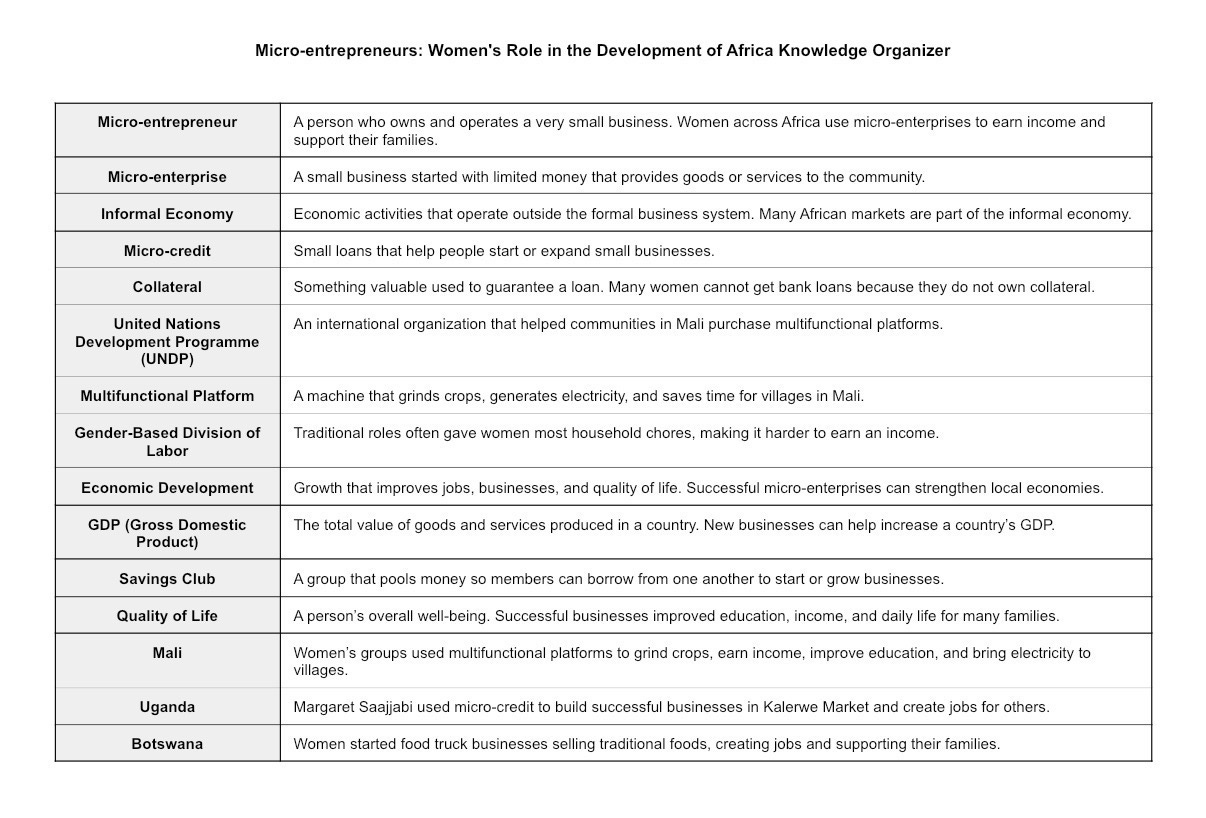
The three conceptual diagrams included in the knowledge organizer serve an intentional purpose rather than just making the page more visually interesting. Each diagram is intentionally paired with a key concept or concrete example to provide an additional retrieval opportunity beyond just definitions. By integrating simple text with key visuals, the organizer’s diagram uses dual modalities, helping students build stronger memory traces. By using spaced cycles of retrieval practice, these diagrams can become an additional part of students’ conceptual mental models, supporting both recall of foundational knowledge and deeper meaning of how the concepts relate to their understanding of the world.
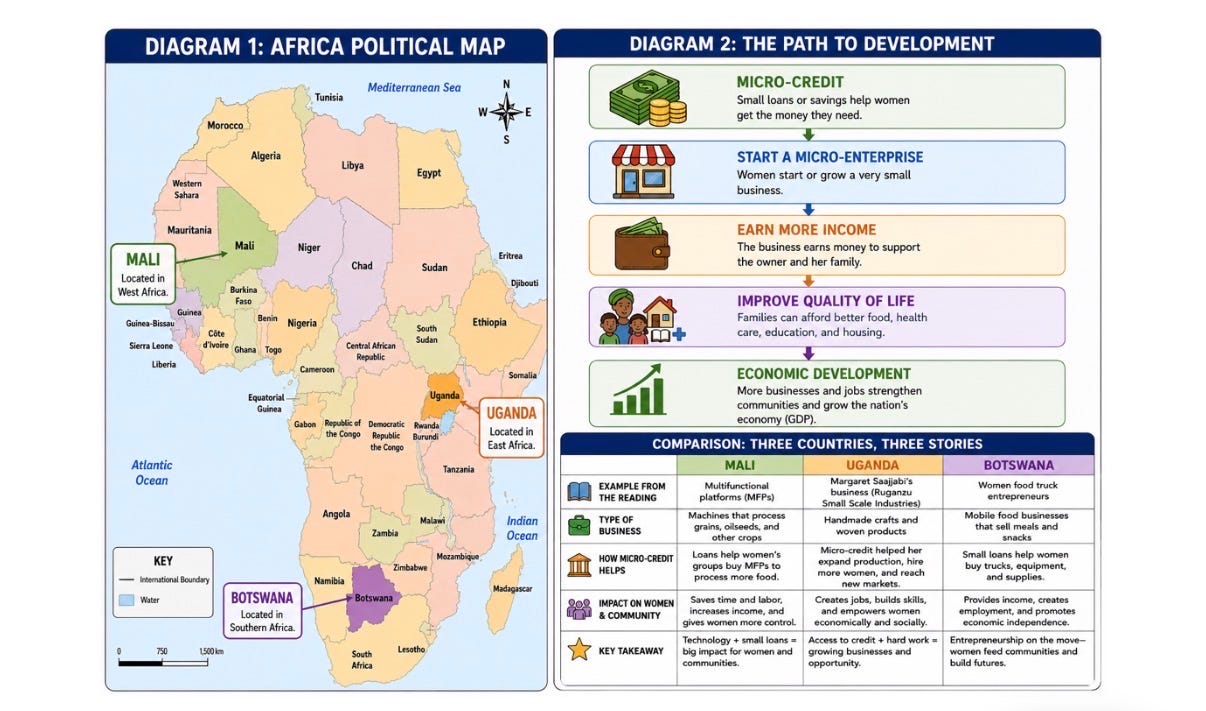
The same process determined the concrete examples I chose to include. Instead of adding every country discussed in the case study, I purposefully selected Mali, Uganda, and Botswana because each can serve as a cognitive hook in long-term memory for a broader, more complicated concept. Mali is associated with multifunctional platforms and quality of life. Uganda is linked to micro-credit and the informal economy. Botswana is connected to gender-based division of labor and collateral. These concrete anchors in long-term memory will help students develop richer, more interconnected schemas that make future learning and harder thinking more efficient.
Knowledge Organizers as a Tool for Building Automaticity
Through repeated retrieval using Cover–Write–Check, low-stakes quizzes, partner recall, and nightly homework , students gradually build fluency and move the most important vocabulary, concepts, people, places, and examples into long-term memory where they can be retrieved with little conscious effort.
That automaticity is essential because it frees working memory for the kind thinking that I ultimately want students to do. Instead of using limited cognitive resources to remember what GDP stands for or where Botswana is located, students can focus their working memory on explaining patterns, making connections, and analyzing complex problems. In this way, my knowledge organizers are no longer reference sheets. They are a tool by which students build expert-level knowledge in their long-term memory they can recall and use automatically. When carefully designed and paired with an intentional and systematic retrieval practice system, knowledge organizers can be a dynamic process for building the durable background knowledge that makes future learning possible.
No posts
Comments
Nothing yet. Say the first thing.
Sign in to join the conversation.