
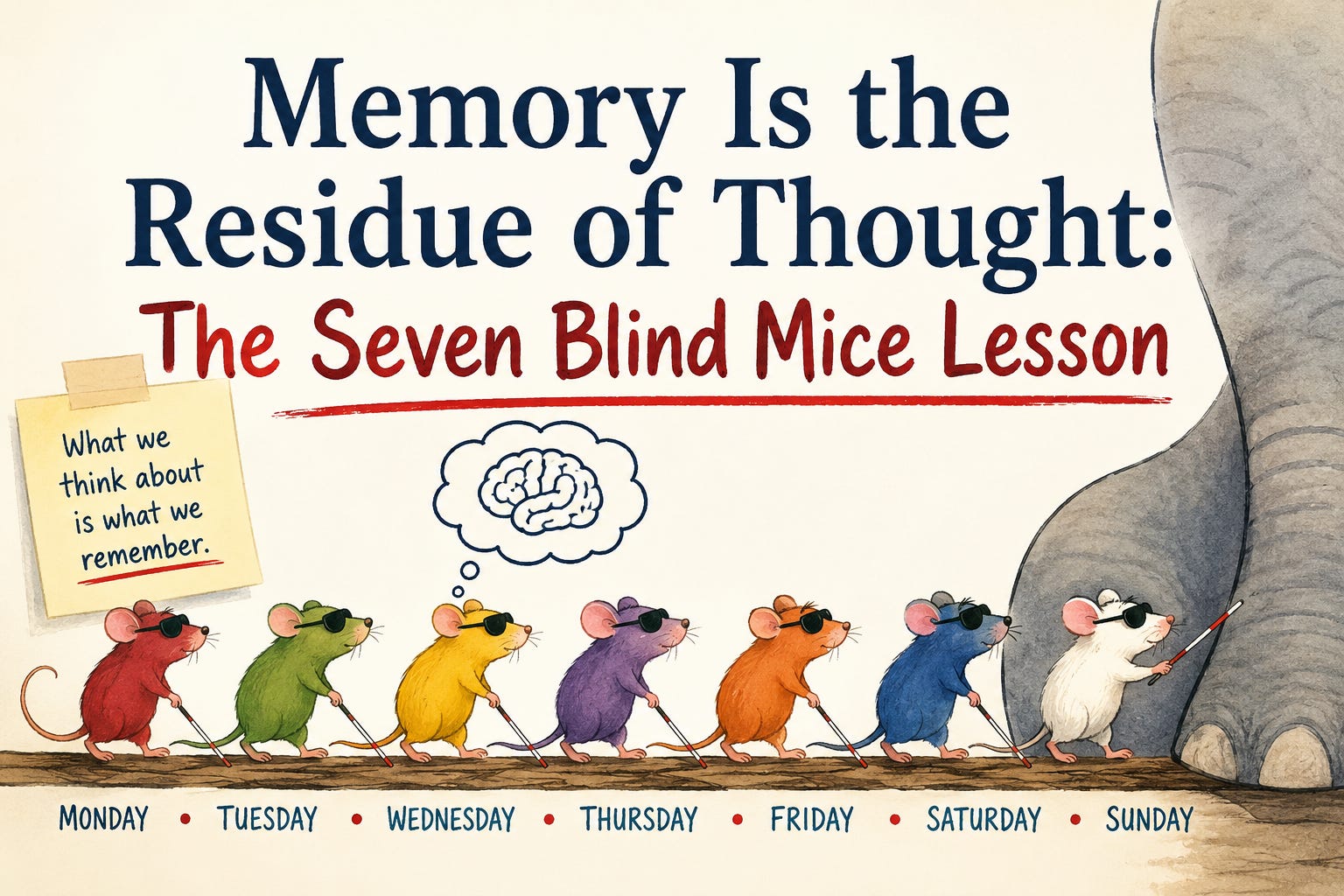
One of the principles of cognitive science that most directly shapes the way I teach is Daniel Willingham’s simple observation that “memory is the residue of thought.” We have all heard or seen the quote before. It’s a remarkably simple way to communicate a remarkably complex concept. We will remember what we think about. Let’s say we all go out to dinner. If one person thinking about the waiter’s accent and another thinks about their facial hair then a week later they are asked to describe the waiter they are far more likely to remember the characteristic they thought about. So simple, yet so brilliant. It’s a concept teachers need to understand inside the classroom as well. In many ways teachers should begin and end with the idea that students will remember what they think about. Therefore, I now consider that outcome when I plan lessons because it provides me with a useful lens and filter for making instructional decisions. If I want students to remember something tomorrow, next week, next month, and next year, I need to be very intentional and explicit about what I am asking them to think about today. That means most of instructional planning, for me, begins with this question: What do I want students to remember, and how will I get all of them to think about it so they to remember it?
That principle became concrete for my students during the first day of school this year. I wanted to give students an immediate, memorable example of what I would soon be teaching them about learning, working memory, attention, remembering, forgetting, and the importance of thinking to memory. To accomplish this, I read Ed Young’s Seven Blind Mice with them. It is a children’s picture book about seven mice who encounter an elephant and each investigate a different part of it. The book has a very useful sequence of details I could leverage: the mice are red, green, yellow, purple, orange, blue, and white, and they go in that order from Monday through Sunday to investigate the Something by their pond. I decided before we began reading that I wanted students to remember the colors and the order of the mice. Once I knew what I wanted them to remember, I could then deliberately plan the lesson around getting them to think about those details repeatedly. What some might call, beginning with the end in mind.
Decide What Deserves Their Attention
This is the part of teaching that I think is easy to overlook. Before I ever select a strategy, prompt, technique, response structure, or question, I need to know exactly what I want students to remember. Otherwise, it is very easy to create a lesson where students are simply busy working, writing diligently, and completing assignments all without necessarily devoting much of their working memory to the information they actually need to remember. When that happens, poor proxies for learning will tend to reign supreme and weak encoding in long-term memory is likely to transpire. I knew that simply telling students the details I wanted them to remember at the beginning of the story would not be sufficient. I needed to create multiple opportunities for them to think about those details in different contexts while we read. So that is exactly what I did.
Every Technique Had a Purpose
As we read, I deliberately prompted students to think about the colors of each mouse and sequence in which they appeared. I paused and asked questions about which mouse had gone, what color that mouse was, and who was coming next. I used turn and talk to give every student an opportunity to think through an answer with a partner before bringing the class back together. I used call and response to get everyone responding together. I used mini whiteboards to require every student to think about and commit to an answer. I used cold calling to make sure students understood that when a question was asked, they should all be thinking about the answer because anyone might be called upon.
I also used an all-hands-up routine to maintain and harness high levels of attention and thinking. After students had an opportunity to think and talk, I would count down and have everyone put their hands up, signaling that they should be prepared to respond. Then I could cold call a series of students and prompt them to build on each other’s responses. The point was not to use a variety of techniques and keep students busy and engaged. Each technique served the same underlying purpose: I was continually directing students’ attention and thinking back toward the specific information I wanted them to remember. The students weren’t going to just hear the order and colors of the mice as I read the story. They were repeatedly being forced to think about them.
Call and Response
As we read Seven Blind Mice, I used call and response every page to repeatedly bring students’ attention to the two details I wanted them to remember: the colors of the mice and the order in which they appeared. When each new mouse appeared, I prompted the class to identify its color and place in the sequence, giving everyone another opportunity to think about and retrieve those details.
I also asked students to raise their hands when a particular mouse’s color was their favorite. We then ranked all seven colors from favorite to least favorite. These simple processes gave students additional reasons to think about, compare, organize, and sequence the colors of each mouse.
Turn and Talk
Turn and talk is particularly useful for this because it gives every student an opportunity to formulate an answer rather than allowing the most confident students to dominate the conversation.
I ask, “What colors of mice have we seen so far?” Students had to think about the question and retrieve the relevant details. Then they turned to a partner and shared their answer. I would follow that with, “What color mouse went first?” and repeat the process.
Mini Whiteboards
Using mini whiteboards provided another way to make that thinking explicit and unavoidable.
When I asked, “What colors were the third and fourth mice?” I could have called on one student and moved on. Instead, I asked everyone to write their answer on their whiteboard and hold it up. Now every student had to retrieve the information and commit to an answer without being able to opt out of thinking.
That gave me a useful formative assessment because I could immediately see who knew the answer and who didn't. More importantly, every student had just engaged again in the thinking necessary to produce memorable memories.
Cold Call
Cold calling added another layer to the same process. If I ask a question and simply wait for volunteers, some students may think and retrieve the answer while others may wait to see whether someone else responds. When students know that I may call on anyone and all their hands are up, the question becomes another thinking task every student must engage in.
Even more powerfully, when I combined think time, turn and talk, all-hands-up, and cold calling, I could confidently ask a question about the colors and order of the mice and knew that every student had been given another opportunity to think about what they needed to remember.
The Retrieval Practice the Next Day
The most important part of the lesson actually came the next day. Two of the questions I selected for our beginning-of-class Do Now retrieval practice were directly connected to the details I had deliberately prompted students to think about during the reading. I asked them to retrieve the colors and order of the mice. I want to see if they remembered what they thought about. More importantly, I wanted them to see if they remembered what they thought about.
And they absolutely killed it. Students were able to retrieve the information remarkably well. Their success was productive in the traditional sense of building stronger memories, but it also became a perfect demonstration of the “memory is the residue of thought” principle I was trying to teach them about in the first place.
I pointed back to the previous day’s lesson and said, in effect, “Remember how I kept asking you about the colors of the mice? Remember how I kept asking which mouse went first, second, and third? Remember how you had to talk about it, write it on your whiteboard, respond together, and be prepared to answer when I called on you? Look at what you can remember today. You remember it because you thought about it.”
Their strong memories provided the evidence I needed. They had thought about those details repeatedly, and when I asked them to retrieve those details the next day, they were able to do it. That gave me an authentic example to use when explaining the science of learning. I didn’t have to rely exclusively on an abstract explanation about memory. I could show students something that had happened in our own classroom, in their own memories, less than 24 hours earlier. I said, “You remembered it because I intentionally and frequently prompted you to think about it.” I hope and expect the end result to be increased student buy-in for the techniques and methods I use because students will clearly understand how it benefits them.
The Lesson of the Lesson
This is one of the many reasons I want students to understand how learning happens. I don’t want them blindly following classroom routines because I told them to. That only promotes basic compliance. I want them to understand why we use those routines and what those routines are designed to accomplish.
When students understand that retrieval practice strengthens their ability to bring knowledge back to mind, that changes how they view retrieval tasks I assign. When they understand that thinking about important information matters for what they remember, they have a more useful mental model for understanding why I continually ask them questions, have them explain ideas to partners, ask them to retrieve information, and revisit previously learned material. The Seven Blind Mice lesson gave students a concrete demonstration of those principles which I can continually refer back to through the year.
Designing a Classroom Around Thought
That brings me back to Willingham’s phrase: “Memory is the residue of thought.”
For me, that is more than a memorable quote to put on a slide during PD. It is a “North Star” instructional principle I use when making decisions about what happens in my classroom.
Before a lesson, I ask what I want students to remember. During the lesson, I deliberately prompt them to think about those things. The next day, I ask them to retrieve those ideas. Over the following days and weeks, I bring those ideas back again through spaced retrieval and strong curriculum coherence.
The Seven Blind Mice was more than just a children’s book. It was a medium by which I choose to make an essential underlying principle of learning explicit for my students: the things you deliberately and purposefully think about are more likely to be the things you remember. More bluntly, if you want to remember what I am teaching you, then you need to embrace how I am teaching you.
No posts
Comments
Nothing yet. Say the first thing.
Sign in to join the conversation.