
She had four offers. Two half-finished programs. And an idea she was going to launch “soon” — she’d been saying soon for eight months. She sat down and laid out everything. Everything she could do, everything she wanted to do, everything someone had once told her she should do. It was a lot. It’s always a lot.
I asked questions. We started removing things. Not the bad ideas — some of them were genuinely good, which is exactly why they were so hard to let go of. But they were sitting there taking up space, like those USB cables you keep in the drawer because they might connect to something. Except you got rid of that thing two years ago, you just haven’t admitted it yet.
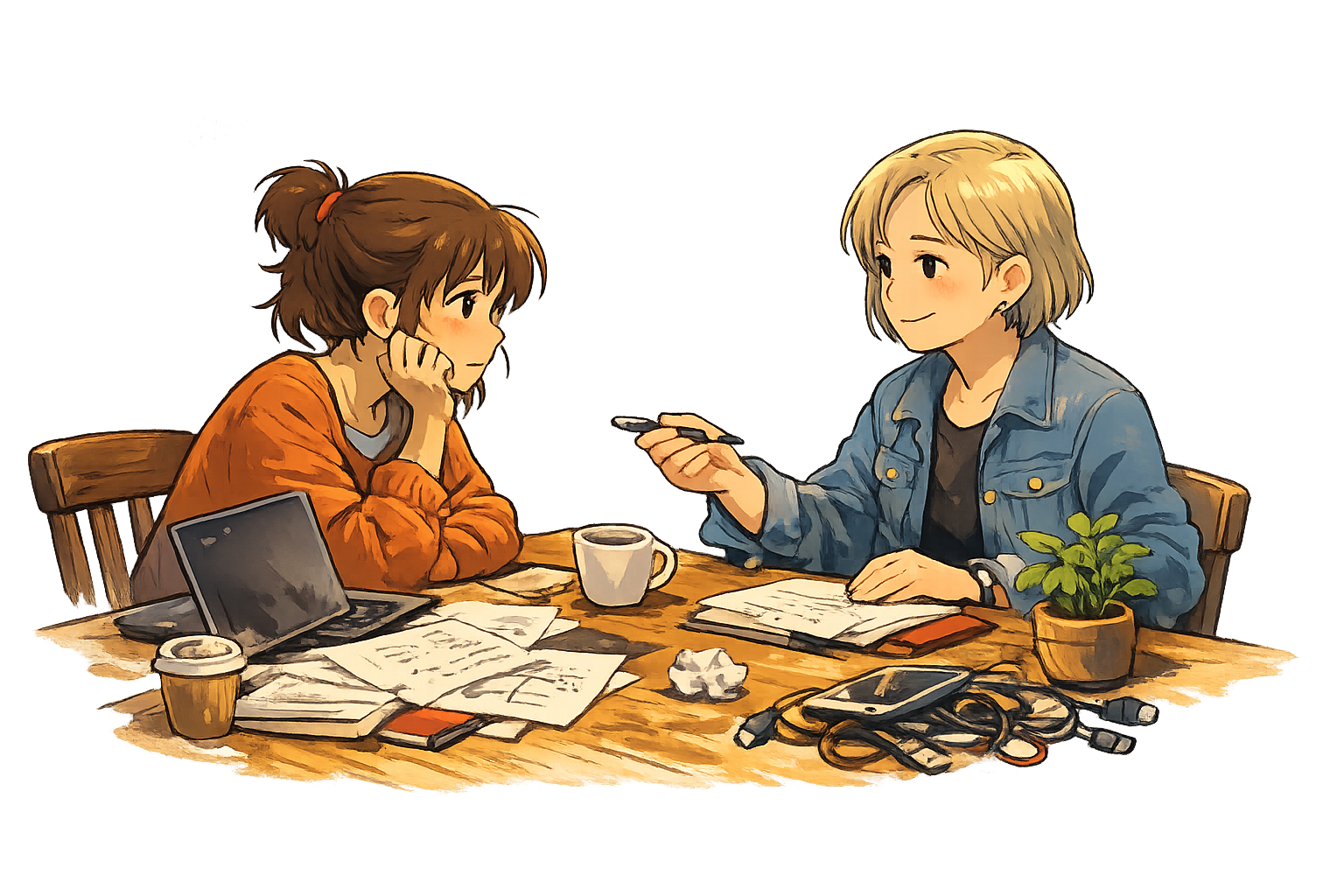
By the end there was one offer. Clear enough to price. Clear enough to actually say out loud when someone asks what you do. She looked at me like I’d done something. I’d done the thing I always do. I just didn’t have a name for it.
Here’s the thing. I built my competence inside corporations. Fifteen years of strategy work in rooms where everything had a name and a slide deck to go with it. Authority came with logos. Or at least a blue suit. You referenced a model when you spoke. You had a diagram when you presented. That was the deal.
Then I left.
And suddenly my thinking stood alone. No logo. No badge. No institution behind me going “yes, what she said.”
Just me.
And for a long time I thought that was the problem — that I was doing something real but couldn’t point to a framework and say *this is what it is.* Because it didn’t look like a framework. It looked like thinking. Like the thing my brain does automatically when someone sits in front of me with too many open tabs and needs help closing most of them.
I’ve been doing this for decades. Just not under the label “coach.” I did it with teams. With peers. With scouts — thirty years of watching sixteen-year-olds figure out how to lead a group through a forest in the rain, which teaches you more about decision-making than most leadership programs, if I’m being honest.
I did it with friends who felt like they were drifting. In their careers, in their businesses, in the space between what they were doing and what they actually wanted.
I did it when I built websites — the technical part was easy for me, but that was never what people needed.
What they needed was someone to sit with them until they could see themselves clearly again, to strip away what wasn’t aligned, to make them feel smart and optimistic again. To strengthen their sense — in their bodies, not just their heads — of being capable people who could trust their own discernment. Underneath all the options they’d piled on top. The website was the surface. The real work was always elimination and alignment.
And then I did it with myself. When illness stripped everything down to what actually mattered. When clarity stopped being something nice to have and became the thing that kept me functional. When “small steps” went from being a concept I vaguely agreed with to being the only way anything got done. At all.
Different rooms. Different decades. Same thing happening every time.
Lay it all out. The whole backpack, emptied onto the table.
Remove what’s not aligned. Not because it’s wrong — but because it’s not connected to anything real anymore. This is the part people resist. Because it means letting go of things that still feel possible. And as long as everything stays possible, nothing becomes payable.
Find the actual decision. There’s always one. And if you listen — to your body, to that slight shift in your own voice — you usually already know what it is. You just haven’t let yourself say it yet.
Commit. To one clear offer, for a defined stretch of time. Long enough that you can’t escape into a shiny new idea the moment it gets uncomfortable.
And then hold. Because deciding isn’t the hard part. Staying decided is.
I didn’t set out to build a framework. I set out to help people think. But when you’ve run the same pattern hundreds of times — in boardrooms and scout camps and hospital waiting rooms and Zoom calls with someone who has seventeen ideas and zero revenue — at some point you have to stop calling it instinct and start calling it what it is.
In rooms where frameworks are currency, unnamed competence sounds like improvisation. And I’ve seen what happens when real thinking sits inside someone else’s structure. How it gets absorbed. Repackaged. Credited elsewhere. For a long time it felt safer to just do the work quietly and let other people name things.
But hiding it doesn’t protect it. Naming it does.
This isn’t borrowed. It’s three decades of pattern recognition, field-tested across corporate strategy, scouting, illness, and now coaching. It’s repeatable. It’s structured. And it’s mine.
If you’re sitting there with more ideas than you know what to do with — not confused, just overloaded — this is the work.
Not because you need more input. You have plenty.
But because at some point, you have to choose what you’re actually willing to stand behind. And then stand there long enough for it to matter.ı
This is what I do with people now. One backpack at a time.
Comments
Nothing yet. Say the first thing.
Sign in to join the conversation.