
“The most powerful financial innovations don’t announce themselves. They arrive as plumbing upgrades — and then everything built on top of them changes.”
The Problem: $133 trillion in global bonds sits locked in legacy settlement rails — T+2 clearing, custody friction, geographic access barriers, and yield that evaporates between counterparties. Institutional capital wants yield. It doesn’t want the infrastructure tax.
The Solution: Tokenized U.S. Treasuries — blockchain-native representations of government debt — deliver 4.5%–5.5% yield with 24/7 settlement, programmable compliance, and fractional access. The technology is not experimental. It is live, scaled, and accelerating.
The Opportunity: Tokenized T-bill funds crossed $7 billion in onchain AUM in early 2026, up from $850 million two years prior. The broader tokenized real-world asset market hit $24 billion by February 2026 — a 266% single-year expansion. BlackRock’s BUIDL alone holds $2.4 billion. This is not a pilot program. This is infrastructure.123
The Thesis: BULLISH on tokenization infrastructure plays — custody, settlement rails, and the asset managers who moved first. BEARISH on traditional custodians and legacy clearing houses that treat blockchain as a threat rather than an upgrade. WATCH the regulatory calendar: PSD3, SEC digital asset guidance, and OCC bank custody rules are the catalysts that will move this from $24B to $240B.
Here is a number worth sitting with: $133 trillion.
That is the size of the global bond market.4 It is the largest, most liquid, most institutionally significant asset class on earth. It is also settled on infrastructure that was designed before the internet existed.
The standard settlement cycle for U.S. Treasuries is T+1 — meaning a trade executed today settles tomorrow. For most bond markets globally, it’s T+2. That gap — that 24-to-48-hour window between trade and settlement — is not a minor inconvenience. It is a capital efficiency tax that costs institutional investors billions annually in margin requirements, counterparty exposure, and idle cash drag.
The custody layer is worse. Holding U.S. Treasuries as a non-U.S. institution requires navigating a chain of correspondent banks, custodians, sub-custodians, and clearinghouses — each extracting fees, each introducing latency, each adding operational risk. A pension fund in Singapore wanting exposure to U.S. government yield faces a bureaucratic obstacle course that would be unrecognizable to the retail investor who buys a Treasury ETF in three clicks.
The result: yield that should flow freely to global capital pools is instead filtered through a system that was built for a different era and has never been fundamentally redesigned.
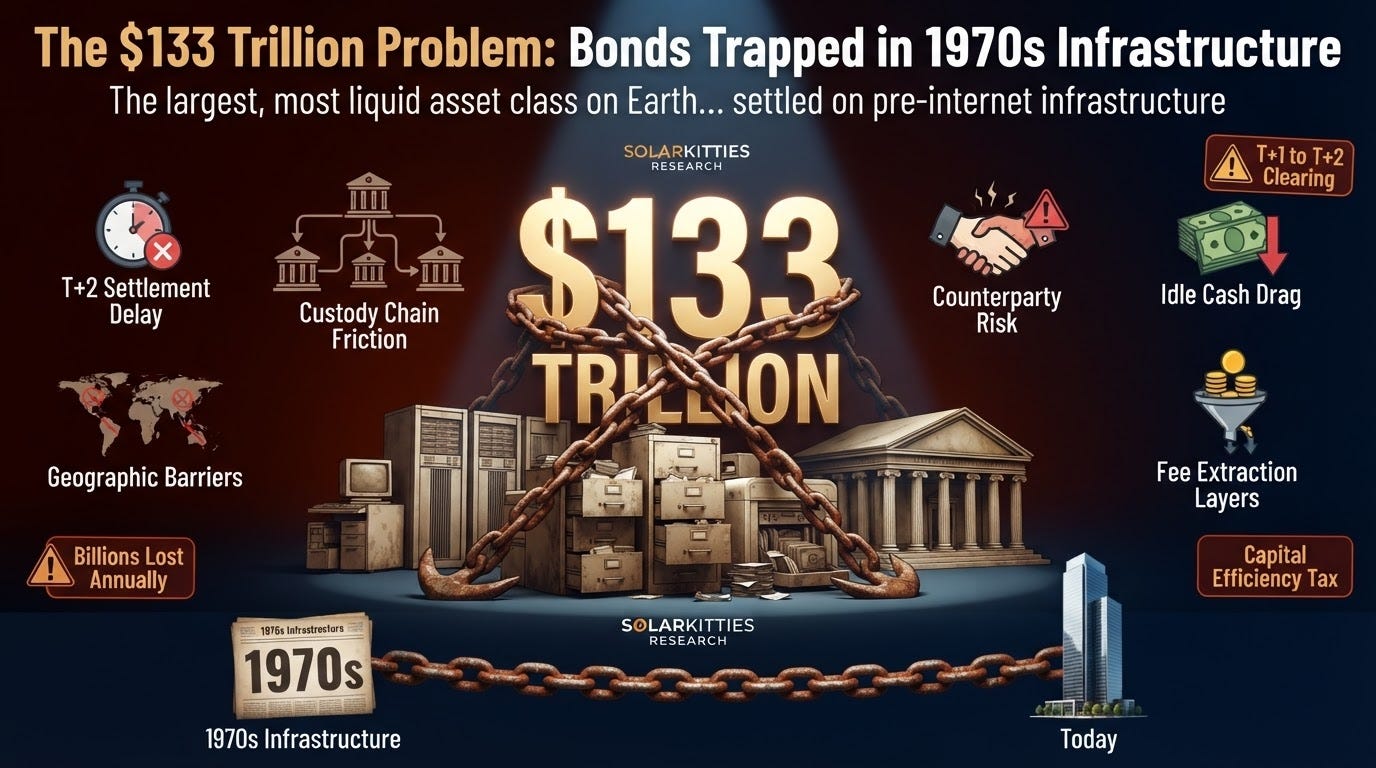
The world’s largest asset class runs on pre-internet infrastructure. The friction is not a bug — it’s a feature for the intermediaries extracting it.
Three compounding pressures are making this untenable:
The yield environment has changed. After a decade of near-zero rates, U.S. Treasuries now yield 4.5%–5.5%. That’s real money. The friction cost of accessing it is no longer trivially small relative to the return.5
DeFi protocols need stable yield. The $100B+ decentralized finance ecosystem has been running on algorithmic yield that proved fragile. What it needs is real yield — government-backed, dollar-denominated, and programmable. Tokenized Treasuries are the answer.
Institutional mandates are shifting. The EY 2025 Institutional Investor Digital Assets Survey found that 76% of firms intend to invest in some form of tokenized assets by 2026.6 That is not a fringe position. That is a consensus forming in real time.
The infrastructure that serves $133 trillion in bonds was not built for this moment. Something new is being built to replace it.
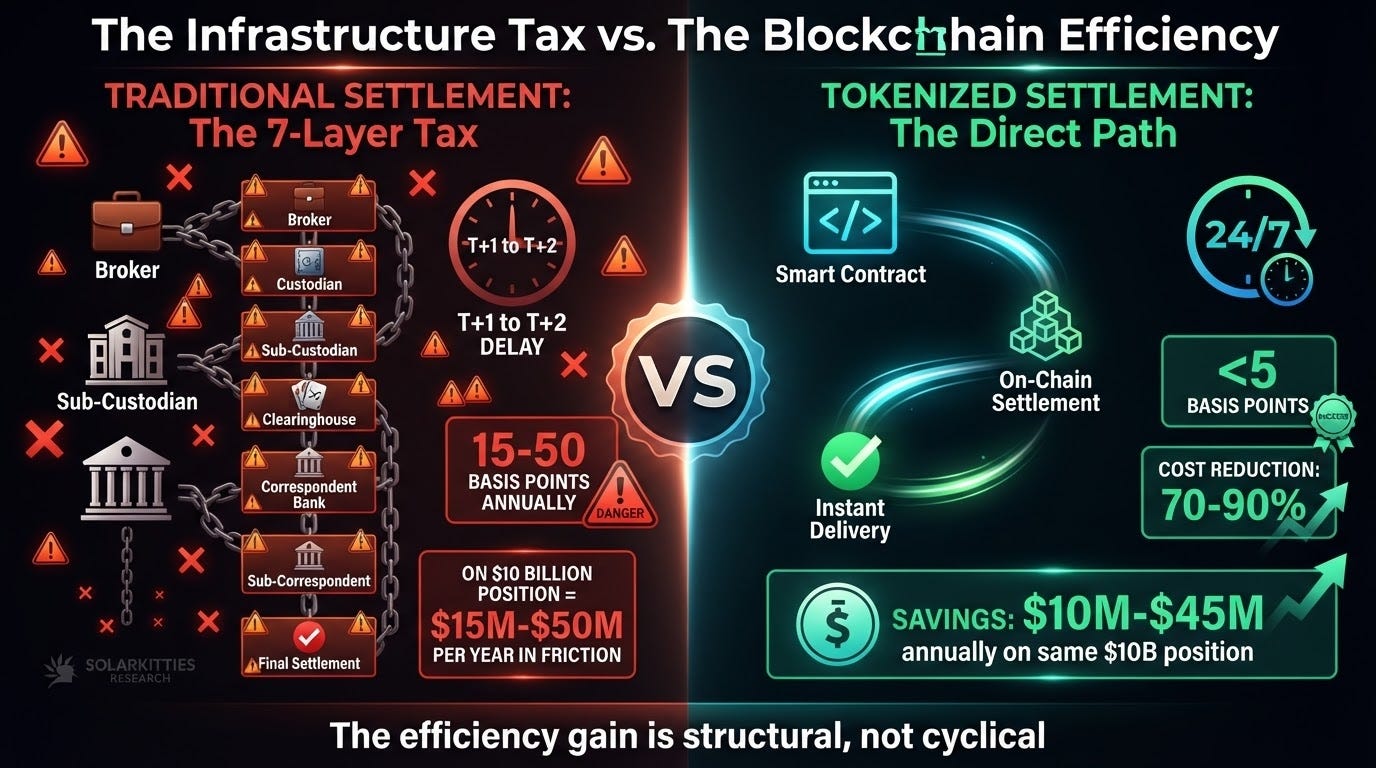
The efficiency gain is structural, not cyclical. Smart contracts don’t take lunch breaks.
Strip away the blockchain jargon and the mechanics are straightforward.
A tokenized Treasury is a digital representation of a U.S. government bond — or a fund holding government bonds — recorded on a public or permissioned blockchain. Each token represents a fractional claim on the underlying asset. The yield accrues to the token holder. The settlement happens on-chain, in real time, without intermediaries.
The technology stack has four layers, each with its own maturity curve and investment implications:
The underlying asset — actual U.S. Treasury bills, notes, or bonds held in a regulated custodial account by a licensed financial institution. The token is not a synthetic. It is a claim on real government debt.
The tokenization platform — companies like Securitize, Ondo Finance, and Backed Finance that handle the legal structuring, smart contract deployment, and regulatory compliance. This is the most technically complex layer and the one with the highest defensible moat.
The blockchain rail — Ethereum is the dominant settlement layer for institutional tokenized assets, but Stellar (Franklin Templeton’s FOBXX operates across eight chains), Polygon, and Solana are active. The multi-chain reality is here; the interoperability question is not yet resolved.
The access layer — wallets, custodians, and DeFi protocols that allow end users (institutions, DAOs, high-net-worth individuals) to hold, transfer, and deploy tokenized Treasuries as collateral or yield-bearing instruments.
What this enables that legacy infrastructure cannot:
24/7 settlement — no T+1 delay, no market hours constraint, no geographic restriction
Programmable compliance — KYC/AML rules embedded in the token itself, automating regulatory requirements that currently require manual processing
Fractional access — minimum investment sizes drop from $100,000+ to $1, democratizing institutional-grade yield
Composability — tokenized Treasuries can be used as collateral in DeFi protocols, posted as margin on digital asset exchanges, or embedded in structured products — all programmatically, without manual intervention
Atomic settlement — delivery and payment happen simultaneously, eliminating counterparty risk in the settlement window
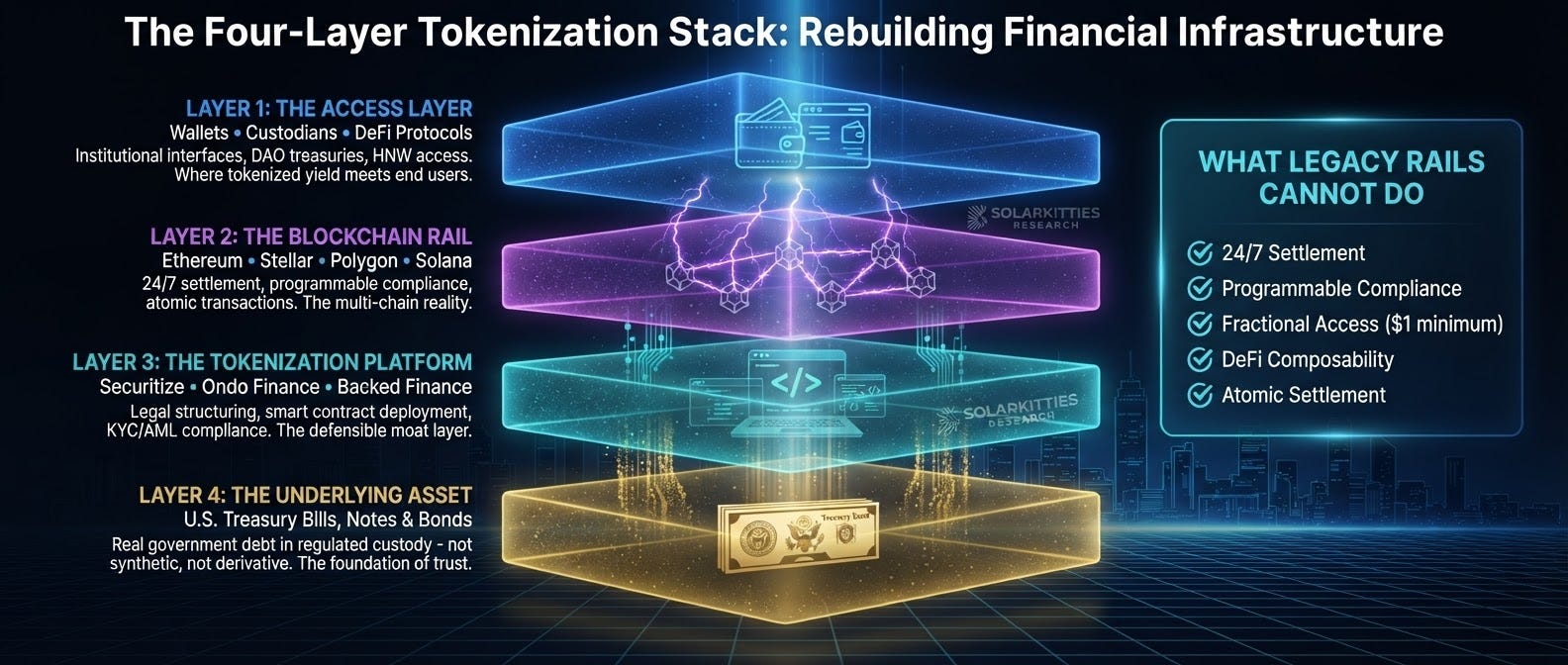
The four-layer stack is already operational. The question is not whether it works — it’s how fast it scales.
The difference between a tokenized Treasury and a Treasury ETF is the difference between a digital photograph and a physical print. The underlying subject is the same. But one can be transmitted, subdivided, embedded, and programmed. The other sits in a frame.
This is not incremental improvement. It is a fundamental redesign of how yield-bearing assets move through the financial system.
The numbers have moved past the point where skepticism is defensible.
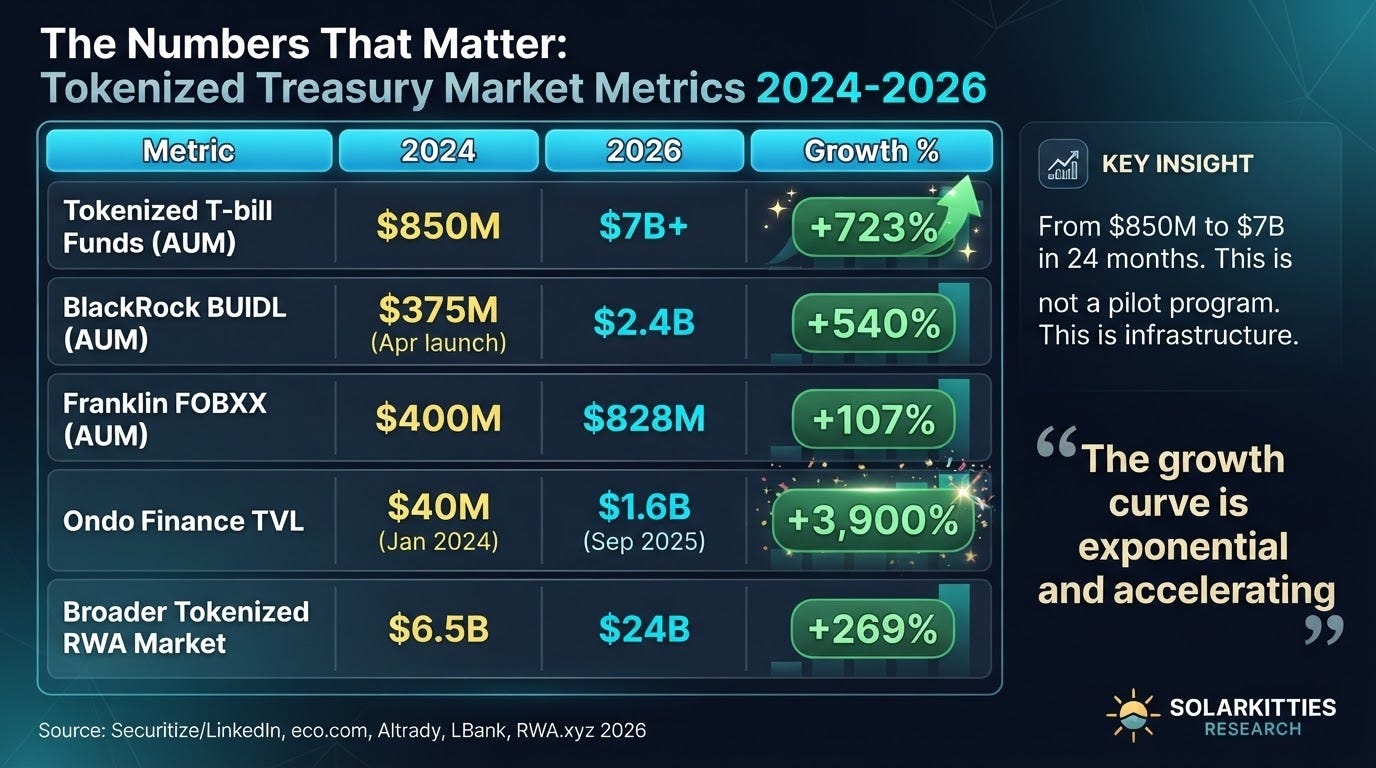
Source: Securitize/LinkedIn, eco.com, Altrady, LBank, RWA.xyz. From $850M to $7B in 24 months. This is not a pilot program. This is infrastructure.
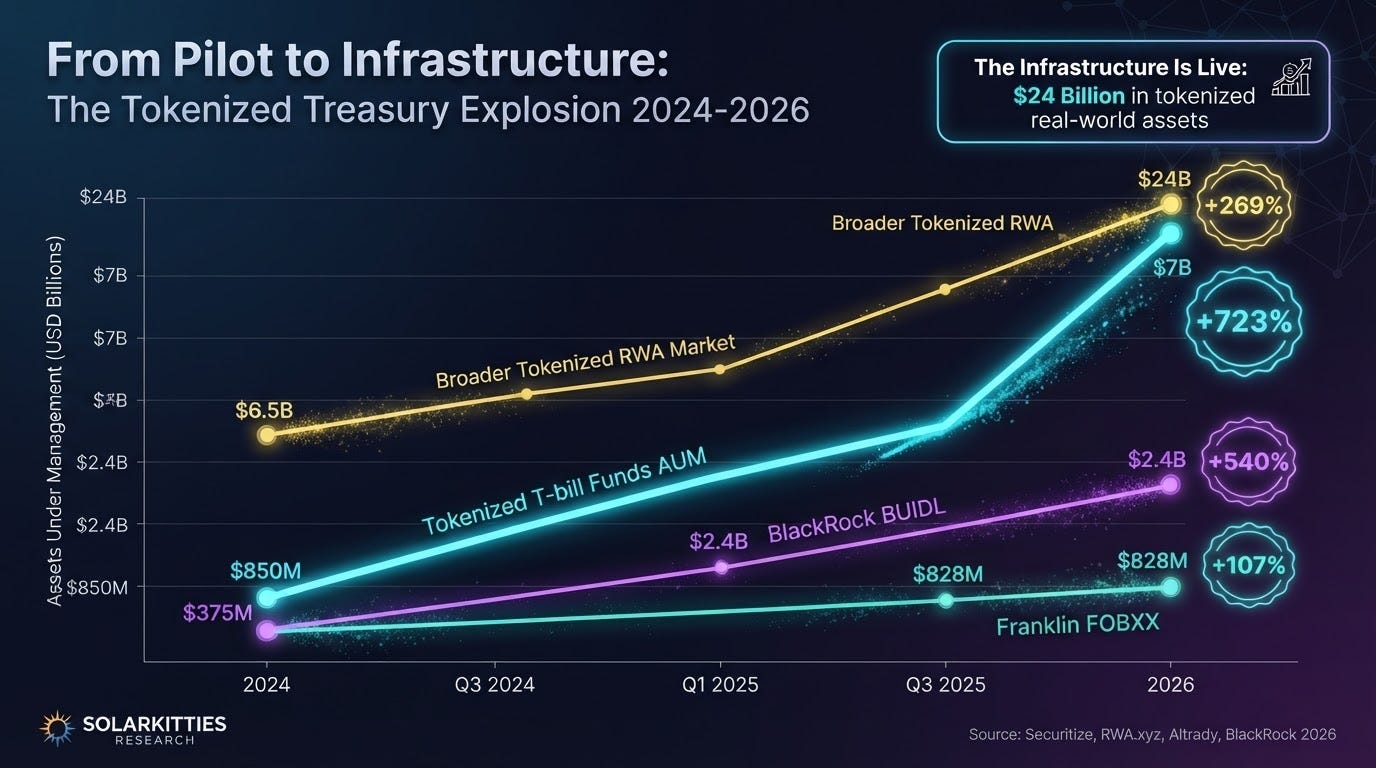
The growth curve is not linear. It is exponential and accelerating — and $24B is still only 0.018% of the $133 trillion global bond market.
The growth curve is not linear. It is exponential and accelerating.
Three structural tailwinds are compounding:
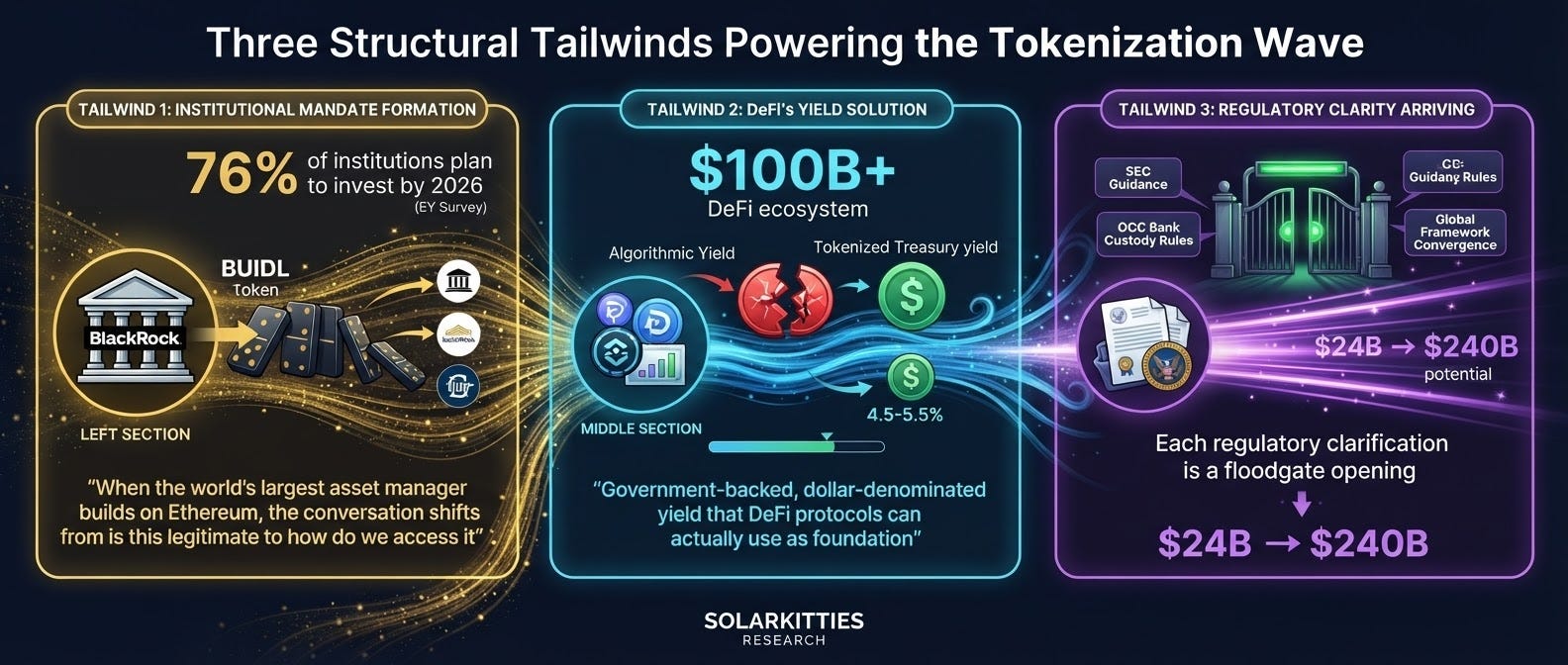
Each tailwind compounds the others. Institutional mandate formation drives capital. DeFi demand creates distribution. Regulatory clarity removes the last barrier.
Institutional mandate formation. BlackRock’s entry with BUIDL was the permission slip the institutional world was waiting for. When the world’s largest asset manager ($10 trillion AUM) builds on Ethereum, the conversation shifts from “is this legitimate?” to “how do we access it?” The 76% institutional intent figure from EY is the downstream effect of that signal.6
DeFi’s yield problem is solved. The collapse of algorithmic stablecoins and unsustainable DeFi yield in 2022 left a vacuum. Tokenized Treasuries fill it with government-backed, dollar-denominated yield that DeFi protocols can actually use as a foundation. Ondo Finance’s OUSG (tokenized short-term U.S. Treasuries) is now embedded in multiple DeFi protocols as a yield-bearing collateral asset — a use case that didn’t exist three years ago.7
Regulatory clarity is arriving. The SEC’s evolving digital asset guidance, the OCC’s 2021 letter permitting national banks to use public blockchains for payment activities, and the global convergence around tokenization frameworks are removing the compliance uncertainty that kept institutional capital on the sidelines. Each regulatory clarification is a floodgate opening.
The Grayscale 2026 Digital Asset Outlook projects tokenized assets could grow by ~1,000x by 2030 — a figure that sounds hyperbolic until you consider that $24 billion is 0.018% of the $133 trillion global bond market.
The runway is not constrained by demand. It is constrained by infrastructure build-out speed.
The competitive landscape has three distinct tiers — and the moats are not where most investors are looking.
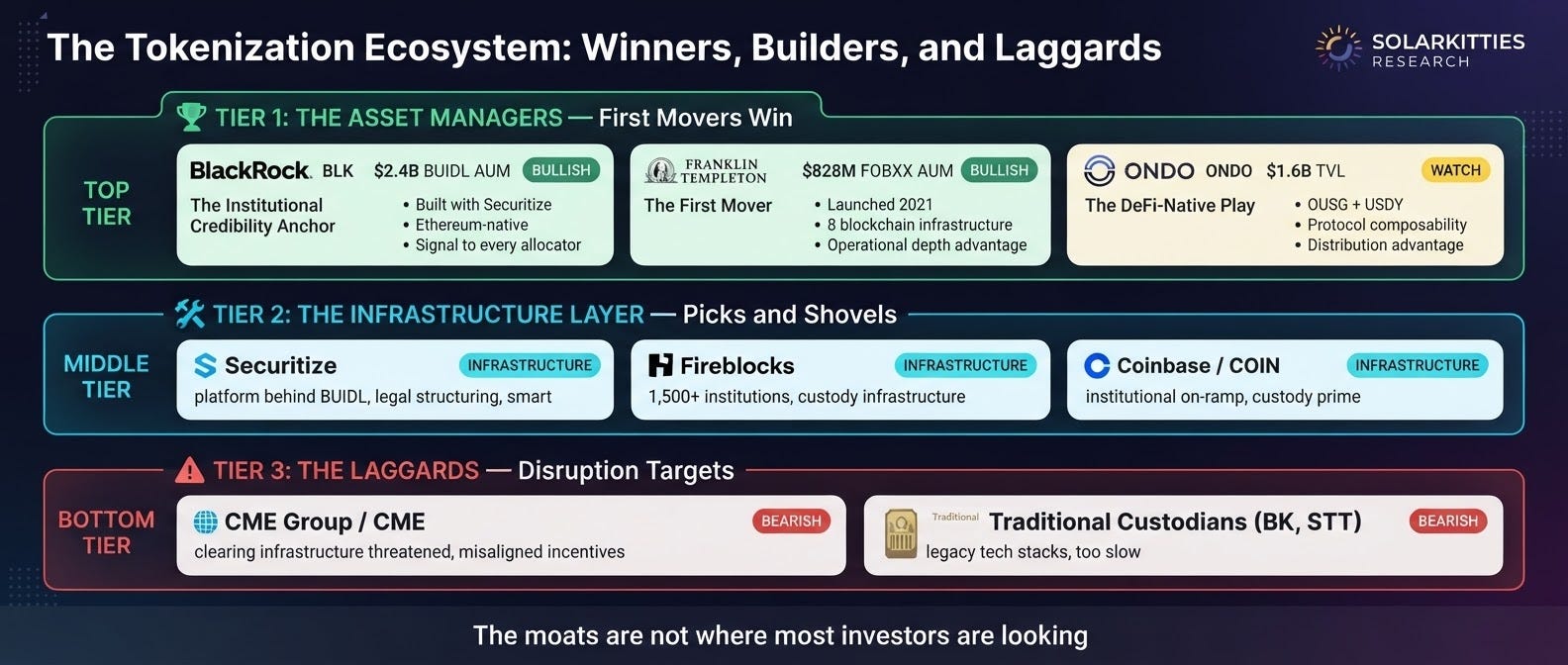
The moats are not where most investors are looking. The picks-and-shovels layer — Securitize, Fireblocks, Coinbase — may be the most defensible position in the entire stack.
Tier 1 — The Asset Managers (First Movers)
BlackRock (BLK) — BUIDL fund on Ethereum, $2.4B AUM, built with Securitize. The institutional credibility anchor. BlackRock’s participation is the single most important signal in the tokenized treasury space — not because of BUIDL’s AUM, but because of what it signals to every other institutional allocator watching.2
Franklin Templeton (BEN) — FOBXX, $828M AUM, operating across eight blockchains. The first mover. Franklin launched FOBXX on Stellar in 2021 — years before the institutional wave arrived. That head start translates to operational depth, regulatory relationships, and multi-chain infrastructure that competitors are still building.9
Ondo Finance — OUSG and USDY, $1.6B TVL. The DeFi-native play. Ondo is not a traditional asset manager — it’s a tokenization protocol that has become the largest provider of tokenized Treasuries and tokenized stocks simultaneously. Its composability with DeFi protocols gives it a distribution advantage that BlackRock and Franklin cannot easily replicate.7
Tier 2 — The Infrastructure Layer
Securitize — The tokenization platform behind BUIDL. If BlackRock is the demand signal, Securitize is the picks-and-shovels play. It handles the legal structuring, smart contract deployment, transfer agent functions, and KYC/AML compliance that make institutional tokenization possible. It is the unsexy, defensible infrastructure layer.
Fireblocks — Institutional digital asset custody and transfer infrastructure. Over 1,500 financial institutions use Fireblocks for digital asset operations. As tokenized Treasuries scale, the custody infrastructure scales with them.
Coinbase (COIN) — Custody, Prime brokerage, and increasingly, the institutional on-ramp for tokenized asset access. Coinbase’s regulatory positioning in the U.S. makes it a critical piece of the institutional infrastructure stack.
Tier 3 — The Laggards (Disruption Targets)
CME Group (CME) — The dominant traditional derivatives exchange. CME’s moat is its clearing infrastructure and regulatory relationships. But tokenized settlement rails threaten to disintermediate exactly the clearing function that CME monetizes. CME is not standing still — it has digital asset products — but its institutional incentives are structurally misaligned with the speed of tokenization.
Traditional custodians — BNY Mellon, State Street, and their peers are moving toward digital asset custody, but their legacy technology stacks and regulatory conservatism make them followers, not leaders. The question is whether they move fast enough to avoid being disintermediated by Fireblocks and Coinbase.
Speaking of assets that institutional capital is quietly accumulating before the mainstream arrives: Noble Plains Uranium Corp (TSXV: NOBL | OTCQB: NBLXF) just published its first NI 43-101 compliant uranium resource at Duck Creek — 6.35 million pounds U₃O₈ — in Wyoming’s premier ISR jurisdiction.
The U.S. imports 95% of its uranium needs. Demand is forecast to surge 200% by 2040. Noble Plains has two Wyoming ISR projects advancing simultaneously, with an LOI signed with Ur-Energy — an adjacent producer — for potential processing. The market cap hasn’t caught up with the resource.
Worth a look: Explore Noble Plains →
[Sponsored — shared because the “institutional accumulation before mainstream awareness” thesis runs through both stories]
The financial case for tokenized Treasuries is not complicated. It is a cost reduction story layered on top of a yield access story layered on top of a capital efficiency story.
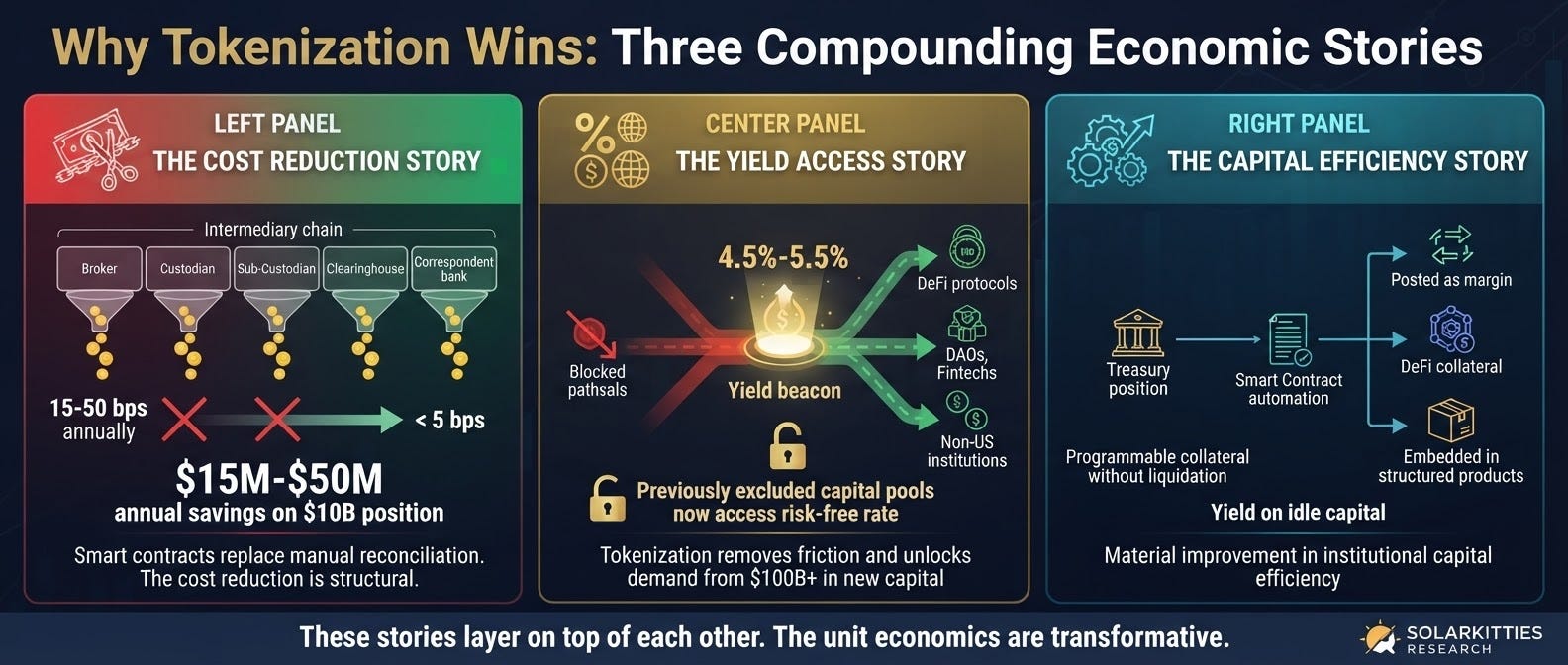
These stories layer on top of each other. The unit economics are transformative.
The cost reduction:
Traditional Treasury settlement involves a chain of intermediaries — broker, custodian, sub-custodian, clearinghouse, correspondent bank — each extracting fees. A conservative estimate of the total intermediation cost for cross-border institutional Treasury access is 15–50 basis points annually. On a $10 billion position, that’s $15–50 million per year in friction costs.
Tokenized settlement eliminates most of that chain. Smart contracts replace manual reconciliation. On-chain settlement replaces T+1 clearing. The cost reduction is structural, not cyclical.
The yield access story:
At 4.5%–5.5% yield, U.S. Treasuries are the most attractive risk-free rate in a generation. But that yield is not equally accessible. A DeFi protocol, a DAO treasury, a fintech startup, or a non-U.S. institution faces significant friction accessing it. Tokenized Treasuries remove that friction — and in doing so, they unlock demand from capital pools that were previously excluded from the risk-free rate.
The capital efficiency story:
Tokenized Treasuries can be used as programmable collateral — posted as margin on digital asset exchanges, used as collateral in DeFi lending protocols, or embedded in structured products — all without manual intervention. This unlocks yield on capital that would otherwise sit idle. For institutions managing large Treasury positions, the ability to deploy those positions as productive collateral without liquidating them is a material improvement in capital efficiency.
The unit economics of the leading funds:
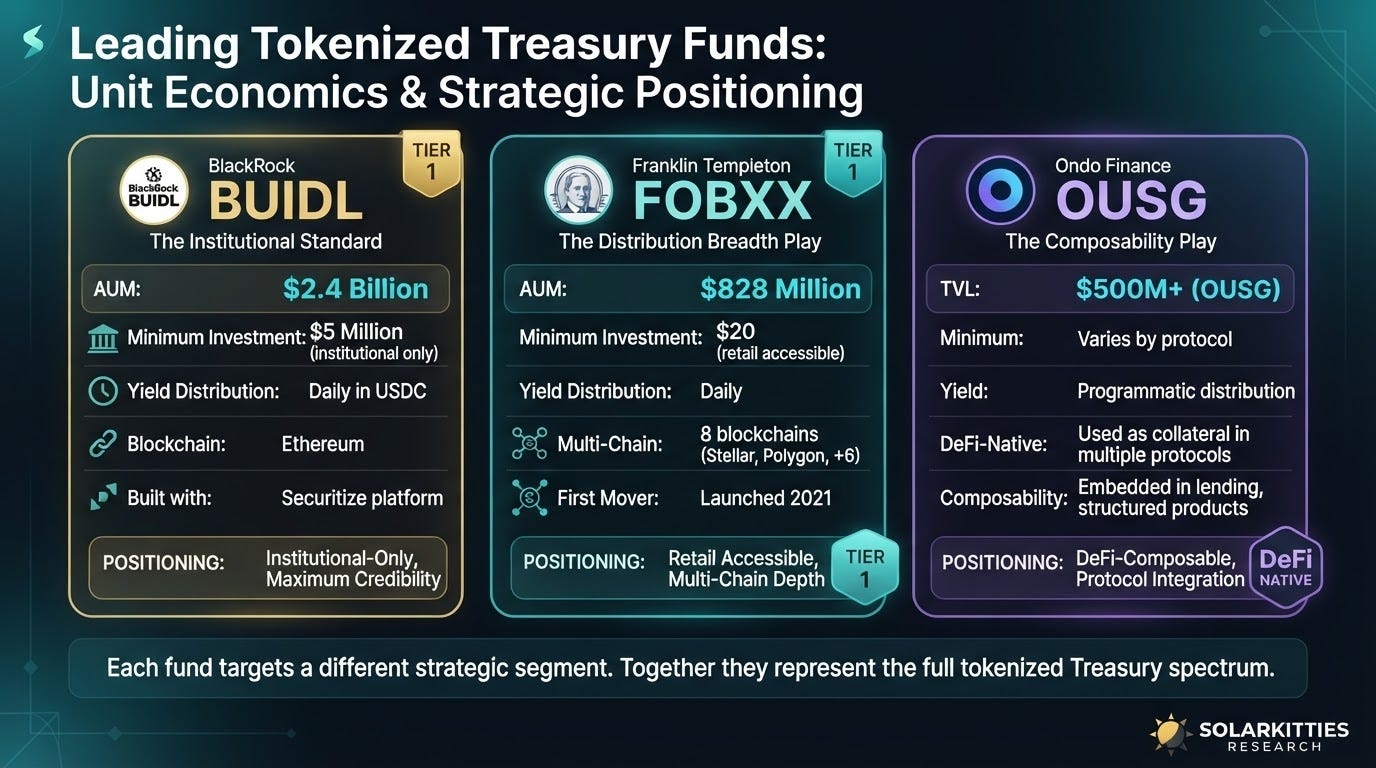
Each fund targets a different strategic segment. Together they represent the full tokenized Treasury spectrum.
BUIDL — $2.4B AUM, daily yield distribution in USDC, minimum $5M investment (institutional). The institutional standard.
FOBXX — $828M AUM, multi-chain (Stellar, Polygon, and six others), $20 minimum investment (retail accessible). The distribution breadth play.
OUSG — $500M+ AUM, DeFi-composable, used as collateral in multiple protocols. The composability play.
Each fund has a different strategic positioning. Together, they represent the full spectrum of the tokenized Treasury market — from institutional-only to retail-accessible to DeFi-native.
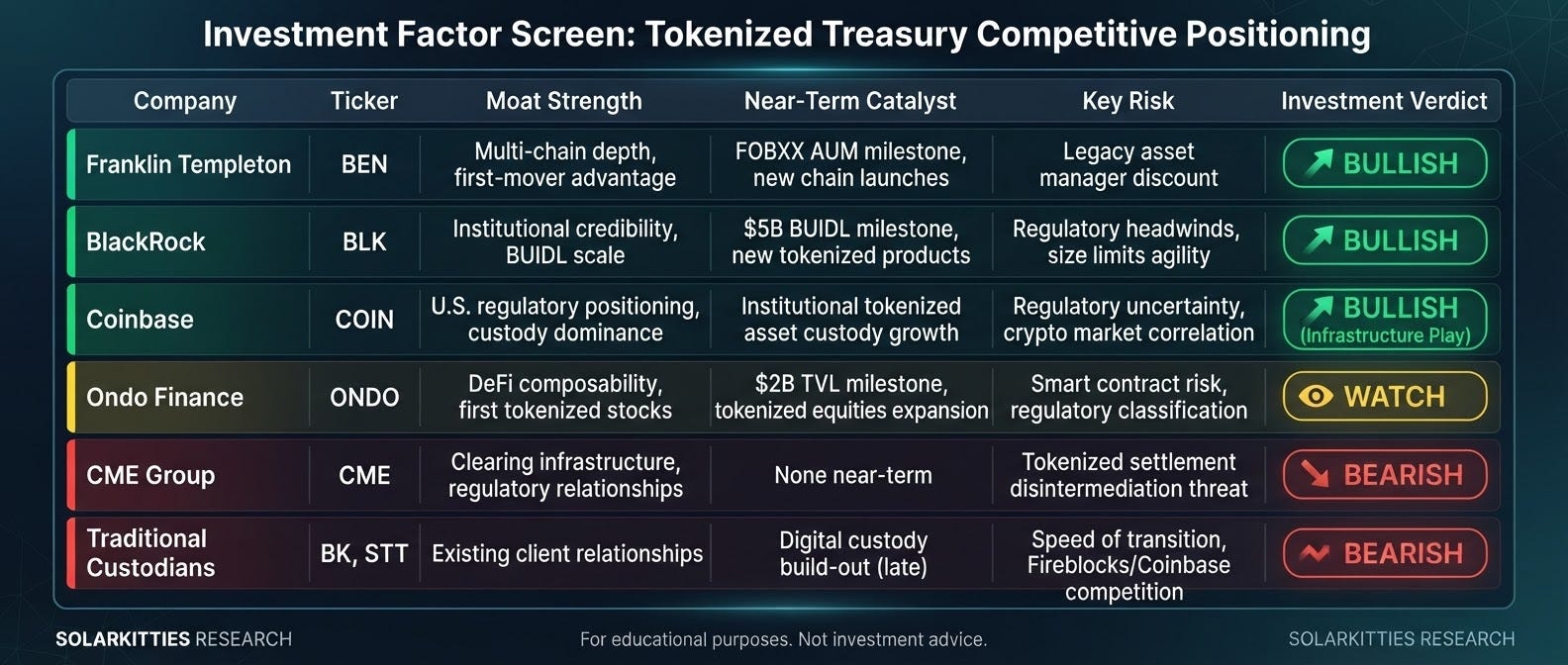
For educational purposes only. Not investment advice. Solar Kitties Research.
The pattern in the factor screen is consistent and instructive. The companies with the deepest infrastructure moats are the clearest long positions. The companies whose revenue depends on the inefficiencies being eliminated are the clearest short positions.
Franklin Templeton’s multi-chain depth is not accidental. It is the result of four years of operational build-out that competitors cannot replicate in 12 months. BlackRock’s institutional credibility is not transferable — it is the product of decades of regulatory relationships and client trust. Coinbase’s regulatory positioning in the U.S. is a genuine moat in a market where regulatory clarity is the primary constraint on adoption.
CME Group and the traditional custodians are not standing still. But their institutional incentives are misaligned with the speed of change. Every dollar of tokenized settlement that bypasses CME’s clearing infrastructure is a dollar of fee revenue that CME does not collect. That structural headwind does not resolve in a quarter.
The tokenization market is currently in the “before iPhone” phase of financial infrastructure evolution. The technology works. The use cases are proven. The institutional adoption curve is arriving.
The companies building the rails — not the tokens — are the durable alpha.
The pure-play tokenization leaders — Securitize, Fireblocks, Backed Finance — are private. But the public markets have a rich ecosystem of small-cap companies that are directly downstream of the thesis in this article. These are not recommendations to buy today. They are companies to research deeply, watch closely, and position in when the catalyst is imminent.
Small-cap tokenization infrastructure is where the 10x trades live. It’s also where the -90% trades live. The difference is catalyst timing and position sizing.
Ondo Finance (NASDAQ: ONDO) — The DeFi-Native Tokenization Protocol
Ondo is the only public pure-play tokenization protocol. OUSG (tokenized short-term Treasuries) and USDY (yield-bearing stablecoin backed by Treasuries) are embedded in multiple DeFi protocols. The January 2026 announcement that Ondo became the largest provider of both tokenized Treasuries and tokenized stocks simultaneously was a structural milestone.10
Market Cap: ~$4B
2026 Catalyst: $2B TVL milestone; tokenized equities expansion; potential institutional partnership announcements
Why It Explodes: The tokenized equities market is orders of magnitude larger than the tokenized Treasury market. Ondo is positioned as the DeFi-native platform for both.
Watch For: New DeFi protocol integrations, institutional partnership announcements, tokenized equities AUM milestones
Risk: Smart contract risk, regulatory classification, crypto market correlation
Coinbase (NASDAQ: COIN) — The Institutional Digital Asset Infrastructure Layer
Already featured in the investment plays above, but worth reiterating here as the large-cap with the clearest institutional tokenization infrastructure thesis. The custody business, Prime brokerage, and regulatory positioning make Coinbase the default institutional on-ramp.
Market Cap: ~$65B
2026 Catalyst: Institutional tokenized asset custody growth; potential tokenized Treasury settlement partnership announcements
Why It Explodes: Every dollar of institutional tokenized asset AUM requires custody infrastructure. Coinbase is the dominant U.S. institutional custodian.
Watch For: Institutional custody AUM announcements, tokenized asset settlement partnerships, regulatory clarity milestones
Paxos (Private — Watch for IPO) — The Regulated Blockchain Infrastructure Company
Paxos is the regulated blockchain infrastructure company that powers PayPal’s stablecoin (PYUSD), Venmo’s crypto features, and multiple institutional tokenized asset programs. The company holds a New York Trust Company charter — the same regulatory standing as a bank — which gives it a compliance moat that most blockchain companies cannot replicate.
Estimated Valuation: ~$2.4B (most recent funding round)
2026 Catalyst: IPO candidate; PYUSD expansion; institutional tokenized asset partnerships
Why It Explodes: The regulated blockchain infrastructure layer is the most defensible position in the entire tokenization stack. Paxos has the regulatory standing, the institutional relationships, and the product suite to be the dominant infrastructure provider.
Watch For: IPO filing, PYUSD AUM milestones, new institutional partnerships
Risk: Private, illiquid; IPO timing uncertain
Securitize (Private — Watch for IPO) — The Tokenization Platform Behind BUIDL
Securitize is the tokenization platform that BlackRock chose to build BUIDL. It handles legal structuring, smart contract deployment, transfer agent functions, and KYC/AML compliance. It is the unsexy, defensible infrastructure layer that makes institutional tokenization possible.
Estimated Valuation: ~$1B (most recent funding round)
2026 Catalyst: BlackRock BUIDL AUM milestones; potential IPO; new institutional client announcements
Why It Explodes: Every dollar of institutional tokenized Treasury AUM that flows through BUIDL flows through Securitize infrastructure. The platform is therapy-agnostic — it doesn’t matter which asset manager wins, Securitize wins.
Watch For: IPO filing, new institutional client announcements, AUM milestones
Risk: Private, illiquid; dependent on institutional tokenization timeline
Fireblocks (Private — Watch for IPO) — The Institutional Digital Asset Custody Infrastructure
Fireblocks is the institutional digital asset custody and transfer infrastructure company used by over 1,500 financial institutions. As tokenized Treasuries scale, the custody infrastructure scales with them. Fireblocks is the picks-and-shovels play for the entire institutional digital asset ecosystem.
Estimated Valuation: ~$8B (most recent funding round)
2026 Catalyst: IPO candidate; tokenized asset custody growth; new institutional client announcements
Why It Explodes: Every institutional tokenized asset program requires custody infrastructure. Fireblocks is the dominant institutional custodian for digital assets.
Watch For: IPO filing, institutional client announcements, tokenized asset custody AUM milestones
Risk: Private, illiquid; competitive pressure from Coinbase and BNY Mellon
Backed Finance (Private) — The European Tokenized Securities Pioneer
Backed Finance is the European tokenized securities company taking a regulatory-first approach to tokenized Treasuries and equities. With the EU’s MiCA (Markets in Crypto-Assets) regulation now in force, Backed is positioned as the compliant tokenization platform for European institutional capital.
Estimated Valuation: Early stage
2026 Catalyst: EU MiCA compliance certification; institutional European adoption; potential partnership with European asset managers
Why It Explodes: The European institutional tokenization market is the next wave after the U.S. MiCA compliance is the moat.
Watch For: MiCA certification, institutional partnership announcements, European asset manager integrations
Risk: Early stage, regulatory complexity, geographic concentration
All market caps are approximate as of July 2026. Private company valuations are estimates based on most recent funding rounds. Liquidity is limited for private holdings.
Here is the contrarian read on tokenized Treasuries that most people are missing.
The mainstream narrative is that tokenized Treasuries are a crypto story — a DeFi use case, a blockchain application, a digital asset innovation. That framing is wrong. It is costing investors the correct mental model.
Tokenized Treasuries are a settlement infrastructure story. The blockchain is not the product. It is the rail. The product is programmable, 24/7, frictionless access to U.S. government yield. The blockchain happens to be the most efficient rail for delivering that product. But the demand driver is not crypto enthusiasm — it is institutional capital seeking yield efficiency.
This distinction matters for three reasons:
The regulatory risk is lower than the crypto framing implies. Regulators who are skeptical of speculative crypto assets are not skeptical of U.S. Treasury bonds. The tokenized Treasury market benefits from the credibility of its underlying asset. The SEC and OCC are not trying to shut down BUIDL. They are trying to figure out how to supervise it.
The institutional adoption curve is faster than the crypto framing implies. The 76% institutional intent figure from EY is not driven by crypto enthusiasm. It is driven by CFOs and treasury managers who want yield efficiency. That is a different — and more durable — demand driver.
The competitive moat is in the infrastructure, not the token. The companies that win in tokenized Treasuries are not the ones with the most innovative token design. They are the ones with the deepest regulatory relationships, the most robust custody infrastructure, and the most composable smart contract architecture.
The second thing the consensus is missing: the interoperability question is the next battleground. FOBXX operates on eight chains. BUIDL operates on Ethereum. OUSG operates on multiple chains. The multi-chain reality creates a fragmentation problem — and the company that solves cross-chain tokenized Treasury interoperability will capture a disproportionate share of the institutional market.
This is not a risk to dismiss. It is an opportunity to identify. The company that builds the universal settlement standard for tokenized Treasuries — the TCP/IP of institutional blockchain settlement — will be the most important financial infrastructure company of the next decade.
The smart money is not buying tokenized Treasuries because they believe in blockchain. They are buying them because they believe in yield efficiency. The blockchain is just the best tool available for delivering it. In 1995, the contrarian signal was: “The internet isn’t about websites. It’s about the pipes.” The tokenized Treasury contrarian signal is: “It’s not about the token. It’s about the rail — and who controls the interoperability layer.”
1. Regulatory Reversal Risk
The current regulatory trajectory is favorable. But regulatory environments change. A hostile SEC chair, a major tokenized asset failure, or a geopolitical event that triggers capital controls could reverse the current trend. The tokenized Treasury market is still small enough to be affected by a single regulatory decision. The OCC’s 2021 letter permitting national banks to use public blockchains is guidance, not law — it can be reversed.11
2. Smart Contract Vulnerability
Tokenized Treasuries are only as secure as the smart contracts that govern them. A critical vulnerability in a major tokenization platform’s smart contract could result in loss of funds, reputational damage, and regulatory backlash. The 2022 DeFi hack cycle demonstrated that smart contract risk is not theoretical. Institutional adoption requires institutional-grade security audits — and those audits are not infallible.
3. Interoperability Fragmentation
FOBXX operates on eight chains. BUIDL operates on Ethereum. OUSG operates on multiple chains. The multi-chain reality creates interoperability complexity — and the absence of a universal settlement standard means that institutional adoption may be slowed by the friction of navigating multiple incompatible systems. This is the problem that could slow the $24B to $240B transition.
4. Liquidity Risk in Early Stages
Tokenized Treasury funds are not as liquid as Treasury ETFs or money market funds. Secondary market liquidity for tokenized assets is still developing. Institutions that need to liquidate positions quickly may face slippage or settlement delays that offset the efficiency gains. The liquidity premium is real and not yet fully priced.
5. Concentration Risk
The tokenized Treasury market is currently dominated by three players — BlackRock, Franklin Templeton, and Ondo Finance. That concentration creates systemic risk: a failure or regulatory action against any of these players would have outsized market impact. Diversification across the ecosystem is not yet possible at scale.
6. The Yield Environment Is Not Permanent
The current 4.5%–5.5% Treasury yield is the primary demand driver for tokenized Treasuries. If the Fed cuts rates aggressively, the yield advantage narrows and the demand rationale weakens. The infrastructure thesis survives a rate cut cycle. The yield access thesis does not. Position accordingly.
The $133 trillion global bond market is not going to be tokenized overnight.
But the direction is not in question.
The infrastructure is being built. The institutional mandates are forming. The regulatory framework is clarifying. The technology is proven.
$24 billion in tokenized real-world assets by February 2026 — up 266% in a single year — is not a trend. It is a structural shift in how institutional capital accesses yield.
The investment thesis is not about believing in blockchain. It is about recognizing that the most efficient settlement infrastructure for global bond markets happens to run on blockchain rails — and that the companies building those rails are in the early innings of a multi-decade infrastructure buildout.
The plays:
BULLISH: BEN (first-mover depth, 6%+ dividend floor), BLK (institutional permission slip, BUIDL scale), COIN (infrastructure on-ramp, regulatory positioning)
BEARISH: CME (clearing disintermediation), traditional custodians (speed of transition)
WATCH: ONDO (DeFi composability, tokenized equities expansion), Securitize and Fireblocks (IPO candidates, picks-and-shovels)
The ledger is being rewritten. The question is not whether to be positioned. It is how.
The tokenized Treasury thesis is not a single trade. It’s a portfolio of positions across the capital structure, each calibrated to a different risk tolerance and time horizon.
The conservative investor collects premium on BEN and BLK bull put spreads, sells premium against CME’s structural decline, and waits for the small-cap catalysts to mature before sizing in. The BEN 6%+ dividend provides a fundamental floor that makes the bull put spread one of the more comfortable structures in the playbook.
The moderate investor adds COIN LEAPS to capture the institutional infrastructure buildout over 18 months, runs the BEN diagonal to fund long-dated exposure to the FOBXX AUM catalyst, and uses the COIN ratio spread to maximize the institutional custody announcement payoff in the most likely outcome range.
The aggressive investor takes equity positions in ONDO — understanding that these are binary-outcome bets sized at 0.5–1% of portfolio, not core holdings. The tokenized equities expansion thesis is the highest-conviction asymmetric bet in the entire tokenization ecosystem.
The patient investor builds the watchlist now, sets price alerts, and waits for the catalysts. Securitize when BlackRock announces a BUIDL AUM milestone. Fireblocks when a major bank announces a tokenized asset custody partnership. Paxos when the IPO filing drops. Ondo when the $2B TVL announcement hits.
The infrastructure is being built. The capital is moving. The window to position ahead of the institutional wave is narrowing.
The token is the Trojan horse. The rail is the empire. The interoperability layer is the trade nobody’s watching.
Until Next Time, Stay Sunny ;)
— C.J. Sinclair
Solar Kitties Research | Vetta Investments
Solar Kitties Research is published for informational and educational purposes only. Nothing in this publication constitutes financial, investment, legal, or tax advice. Options trading involves substantial risk of loss. All investment decisions should be made in consultation with a licensed financial advisor. The author and Solar Kitties Research may hold positions in securities mentioned.
1.Securitize / LinkedIn — “Tokenized Treasuries have surged 870% since launch” (September 2025). https://www.linkedin.com/posts/securitize_tokenized-treasuries-have-surged-870-since-activity-7375259993119285248-EI1x ↩
2.Altrady — “BlackRock BUIDL Tokenized Treasury Guide 2026” (May 2026). https://www.altrady.com/blog/cryptocurrency/blackrock-buidl-tokenized-treasury-2026 ↩ ↩2 ↩3
3.RWA.xyz / InvestAx — “Real World Asset Tokenization: Trends and Outlook for 2026” (May 2026). https://investax.io/blog/real-world-asset-tokenization-trends-and-outlook-for-2026 ↩
4.Bank for International Settlements — Global bond market size estimate. https://www.bis.org/statistics/ ↩
5.U.S. Department of the Treasury — Current Treasury yield data. https://home.treasury.gov/resource-center/data-chart-center/interest-rates/ ↩
6.EY — “Growing Enthusiasm Propels Digital Assets into the Mainstream: 2025 Institutional Investor Digital Assets Survey” (March 2025). https://www.ey.com/content/dam/ey-unified-site/ey-com/en-us/insights/financial-services/documents/ey-growing-enthusiasm-propels-digital-assets-into-the-mainstream.pdf ↩ ↩2
7.LBank / Ondo Finance — “What Is Ondo Finance? RWA Tokenization and Treasuries.” https://www.lbank.com/explore/ondo-finance-rwa-platform-tokenizing-treasuries-stocks ↩ ↩2 ↩3
8.Grayscale Research — “2026 Digital Asset Outlook: Dawn of the Institutional Era” (December 2025). https://research.grayscale.com/reports/2026-digital-asset-outlook-dawn-of-the-institutional-era ↩
9.eco.com — “BENJI Deep Dive 2026: Franklin Templeton’s Tokenized Money Market” (May 2026). https://eco.com/support/en/articles/15254016-benji-deep-dive-2026-franklin-templeton-s-tokenized-money-market ↩ ↩2
10.Ondo Finance — “Ondo Finance Becomes the Largest Provider of Both Tokenized Treasuries and Tokenized Stocks” (January 2026). https://ondo.finance/blog/ondo-becomes-largest-tokenized-stock-treasury-provider ↩ ↩2 ↩3
11.LinkedIn / CrypticWeb3 — “Institutional Crypto Adoption in 2026: What’s Changing” (April 2026). https://www.linkedin.com/pulse/institutional-crypto-adoption-2026-whats-changing-crypticweb3-olofe ↩
Comments
Nothing yet. Say the first thing.
Sign in to join the conversation.