
Hi Soil Friend!
I got a juicy question that I thought we could dig into today. This comes from Ryan who works in the grounds department at a community college in Nevada. He has been enrolled in the Re:wild Your Campus program, in partnership with The Association for the Advancement of Sustainability in Higher Education (AASHE), where I recently gave a talk that explores soil as an ecosystem, and practical tools available to the landscaping industry to steward it as such!
One of those tools is a composting method called a Johnson-Su Bioreactor. If you’ve never heard of this, I’d encourage you to check out a couple oldie but goodie posts I’ve written about them (here and here).
In short, a Johnson-Su Bioreactor (JS), is a very DIY-friendly static, aerated compost cylinder designed by husband and wife, Dr. David Johnson and Hui Chun Su. They only require carbon-rich feedstocks (think woodchips, brown leaves) and when managed correctly (building it right and keeping it moist) they yield a very biodiverse, and fungal-rich soil amendment which can be diluted in water as a compost extract and applied as a soil drench, introducing a full suite of beneficial microbes to the rootzone which is all too often deficient in bacterial predators and fungal communities.
That is the background you need to know, now lets get to Ryan’s questions!
Oh and if you have any thoughts or experiences to share related to this topic, or follow-up questions of your own, please share them in the comments. This is meant to be a forum where we can collaborate. 🤎
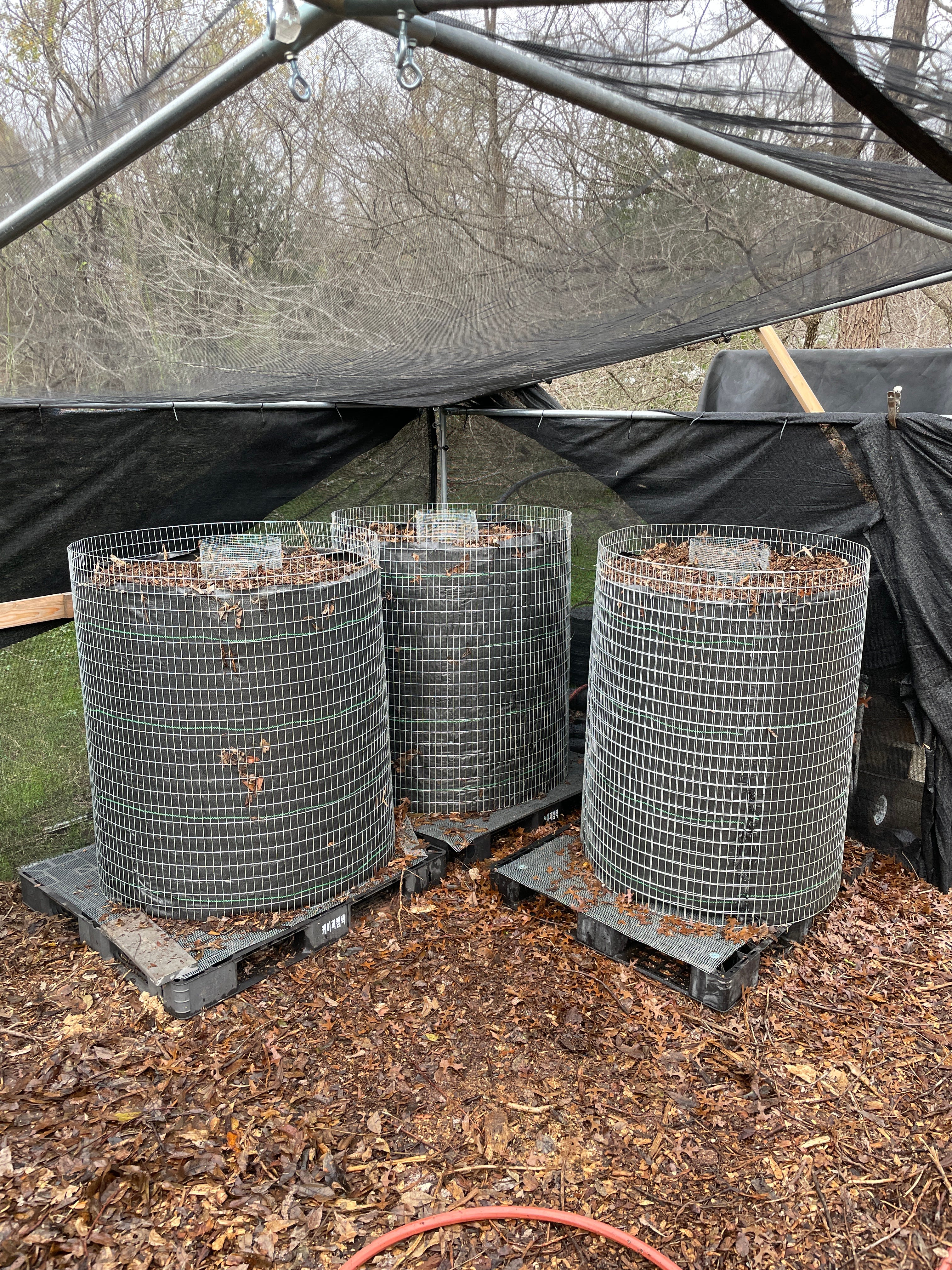
Some of my colleagues and I attended the talk you gave for Re:wild Your Campus on soil and compost and we were fascinated. We were also happy to hear that you’re a fellow compost enthusiast! Compost is a big part of our grounds management in these high desert soils.
Last year we started experimenting with JS bioreactors here trying to convert some of the cleaner portions of our cardboard waste stream into usable compost. We struggle with seasonal inputs like fall leaves and not having enough green material, or spring grass but having no carbon. Cardboard is available all year and we want to have some form of composting happening all year long. It’s just an experiment with a couple of bioreactors for now but I wanted to bend your ear.
We run into a lot of worry about contamination with our use of cardboard as a primary carbon feedstock. I was wondering about your thoughts on the likelihood of contamination and if mitigation is possible. Right now we limit the feedstock to choice pieces that have not tape or labels, colorful dyes, glossy or shiny coating.
We’re in uncharted waters here with a cardboard dominant compost in a JS bioreactor as an institutional practice. The closest analog that we could find to answer the concern of contamination was research on cardboard in sheet mulching, showing that it’s largely safe but I’m curious about your thoughts and experiences.
We’re also looking at scaling the cardboard composting but we’re debating if it’s worth it to have a whole mess of bioreactors or try to build one or two very large bioreactors. When looking into large bioreactors, I came across Soil is Sexy and saw a picture of a larger, horizontal JS bioreactor. Do you have any experience with scaling these to more of a production scale or know anyone who has? What was the experience? Any resources you would recommend?
Any guidance you could give would be welcome and we’re happy to hear from you!
Hi Ryan! You’ve sparked so many thoughts for me, and I am so encouraged to hear about the practices you’re employing through your program — your grounds team sounds like true land stewards! That’s the world I want to live in. 💚
I’ve organized my response to address specific items you shared:
We struggle with seasonal inputs like fall leaves and not having enough green material, or spring grass but having no carbon.
Might it be possible to stockpile / store feedstocks so that you have carbon on hand during the spring time, and green material on hand for the winter? The former being straightforward (heap), and the latter being trickier, but not impossible!
You can dry down green material by spreading it out on a large tarp or pavement, allowing the sun and wind. Dehydrating green material will preserve the nitrogen content within the feedstock, but allow them to be stored in a container (ideally breathable). Once re-wetted they’ll behave like a nitrogen-rich feedstock.
Just an idea for at least some of your composting that requires more nitrogen than the JS systems!
We run into a lot of worry about contamination with our use of cardboard as a primary carbon feedstock [in a Johnson-Su Bioreactor]. I was wondering about your thoughts on the likelihood of contamination and if mitigation is possible.
It’s frustrating that we have to constantly be concerned with contamination even with materials that are natural and should breakdown readily. That’s the world we live in for now. Here is how I see this:
Green Flags: Carbon is a similar Carbon-to-Nitrogen ratio (C:N) as woodchips. As far as I know, most inks are soy-based, and the glues used in cardboard are readily decomposed by fungi.
Red Flags: Outside of plastic tape, the biggest thing I’ve been taught to look out for (through the Soil Food Web Foundation curriculum) are glossy textures and bright colors.
Tackifiers that add gloss can be harmful to beneficial microbes (and they’ll obviously resist decomposition). Additionally, bright colors may contain heavy-metals (though lead is no longer allowed in the printing industry).
Yellow Flags: more recently, I’ve had concerns of PFAS contamination from things like pizza boxes that may be specially treated to hold up to grease. Secondly, cardboard is likely much more sterile than other, more natural feedstocks which may make them slower to decompose.
Tip: you could spray the cardboard with a biologically active compost extract to inoculate it at the time of building, or water them in with extract post-build.
When it comes to possible contamination I like to lean on a few things:
Scientific Literature: It sounds like you’ve already done some research! I’d specifically look into PFAS and cardboard to see if there are any known types to avoid (and let us know what you find!)
Observation: taking note of any observations — from sight, smell to feel — and comparing that to your other experiences of bioreactors built with woodchips or more conventional carbon-rich feedstocks.
Biology: the microscope can be a very useful tool to bring insight and peace of mind. In my book, if at the end of the day we have a biologically diverse community of microbes, the material ought to be safe enough for our soils.
Red flags under the microscope look like little to no life at all, or only bacterial communities and nothing else.
Plant Assay: additionally, trying to germinate seeds using the product can give good peace of mind before applying across large areas of land
In short, I’d look at a sample of your cardboard bioreactors ~6 - 9 month time from to see what the microbial communities are looking like. It could be assessed later, but ~6 - 9 months should give you an idea if there are any concerns and allow a chance for any corrections.
We’re also looking at scaling the cardboard composting but we’re debating if it’s worth it to have a whole mess of bioreactors or try to build one or two very large bioreactors.
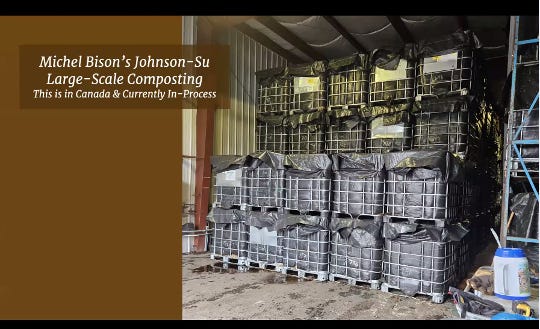
I don’t have any first-hand experience scaling past irrigation, large remesh cylinders. The only scaled systems I’ve seen are the cattle-panel pen design pictured on Colville Compost’s website. I’ve also seen stacked IBC totes that are modified to honor the principles of the JS design (example below, plus check out Midwest Restore).
You’re at the forefront, my friend! I’d encourage you to innovate and iterate ✊ for soil’s sake!
No posts
Comments
Nothing yet. Say the first thing.
Sign in to join the conversation.