
My childhood passed through me too quickly, in a hurry to be elsewhere. Memories of my early life feel dispersed, existing outside of me. Bits and pieces of whose coherence resides purely in their distance. That distance leaves me unable to see any border between ignorance and knowledge, nothing that I can gesture towards and isolate as the start of everything else.
In other words. When I remember, I do not arrive closer to myself.
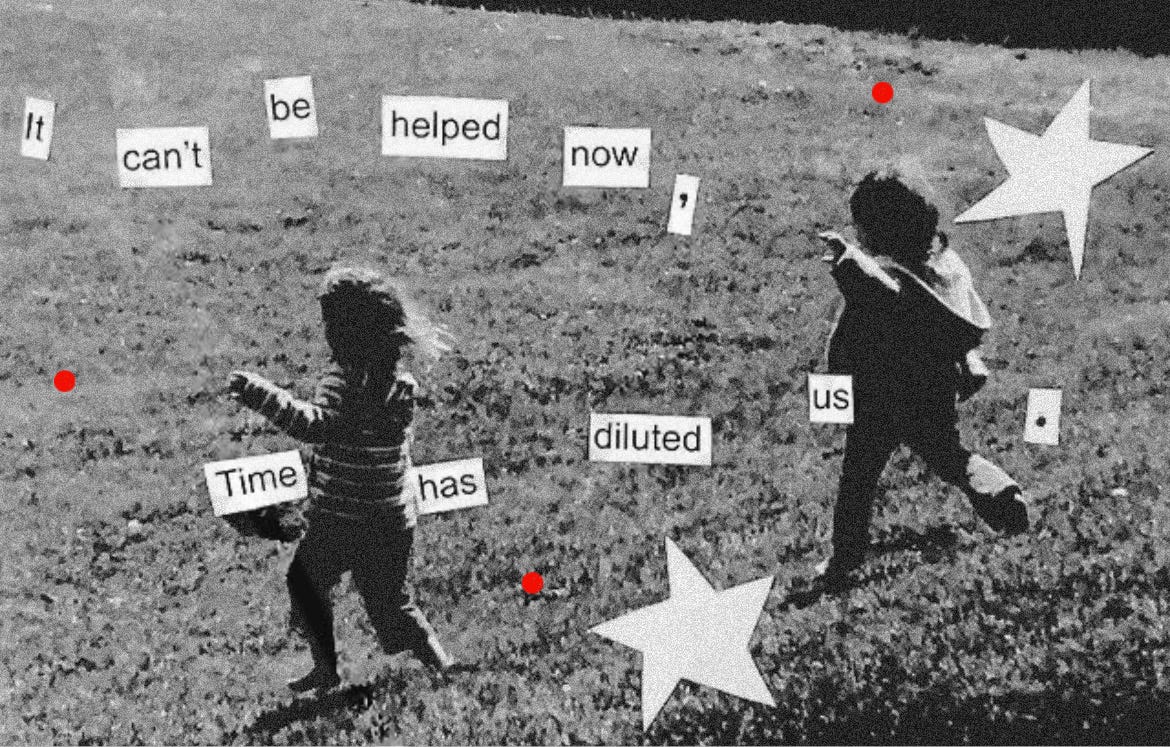
People say you lose your childhood as you grow up, but loss assumes a form of possession intact enough to be mourned, and it is hard for me to find a version of such a childhood anywhere in memory nor in feeling. How then can I say that I was once whole, and later broken.
Whatever continuity others recognise as a selfhood appears for me, to have been handed over to time itself. Instead I feel held together by the mundane fact that one moment followed by another.
I track down my patterns and habits with a grim competence, and when doing so find it difficult to ignore that flicker of anger. One aimed less at what happened, and more to the fact that it happened so completely. To so much of me.
So brazenly selfish in its taking.
I think this is what confuses me the most. I know what shaped me but I do not remember being shaped.
I am not curious to know where my childhood went. No, what I want to know is what kind of a thing was it, if it could leave so little behind.
If a person is a collection of memories, layered moments piling on top of each other, explaining how you became the person you are now. What becomes of someone whose memories are largely incomplete?
What exactly am I a collection of then.
Childhood is usually retold retroactively, once it has already been organised into a coherent enough story which can be easily exchanged in conversation.
Most adults report their earliest autobiographical memory from around ages three to four. The difficulty of lacking this seemingly inert ability to retrieve it, is not only personal, but a social one.
It is an unfair thought that I can’t seem to shake, that I am failing to give that expected proof of having been a child in the correct way.
Autobiographical memory develops as the brain matures. Experiences are increasingly bound together into a personal timeline, allowing them to be recalled clearly and recognised as your own history.
For an experience to be remembered as part of your life, more has to happen than the event itself.
Comments
Nothing yet. Say the first thing.
Sign in to join the conversation.