
these days my life is packaged up neatly into a calendar. i sleep on a silk pillow case because i watched a tiktok once that said it was good for your hair. i take my vitamins. i go for walks. and i also let good things drift past me because some stubborn part of me still believes i am not meant to have them.
somewhere in there is the girl who grew up in a house surrounded by constant anger and hurt. i promised her, in a hundred private moments, that it would not be for nothing. that the hurt would eventually add up to something.
so now i drink a glass of water as soon as i wake up, and i write about the hurt.
you’re not supposed to miss your suffering, but sometimes you do. you remember that crystal clear clarity that comes when everything hurts and nothing is trivial. and then you compare that version to the one who goes to therapy. who says no sometimes. who isn’t obsessed with making reckless choices anymore. and you feel oddly, disloyal.
stable you, with your magnesium supplements and half-decent boundaries, feels suspiciously like a side character. the main character is still twelve or seventeen. or twenty five. and you write from their voice, you date through their drama. you half-hope for relapse because the competence of your current life feels a bit like betrayal.
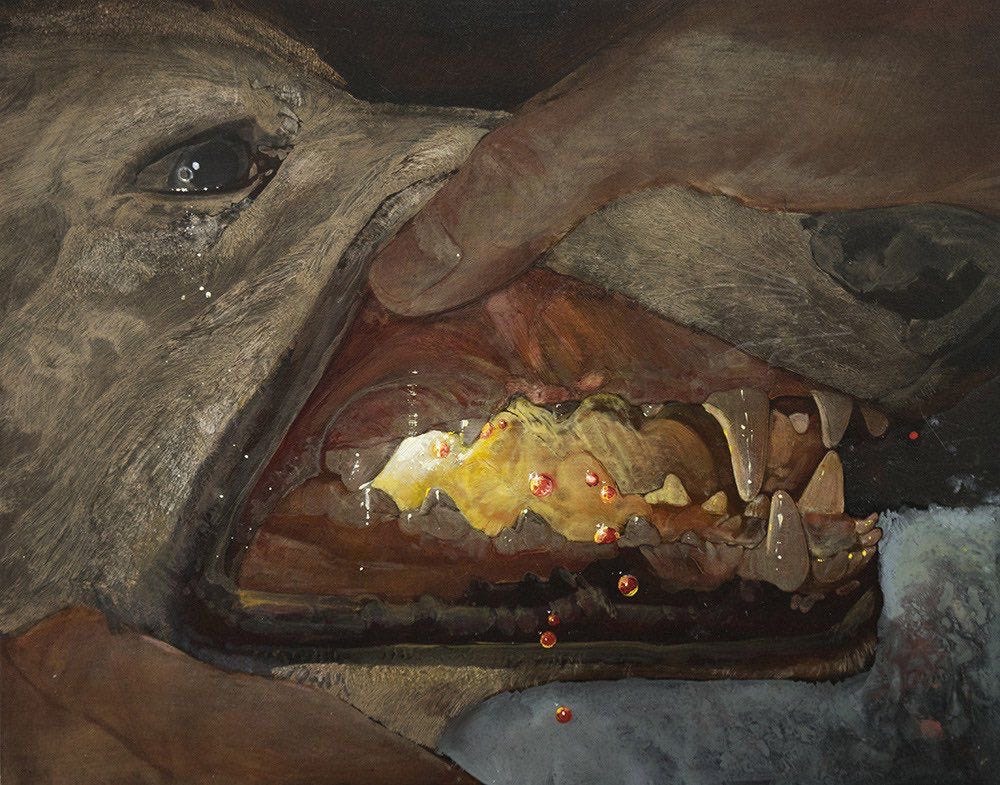
it feels like betrayal to me because i am here using all the things she never had and she’s stuck back there. i have left her in the burning building.
often your wounded self is more like a slightly unhinged, paranoid flatmate. its a part of you that refuses to let you relax, who checks every door twice. they are the one who half destroys your life and half saves it. you hated living as them and now, annoyingly, you miss them. afterall, they were the one who saw through everything. they knew exactly when the tension in the room changed.
they knew that “i am just tired” meant “i am tired of you”.
you did not enjoy the panic and the mess, but it’s hard to deny how vivid they were. it is easy to build a cult around that version. you remember standing in the hallway, listening for how loud the voices got before you decided to go in. you remember the nights of crying and the days of holding yourself together in the school bathroom. you remember going on dates with people you already knew would hurt you, because at least you understood that kind of pain.
but they were also the version of you whose standards were subterranean. and whose instincts were the only thing keeping you from completely breaking.
you hated living as them and now you miss them. that is the ridiculous truth.
and maybe out of love, naive or not, you keep certain habits, simply because you used to have them. you listen to the same songs. you flirt with the same sort of people. in some way, you do not know how to love that part of yourself without living like them.
it feels rude to move on. it feels almost adulterous to enjoy pleasures they could not even imagine. a kind conversation, a body that is not full of adrenaline, a day without hurt.
we despise our wounded self while we are trapped in them, only to idolise them the moment we start to climb out.
anxious, preoccupied, avoidant, traumatised, raised by narcissists. there’s an overwhelming abundance of labels found in every corner of the internet. what starts as frameworks to understand behaviour turns into identities to cling to.
you are not someone who learnt detachment as a child because closeness was unpredictable, you are avoidant. you are not a person with a body that adapted to unsafe conditions, you are anxious.
these labels can be a relief and they can also be a trap. attachment theory, originally meant to explain how early patterns of safety or fear show up in later relationships, gets flattened into a personality quiz where your worst coping strategy becomes your whole identity.
we are boiled down until we barely resemble what we have lived.
and so when you try to heal, you are not just arguing with your past, you are arguing with your “now”. if your work, your friendships, your posts, your persona have been built around being the one who has been through hell, then who are you when hell is not the main thing about you?
do you still find yourself interesting when you are not suffering?
and in an attempt to stay interesting, it is very tempting to make small theatrical gestures towards healing while keeping the core of it all untouched. you talk about boundaries, but you only use them to save other people. you go to therapy, but you carefully swerve the one subject that would actually change something. you pass around quotes about self worth, and then go home with the same person who treats you like a hobby.
it looks contradictory from the outside, but from the inside it is sort of a compromise.
i will not betray them entirely. i will improve, but only up to the point where my story still hurts.
Comments
Nothing yet. Say the first thing.
Sign in to join the conversation.