
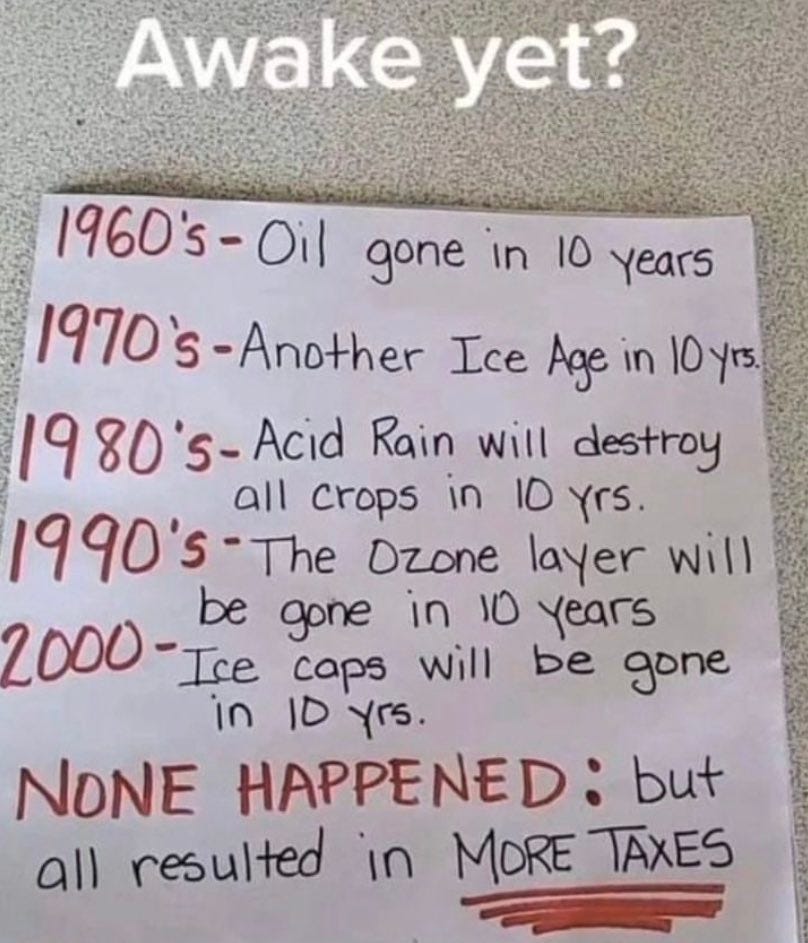
I've seen this meme doing the rounds again and felt that it was time to clarify how stupid it is.
Each of these points stand alone and they each have different nuances. Let's go through them.
Peak oil has been an ongoing meme for over a hundred years. We as a society have been citing it as a potential for a century. Here are all the examples of headline expectations that I could find with a quick search. 13 of them.
1909: 25 or 30 years longer
1919: Two to five years until maximum production
1937: Gone in 15 years
1943: Peak oil has been reached
1945: Just thirteen years left
1956: Ten to fifteen years until peak oil
1966: Gone in ten years
1972: U.S. oil depleted in twenty years
1977: Oil will peak by the early 90s
1980: In the year 2000
1996: Peak oil likely by 2020
2002: Global peak by the year 2010
2007: Sometime between now and 2040
We just keep saying it, and being wrong. Why are we wrong? There's 4 main reasons.
We find new sources
New technologies for detection are created
New extraction techniques are created
Consumption is reduced
There’s no incentive for calling this out, by the government or oil companies. There is a genuine possibility that we'll run out of oil one day. If we did, it would be catastrophic, so that's why there's so much anxiety around it. We just keep getting it wrong. That's probably a good thing.
Acid Rain was first discovered in 1963. At its peak, it stripped forests bare in Europe, wiped lakes clear of life in parts of Canada and the US, and harmed human health and crops in China where the problem persists.
There is now a strong scientific consensus that the cause was sulphur dioxide and nitrogen oxides emitted by fossil fuel combustion by cars and industrial facilities like smelters and coal-burning utilities.
This was disputed at the time because there were a lot of vested interests on the US/Canadian border where both sides had industrial facilities. Eventually, that tree hugging hippie George H. W. Bush enacted the clean air act in 1990.
From its discovery in 1963 to passage of the Clean Air Act in 1990, legislative action on acid rain took 27 years. Now, compared with 1990 levels, sulphate ions in the atmosphere have dropped considerably, reduced to almost negligible levels at former hotspots.
So in regards to the meme, the problem was real, and it was solved by legislative action (by a Republican government).
In 1974, scientists Mario Molina and F. Sherry Rowland published a paper theorising that CFCs could destroy ozone in Earth's stratosphere.
It was disputed.
Then, in the scientific journal Nature on May 16, 1985, three scientists from the British Antarctic Survey, using Dobson spectrophotometers – ground-based instruments that measure changes in atmospheric ozone, announced their detection of abnormally low levels of ozone over the South Pole.
This story blew up and the world started paying attention. In 1987, it was discovered that the hole was 20 million square km in size.
Later in 1987, 46 nations signed the Montreal Protocol, pledging to phase out substances known to cause ozone depletion - CFCs found in aerosols and refrigerators.
Eventually all 197 members of the UN signed the treaty.
Had we not banned CFCs, there would be an ozone hole over the entire world by mid century.
Now, it's expected that the hole will have fully recovered by then.
This is known as the most successful climate legislation in history, and one of the most successful international collaborations on climate science.
Again, in regards to the meme, it was a real problem, solved by legislative climate action and international collaboration.
Data from NASA satellites and multiple studies confirms the Antarctic and Greenland ice sheet have been melting for decades. Antarctic ice is melting at an average rate of 150 billion tons per year, according to NASA.
A recent study from Jan. 25, 2021, researchers from the University of Leeds, the University of Edinburgh, University College London, and Earthwave found that between 1994 and 2017, planet Earth lost 28 trillion tonnes of ice.
To put that in perspective, that would be equivalent to a 100-meter-thick sheet of ice the size of the U.K.
The rate of ice loss has increased by 65% between 1994 and 2017, with Antarctica and Greenland worst affected.
So, this is an ongoing problem - but it's not clear cut.
The disagreements are over whether this is a major problem or a modest one, and how much control we have over it.
The predictions were based on short timeframes that didn’t eventuate.
The predictions on timelines vary wildly - but scientists agree that the ice caps are melting.
In 1971 Dr. Murray Mitchell of the National Oceanic and Atmospheric Administration stated that the planet’s temperature had decreased by “one-half a degree Fahrenheit” since World War II in an article, titled “New Ice Age?”.
Claims of longer and harsher winters in Europe since 1940 were also cited. German meteorologist Dr. Martin Rodewald predicted that if this weather pattern continued, Europe “would be covered with the glaciers of a new ice age by the turn of the century.”
The media ran with it. On April 28, 1975, Newsweek published a provocative article, “The Cooling World,” which described a significant chilling of the world’s climate, with evidence accumulating “so massively that meteorologists are hard-pressed to keep up with it.”
However, this all turned out to be a really BAD prediction.
The study of the world’s climate was still primitive in the 1970s. Few meteorological scientists then knew how to interpret trending temperature information, and the information that climate researchers had collected was incomplete and easy to misread.
Biosciences have advanced by huge leaps since then. There are now many more scientists studying the climate. There have been no peer-reviewed article advancing evidence for a cooling world published in a reputable scientific publication for decades.
However, this prediction really damaged trust in science and is frequently cited to deny climate change to this day.
When conspiracy theorists share this stupid meme, they have this one failure to fall back on and they think this makes all the other points of the meme valid too. It doesn't. They were all real issues, and many have actually been solved (by climate legislation!) so the point about them "never happening" highlights the idiocy of the meme.
Science generally does a good job. Don’t let a silly mistake made in the 70s, while climate science was still new, detract from work being done today. Climate legislation and international cooperation can make a difference. Of course there’s a chance that incentives can be manipulated. You have to be vigilant against that. But not everything is a conspiracy to extract more taxes from you.
Also:
Don’t believe random pictures on the internet.
Most arguments online lack nuance, with the only goal to manipulate the narrative.
The truth is usually much more complicated than can be conveyed in an idiotic meme.
No posts
Comments
Nothing yet. Say the first thing.
Sign in to join the conversation.