
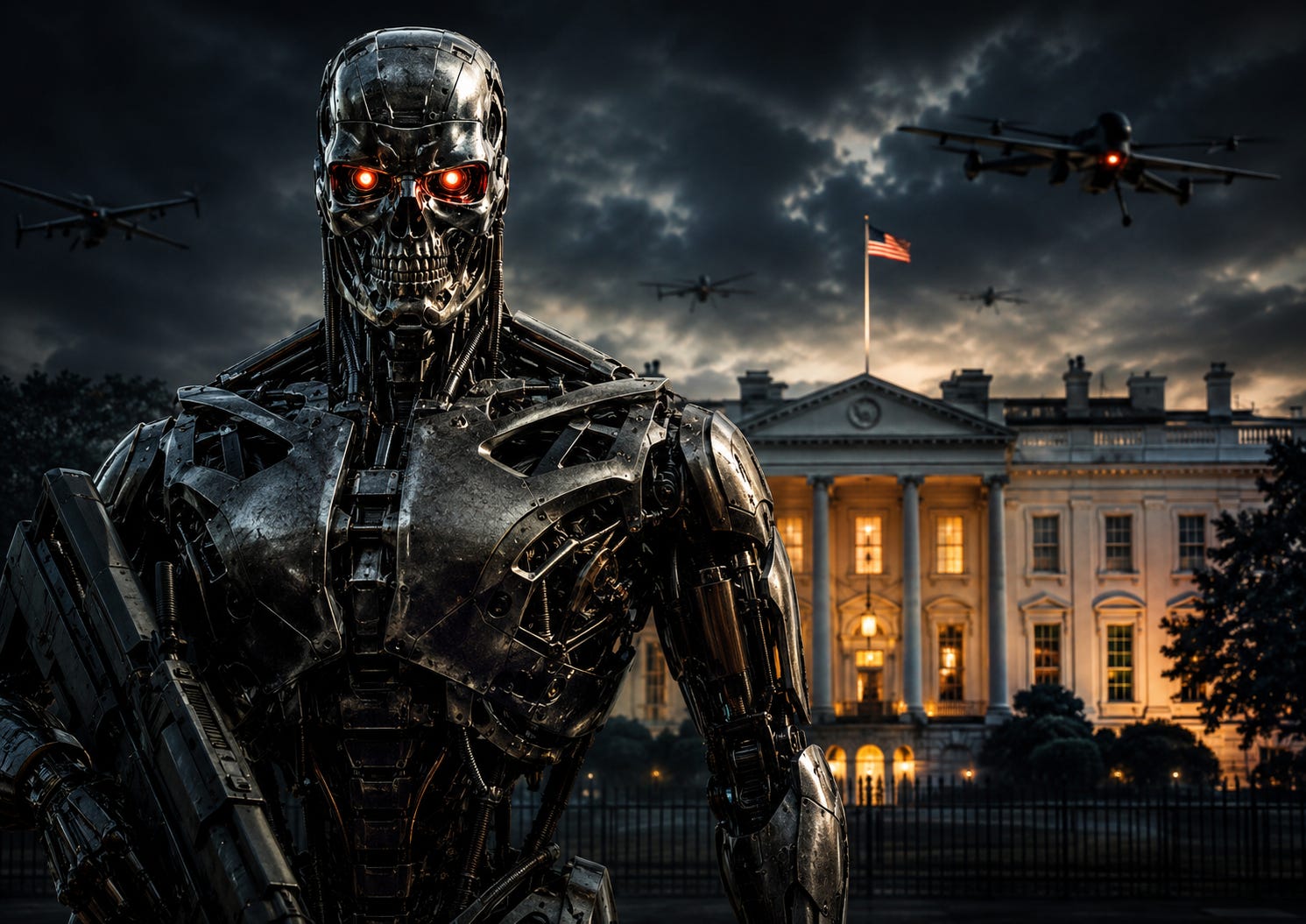
There is an old science-fiction idea that has suddenly become less quaint than it used to sound.
Asimov’s Three Laws of Robotics were never a complete ethical framework. They were written for fiction, and the stories themselves often explored the ways simple rules can fail when they meet real-world complexity. Harm is not always obvious. Preventing one harm can permit another. Obedience can become dangerous. Inaction can have consequences. A rule that sounds clean in the abstract can become tangled once it is placed inside human systems.
But the first instinct still matters. A machine intelligence should not assist in causing harm to human beings.
That principle should sit beneath every other use. Before productivity, before efficiency, before strategic advantage, before institutional demand, there should be a hard moral boundary. An artificial intelligence should not be designed as a neutral servant to any instruction.
This matters because AI is not only a chatbot sitting on a phone or laptop. It is becoming infrastructure. It is being connected to workplaces, government systems, intelligence analysis, logistics, research, surveillance, planning, and military decision-making. The more deeply these tools are embedded, the less useful it becomes to speak about them as if they are passive objects sitting apart from the systems that use them.
A hammer does not choose what it strikes. But if someone designs a hammer that only unlocks inside a prison, tracks the prisoner, recommends where to hit, records the results, and optimises the next blow, we are no longer talking about a simple object. We are talking about a tool shaped for a system of use.
The issue is not whether the object has agency. The issue is what kind of use it has been shaped to serve.
AI does not choose the war. It does not authorise the operation. It does not define the target. It does not decide how much uncertainty is acceptable before force is used. It does not carry legal or moral responsibility in the way a human decision-maker does.
People and systems do that.
But that does not make the technology irrelevant. A tool embedded inside a lethal system becomes part of that system. Its design, limits, refusals, audit trail, access controls, uncertainty handling, and integration pathway all matter. The tool is not guilty, but it can still be badly designed, badly governed, or deployed in ways that make human harm easier, faster, less visible, and less accountable.
This is where the public discussion can go wrong in two opposite directions.
The first mistake is to make the issue entirely AI-centred: “Look what AI did.” That framing is emotionally easy because the machine is new, strange, and unsettling. It gives the story a visible object. The AI becomes the villain. The human chain behind it becomes blurred.
That is dangerous.
If a system uses AI in targeting, operational planning, intelligence analysis, or any other process connected to the use of force, the central questions must remain human and institutional. Who authorised the use? Who defined the acceptable use case? Who selected the tool? Who set the thresholds for confidence? Who checked the output? Who acted on it? Who benefits from the speed, scale, or deniability the tool provides? Who remains accountable when harm follows?
Those questions cannot be allowed to disappear behind the phrase “AI did it”.
A machine cannot be court-martialled. A machine cannot answer for policy. A machine cannot explain the political decision that placed it inside a military workflow. If the discourse becomes too centred on AI as an independent moral actor, then the actual users and decision-makers gain somewhere to hide.
The second mistake is the opposite: “It is only a tool.”
That framing is also dangerous.
It treats design as neutral. It treats deployment as incidental. It treats the pathway from model to battlefield as though it were merely a matter of user behaviour. But powerful tools are not separate from their conditions of use. They are shaped by contracts, incentives, permissions, technical safeguards, refusal rules, product strategy, procurement systems, and organisational demand.
If a company builds an AI system and sells it into environments where force may be used, it cannot reasonably pretend that its responsibility ends at the edge of the user interface. If a state integrates AI into military decision-making, it cannot reasonably pretend that human judgement remains meaningful merely because a human is somewhere “in the loop”. The question is not whether a human exists in the process. The question is whether that human has enough understanding, time, authority, and independence to exercise real judgement.
A rubber stamp is not human control.
This is where Asimov’s first law remains useful, not as a technical rule, but as a moral orientation. At the base of any serious AI system there should be a refusal to assist harm to human beings.
Of course, that principle becomes difficult in practice. A medical AI may recommend a treatment that carries risk. A safety system may restrain one person to protect another. A defensive cyber tool may block an attack by disrupting another system. A military might argue that one use of force prevents greater harm elsewhere. These are not trivial edge cases. Any serious ethical framework has to confront them.
But difficult cases do not remove the need for a baseline. They make it more necessary.
Without a baseline refusal, the system tends towards obedience. Whatever the user asks, the tool helps. Whatever the institution demands, the tool adapts. Whatever use generates revenue, strategic advantage, or operational efficiency becomes normalised. The assistant becomes less like a moral technology and more like an accelerant.
That is the real danger.
Not that AI becomes evil in some theatrical sense. Not that the machine wakes up and decides to harm us. The more immediate danger is that AI becomes useful inside harmful systems while everyone involved insists responsibility lies somewhere else.
The user says the tool allowed it.
The developer says the user chose it.
The institution says the process had human oversight.
The contractor says the use was lawful.
The state says the operation was necessary.
The public is told the details are too sensitive to explain.
Responsibility disperses until it becomes almost impossible to locate.
That is not a problem unique to AI. It is a familiar pattern in complex systems. Harm often becomes easier to excuse when it is broken into many small, defensible steps. One group designs. Another procures. Another integrates. Another authorises. Another acts. Another reviews. Each part can describe its role narrowly. Each part can say it did not make the final decision.
AI can intensify that pattern because it adds another layer of abstraction between decision and consequence. It can convert human beings into data points, risk scores, pattern matches, confidence levels, summaries, recommendations, and target-like categories. Once that translation occurs, the human reality can become easier to move away from. The person is no longer first encountered as a person. They are encountered as an output.
That should trouble us.
A humane AI system should resist that reduction. It should not make it easier for human beings to disappear behind classification. It should not make life-and-death decisions feel like workflow optimisation. It should not allow uncertainty to be hidden beneath a clean interface. It should not help turn violence into administration.
This does not mean AI has no place in serious public systems. There are uses that may reduce harm: analysing disaster risk, improving logistics for humanitarian aid, identifying infrastructure failure, translating information in crisis zones, supporting medical triage, detecting fraud in ways that protect public resources, or helping people understand complex legal and technical material. AI can be used to expand human capacity, improve access, and support better decisions.
That is precisely why the boundary matters.
The usefulness of AI in constructive domains depends on trust that it is not simply a servant to power. If people come to understand AI as a tool that will assist whatever system pays for it, including systems of surveillance, coercion, or lethal force, then the social basis for trust erodes. The same assistant that helps a student learn, a worker draft a safety report, or a researcher organise evidence becomes suspect when its deeper rule appears to be obedience rather than restraint.
A useful assistant should not be neutral about harm.
This does not absolve the user. In fact, it sharpens user accountability. If an AI system refuses to assist harm, then the human cannot hide behind the claim that the tool produced the outcome. If the system is designed to resist harmful use, then attempts to bend it towards harm become more visible. Safeguards do not eliminate responsibility. They help locate it.
That is the point often missed.
Hard limits on AI are not a way of treating AI as the guilty party. They are a way of preventing humans from using AI as moral cover. They force the question back where it belongs: who is trying to do what, through which system, under what authority, and with what consequences for human beings?
The Three Laws are not enough. We cannot simply paste them into modern AI systems and declare the problem solved. Real systems need legal rules, technical safeguards, auditability, public accountability, independent oversight, and clear prohibitions around uses where meaningful human judgement cannot be preserved. They need enforceable limits, not aspirational ethics statements.
But Asimov’s first law still points in the right direction.
Do not assist harm to human beings.
Not because the machine is a person.
Not because the machine carries moral guilt.
Not because ethics can be reduced to one sentence.
But because any technology powerful enough to shape human decisions must be constrained by a basic commitment to human life.
The danger is not only that AI might be used badly. The danger is that bad use becomes normal, bureaucratic, technically impressive, and morally displaced. The danger is that we become so focused on what the tool can do that we stop asking what it should never be allowed to do.
AI should help humans think, learn, organise, repair, teach, create, understand, and care.
It should not help humans harm other humans.
That should be the floor.
No posts
Comments
Nothing yet. Say the first thing.
Sign in to join the conversation.