
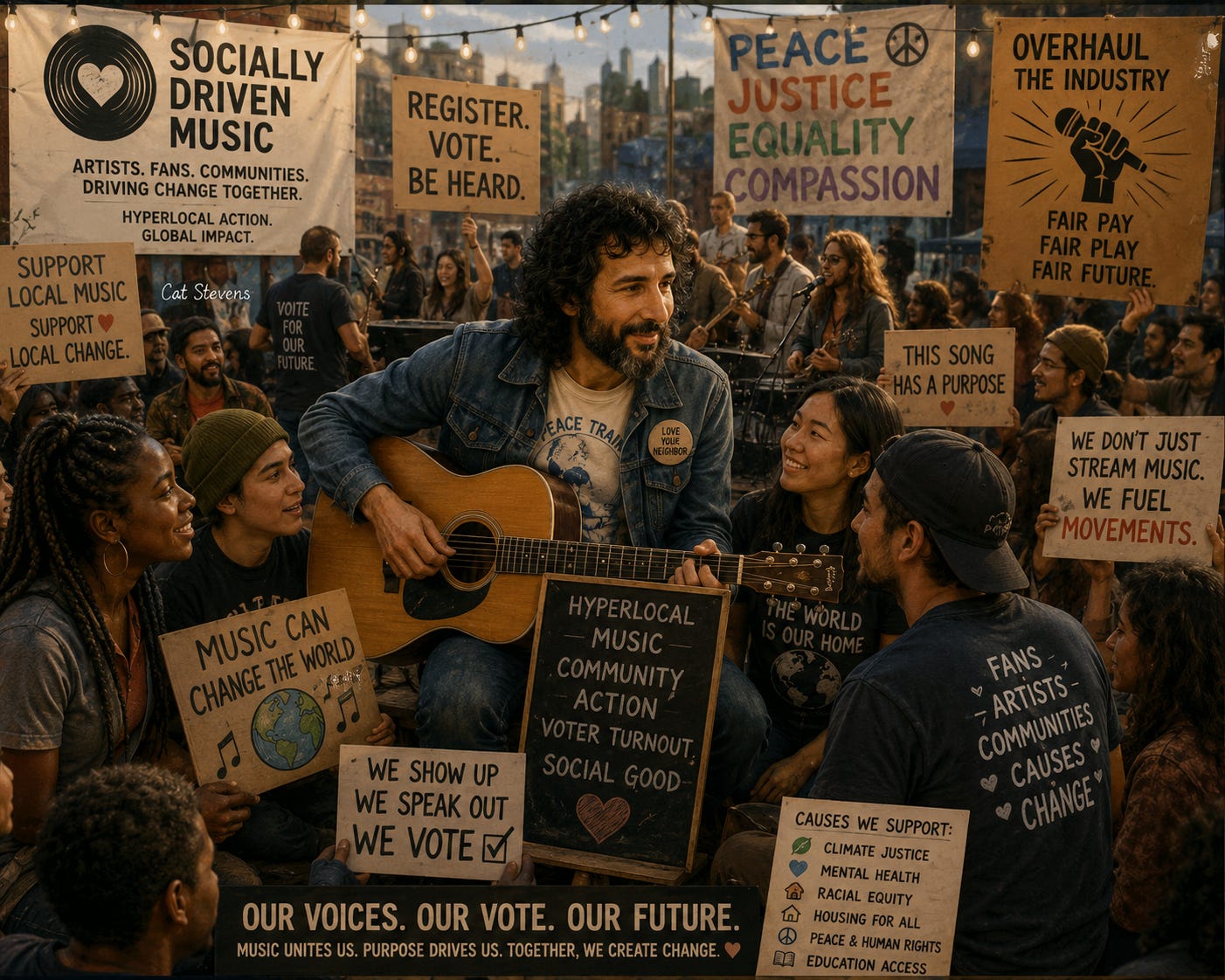
There is a particular kind of epiphany that arrives not as a thunderbolt but as a slow accumulation, the kind where you realize, usually in the middle of the night, that three or four things you have been thinking about separately for years are actually the same thing, albeit seen from different angles. New perspective also comes with getting older and especially when a health issue arises that is inexplicable for someone who is fastidious about health, diet and exercise. One ponders purpose and legacy as elder colleagues are naively sidelined or appear in obituaries with increasing frequency. And because I write the Substack publication, Socially Driven Music, precisely to elucidate those often intricate musings, I am going to put this one plainly, especially for the asleep at the wheel, parochial corporate music executives who consistently demonstrate their insular lack of vision.
Nonetheless, I should also say at the outset that this essay is a wakeup call to the more imaginative executives in “the business” with the relationships within the media ecosystem to influence a much needed sea change from the preponderance of directionless music pablum, the flavor of the week they promote to mindlessly compete with each other. How this business is perplexed about why music is no longer a lean-in necessity, speaks to its mentality, when it should easily comprehend the rewards of music that viscerally recaptures imaginations and ignites inspiration.
Music can affect our psyches profoundly and challenge the current political conflagration. We must now activate careers at the intersection of music and visual media which, for the enlightened, brings the potential of purposeful leverage for social good and a return to the values we cherish, not necessarily altruistically, but often as the driver of financial reward.
Such alchemy is exemplified with the management of both an Academy Award winner, the late Peter Finch, and the music icon, Cat Stevens, each which serves as an example of prescience and opportunity, and is exponentially powerful in combination, as we’ll discuss.
I have spent the better part of my professional life as a music industry executive and recognized thought leader considering music as a vehicle for something larger than just entertainment. That conviction is the foundation of Socially Driven Music, where I have argued, repeatedly and with escalating frustration, that the corporate music industry is squandering the most powerful instrument for human connection ever devised, not through malice, but through a combination of myopia, timidity, and a fundamental failure to understand that music, at its best, has always had a purpose, an elevation of social consciousness.
Yes, there are examples of music corporations’ charity/philanthropy and institutional lobbyists for the business of music, but the focus on social issues is anemic when compared to the potential of motivated artist communities and energized fan bases. Let’s stipulate that, despite lack of corporate encouragement, there are certainly artists who have embraced causes important to them and who have even created supportive foundations. However, these efforts are often quiet and under the radar of the general public, including ardent fans. Even the well-intentioned large charity events are “Band-Aids” that have little to no long-term effect.
The industry’s current obsession is the superfan. Every label, every streaming platform, every manager and A&R executive is chasing the same white whale, the fan who doesn’t just listen but lives inside an artist’s world, who spends more, advocates more, sustains an artist’s career despite the algorithm’s indifference and the playlist’s fickleness. They have built entire data infrastructure around identifying superfans, quantifying superfan behavior, and hopelessly trying to engineer superfan loyalty. They have conferences about it. They commission reports. They’ve embraced production values and eschew professional songwriting that sustains over the years and yields decades of cover recordings, and they continue to behave like lemmings, replicating the latest forgettable confection. Once upon a time, music spoke to us and for us viscerally and intellectually. It created community. Today, a fraction of the music deluge is compelling or memorable, and is discoverable only with a deep dive into alternative playlists. A handful of true artists do break through (e.g., Sienna Spiro, Sam Fender, Olivia Dean, Lola Young, James Blake, Turnstile, Nectar Wood, Jalen Ngonda, Raye, The Last Dinner Party).
The business of music, almost without exception, is clueless and looking in the wrong direction for its future. Look to the Independent labels and artists for breakthroughs.
The superfan is not a consumer to be targeted with ill-conceived ploys like Universal Music’s retail gambit and industry de facto gimmicks, such as Warner Music’s embrace of Suno, the AI tool for music slop by anyone, which is deleterious for copyrights and further dilutes attention as the listener is subsumed by dubious quality that relegates everything to background noise, but for those who expend the effort to discover quality. The superfan is a citizen waiting to be seen. Artists with factual knowledge of a subject have credibility and are influential. Meanwhile, the detached music industry and most of its “product,” is rendered irrelevant with its corporate risk-aversion and propensity to follow the leader’s algorithmic cowardice.
The new paradigm does not ask artists to perform political allegiance at stadium scale. It asks them to do something more demanding and more powerful. It requires empathy, to learn with genuine curiosity and care about the specific ways that specific policies are landing in the specific communities their music reaches, and to speak about those specifics in their own voice, in direct conversation with the people who love their work. The answer evading the myopic corporate music industry in a downward spiral of irrelevance is found with artists’ hyperlocal connection and personal interaction to community about shared values and issues. The epiphany is that fans can inspire artists rather than waiting for their favorites to find a purpose (read on). It is breathtaking that an industry can be silent and abdicate its responsibility to speak up for and with an embattled audience, the one role that would actually create the deep, lasting, life-altering loyalty it claims to want. Now would be the moment to act in the face of an aspiring authoritarian administration staffed by grifters and miscreants actively dismantling the democratic institutions that generations of Americans died to build and protect.
I have been advocating this music business disruption for a while now. And then, in the space of a few weeks, three things coalesced in my thinking that perhaps will be more illustrative for those who still need a primer. The essence of the thesis could be presented with any of the myriad social issues confronting us and exacerbated by political gamesmanship, from gun violence, to voting rights, to immigration, to food scarcity, to the health system, etc. I chose to illuminate the point with prejudicial censorship and discrimination as the centerpiece, but there is no dearth of urgent issues to tackle, none more asinine than the loosening of gun access laws for the mentally challenged (literally).
The first was “Network.”
Everyone knows the classic movie, “Network.” Howard Beale. “Mad as hell.” 1976. Paddy Chayefsky. We treat it as a cultural touchstone, which is another way of saying we have successfully defused it, turning a live grenade into a museum piece.
But watch it again now. Not as a satire. As a documentary.
Chayefsky did not write a comedy about television’s excesses. He wrote a precise, furious diagnosis of what happens when the machinery of mass communication is handed to people whose only loyalty is to the quarter’s earnings. His villain is not Howard Beale, the unhinged anchor who becomes a ratings phenomenon. His villain is the system behind Beale, the Frank Hacketts who see Beale’s genuine anguish as a programming format, the Diana Christensens who understand that authentic human suffering, properly packaged and emotionally amplified, is the most powerful audience-retention tool ever devised.
And then there is Arthur Jensen, the corporate patriarch who summons Beale to a vast, cathedral-like boardroom and delivers what is essentially a sermon that nations are fictions, peoples are fictions, democracies are fictions. The world is, in reality, one vast interlocking corporate system, and Beale’s outrage, his quaint, patriotic, humanist outrage is a vestigial response to forces that have already made it obsolete.
Jensen is not a fascist. He is something more dangerous, a man who has simply stopped pretending that democracy was ever real.
What Chayefsky dramatized as dystopian satire, the modern Outrage Cabal has been institutionalized as a business model. Today, it hardly feels like fiction. The Sean Hannitys and Greg Gutfelds and Laura Ingrahams are not journalists who went wrong. They are Diana Christensens with better distribution, amoral programming executives who discovered that a nightly cocktail of manufactured apocalypse, rotating scapegoats, and messianic political grifters was the most reliable subscription model in the history of media. The Dominion Voting Systems lawsuit gave us the receipts. Internal communications proved that Fox’s primetime hosts privately dismissed as absurd the very conspiracy theories they were broadcasting to millions of viewers, and kept broadcasting them, because the alternative was ratings erosion and stock-price collapse.
The mechanism comprises the Triple Lies:
The Apocalyptic Lie, a fabricated existential crisis, renewed nightly, that keeps the audience in a state of managed panic. Everything is collapsing. The culture is being replaced. The system is rigged against you. Stay tuned.
The Scapegoat Lie, a rotating cast of manufactured villains to absorb the audience’s fear and convert it into hatred. Immigrants. Muslims. Jews. Academics. Doctors. Election workers. The specific villain matters less than the structural function. The audience must always have someone to blame who is not the people selling them the story.
The Grifter’s Lie, the promise of salvation, delivered by the only figures the audience is now permitted to trust: the political entertainer and his/her chosen political vessel. Donate. Vote your fear, not your truth. Buy the merchandise. The salvation never arrives, because arrival would end the subscription. The crisis must be perpetual to keep the business model solvent.
This is the machine that has now fully captured the executive branch of the United States government, and if you want to understand precisely how that capture was executed, and what it looks like from the inside, Maggie Haberman and Jonathan Swan have just published the most important political document of this moment: “Regime Change: Inside the Imperial Presidency of Donald Trump.” Based on over a thousand interviews conducted across three years, drawing on sources embedded in the administration’s most closely guarded rooms, “Regime Change” is the receipts, a real-time chronicle of how a president, emboldened by indictments that made him a martyr, convictions that made him a cause, and four years of exile that transformed grievance into fuel, returned to office not chastened but weaponized.
The architecture of what Haberman and Swan document is not merely one man’s pathology. It is a coordinated, three-layer assault on democratic governance. At the ideological foundation sits the Heritage Foundation’s Project 2025, not a fringe document but a detailed operational blueprint for dismantling the administrative state, implemented in real time by Russell Vought, its primary architect, now installed as Budget Director with the mandate, in his own words, to “destroy” the civil service and “traumatize” federal workers into submission. Vought is the quiet revolution, less visible than the daily chaos, more consequential than almost any of it, methodically gutting the institutional infrastructure that makes self-governance possible while the cameras point elsewhere.
At the operational center sits Stephen Miller, the driving force behind racial profiling, indiscriminate detentions, masked and unaccountable security forces on American streets, and the shipping of migrants to gulags in El Salvador. Miller is one of the more consequential useful idiots in the administration. He is the machine’s most disciplined technician, the man who understood before almost anyone else that the Outrage Cabal’s Scapegoat Lie, properly translated into executive policy, could be institutionalized as governance. Miller’s philosophy is as ugly as his countenance.
And then there is the president himself, a man operating almost entirely on instinct, unwilling to be briefed on harsh realities, seeing fewer polls than at any point in his first term, willing to take brinksmanship risks that could throw not only his presidency but the Republican Party and the entire world into chaos and carnage. He surrounds himself with a Cabinet of unqualified misfits. What Haberman and Swan reveal is a figure his own aides privately describe in terms that would be alarming if applied to anyone managing a mid-sized corporation, let alone the most powerful office on earth, someone his inner circle believes has an almost mystical quality, able to hear frequencies others cannot, a belief that is less a compliment than an acquiescence. These are supplicants prostrating themselves, who accept a daily cascade of untruths and contradictions, who have stopped expecting rationality and started requiring irrational faith to a leader in evident mental and physical decline.
This is the partner the ideologues needed. Peter Thiel provided theoretical scaffolding through his investments in neo-reactionary politics. Curtis Yarvin provided the ersatz intellectual permission structure, the blogosphere argument that democracy was always a lie and that what America actually needed was a CEO-monarch unencumbered by constitutional friction. The Heritage Foundation provided the policy apparatus and the call to Christian nationalism. Larry Ellison was able to manipulate a compliant president susceptible to flattery to control an inordinately large piece of national media. And a supine, sycophantic House and Senate, populated by men and women who know better, who said so privately, and who chose their seats over their country, provided the confirmation votes, the budget approvals, and the studied silence that allowed every norm violation to pass without consequence. The Senate did not fail to stop this. It chose not to. That distinction matters enormously, and history will not be generous about it.
The result, as Haberman and Swan document across four devastating sections — “Whirlwind,” “Retribution,” “The Enemy Within,” and “Plunder” — is a presidency that has turned the Justice Department into an instrument of personal retribution, shaken down white-shoe law firms, deployed the National Guard to American cities for no legitimate security purpose, and converted the office itself into a brazen vehicle for personal enrichment. Not to mention the defacing of the Oval with obscenely crass gold trim, and endeavoring to transform Washington, D.C. with various garish monuments to himself. Arthur Jensen’s corporate gospel, the world is a system of markets and power, and democratic sentiment is a friction to be eliminated, has now been handed to a government.
The Greatest Generation defeated authoritarianism on foreign soil. They stormed Normandy, liberated the camps, and built the postwar democratic order from the rubble of actual fascism because they understood, at the cost of their lives, what the alternative looked like. We are being asked to defend that inheritance on domestic soil, and so far our institutional response has been a cascade of capitulation. Law firms that folded under pressure, universities that abandoned academic freedom, corporations that purchased temporary peace with authoritarian demands, technology leaders who confused proximity to power with alignment to principle.
The machine has learned that the cost of intimidation is acceptable. And so it escalates, every week, testing the next threshold, because no one with the institutional authority to hold the line has yet chosen to hold it.
The playbook that the machine operates through is the age-old divide and conquer mechanism against the communities it needs to keep divided. It follows that music that creates interconnected communities is the antidote.
I was familiar with two men whose stories embody navigating divisive prejudice, indeed any discrimination, and who could serve as my protagonists as they frame how to defy the inevitability of a devious scheme. These lived experiences from opposite sides of a manufactured divide, represent an illustrative microcosm in which each independently arrives at the same understanding of how the mechanism worked and how to stand against it.
As of this writing, these two men have not been introduced to each other. They do not yet know that I am proposing them as the center of a larger project, one envisioned as ideally suited for development by one of the socially aware production companies for a major, enlightening streamer. What I am offering here is a thesis, a conceptual framework that I believe reflects the truth of two parallel experiences that then intersect with a poignancy that calls for a collaboration that obliterates stereotyping. Whether that collaboration becomes real depends on conversations that have not yet happened. But I am putting this forward because ideas, stated clearly and publicly, have a way of finding the people they belong to.
The first referenced individual is Yusuf Islam, the man the world knew as Cat Stevens before a spiritual journey of extraordinary depth and seriousness led him to embrace Islam and, in one of popular music’s great acts of conscience, to walk away from a career at its commercial peak because he felt it no longer aligned with who he was becoming. Listen to his body of work (including the 2023 album, “Man of a Land”) and the telltale examples of social conscience are glaringly evident. The press, predictably, could not accommodate the complexity of this. A rock star becoming a Muslim was a story the tabloid mind could only process as either apostasy or radicalization, and the coverage largely chose radicalization, flattening decades of theological study, humanitarian work, and artistic integrity into a sensationalized headline that served the Islamophobia narrative with convenient efficiency.
Yusuf Islam has spent years insisting on the fullness of his humanity against a media apparatus that finds his reduction more commercially useful than his truth. He is, in this sense, the living rebuttal to the Scapegoat Lie aimed at Muslim communities, a man whose faith is a fourteen-century tradition of theology, philosophy, art, jurisprudence, and spiritual practice embraced by nearly two billion human beings across every culture on earth. This is a tradition that has nothing to do with the political ideologies of specific actors or regimes that the Cabal uses to construct its weekly Islamophobia segment.
The second is my friend, Dr. Peter Warshawsky, known in his youth, with the particular cruelty that children reserve for the visibly vulnerable, as “Pete the Panic.” His memoir *Blows* is one of the more remarkable documents I have encountered in recent years. It’s a raw, unflinching account of a Jewish boy who grew up bullied, anxious, and suffused with self-loathing, in a household shaped by parents whose own response to antisemitism had been trained into timidity by the long shadow of World War II. His parents had lived through an era in which Jewish visibility could be lethal, and the survival instinct that era produced (keep your head down, don’t make yourself a target, absorb the blow and move on) was transmitted to their son not as cowardice but as love. As the only protection they knew how to offer.
The result, for young Peter, was an interior landscape of devastating negativity. The voices in his head, as he describes them, were relentless: I suck. I can’t. I won’t. I shouldn’t. He was anxious, fearful, awkward, and he hated being that person. More than that, he hated being himself.
And then he made a choice. Not a dramatic, cinematic choice, a quiet, daily, grinding, inch-by-inch choice to stop being “Pete the Panic” and become someone he had not yet met: “Icy Pete.” Calm. Confident. Courageous. The transformation came through Brazilian Jiu-Jitsu and boxing, disciplines that demand exactly the qualities his anxiety had denied him: presence under pressure, the ability to absorb a blow without being defined by it, the tactical intelligence to read an opponent’s mechanics and respond with precision rather than panic. He trained through self-doubt. He trained through an arthritis diagnosis that would have given most people a medically sanctioned exit from the whole endeavor. He trained through the voice in his head that kept insisting he go back to being a slug.
He did not go back. “Pete the Panic” became Dr. Peter Warshawsky, DDS, a periodontal surgeon, a husband, a father, a competitive fighter. A man who spent his professional life in the intimate, trust-requiring work of healing people’s most vulnerable anatomy, and who spends his personal life proving that the story you are handed in childhood is not the story you are required to finish.
I want to sit with that biographical arc for a moment, because it is not merely inspiring in the generic self-help sense. It is structurally relevant to the point I am making. The Outrage Cabal’s most powerful weapon against Jewish communities is not overt antisemitism, it is the activation of inherited fear. It is the deliberate triggering of the same generational trauma that taught Peter Warshawsky’s parents to keep their heads down. It’s the suggestion, renewed nightly, that the danger is existential, the enemies are everywhere, and the only protection available is total loyalty to the demagogue offering it. The Apocalyptic Lie aimed at Jewish audiences is specifically engineered to produce “Pete the Panic” at a civic scale, a community so conditioned to expect persecution that it becomes susceptible to anyone who promises, however cynically, to stand between them and the mob.
What Peter Warshawsky’s life story demonstrates, methodically, physically, and metaphorically is that the answer to that engineered panic is not more panic and not more deference. It is the disciplined, stoic, daily practice of refusing to be defined by the fear that was handed to you. The martial artist does not eliminate the blow. He learns to receive it without being destroyed by it, and to respond with precision rather than terror. That is a personal philosophy. It is also, I would argue, a political one.
Warshawsky demonstrates how to navigate the particular psychological burden of being Jewish in a media environment that weaponizes Jewish historical trauma with cynical precision. It activates the memory of persecution not to protect Jewish communities but to deploy their fear as a political instrument, to make every moment feel like a harbinger of catastrophe, and therefore to make every demagogue who offers protection feel indispensable. The Scapegoat Lie aimed at Jewish communities does not look like overt antisemitism, at least not initially. It looks like solidarity. It looks like protection. It is, in fact, the same machinery of manipulation that produces overt antisemitism in other directions, run by the same operators, for the same commercial and political purposes.
Central to both men’s experience, and to the Cabal’s operational playbook, is a deliberate, politically motivated conflation that must be named and dismantled. To criticize the policies of the Israeli government is not antisemitism; to hold Jewish people collectively responsible for those policies is. The Outrage Cabal weaponizes this distinction strategically, collapsing it to shield a political agenda from legitimate scrutiny, then re-erecting it selectively to paint critics as bigots. The mechanism is identical on the other side. Islam as a faith and Islamism as a political ideology are not the same thing, and treating every Muslim as a suspect collaborator with the worst acts committed by anyone who has ever invoked the religion’s name is the precise equivalent of holding every Christian responsible for the Inquisition or the bombing of abortion clinics. Both conflations, Judaism with Zionism, Islam with Islamism, serve the same master. They make nuance impossible, dialogue impossible, and coalition impossible. An audience that cannot distinguish between a faith and a political movement, between a people and a government, between a religion and an extremist fringe, is an audience that can be aimed at whoever the Cabal designates as this week’s enemy with reliable, monetizable precision. That is not a side effect of the confusion. It is its entire purpose.
What I am proposing, conceptually, is an alliance between these two men, the Jewish martial artist who has learned to meet fear with disciplined precision, and the Muslim artist-theologian who has spent a lifetime refusing to be reduced, as the human center of a larger argument about how cross-cultural solidarity breaks the machine that requires their mutual suspicion to function.
The third prong of this conceptual triad was the recognition that mass protest, however morally necessary, however admirable as an expression of democratic vitality, is operating at the wrong altitude to defeat what we are actually facing.
“No Kings” fills the streets. The would-be kings remain.
I do not say this to disparage the people who show up, who march, who make their bodies animate a peaceful argument. That civic impulse is precious and must be protected. But the Outrage Cabal has spent decades inoculating its audience against the spectacle of mass protest. Indeed, the protest march has become part of the programming, another grievance to monetize, another image to reframe as threat. The macro gesture is absorbed and metabolized by the apparatus without structural consequence, because the apparatus does not respond to aggregates. It responds to the specific: the specific advertiser, the specific legislator in the specific primary, the specific voter in the specific precinct.
What cannot be ignored is the micro truth, delivered personally.
And this is where the music industry, if it can stop grieving the business model it lost, circumvent opportunist ventures like Suno and its user-generated AI ersatz music that is diluting the art, and start recognizing the model hiding in plain sight, can do something genuinely historic.
The answer evading the myopic corporate music industry in a downward spiral of irrelevance is found with artists’ hyperlocal connection and personal interaction to community about shared values and issues.
Billie Holiday did not sing a general protest against racism. She sang “Strange Fruit,” a specific, unbearable image of specific bodies in specific trees in a specific American landscape. And it cracked something open that abstract moral arguments had not reached. Bob Dylan did not write manifestos, he wrote “Hurricane,” a particular story, a particular injustice, rendered with such specificity that it became universal. Sam Cooke sang “A Change Is Gonna Come” from inside the wound. Marvin Gaye’s “What’s Going On” arrived at the precise intersection of Vietnam, urban poverty, and environmental collapse and asked, with heartbreaking gentleness, whether the people in charge had considered what they were destroying.
What these artists shared was not volume. It was precision. They did not protest in the abstract. They reported from the particular. And the particular is where human beings actually live.
That tradition of music never died. But its delivery mechanism changed, and the industry responded to the change by optimizing for consumption metrics rather than recognizing that it had, in its hands, something the old broadcast model never permitted, a genuine two-way relationship between artist and audience.
The superfan the industry is desperately trying to engineer through data and algorithms is not a mystery. She is created by one thing: being seen. Not being entertained. Not being marketed to. Being seen through having an artist demonstrate, specifically and personally, that they understand the actual conditions of her life.
A country artist with a following in rural Ohio, talking to a fan whose child lost Medicaid coverage. A hip-hop artist with a following in Atlanta, talking to a voter whose polling place was moved sixty miles from their home. A pop star with a global reach, talking to a first-generation immigrant whose family is navigating deportation terror. Not in a campaign ad. Not in a stadium speech. In a song that knows their story. In a post that asks rather than performs. With interaction in a group dedicated to improving a shared issue. In a direct message that says: I see what is happening to you, specifically, I want to connect with you about this, and I made something about it.
This transcends partisanship, because human suffering is not partisan. It is a return to music’s original function to bear witness, to build solidarity, to make people feel less alone in the conditions of their lives. And it is, not incidentally, the only proven antidote to the Scapegoat Lie. When your artist sees you as a full human being, it becomes considerably harder for a cable host to convince you that people who look different from you are your enemy.
The music industry’s elusive superfan is waiting. She will not be captured by a better algorithm. She will be created by an artist willing to be honest, specific, and brave in this political moment, when the cost of bravery is real and the cost of silence is higher.
The late Peter Finch’s portrayal of Howard Beale remains one of the great performances in American cinema. He’s the original mad prophet, the template against which every subsequent television demagogue must be measured. And Yusuf Islam is a real life icon who, at the height of his music career, prioritized a spiritual journey that the media would caricature and the world would misconstrue, but who nonetheless navigated with a dignity that the coverage never equaled.
The connective tissue between “Network,” Yusef Islam, and Peter Warshawsky’s emergence from prejudicial cultural insecurity, that comprises the very architecture at the core of this essay and presents a compelling script, should be very evident. It depicts the dynamics of what’s possible with the courage to visualize and greenlight a production that speaks to our confounded zeitgeist from the inside, in ways that most people only encounter as abstraction. A story emerges of introspection, emotional intelligence, sentience and perseverance that we in the business of music and media are uniquely positioned to bring to life. It’s the streamer that the country is yearning to receive at our currently conflicted crossroads.
Let me state it simply.
The machine runs on division. It requires that Jews and Muslims distrust each other. It requires that Black and white working-class communities compete rather than organize. It requires that every potential coalition be pre-fractured along lines of identity before it can cohere into political power. It requires that artists stay silent, that institutions capitulate, and that citizens feel individually powerless against forces too large and too cynical to fight.
None of that is inevitable. All of it is chosen by the people who built the machine, and by the people who have decided, so far, not to dismantle it.
The tools for dismantling it exist. The music exists. The artists exist. The fans — the citizens — exist, waiting to be recognized not as a demographic but as human beings whose specific lives are being specifically affected by specific policies that can be specifically named, specifically opposed, and specifically voted out of power.
Paddy Chayefsky showed us the machine fifty years ago and nobody stopped it. Howard Beale told the truth on live television and they killed him when it became inconvenient.
The difference now is that the microphone is no longer controlled by the Frank Hacketts. The artists have it. It’s the only media not as yet being overtly censored by this administration. Perhaps because the industry has been afraid and is complacent and complicit. It could also be that the music it promotes is so innocuous as to not matter. The question is whether this business is willing to support artists who use their voices for something other than fleeting, meaningless content.
I believe they are. I believe the moment is demanding it of them and that this project will lead to cross-cultural music gems that inspire voting and peaceful change. And I believe that the alliance between a Jewish man who learned to stand his ground and a Muslim man who refused to be reduced, and the larger movement that alliance represents, is the beginning of an answer for which the machine does not have a counter-program.
This is the framework for a streamer that reintroduces the social construct of cross-cultural civility and common good, with a music soundtrack as diverse and collaborative as the infinite personal experiences that transcend despair through collective perseverance.
Socially Driven Music is the catalyst and exchange where music artists and fans come together to parlay their hopes for the future that most of us desire. Join us and we will facilitate the connections.
#Music, #MusicIndustry, #Politics, #Democracy, #Activism, #SocialGood, #PeacefulResistance, #Midterms, #Elections, #Congress, #Indivisible, #NoKings
Stephen Craig Love (https://bit.ly/Stephen_Craig_Love_IMDb_Profile) writes Socially Driven Music, a Substack publication at the intersection of music, democracy, and the stubborn belief that art still has the power to change the world if the people who make it are willing to try.
Comments
Nothing yet. Say the first thing.
Sign in to join the conversation.