
(Click on Image for Video)
The P-word referenced above is not what you think, albeit with the same connotation. It’s pusillanimous (craven, cowardly, feckless, timid)! Wake up before your music profession becomes an avocation.
Socially Driven Music has written extensively and fastidiously over the last few years about the decay of the corporate music industry and its abdication of song creativity (there are many incredibly inventive productions, but ultimately built around a wasteleand of forgettable, inane, vapid excuses for songs). The essays are a deep dive into the music industry’s myopia and offer a menu of untapped solutions informed by socially conscious observations for music that both entertains and becomes thematic fodder that can motivate calls-to-action.
The current state of American politics and its calculated divisive polarization of society couldn’t be more conducive to a method of mass communication that is visceral and ubiquitous. The fact that music can be a potent transformative agent and concurrently lift itself from its doldrums is ostensibly lost on the dimwits in charge of the corporate music industry. They are demonstrably too inept to visualize how to circumvent music’s march to a passive commodity that is becoming tertiary to other media. We’ve cajoled and then implored more aggressively. It’s time for the gloves to come off. Let’s begin by stipulating that neither major American political party is blameless for our cultural deterioration, and emphasize that this piece is not about partisanship. It’s reality.
History warns us that authoritarianism begins not with tanks in the streets, but with the quiet dismantling of culture, memory, and truth. That is happening now in America. The fact that we’re also seeing local governments usurped with administration orders for troops in the streets under the guise of abating violence is not only disingenuous, but an ominous portend of more to come.
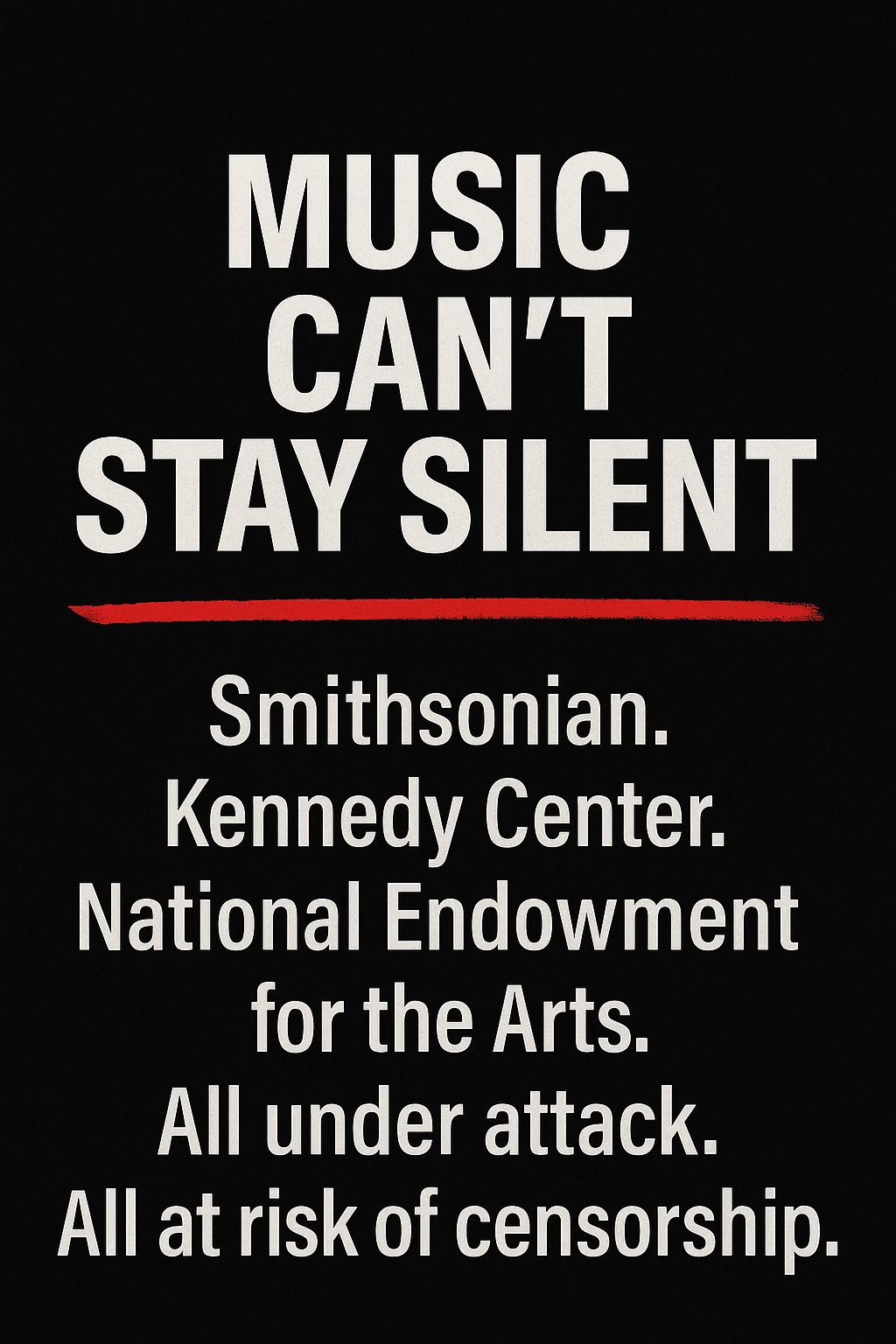
The Smithsonian Institution, including the National Museum of African American History and Culture, the National Portrait Gallery, the American Women’s History Museum and more, has been ordered to strip “divisive” content from exhibits (Axios, People, Washington Post).
The National Endowment for the Arts, the National Endowment for the Humanities, and the Institute of Museum and Library Services are once again being targeted for elimination.
And the Kennedy Center, long a beacon of American performing arts, is no longer safe either. Donald Trump has named himself its chairman and is talking about renaming it in his and his wife’s honor (do we have your attention yet?). Its leadership is under political siege, its programming pressured to conform. This is not oversight. It is a takeover.
And still, the music industry remains silent.
Why? Perhaps the answer is fear. Fear of reprisal. Fear of political backlash. Fear of becoming the next target. But if this is true, then the industry must ask itself: What would it mean to admit that we bowed out of fear, while the very institutions we claim to honor, our veterans, our “Greatest Generation,” once fought and died for freedoms we are now too timid to defend with a song and peaceful calls-to-action?
Silence is not neutrality. It is complicity. Because if museums and performing arts centers can be censored today, music will be censored tomorrow.
One-off spectacles like Stand Up To Cancer, commendable though they most certainly are, fade within days. Their impact cannot meet the scale of this crisis and we have suggested alternatives.
What endures are stories. As Socially Driven Music’s essays argue, artists must tell personal, lived stories of their families, their friends and their fan about how this administration’s policies and censorship are eroding lives. That is how music becomes a bridge to action, and how fans become superfans: not through marketing gimmicks, but through truth and interaction for defined purposes that resonate with them.
Think again about how pervasive cancer remains in society. mRNA technology saved millions of lives and is vital in the fight against cancer, AIDS, and other diseases, and yet is now ridiculed and defunded. This is the ideal example of how artists should highlight concerns that affect virtually everyone. Experts agree this will cost millions of lives. If artists won’t tell these stories, if they won’t tie their voices to the stakes of survival and justice, they abdicate their social purpose.
The lesson is stark:
If musicians use their voices, they can help preserve culture and democracy.
If they retreat into silence, they will see their own industry hollowed out, their own art censored, and professions reduced to avocations.
This is not about “politics.” This is about defending the very freedoms that we claim to celebrate at every national holiday and every halftime show, and the example of liberty that is the aspiration of people in other countries around the world.
If the music industry cannot rise to this moment, then it will be remembered not as a cultural leader, but as an industry that capitulated out of fear and became unimportant background noise.
We expect change to come from independent artists, labels and music publishers, not the music industry corporations, and invite them to join us. We also welcome music managers who accept their responsibility to guide their clientele to music for a purpose which artists and songwriters will find reciprocally beneficial for their careers and livelihoods if genuine. Again, read the Socially Driven Music essays (linked above) and contact us to join a coalition of connected artists, songwriters, superfans and their dedicated causes and supportive businesses which will influence politicians or vote them out.
#Music, #MusicIndustry, #Democracy, #Politics, #Censorship, #Activism
Comments
Nothing yet. Say the first thing.
Sign in to join the conversation.