
From the Daily Mail…
Revealed: Alarming reasons behind Britain’s alcohol death crisis - according to the scientists that spotted the surge in victims (and it’s not just Covid)
It wasn’t difficult to spot the surge in ‘victims’. The UK’s alcohol-specific death rate rose from 11.8 per 100,000 people to 16.6 per 100,000 people between 2019 and 2022 - an increase of 40%. Since the rate had been pretty flat for years before the pandemic, it is safe to say that the ‘surge’ was due to the boredom and despair of lockdowns combined with the inability of alcoholics to access face-to-face treatment.
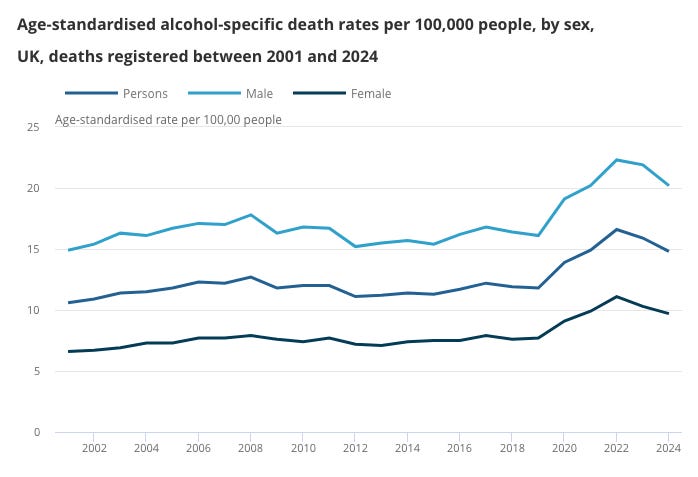
This was soon noticed at the time, so who is taking the credit for ‘spotting’ it? Step forward Colin Angus, purveyor of low quality ‘public health’ modelling, and his pals who published a study year last about alcohol-specific deaths in England between 2001 and 2022 in which….
We used annual mortality data for England published by the Office for National Statistics (ONS).
Repackaging publicly available data for the Lancet apparently qualifies these people to explain why alcohol-specific deaths, from liver cirrhosis in particular, went up in 2020-22. In their study, they stick to the usual neo-temperance template of demanding action on the three As’: ‘advertising, availability and affordability’.
….effective preventive policies are required to reduce rates of alcohol consumption at a population level, including the introduction of policies that affect the affordability of alcohol consumption, such as minimum unit pricing, those that affect the accessibility of alcohol, and those that restrict advertising.
If tackling advertising, availability and affordability is the solution to the lockdown surge in alcohol abuse, it implies that advertising, availability and affordability were in some way responsible for it in the first place. But, as I explained in Lockdown Lessons in Public Health Economics, alcohol became less available during lockdown (all the pubs and clubs were shut) and there was less alcohol advertising (it’s not worth advertising many alcoholic drinks if the pubs and clubs are shut). Affordability didn’t really change, except in Wales where minimum pricing made alcohol less affordable from April 2020 (Scotland already had minimum pricing).
I’m not sure why the Daily Mail is speaking to some academics who published a paper last year about what happened four years ago. The post-pandemic peak in alcohol-specific deaths is coming down and I expect it to continue to do so. Needless to say, they are still singing from the same hymn sheet…
Colin Angus, Professor of Alcohol Policy at the University of Sheffield who was also involved in the Lancet study, says that Britain’s access to alcohol often comes under the spotlight through the eyes of foreign visitors.
‘I’ve met alcohol researchers from overseas who had never visited the UK before, and they were astonished by just how easy it is to buy alcohol here,’ he tells the Daily Mail.
If you spend your time hobnobbing with Scandinavian temperance campaigners from the Kettil Bruun Society, I suppose that’s the kind of thing you’re going hear.
‘Our team used market-research data to map every licensed premises in Great Britain. Covent Garden had the highest concentration anywhere in the country.
‘If you stood outside Covent Garden Underground station, there were more than 1,000 places selling alcohol within a one-kilometre radius.’
Alcohol is widely available in the heart of London’s West End? What will science teach us next?
Experts - including Professor Angus - believe that the foundations of the crisis have been forming since the 1960s when licensing laws first began to change after wartime restrictions imposed at the turn of the century.
We’ve been through all this before. The Licensing Act which came into effect in 2005 had no effect on alcohol consumption or on alcohol-related problems. Alcohol consumption has fallen significantly since then. The hoo-ha about ‘24 hour drinking’ was a moral panic and yet another example of ‘public health’ academics making terrible predictions.
Per capita alcohol consumption (litres per year) since 2000 is shown below…
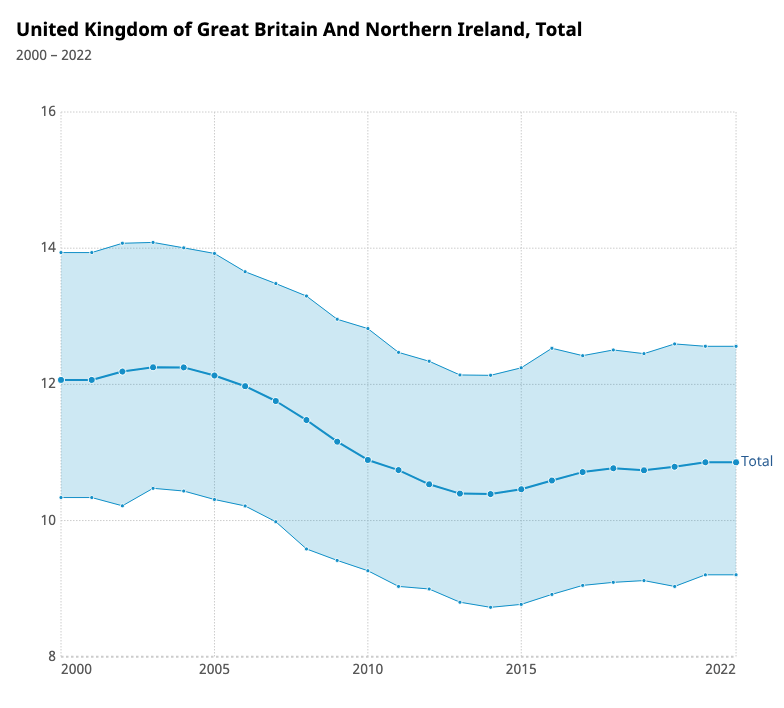
In any case, pub opening hours obviously had nothing to do with alcohol-specific deaths rising during lockdown.
NHS figures released in 2024 revealed that alcohol is 91 per cent more affordable than it was in 1987.
Nearly everything is more affordable than it was in 1987, with the notable exception of housing. That’s the whole point of economic growth. But alcohol is still less affordable than a normal basket of goods, thanks to all the taxes.
This, says Professor Angus, is mostly driven by supermarkets offering cheaper prices than pubs and bars.
‘When you compare the prices in pubs to the prices in shops, they’re on completely separate trajectories,’ he explains.
‘As alcohol became much more available in shops, it also became much cheaper, and people have shifted their drinking from pubs to home.
‘It was maybe only 30 years ago that about three quarters of the alcohol sold in the UK was drunk in pubs. Now it’s drunk at home.’
And yet we are not drinking more than we were 30 years ago.
Until well into the 20th century, many British pubs treated the public bar as a male preserve, with women often expected to sit in a separate lounge or snug and receive table service.
Although this was not a universal legal ban, pubs could still operate discriminatory policies. In 1982, the Court of Appeal ruled that London drinkery El Vino’s policy of preventing women from standing at the bar and requiring them to sit in a back room was unlawful under the Sex Discrimination Act.
Today, millions of women think nothing of describing their personality as being a ‘wine mom’ and proudly fetishise drinking prosecco at every opportunity.
Get thee to a nunnery!
‘Looking at trends in liver disease, which are very highly correlated with alcohol, they have tripled in women,’ says Professor Angus, who adds that much of this can be traced back to the 1960s.
‘Back then, drinking for women was much rarer and a bit more taboo before slowly becoming more socially acceptable.’
Not for long if these people get their way. They want to take the policy of ‘denormalisation’ that they have used with such success against smokers and apply it to drinkers. By the looks of it, they’re going to start with the ladies.
‘Drinking alcohol also started to move from being very much a thing that happens in pubs, which were very male-dominated, beery environments, to drinking at home, and wine became much more available.’
Speaking of wine, Professor Angus adds that he finds it astounding that wine is marketed so aggressively at women.
Is it?! I hardly ever see a wine advert.
None of this has got anything to do with the pandemic rise in alcohol deaths. Death rates rose among both men and women in 2020-22 but more among men than among women. Advertising had nothing to do with it either and is an irrelevance anyway. As for pricing, the ‘excess’ alcohol-specific deaths in 2020-22 were at least as bad in Scotland and Wales, which have minimum pricing, than in England, which doesn’t.
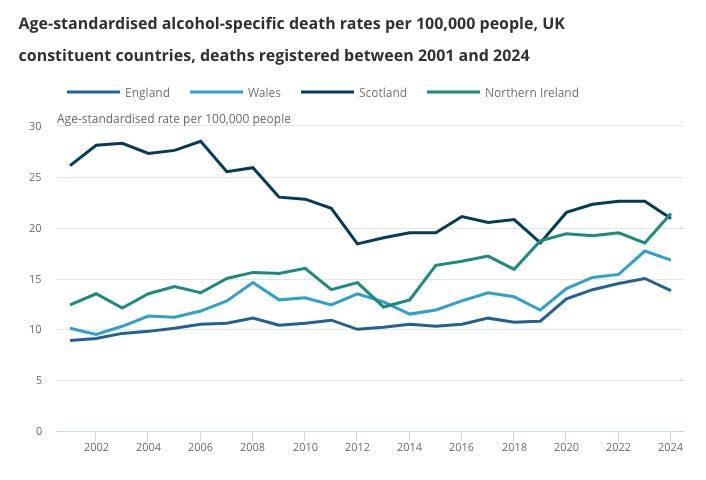
The only slight mystery is Northern Ireland where deaths have gone up and up despite there has been a big drop in the number of people drinking above the government’s ridiculous guidelines, according to this graph in the Daily Mail.
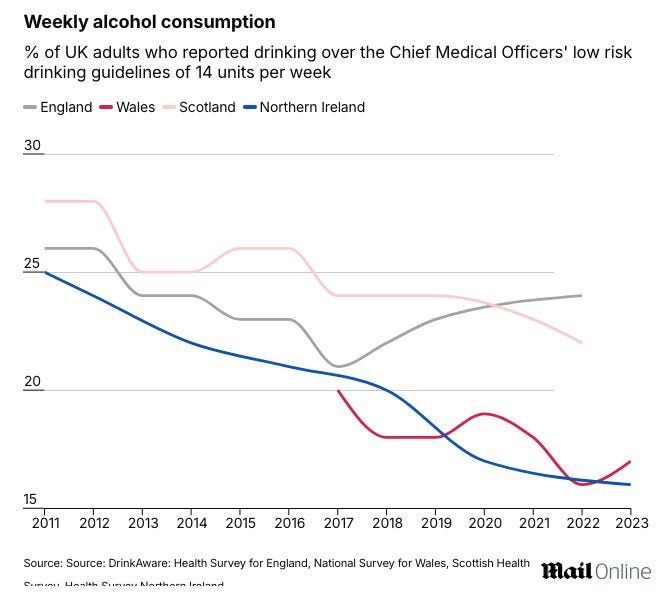
This only serves to show how fatuous the neo-temperance approach is. You’re not going to die from cirrhosis if you drink a bit more than the Chief Medical Officer tells you to. The number of people drinking within the guidelines is a poor proxy for alcohol-related harm. So too is per capita consumption, which barely changed during the pandemic despite a 40% increase in alcohol-specific deaths.
It all highlights what a farce the ‘whole population’ approach is. The lockdown surge in alcohol deaths showed that it is not the whole population that we should be concerned about. It was a relatively small minority of people who were pushed over the edge in 2020-21, not by advertising or availability but by the unintended consequences of ‘public health’ measures.
As Angus and chums say in their study…
Between 2001 and 2019, alcohol-specific deaths remained largely stable, followed by a sharp increase in 2020 and further increases in 2021 and 2022.
None of the things they are complaining to the Daily Mail about - Pub opening hours! Supermarket booze! Women’s liberation! Alcopops! - started in 2020. They go back decades. They are endemic. They cannot explain an unusual spike that occurred suddenly. That spike is worth studying because it shows how some people are susceptible to alcohol abuse when their personal circumstances are grim. It shows how effective treatment can be. But these explanations don’t suit the ‘public health’ approach and so they must be ignored in favour of the same tedious neo-prohibitionist dogma.
No posts
Comments
Nothing yet. Say the first thing.
Sign in to join the conversation.