
You wait ages for the worst quack science of the year to show up and then two contenders arrive at once.
This morning I awoke to find this on the BBC homepage:
Limiting sugar before age two linked to better brain health
Scientists have suggested eating very little sugar up to the age of two may help protect the brain decades later.
Wow, that must have been a long running study. I wonder how they did it?
The research analysed the impact of the end of sugar rationing in the UK which led to a rapid increase in the amount of sugar in people’s diets.
The results suggest those who were toddlers during sugar rationing had a 23% lower risk of dementia.
Surely there must be more to it than that. Surely they didn’t just compare rates of dementia among people born during the Second World War to those born after the Second World War and attribute any differences to sugar rationing?
Alas, that is what they did and that is all they did. The study is here and the press release is here.
This comes from the latter…
Of 15,025 who experienced sugar rationing before birth and during their first year of life, 388 developed dementia. Of 15,256 who experienced sugar rationing before birth and during their first two years of life, 456 developed dementia. Of 23,774 born after sugar rationing, 504 developed dementia.
How very scientific! But why sugar rationing? Why not meat rationing? Why not flour fortification (1941)? Why not anything else that happened in the next 80 years? One might just as well claim that being bombed early in life reduces the risk of dementia. That would make more sense than “experiencing sugar rationing before birth”, whatever that means.
(Update: As a reader pointed out to me via e-mail, the figures above indicate a rate of 2.6% for the first cohort, 2.5% for the second cohort and 2.1% for the last cohort, thereby suggesting a decline in dementia rates after sugar rationing was abolished. The claim that rates rose is based on adjusted data.)
Even the BBC has to admit that this is not slam-dunk evidence…
The study cannot provide definitive proof, but experts say a healthy diet is good for the brain anyway.
That’s the spirit! Who cares if the media is flooded with garbage so long as it sends the right message?
"They may be onto something," said Rachel Richardson, the methods support unit lead for evidence production and methods directorate at Cochrane, an independent non-profit network that gathers and summarises medical research.
Archie Cochrane must be spinning in his grave.
No sooner had I finished reading that article (which, unusually for the Beeb, doesn’t conclude with some gobshite from Action on Sugar demanding more regulation) than I saw a tweet from the journalist Gareth Corfield alerting me to some exciting news from the vibrant field of gambling research.
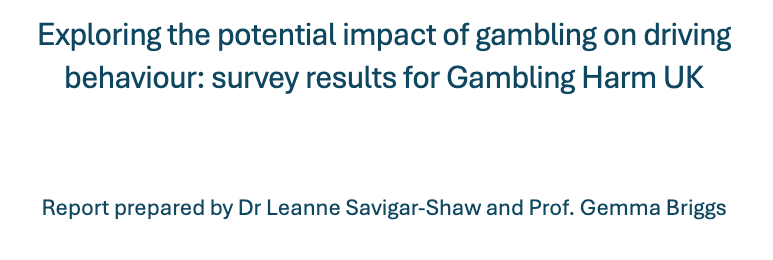
According to an unpublished study commissioned by Gambling Harm UK, there are “around 3.71 million drivers [who] could have, at some point, gambled or thought about gambling while driving.” A terrifying statistic, I think you’ll agree, but it gets worse. There are 1.06 million motorists in Britain who have driven “while feeling tired as a result of gambling” and there have been “530,000 collisions where gambling may have contributed to the collision” (timeframe unspecified).
To deal with this hidden epidemic of gambling-related car crashes, Gambling Harm UK is calling on the government to “Commission urgent independent research into gambling harm and road safety, “Ask the Department for Transport to review collision investigation guidance” and “Establish a cross-government taskforce”. This all sounds rather expensive and it is unclear what it would achieve, but the big message is that gambling is not just a ‘public health’ issue but a public safety issue.
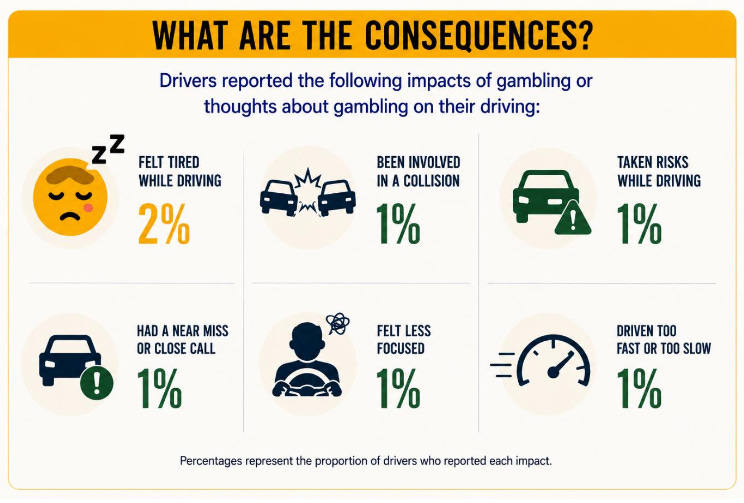
The study is entirely based on a YouGov survey of 5,639 motorists, a tiny proportion of whom claim to have ever felt distracted, excited or anxious about gambling while driving. The supposedly negative effects of gambling are self-reported and never exceed 2% of the sample. Competent social scientists treat such small numbers with extreme caution because every survey will have a few people who don’t understand the question, answer at random or are simply being mischievous. Instead, the authors extrapolate wildly. Since 1% of respondents claimed to have been in a collision that involved thoughts of gambling, they assert that 530,000 car crashes have resulted from gambling.
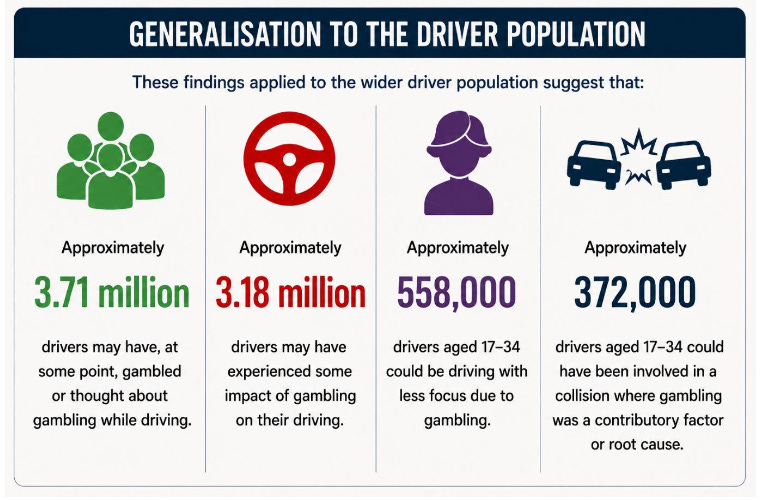
Strangely, there were more people in the survey claiming to have been distracted at the wheel by worries about somebody else’s gambling than about their own. The authors inevitably interpret this as meaning that “around 2.12 million drivers could have, at some point, experienced some impact on their driving behaviour resulting from concern.” Perhaps the solution lies in getting people to chill out about gambling and understand that it is an enjoyable and normal leisure activity?
This is preposterous stuff, but we can expect more junk science like this now that anti-gambling research is being funded to the tune of £20 million a year via the gambling levy. Gambling Harm UK - has already received £1,248,620 from the levy.
No posts
Comments
Nothing yet. Say the first thing.
Sign in to join the conversation.