
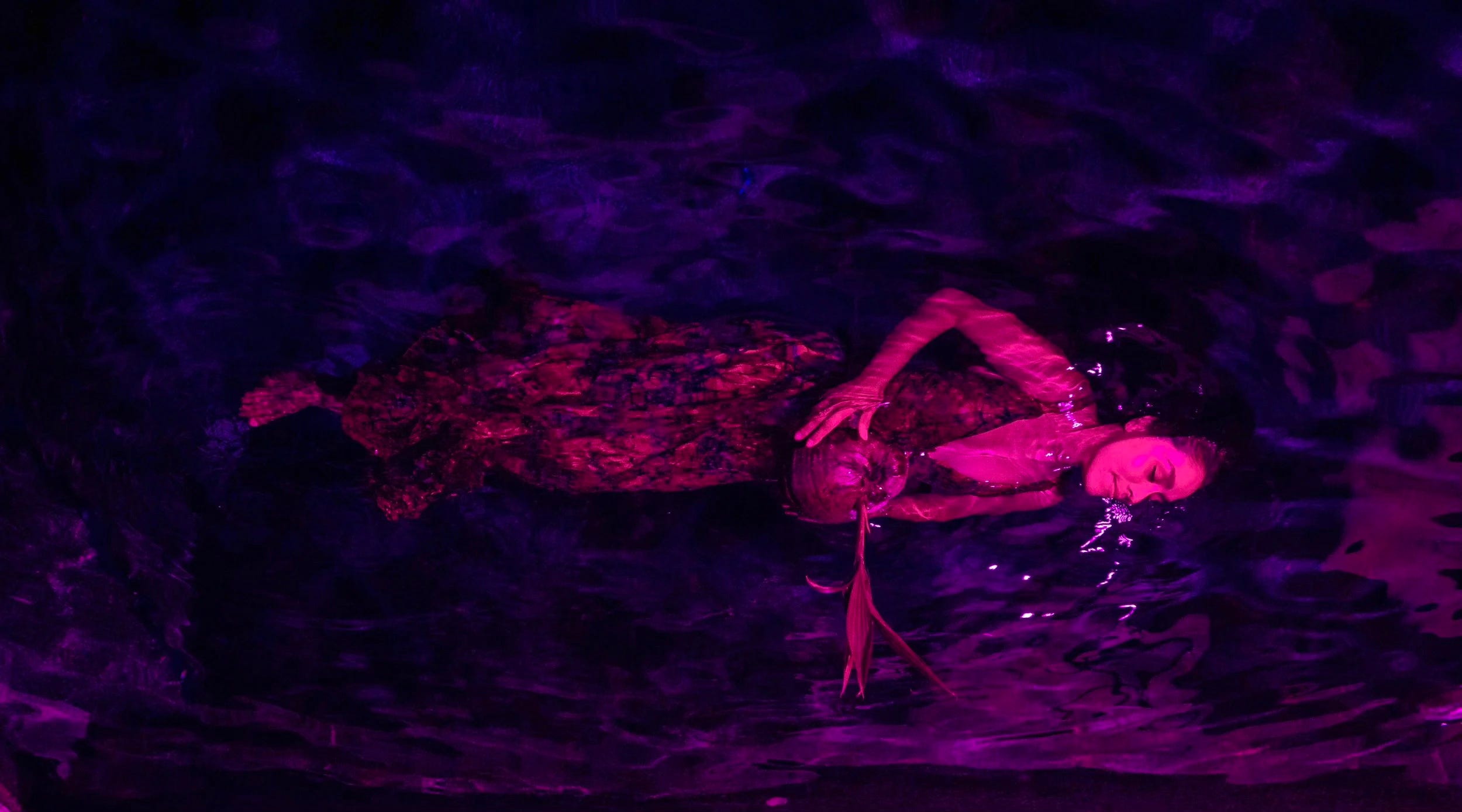
There’s a moment in this conversation where Priscilla Aleman describes writing a poem on an archival bag while working on a burial site—“Brushing the dirt off your teeth, site D102.” It’s a small detail, almost incidental, but it reveals something essential. Even then, archaeology wasn’t just about uncovering the past—it was already edging toward something more instinctive, more personal, more alive.
Aleman’s practice sits in that space between excavation and creation. Trained at Cooper Union and shaped by her time working with Miami-Dade archaeologist Robert Carr, she approaches materials with a rare kind of sensitivity—one that honours both scientific rigor and emotional connection. What emerges is a body of work that leads us to a series of encounters: plaster casts that read as acts of care, installations that behave like ecosystems, and performances that blur into sculpture.
The body is her starting point, whether she’s casting a loved one, building fountains that double as portals, or working with rainwater, coffee grounds, and CD fragments, there’s a sense that everything is in relation.
Music, movement, and ritual thread through it all. Drawing on her Colombian-Cuban heritage, diasporic memory, and what she calls ‘metaphysical ecologies’, a sports field becomes a sacred threshold; her studio, a living garden, nothing is too small or too ordinary to carry meaning.
At the end of our conversation, Priscilla heads off to Home Depot to pick up moss and support beams. It’s a practical errand, but it perfectly demonstrates her approach. That easy shift—from the metaphysical to the everyday, from cosmic thinking to home store runs. The same world, just viewed from a different angle.
You’ve worked in the world of archaeology. Can you talk me through this? At what point did the act of finding artifacts transform into the need to create them?
I’ve always had an interest in science, my mom is in the medical field, and my dad was a civil engineer. I was homeschooled for many years, surrounded by books and spent a lot of time in museums or libraries. From an early age I was tuned to be in research mode from the world around me. I was always looking into systems and how things work in relation to each other, and also how I am part of it all.
‘The body is my entry point into how to create, how I feel in it, how I move, how I sense the world around me’
After my studies at Cooper Union I began working with Robert Carr, the former Miami-Dade County archaeologist, on ancient burial grounds. I learned a lot about the methodologies in this field, and would also reflect on what it means to handle these sensitive materials, and how one navigates this with deep care. Over time I would start to get creative with these systems as a way to resolve these big questions, and as a way to imbue back the humanity and ethos in this work. I would write a poem on the corner of archival bags like ‘Brushing the dirt off your teeth, site D102’.
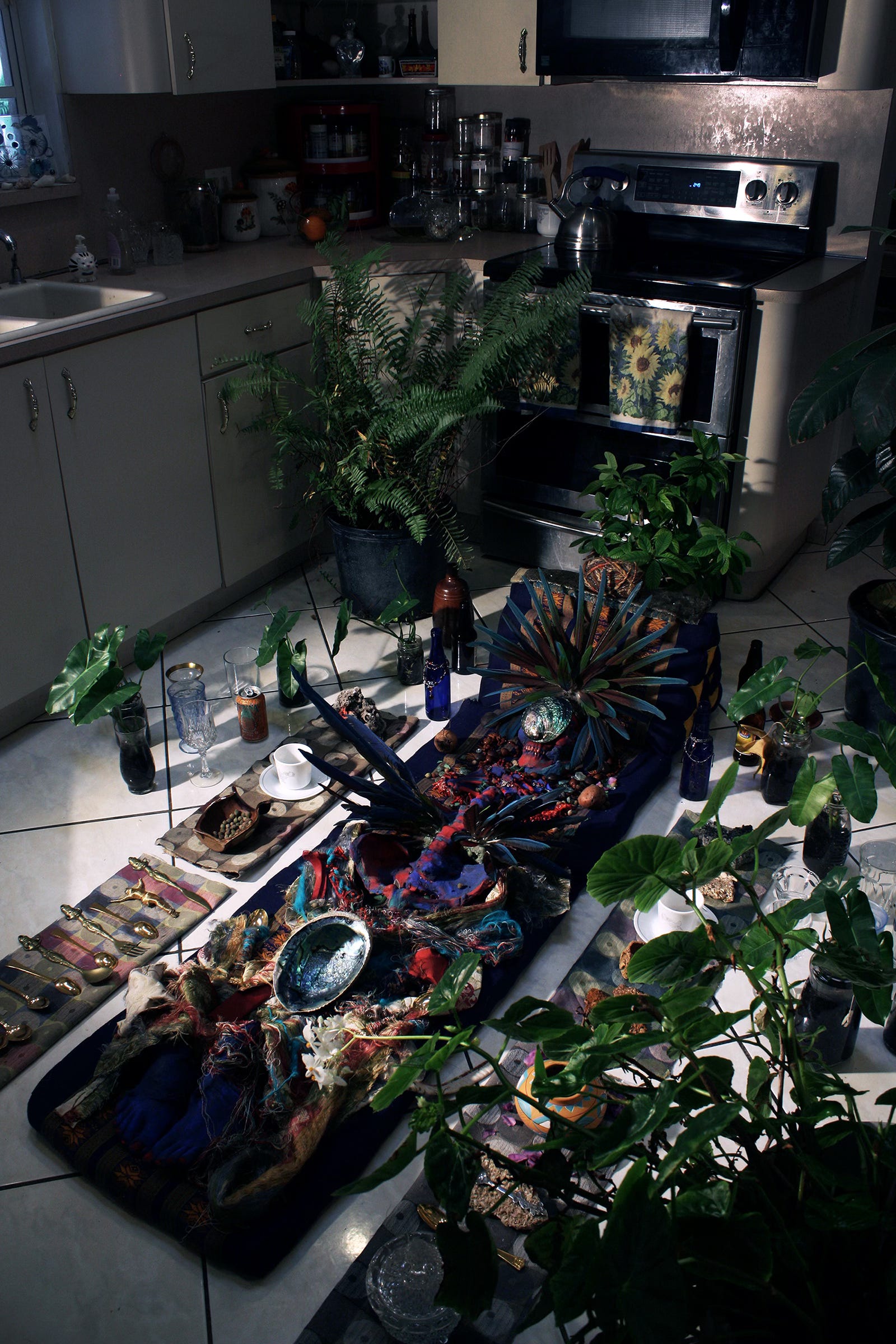
I then began looking at specific burial sites like the Tomb of the Red Queen in Mexico. She is visually stunning, her bones are covered in red cinnabar with turquoise beadwork strung across the body. I was inspired to recreate her burial scene in my kitchen using casts for bones but thinking about it as if it was someone I knew and loved personally like my grandmother. This shifted how I handled the materials, it became a practice of the heart, a feeling of being connected. This practice instilled the type of sculpture work I make, where material is so much more than just an object, its presence and energy.
How do you approach a new project or commission? Could you walk me through your creative process?
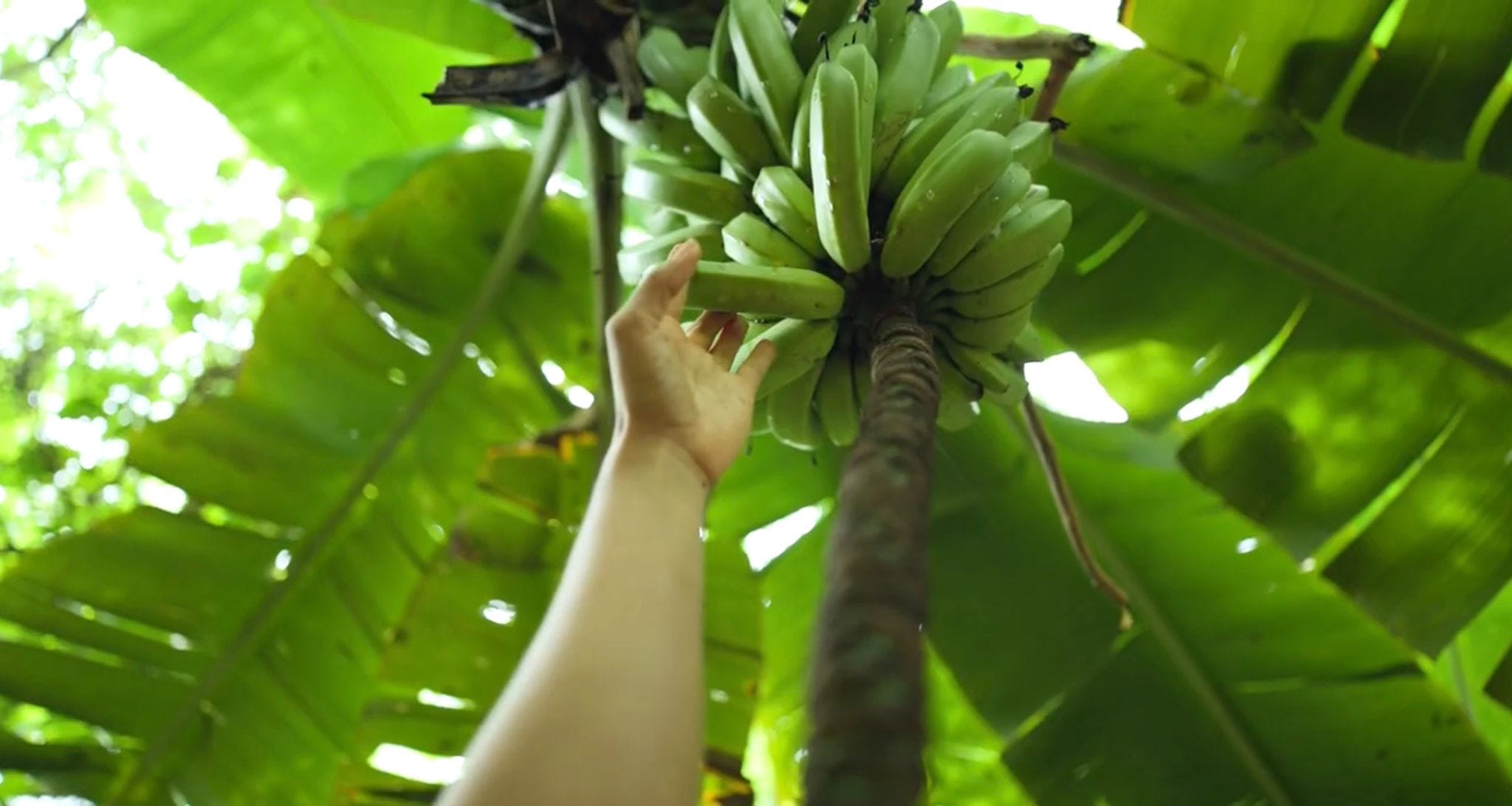
My process is multifold. Currently I’m working with the National Tropical Botanical Garden, the Kampong, thinking about how sculpture can engage with the landscape and grow with it. I’m very green-thumbed so it’s the perfect location for me—I’m engaging with the tropical plants here and the stories they carry. I am creating a performative film that taps into these deep Caribbean histories, and the installation will operate as a portal into the metaphysical realms of the garden. Water is a conduit for these kinds of experiences and for growth in the garden, with this I am creating sculptural fountains that utilize innovative irrigation systems.
You’ve described the body as a ‘vessel for the worlds we bring’. When you are layering plaster onto a friend or family member, do you feel you are capturing a person, or are you capturing a piece of a larger, collective diasporic memory?
My mom in many of my sculptures is the one who helps me body cast—the formed plaster casts in sculptural terms are called mother molds— it’s a fitting analogy for a beautiful exchange in creation and regeneration. I feel as if in these moments and processes I capture the natural world and the cosmos.
When I’m casting a portrait of myself, a friend, or family member, I like the notion that we’re not just one person, we’re actually the emergence of a community. I also see plaster casting as a form of a baptism, totally immersing the body in water and plaster that cleanses, brings grounding presence, or marks a transformation.
Casting these moments is a way of remembering. The body of work that I’m making called Sketches from the New World, considers these moments as a new world where one feels a sense of transcendence or understanding of all these ecological and cosmic alignments.
‘I call them metaphysical ecologies, a constellation of moments connecting environment, consciousness, and the sublime ’
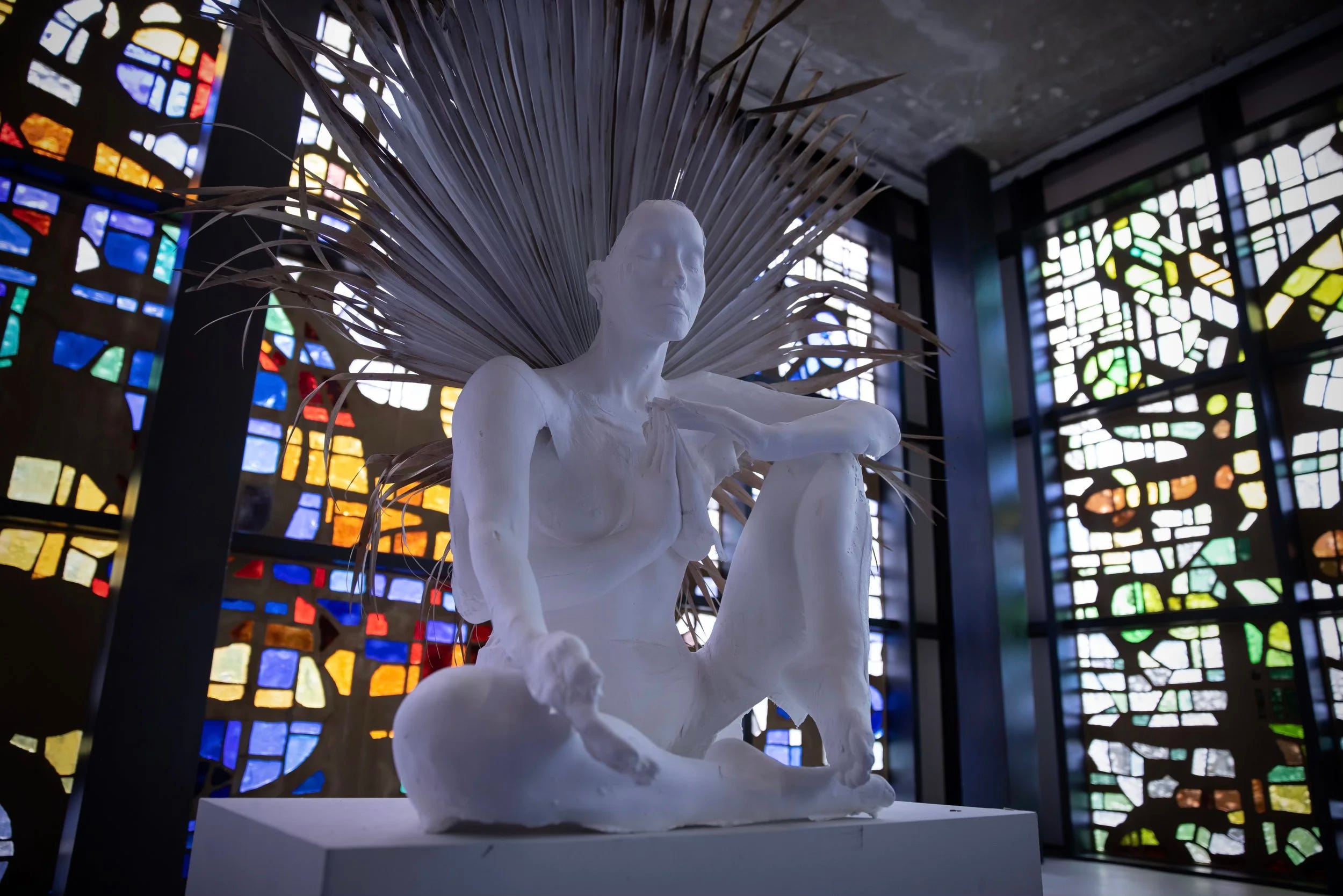
Your materials list reads like a poem! Rainwater, makeup concealer, ipods, CD fragments, coffee grounds and banana leaves. Why is it important for you to use ‘accessible’ or ‘found’ materials?
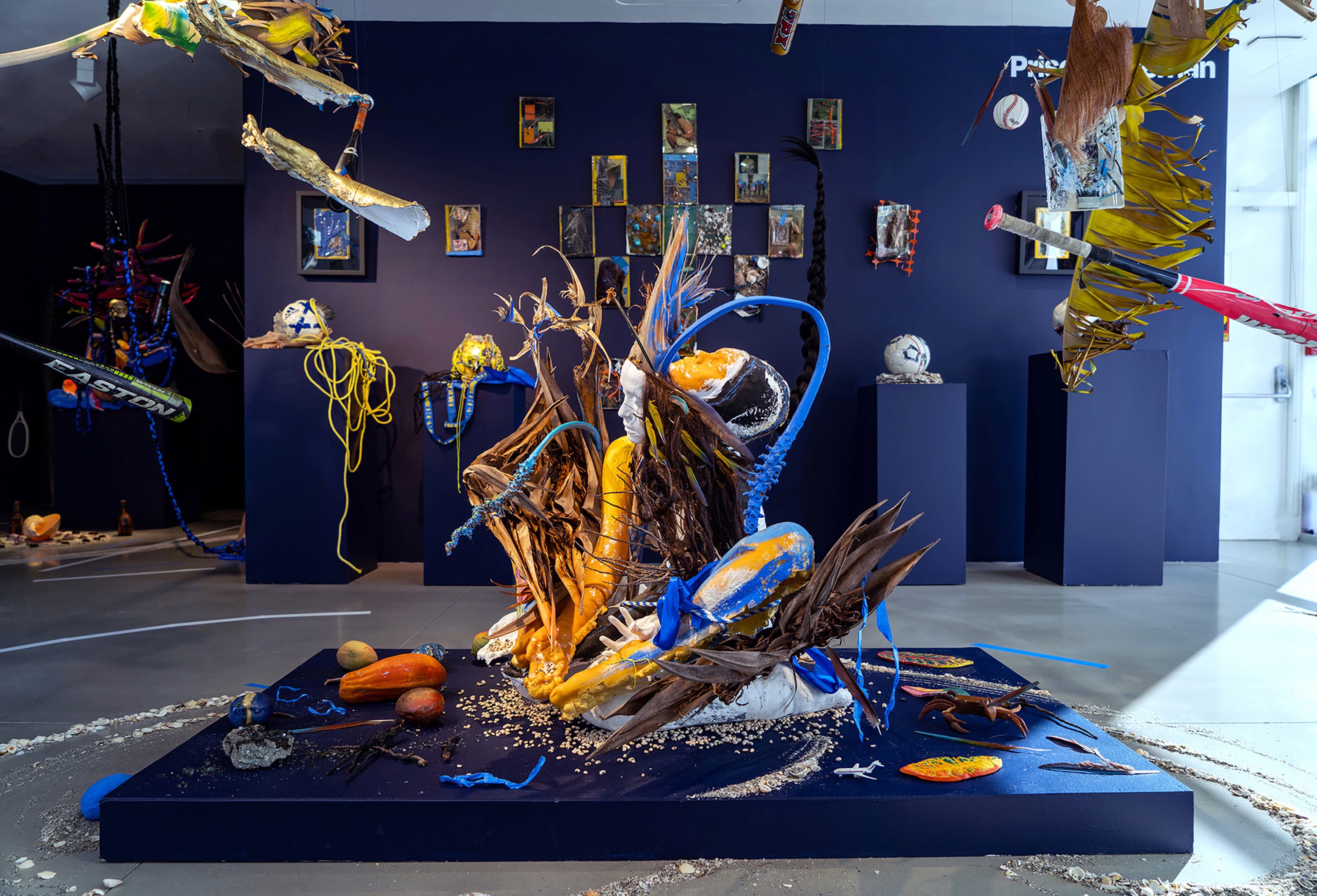
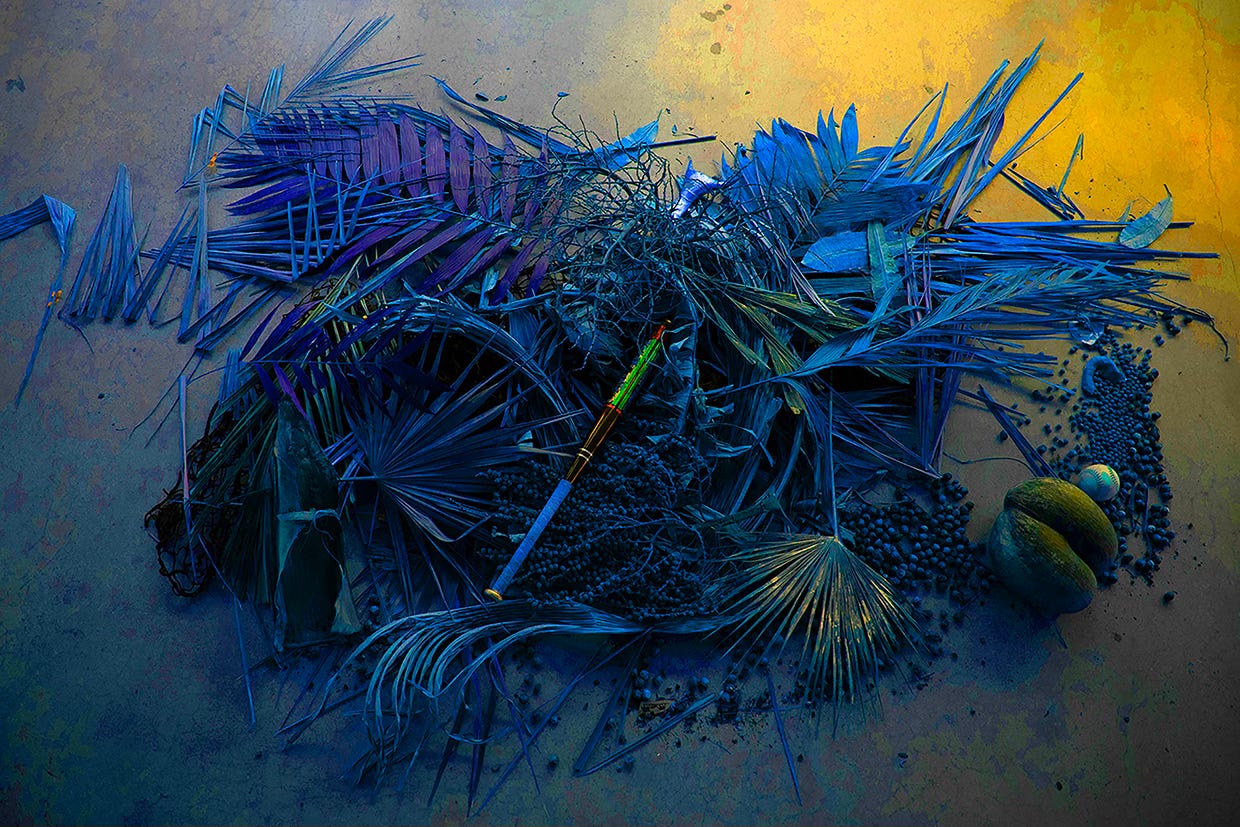
I work with a lot of resourced materials, everything from organic to synthetic. The way that things work in my studio is a lot like composting and gardening. I let the leaves fall where they may—whether they’re literal leaves, pages from a National Geographic magazine or ceramics fruits I have cast.
They’re intentional ‘messes’—these materials mingle and I watch for the relationships, everything is part of the installation. If it’s a brush or a rubber band or a ceramic seed, I start seeing the map of things coming into being, plants growing, constellations forming. Color is a really important key for connecting all these relationships and creating movement with the eyes.
Do you always make a point of trying to use found items?
Materials are found, resourced, or it finds me. Coffee for example, we all use it one way or another daily, whether it’s just for drinking or used for fertilizing the earth. I take what seems normal and sort of invisible in the everyday and recognize that it holds so much more. Coffee is something you drink, or in caribbean practices it’s a material that not just nourishes the landscape but it also protects you and gives you another way of sensing spirits and ancestors.
There is this spectrum of engagement where a utilitarian material becomes elevated to something that is of great value. This shift in appreciation and respect of materials is where the magic happens for me, it’s a new way to see the universe in front of you.
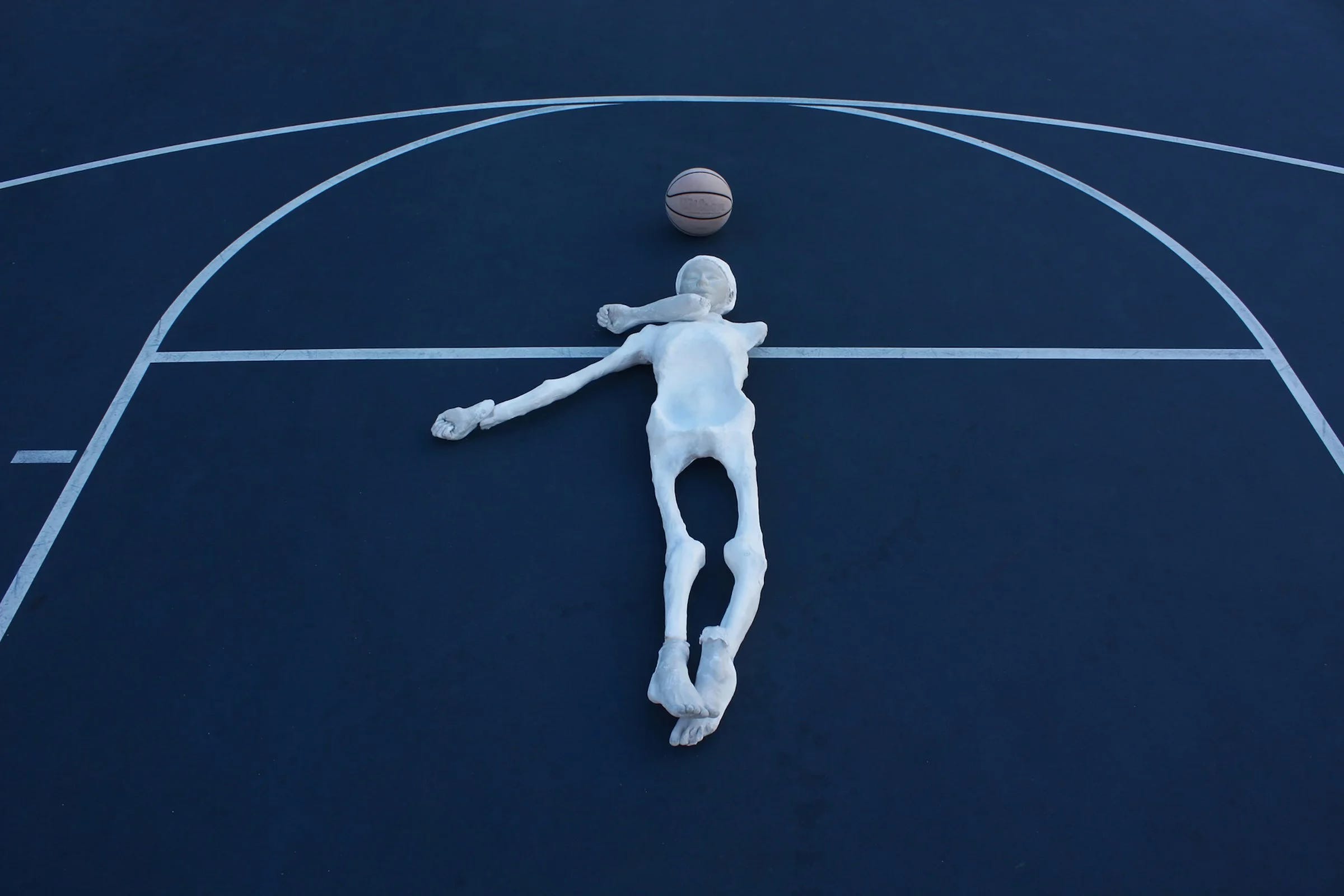
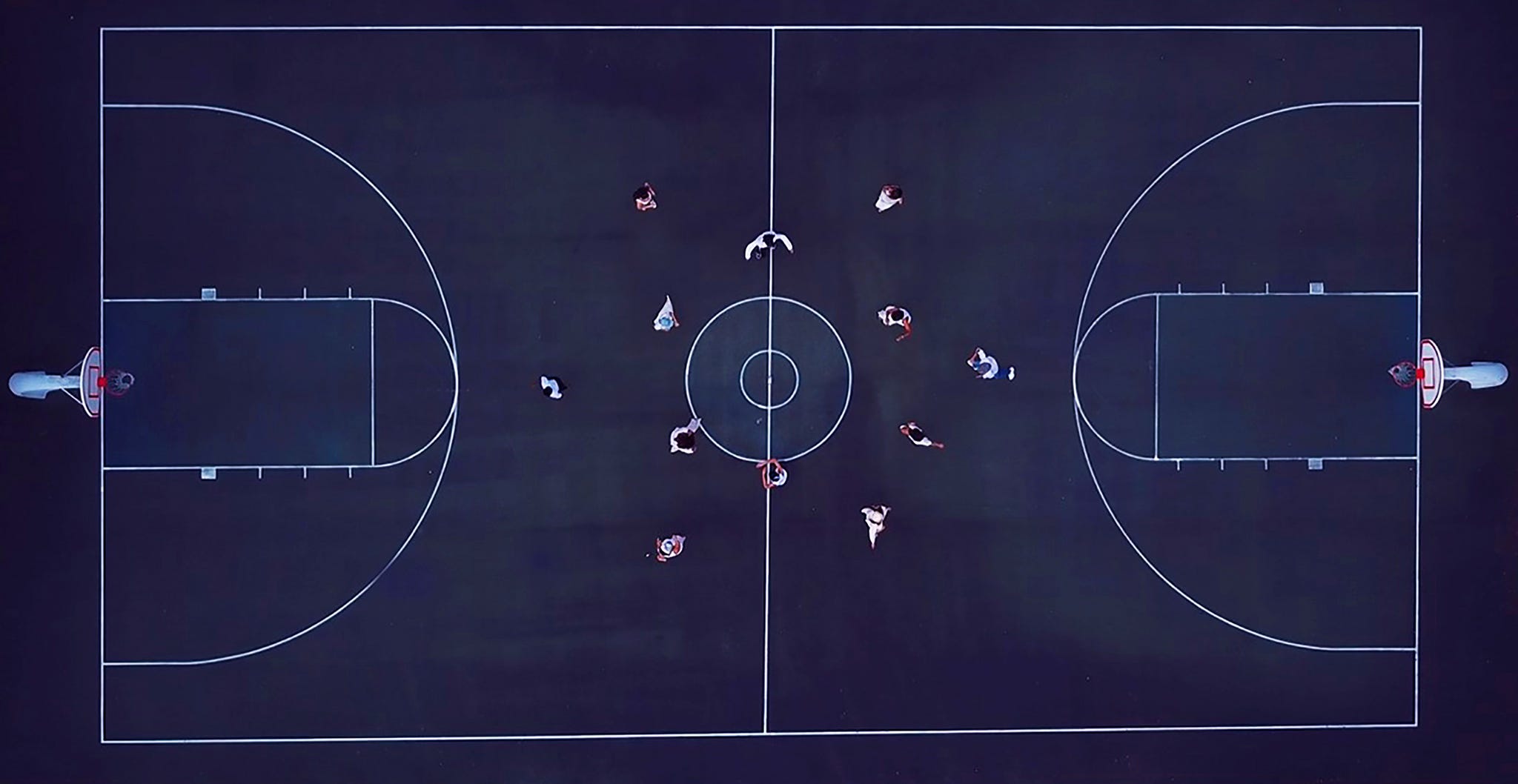
You’ve noted that sports fields are ‘portals of thresholds’. What makes the stadium a sacred space?
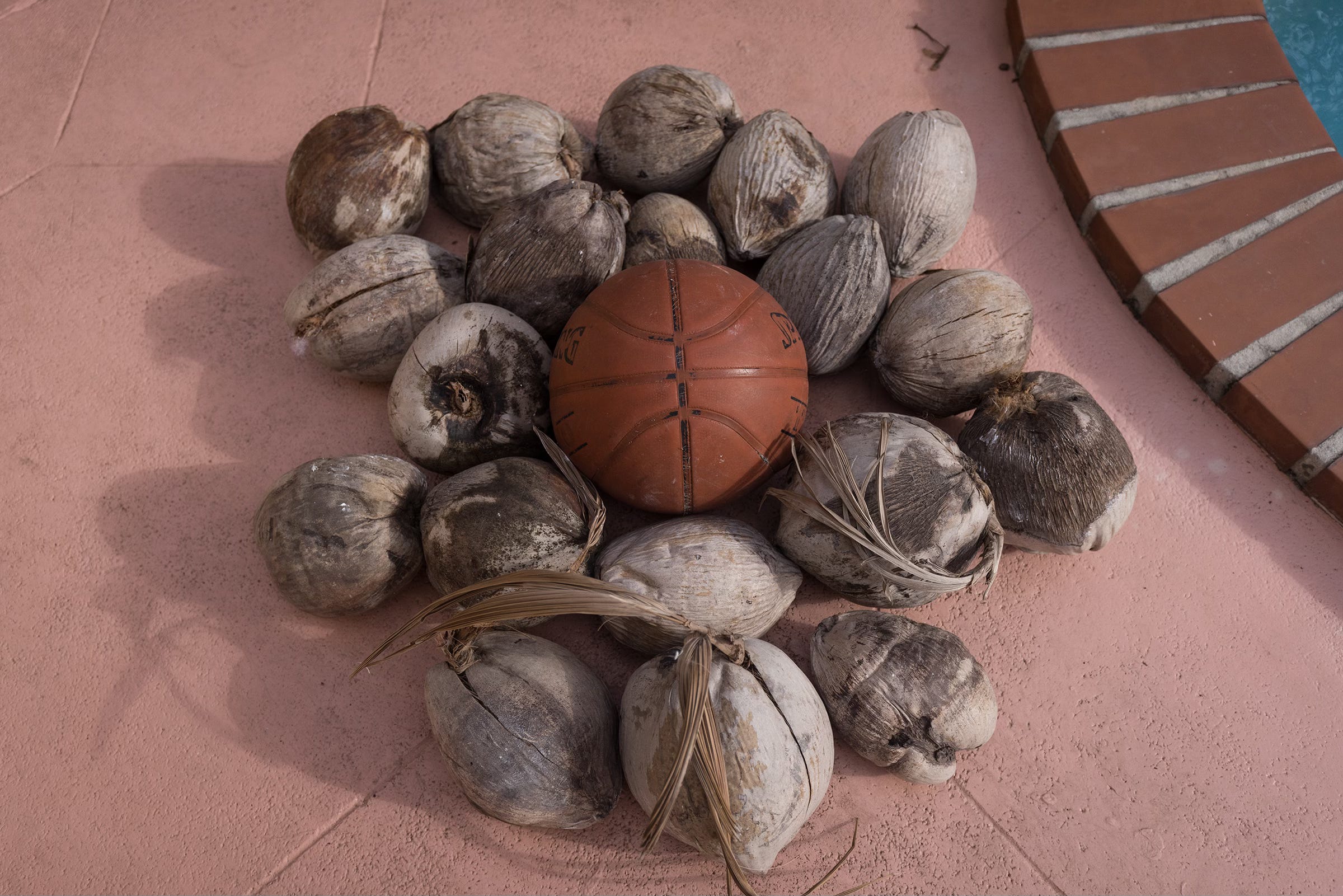
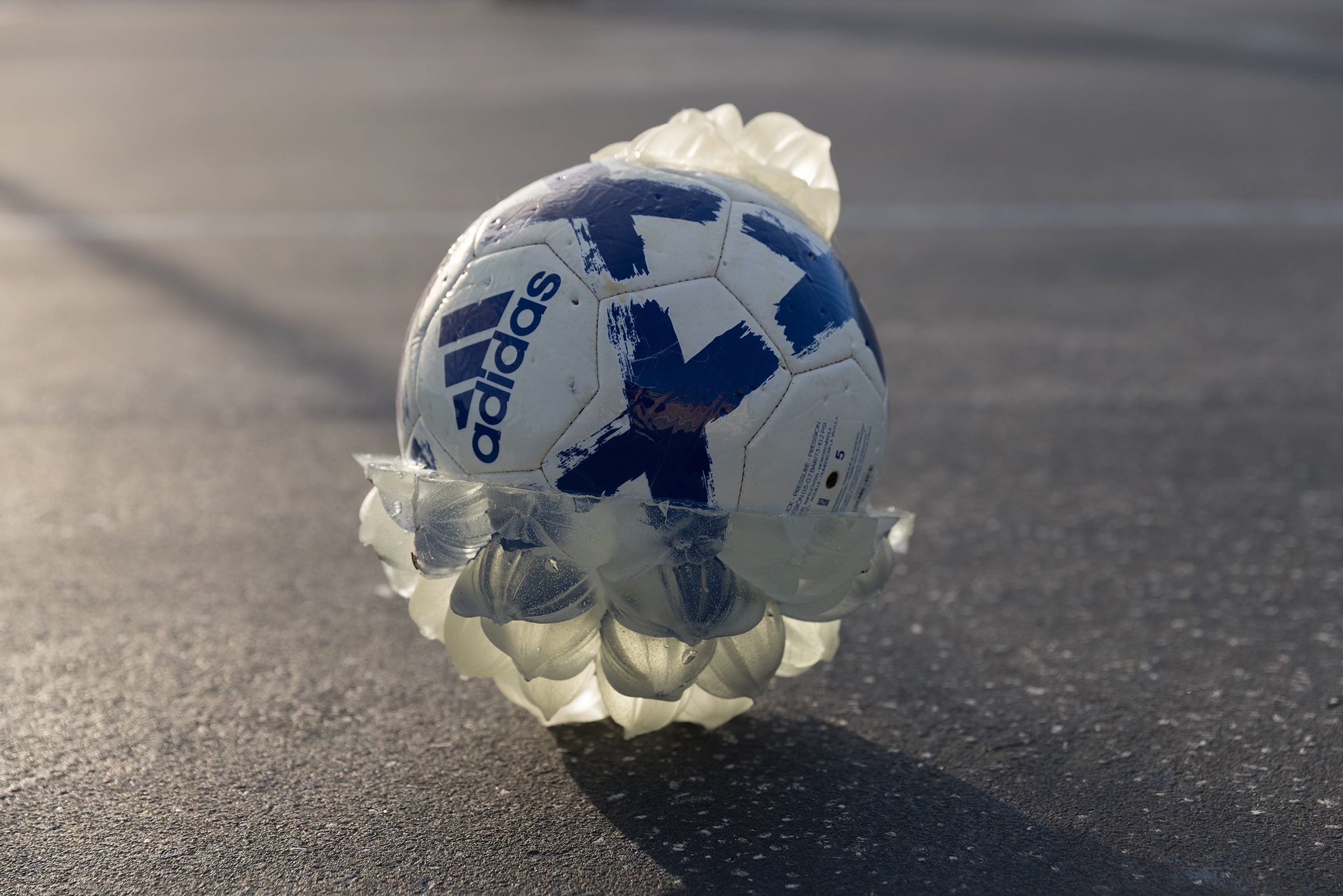
The Ball Game originates from the Olmecs, where the sports field is a cosmic plane and the ball represents the sun, the life force that moves through the cosmos. This field is the threshold where the Gods and the humans get to play, where the origins of the universe came into being and is navigated through order and chaos. To this day we still play sports, and I see the influence these fields play in our daily lives. The field or stadium is an architecture of resonance, the audience and the athletes are all present in the moment. If someone gets hit, or if someone makes the shot, we all feel the ascension or the fall. I think it’s such a human and spiritual experience.
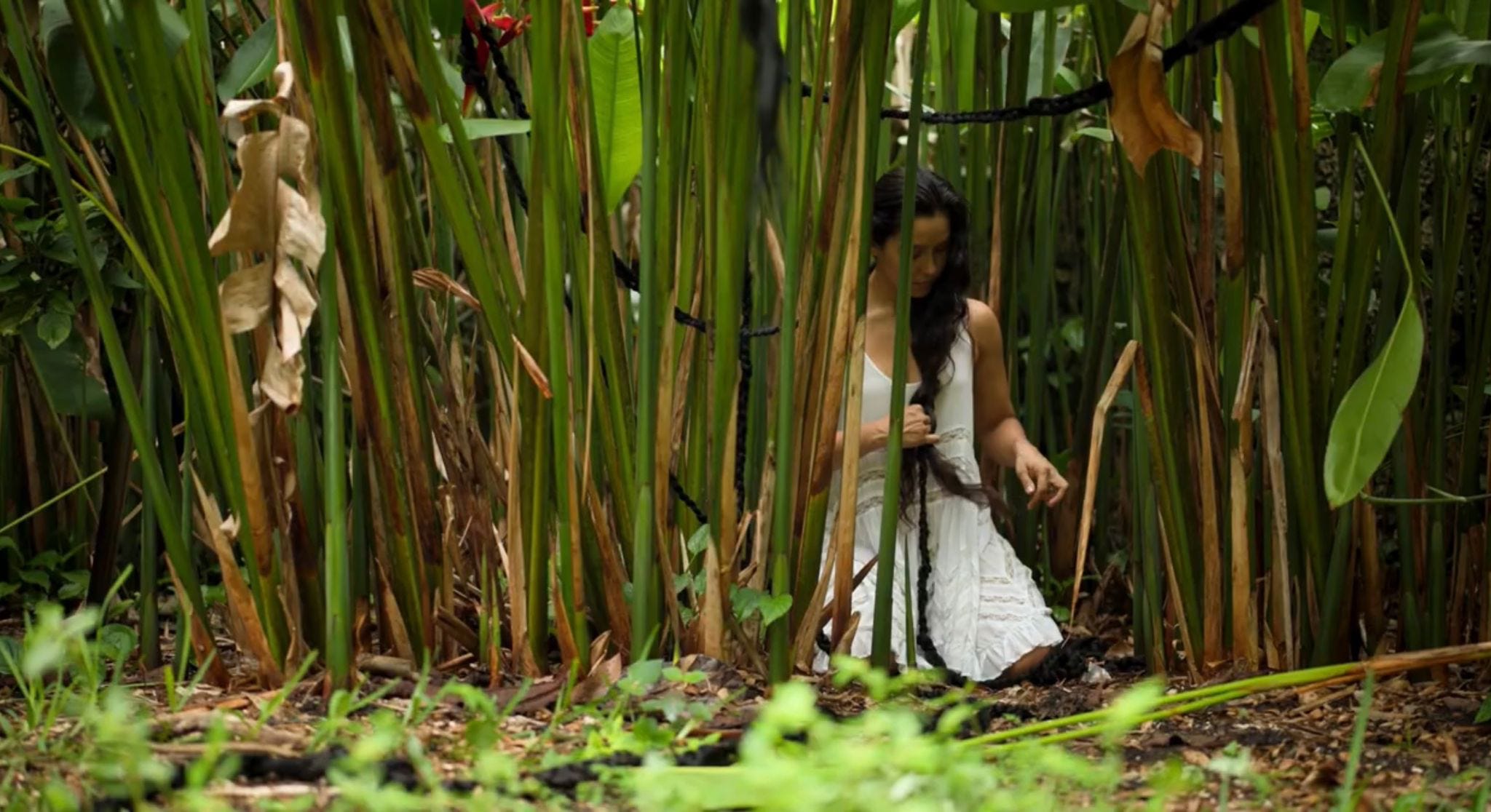
Music seems to be so essential to your practice and your performances. Is it another way of storytelling and pulling history into the present?
Music is transportive, I feel present, at home and in body. I’m always listening to music either on my iPod, CDs, the radio or in my mind—lately I love sourcing music on NTS and I’m currently listening to ‘Rum Punch with Danny Fitzgerald & Bonito y Sabroso’. When I’m dancing I tap into the stories and characters, music is embodied, and many times these experiences become a new sculpture or a performance.
Beyond sculpture, you are a filmmaker and a choreographer. Do you see your installations as ‘frozen performances’?
I would see them more as an embodiment of that moment, nothing has really truly stopped, stillness in itself is a form of movement or activation, it’s a moment that is part of something bigger.
In your Collectibles work, you encased National Geographic magazines in resin. Can you tell me about that project? What was it you felt the need to conceal or preserve within those pages?
I grew up with a lot of these magazines in the house, going through the pages and feeling inspired about all these worlds and textures it brought to our living room. While I was in grad school at Columbia I started laying them all on the studio floor, ripping and tearing them apart, putting objects on them as placeholders, note taking, using paper clips, tape, each one a thinking place, a meditation into a dream world. National Geographic is a text with a double nature to it.
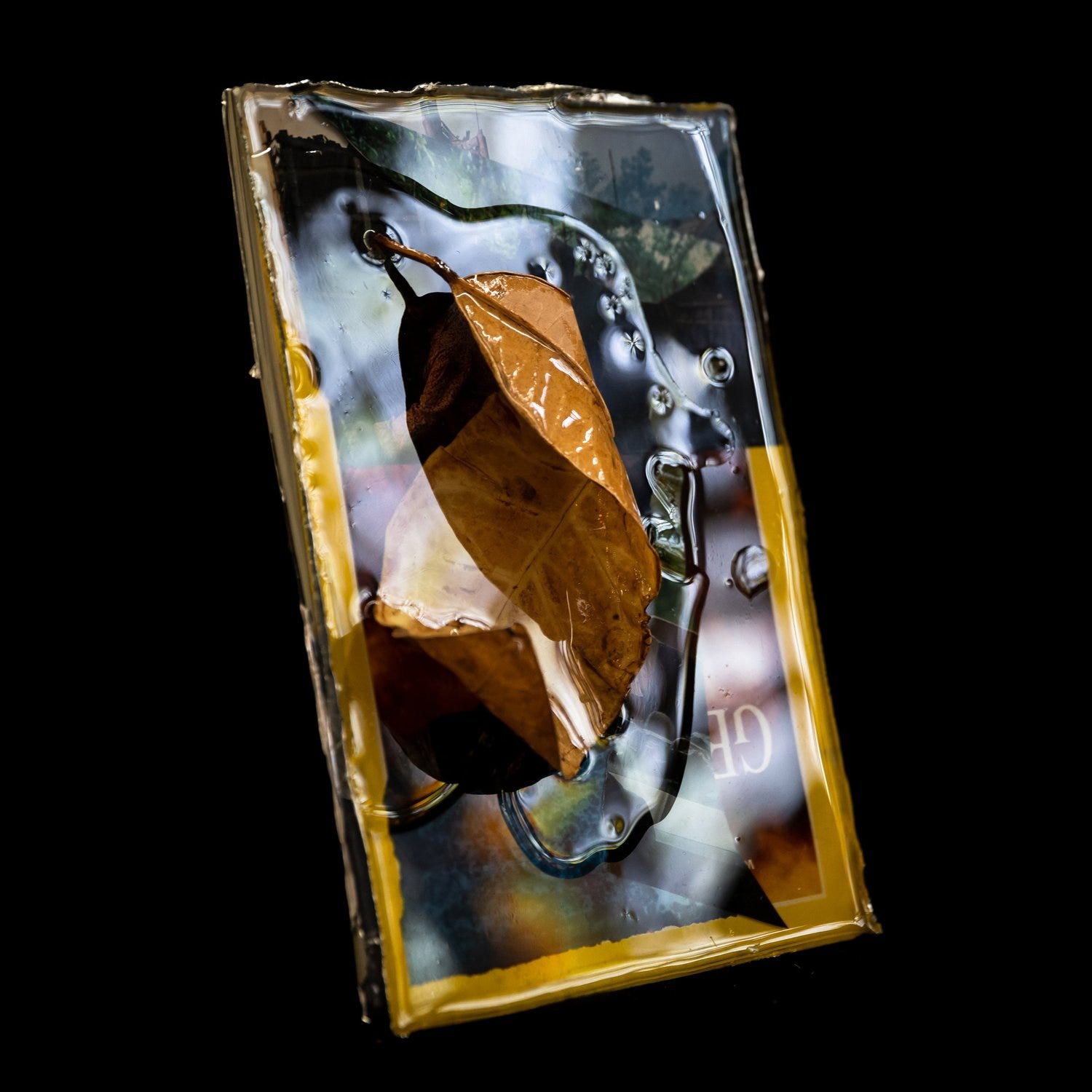
Much like when I worked in archaeology I thought deeply about how I handle these materials with care, or even love. So I allowed them to be dream spaces, letting whatever comes up, come up. Some pieces are loaded and heavy, others are more playful and color coded, I am always surprised with what new readings come through. I started pouring resin onto them to preserve those moments.
You use the ocean as an analogy for transformation—is the water in your work a barrier to be crossed, or a bridge between the Old and New Worlds?
I like thinking about the ocean as something between continents, between worlds, a place with depth, another realm, it’s a place where one can experience total immersion with all that is familiar and unfamiliar. Since I’ve started diving more and being underwater my sense and awareness of space and even time has shifted.
I think next life I’m coming back as a whale!
Has your work with the legendary Wangechi Mutu informed your own practice?
It started as a dream. In high school, I had an incredible art teacher and someone who is still my friend, Westen Charles, and in class one day he was talking about Wangechi’s work. I looked up her books in the school library and was immediately entranced by the drawings and sculptures she was making at the time. I related to the figurations, the body, the contrapposto, the cutting and pasting of the national geographics. She held viscerality and beauty and repulsion, all of it. As a 15-year-old, I was like, I love this!
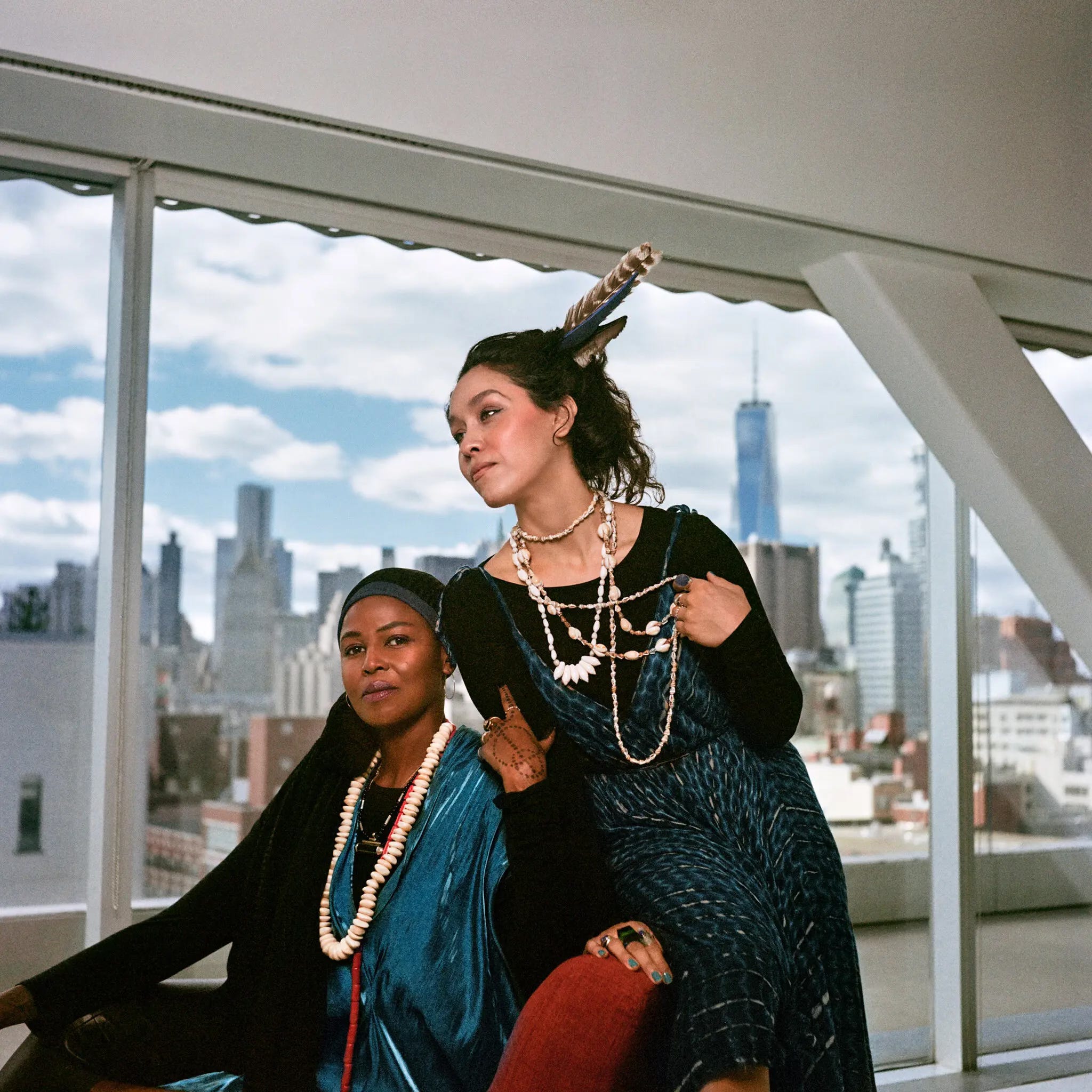
Later on when I went to school at Cooper Union, I had the opportunity to work with her as a studio assistant—we just clicked. I worked with her for over six years, watching how she orchestrated her studio and cultivated ideas had a huge influence on my work and how I take my practice seriously.
What are some of the biggest challenges you face as an artist, and how do you overcome them?
I think it’s just keep going. There’s a certain kind of faith and vision one has to have in their work and trusting that that idea is being fostered and growing. A lot of my art practice comes from gardening and growing things from seeds, there’s trust in that process, and patience too. It’s the same with projects which come from the seed of an idea, you just keep watering it and giving it the right atmosphere. Sometimes you wear many hats as an artist. Learning how to work with others I think is key when it comes to the bigger projects. That’s what allows for expansion.
What advice would you give to emerging artists trying to establish themselves in the art world?
Build your network, it could be just two or three people, but when you start collaborating with others, it really opens things up.
Are there any upcoming projects or collaborations that you’re excited about?
Yes, I have large-scale outdoor sculpture works coming up at The Kampong in Miami. That one’s a bun in the oven! We are projected to launch this project in the late fall and I’m excited. Most of the programming will be activated in early 2027.
Where can people see and buy your work?
Here in my studio, both in Miami and New York. I also have a website and Instagram account where people can see my work. Pricing is available upon request.
Thank you Priscilla. Where are you off to next?
I need to go to Home Depot and get moss and support beams!
CONTACT AND INFO:
Website: www.priscilla-aleman.com
Instagram: @priscillaaleman.studio
Email: alemanpriscilla@gmail.com
New York Times article: Wangechi Mutu and Priscilla Aleman
https://www.nytimes.com/2023/04/20/t-magazine/wangechi-mutu-priscilla-aleman.html
Listen to Priscilla’s studio playlist: Rum Punch with Danny Fitzgerald & Bonito y Sabroso
No posts
Comments
Nothing yet. Say the first thing.
Sign in to join the conversation.