
When I was 21, my mother flew out with me from Boston to help set up my first apartment in West LA. I was two months out of college, and so sure of what was coming next that I’d spent spring break of my senior year flying back and forth across the country to find an apartment. My mother hung curtains, organized my kitchen, and ate burgers with me on the floor before I had a dining room table. And then, the day before she left, we went to see Toy Story 3.
If you haven’t seen it, what’s wrong with you? it’s a movie about growing up and saying goodbye, and I don’t recommend watching it with your mother directly before she gets on a plane and leaves you alone in a city you don’t understand yet, unless you would like to feel that the moment you’ve been waiting for your whole life might also be the thing that breaks your heart. We sat in the dark and cried the fat, wet tears of two people who knew a chapter was ending. Somewhere nearby, a child was watching the same movie and having a perfectly nice time.
Sixteen years later, I’m writing this from the same city, and we are leaving it. My husband, my two-and-a-half-year-old son, my fourteen-year-old dog and I are moving to Paris for a few years. My husband has French citizenship, I have a Duolingo app I’m actively losing a war against, and we are doing what so many people in Los Angeles seem to be doing lately: saying goodbye.
I was born in Los Angeles. My father was in the entertainment industry, but he was starting to burn out by the time I came along, and he and my mom decided to move us to Boston when I was 5. I understand that move a lot better now than I did then. This city and this industry can wear people down, especially as dreams evolve, change, or slip out of grasp.
I didn't know that yet at twenty-one. What I knew, or thought I knew, was that I was going to be an actress. I'd been hip-pocketed by an agency in New York during college and sent out on Broadway auditions, which taught me the single most useful thing I'd ever learn about myself: I could not survive rejection as an actress. Every "no" translated into something is wrong with your face, your body, your personality, you as a person — and I didn’t have the constitution to live like that. But rejection of my writing felt oh-so-slightly less personal (while still somewhat devastating, obvi). So somewhere in that last year of college I swapped one impossible dream for another. I wasn't going to audition for the leading lady; I was going to write her. And the place to do that, I knew, was Hollywood.
A dear family friend got me a job in the mailroom of a top-five talent agency, and that's where my new life began. It was my entertainment-industry graduate school, teaching me the business from the ground up — a job where I did things like answer phones and fight with my coworkers over who got to greet Ghostface Killah in the lobby and walk him to the conference room — and it handed me a group of friends who, sixteen years later, are my family in every way except biological. We trauma-bonded hard and hung out on weeknights, on weekends, on a friend’s rooftop in Venice, dragging girlfriends and boyfriends into the fray until it was one big sprawling family. We went to each other’s birthdays, each other’s weddings. We took trips together. Now our children play together, and I look at them and think: this is what I was actually building, back when I thought I was just answering phones.
A few specific agency memories:
A mailroom salary, in that particular window of time, could still pay your rent in Los Angeles, which feels now like a folk tale I’ll tell my son.
Holiday parties would get a little out of control, and the next morning staff meetings would somehow turn into a recap of who had hooked up with whom. One woman had recently started as an agent, got wasted at the party, hooked up with an assistant, and was so humiliated by the resulting gossip she left a week or two later.
There were bagel Fridays, until one guy complained that bagel Fridays were "too Jewish" and lobbied for donuts instead.
There was a bar cart in every office, because it was universally understood that the day might require one.
Accidentally hitting Reply All to a company-wide email about gaining Stockard Channing as a client, writing a Grease joke, clicking send, and then getting about a hundred phone calls and messages within fifteen seconds. I’m shocked I wasn’t fired.
There was a very offputting HR woman who ran our trainings who was inexplicably obsessed with Nestor Carbonell.
There were industry-wide assistant beer pong tournaments at the Parlor (RIP).
One time, when a client's movie was about to bomb, the agency bought tickets for every single employee and more or less shut the whole place down for a day so we could all show up and pad the opening-weekend numbers ourselves.
We went to the Crescent — a hotel bar across from our office in Beverly Hills — nearly every night, and the bartenders knew exactly how little we made and plied us with free drinks accordingly.
One of my bosses did cocaine at the office regularly enough that his colleagues had a code for it — "team meeting" — and I didn't understand what that meant until I noticed he kept coming back from their offices red-faced, vibrating, and ready to roll calls at a hundred miles an hour. This same boss asked me to smoke a joint with him on our lunch break, drove us to his nearby apartment, and let me walk in on a used condom lying on his floor. I decided right there that I would never respect him again, which turned out to be a bizarrely functional dynamic for us, because it meant his temper tantrums no longer worked on me and we got shit done.
When I was a floater in the mailroom (aka unassigned to a specific desk) there was an agent who found me at the Crescent one night and challenged me to a game of Jenga. If I lost, he said, I'd have to work for him for a week. I thought he was joking. The following Monday I discovered I'd been assigned to him. He spent that week rubbing my shoulders, putting his hand up my skirt, and telling me my dress would look better on the floor. This was before #MeToo. I told no one, because I needed the job. I've talked to enough assistants since to know that story isn't even close to rare. I got to watch this industry go through something like a reckoning for men like that, eventually. Although I’m fairly confident most of them are still doing just fine.
Eventually I moved on from the agency, the way you're supposed to, and worked my way around the industry — for some genuinely incredible, inspiring people, and for some absolutely despicable people (because the agency, it turned out, had no monopoly on those.) There was the producer who called me on a weekend I was skiing with friends in Big Bear and made me drive home early to pick up a DVD from a store one block from his house (I have a theory he hated me because I once handed him a joke for his show that critics singled out as the only funny thing in an otherwise badly reviewed pilot.) There was the writer in a room I was assisting who — after I gave my opinion on a bit, an opinion I'd been asked for — looked me dead in the eye and told me that in her last room, the writers' assistant wasn't allowed to speak.
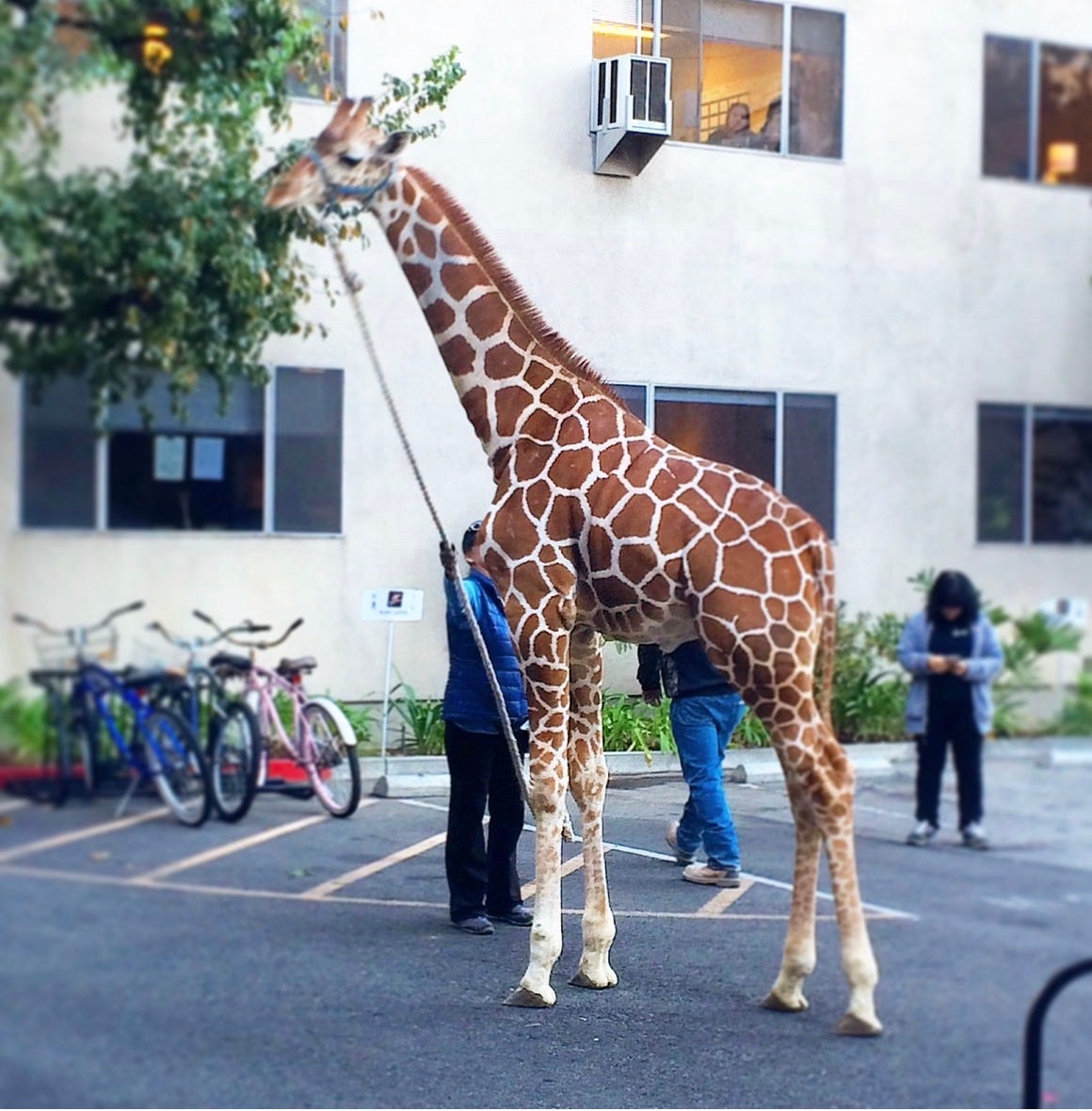
Yet no matter who I was working for, these jobs were all part of the dream. I worked backlots the way other people work office parks, and they were, without exaggeration, my favorite places in the world, because you could feel actual movie magic and actual history in every brick of every building (the exception being the Disney lot, which was somehow the unhappiest place on earth.) The Sony lot was the best of them — the giant rainbow sculpture, the Breaking Bad RV parked in a place of honor for everyone to admire, a commissary staff who made the best bagel egg-and-cheese in Los Angeles. The whole place hummed like a college campus and everyone seemed grateful just to be there. At Universal, my office was right next to the soundstage where they filmed The Voice, so my afternoons were regularly soundtracked by hopeful strangers running their scales directly outside my window — equal parts delightful and infuriating. One day I walked out of my office in the Rock Hudson building and there was a giraffe standing in the parking lot. No one ever explained it to me. I have made my peace with never knowing.
In 2015, I won a screenwriting competition, got repped by a major agency, and quit my assistant job a month later to be available for staffing season — a real, once-thriving thing that barely exists anymore, where studios and networks would spend a frantic few months each year actually hiring writers to staff actual shows. And then I was living it, the exact dream I'd traded the acting one for: getting flown to Shanghai to consult on an animated feature. Standing on set and watching my own sentences come out of someone else's mouth. Seeing my name in the credits. Spending one surreal afternoon watching the Kavanaugh hearings with Lisa Kudrow. Getting job after job and understanding, for the first time, that writing might actually keep me alive. In 2019, I joined the WGA. Los Angeles had done what it promised. It held me, it built me, it made good.
And then things started to change. The staffing meetings went first. Then the general meetings. Then the open writing assignments. I did more free work than I can bring myself to add up, work that often led nowhere. I was dropped by my agents, picked up by new ones, and the work still didn't come back.
And it wasn’t just me. Since the streaming bubble popped, America has lost somewhere in the neighborhood of 73,000 production jobs, and about two-thirds of them were here. Seven years ago, 40 percent of the scripted shows in this country filmed in Los Angeles; now it's less than a quarter. The work went to Atlanta, to Albuquerque, to London and Dublin and Toronto — anywhere with a shinier tax credit and cheaper crews — and the people went with it, or they didn't, and simply stopped being able to pay for their lives here. Industry people have started comparing Hollywood to Detroit, which is a really fun thing to read over your morning coffee when your entire career, marriage, friend group, and child exist because of this town's signature industry. Meanwhile the city itself kept getting more expensive: the rent, the groceries, the gas, the insurance premiums after the fires — if you could even keep your insurance — and childcare that costs a second rent, assuming you can find it. The math of Los Angeles for people like us has, as the kids say, simply stopped mathing.
Between COVID and the strikes, this town has been in a slow-motion mass exodus, and I've spent the last few years watching people I love pack up and leave — feeling sad for them, and secretly, stubbornly secure that I would be the one who stayed and made it work. The hardest version of that goodbye has been watching the friends who left the industry entirely, who walked away with the confidence that they had other skills and lives available to them, the way I have never quite believed I did. I’ve taken jobs outside of the entertainment industry, and they haven’t lasted. But now the time has come for us. We can't afford to stay. The work isn't coming. And so we're going.
Moving to Paris scares the merde out of me for more reasons than I can name. Navigating the Metro or French bureaucracy for something as unglamorous and non-negotiable as a prescription refill. Finding the right school for Cooper. What a transatlantic move does to a fourteen-year-old dog. Being side-eyed by French mothers for my American parenting before I've even said a word to give myself away. I don't know what shoe size my son wears in France. I don't know where to buy diapers. I don't know how to fill out a form in French, or how to navigate a culture of cheek-kissing when I am, by nature and by nurture, a hugger. I do not currently own a single article of clothing appropriate for this new life — since giving birth, I have lived exclusively in oversized jean shorts and sweatpants because I genuinely do not know what size my body is anymore, and I have questions about whether the French have figured out a bra for the specific architecture of a postpartum body that I will not elaborate on here. I’m a hot sleeper, and I’m moving to a city with no air conditioning. I’ve been lucky enough to be near family through every phase of my life, and in Paris, I’ll have none. I'm taking my son away from his grandparents during that perfect, small window when he is young and they are healthy, and the guilt of that is crippling. I’m taking him away from uncles and aunts and cousins. People I’m going to miss every moment of every day.
Last week we told Cooper’s daycare we were leaving. These are the women who have loved and cared for my son since he was five months old, five days a week, eight to five-thirty, every week of the year except a handful of holidays. If I let myself do that math — and I try very hard not to — they have probably logged more hours with him than I have. Taking him from them, and them from him, feels like a punishment neither of them earned. When the actual last goodbye comes, I fully expect to disappear into thin air rather than survive it in front of everyone.
I’m having, if you couldn’t tell, a very hard time. I feel like I’ve jumped off the high dive and I’m just flailing my arms and legs the entire way down while desperately attempting to gauge the temperature of the pool before the water swallows me.
Los Angeles was never just a city to me. It was the town where everything I loved had been made, where my heroes once stood on the same soundstages I got to stand on. I’m not done with that dream — I don’t think you ever really are, not fully — I’m just old enough now to admit it isn’t working out the way I pictured it at twenty-one, crying in a dark theater next to my mother, with no idea yet what I was actually saying goodbye to. This city gave me everything I ever dreamed of. My dog, who has been the single longest and most consistent relationship of my adult life. My husband, who I met at baggage claim at LAX, and we got engaged there 4 years later. We had our son and took him to the same pediatrician I went to when I was a baby. This city built me twice: once as a kid, once as an adult. Then it turned around and built my whole family. Whatever else I say about the economics of this place, that debt doesn’t shrink.
But somewhere below the terror, I'm starting to feel excited. I'm moving to a country with universal healthcare, where taking my son to the doctor will not involve a phone tree, three prior authorizations, and a bill four months later for an amount that has been generated by throwing darts. I'm moving to a country where the government subsidizes childcare — where daycare is treated as infrastructure, like roads, instead of as a luxury good (the first time I read about the French crèche system I had to sit down.) I'm looking forward to the pace of a life built around lunch and wine and stopping to enjoy small moments — a culture that decided, centuries ago, that the entire point of an afternoon is the afternoon. I'm looking forward to my son learning French the effortless way, by being three, while I learn it the humiliating way, by being thirty-seven at a bakery counter. I'm looking forward to trains — to the fact that when we want to leave town, we can be in Provence or Brussels or the Alps in a few hours without once merging onto the 405. I wish I smoked cigarettes, purely for the aesthetics of doing it outside a café with an espresso (though I won't, Mom and Dad, I promise). I'm looking forward to sketching architecture and to writing with a view of a river that isn't the concrete-lined trickle we call the LA River back home. And while our departure is devastatingly timed right before the reopening of our beloved Cinerama Dome, at least we're headed to the literal birthplace of cinema.
Mostly, though, I’m looking forward to connecting my son to his father's roots, and to giving our little family an unforgettable adventure.
And the bread. There’s going to be so much fucking bread, you guys.
We leave Los Angeles on September 12th. We’re visiting family for a while and aiming for Paris in October. There will be new neighborhoods, a new language I can’t yet apologize in, and a son who won’t remember any of his time here. That's the deal with a kid this small: he doesn't get to keep his own memories yet. We keep them for him. So we'll carry Los Angeles with us — every jacaranda, every backlot, every goodbye — and hold it safe until the day he's old enough to ask where he came from. This city held us for sixteen years. We can hold it for him forever.

More Los Angeles memories to come in Part 2.

Welcome back to SMOTHERHOOD, a reader-supported publication. If you’re able, please consider becoming a paying subscriber for $6/month. Paid subscribers get the full archive, subscriber-only posts, and the warm knowledge that you are personally responsible for keeping a freelance writer off the streets and on the internet, where she belongs.
Not ready to go paid? There are other ways to make me feel loved/validated:
Hit the ♥️ on this post. It costs nothing and the algorithm is nourished by it.
Leave a comment. Agree, disagree, tell me a story of your own—I read every single one.
Share a quote or the link to this post. Sharing is caring!
Become a free subscriber. Zero dollars, straight to your inbox.
Recommend Smotherhood to a kindred spirit.

No posts
Comments
Nothing yet. Say the first thing.
Sign in to join the conversation.