
Cassidy Gard and I met online and connected in that classic and adorable internet-way where you realize you’re thinking about the same things, asking the same questions, and suddenly this person you’ve never actually met feels like someone you know.
Cassidy is a three-time Emmy Award winning journalist, author, and storyteller whose work bridges media, motherhood, healing, and personal reinvention. So when her debut memoir Cosmic Goodness was published, I devoured it.
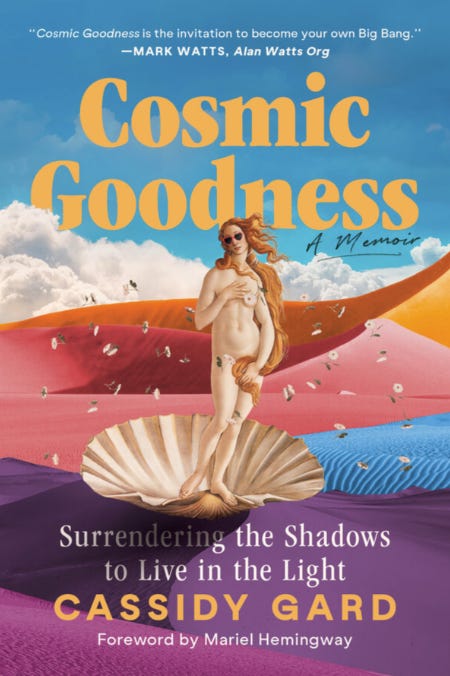
Cosmic Goodness is a lot of things. It’s a burnout memoir from a woman who won Emmys before thirty and slept under her newsroom desk waiting for tragedies to break. It’s a recovery story—about SLAA, AA, Al-Anon, and what “conscious sobriety” actually means. It's a real estate narrative about a woman who invests in properties in Montana and the Hamptons and has the audacity to actually admit her mother helped with the down payment. It’s a spiritual awakening that manifests as a love story about meeting your sober partner on 2/22/22 after literally journaling about him the night before.
But mostly, it’s about what happens when you conclude achievement can’t fix loneliness, and that sometimes the most radical thing you can do is stop performing and start becoming. Cassidy was isolated. She was excellent. She was dying inside. Then she stopped running and started listening. She writes about her father’s death, the generational healing with her mother, the refusal to shrink into “easy and breezy” when she’s “windy and complicated,” the building of autonomy and sovereignty (all the stuff we're supposed to want but are terrified to actually claim.)
And at the center of all that is motherhood. Not as the happy ending necessarily, but as the place where all that work gets tested. She writes about the postpartum rage, the invisible labor, the way the weight fell on her shoulders without discussion. She writes about loving her baby completely while also being furious at the imbalance. She doesn't romanticize it. She doesn't pretend motherhood fixed her. Instead, she shows us what happens when a woman who's done the hard inner work becomes a mother—imperfectly, honestly, and staying intact while also completely transformed.
I can’t recommend this book enough. Plus, the more people who read it, the more people I have to obsess about it with besides Cassidy herself, because she has a life to live.
BUT. I was privileged enough to sit down with her for a Smotherhood exclusive. And here’s what she told me.


Cassidy: It felt hot. Physically hot, on my chest and my cheeks, like my body was running a fever made of fury. When it came, I learned to put the baby down in a safe space and go calibrate. So many times I just laid a blanket down in the grass and laid down next to my little one, because I always felt better with my body on the earth. And underneath the heat was grief. I gained seventy pounds with both pregnancies. I could barely walk. I’ve had joint issues and inflammation and a body I genuinely could not recognize in the mirror. So the rage wasn’t really at the baby, ever. It was at the disappearance. I had given everything, and somewhere in there I lost myself, and nobody warned me that kind of loss can come out as anger.
We have had some very hard conversations, and a lot of them started with me explaining, in plain language, what a woman’s body and hormones are actually going through in that first year. It is not information men are handed anywhere. I will say his own program of sobriety helps him meet those conversations with real openness, because he already has a practice of sitting with hard truths without getting defensive. And then our second son arrived and rocked us both, because with two under two, there was simply no space for either of us to be off. That first year put all the invisible labor right out in the open. You cannot pretend the load isn’t there when you’re both carrying it at three in the morning.
Producer awake has a finish line. The story airs, the adrenaline drains out of you, and you sleep for twelve hours and rise from the dead. Your body knows the deal: sprint, then collapse. Mother awake is different. There is no control room, no wrap, no moment where someone says we got it, go home. It is vigilance with no end of broadcast, and the stakes are not a segment, they are the person you love most in the world breathing in a bassinet three feet away. My nervous system had spent a decade learning to spike and recover, spike and recover. Motherhood taught it to hover. Even now, part of me is always half listening, the way a producer keeps one ear on the control room even at dinner. The difference is I never get to take the earpiece out.
Comments
Nothing yet. Say the first thing.
Sign in to join the conversation.