
Three months ago I sat down with the CEO of a global investment firm. Fifteen people managing equity portfolios across two fund structures. Successful business. Sharp team. They’d built something that worked.
They were also well ahead of most companies on AI adoption. The team was already running a stack of different tools, each pulling its own slice of data and information. Seven tools already in play across different workflows. These weren’t people who needed convincing that AI mattered. They were already there.
But the tools didn’t talk to each other. A senior portfolio manager was spending the first two hours of every morning moving content between four applications to produce a daily research note. Compliance policies lived in Word documents. They even had meeting note-takers. But the notes lived in their own silo. They weren’t mapped back to the people, companies, or projects they related to. When someone asked “what did we decide about that position last Tuesday?”, the answer existed somewhere. It just wasn’t connected to anything.
None of this had stopped them from running a successful business. Humans compensated, as they always do. But it meant that all seven of those AI tools were operating in isolation, each one working from a fraction of the picture.
His vision was clear: a 15-person company that operates like 100. Not by hiring. By embedding AI into the way the business actually works.
That gap, between where they were and where he wanted to be, is the gap Notion’s AI Transformation Model describes.
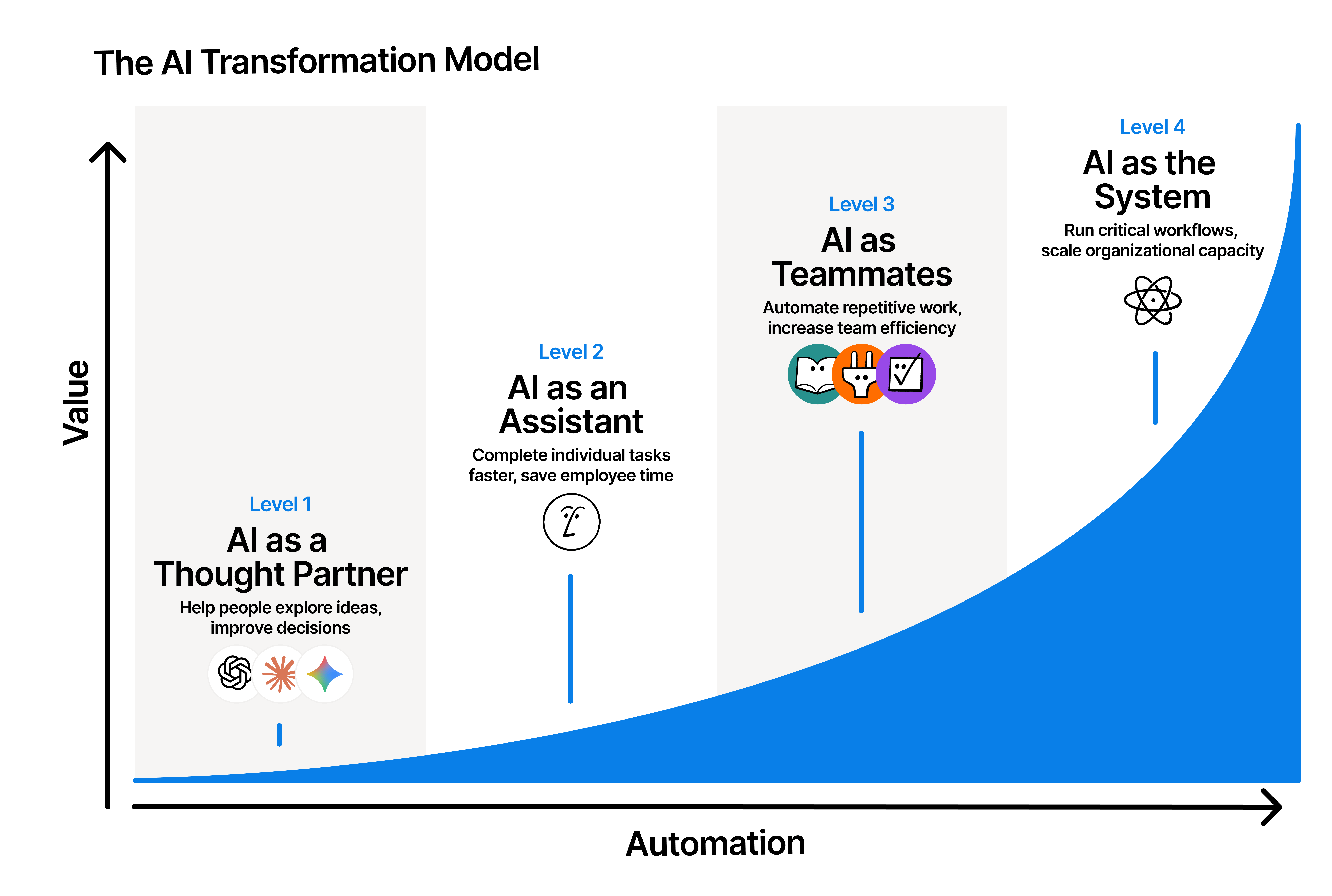
Notion recently published the AI Transformation Model. Four levels. Level 1: AI as a thought partner. Level 2: AI as an assistant. Level 3: AI as teammates. Level 4: AI as the system. Companies move through them as AI goes from ad-hoc tool to operational infrastructure.
The model is useful. The levels are real. And the principle they keep coming back to, that context is the foundation, is one I’ve watched hold up on every client build.
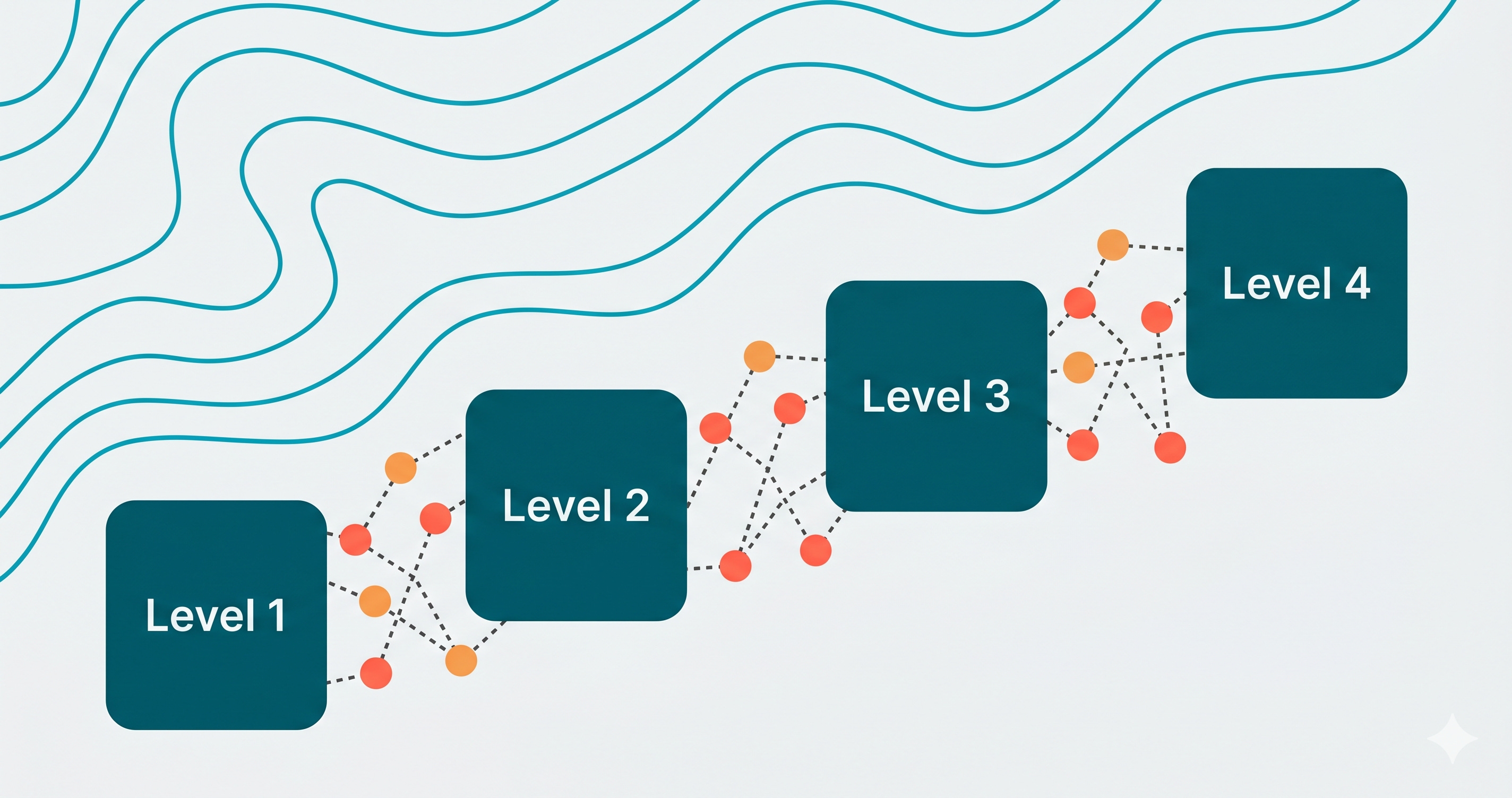
But a model is a map. And maps don’t tell you what the terrain is like between the contour lines.
I run a consulting practice that builds digital operating systems in Notion. I’ve built over 30 AI skills that run my own business. I’ve taken companies from scattered tools and tribal knowledge to structured workspaces with AI agents running real workflows. What follows is what the AI Transformation Model actually looks like when you build it. Level by level. What changes, what breaks, and what their model doesn’t warn you about.
Notion’s model starts at Level 1. You’re already using AI. But that investment firm I mentioned? They weren’t failing. They were thriving. They had systems. They had structure. They had enough of both to run a successful business for years.
But “enough for humans” and “enough for AI” are different bars. Research lived in individual inboxes. Meeting notes were captured but not connected back to the clients, projects, and decisions they related to. The team had their rhythms and their workarounds, and those workarounds worked. Until you asked an AI agent to operate across them.
AI can’t think about your work if your work isn’t written down, structured, and connected. That’s not a failure of the business. It’s a gap between what humans need and what AI needs. The business was never broken. It just wasn’t built for this yet.
We call this the Foundation phase. Clarify what the business actually does. Map where information currently lives. Design how it should connect. Then build the databases and relations that hold it together. No AI involved yet. Just taking what already works and raising it to the level AI demands.
Notion’s model assumes this work is done. For most companies I work with, it’s the hardest 80% of the job.
The jump from Level 1 to Level 2 is the most important transition in the whole model. Notion describes it as “connect data and permissions.” Three words that contain about six weeks of real work.
Context isn’t something you switch on. It’s something you build. And building it well is a design discipline.
We codified this into a build standard we use on every engagement. The thesis: Notion AI retrieves by context, structure, and text. Everything you build either makes that easier or harder.
What that means in practice:
Naming matters more than you think. “Update” and “Notes” are invisible to AI. “Daily Research Note, XYZ Capital, 8 March 2026” gives AI strong signal. Every record title is a retrieval surface. Treat them that way.
Running summaries are the secret weapon. A short plain-English field on every key record that says “here’s where this thing is right now.” AI reads this when someone asks about a project. If it’s stale, AI gives stale answers. If it doesn’t exist, AI guesses.
Relations are the connective tissue. Projects linked to tasks linked to meetings linked to client engagements. Orphaned pages are invisible pages. The more connected the workspace, the more AI can navigate it.
External information needs a bridge. Key decisions made in Teams calls, important emails, documents in SharePoint: if it matters, it needs a Notion-native summary close to the relevant record. Not a copy of everything. A distillation: what was decided, what changed, what’s the current state.
For that investment firm, this meant taking a workspace that already served the team well and elevating it to the standard AI requires. Meeting capture with automatic summaries and action items. Email context filed against clients and projects. The operations page restructured into something the team could rely on daily. When someone asks “what did we say about McDonald’s on March 1st?”, the answer is there. Not trapped in someone’s inbox.
This is what “connect data sources” actually looks like. It’s not plugging in an API. It’s designing an information architecture where AI can find what it needs.
Level 3 is where things get genuinely exciting. Agents that run in the background, handle recurring workflows, make judgement calls. This is the “AI as Teammates” level and it’s where most of the operational leverage lives.
For that investment firm, Level 3 is taking shape around the workflows that used to eat the most hours. The senior portfolio manager’s daily research process, the one that took two hours of copying between four applications, is becoming an AI workflow that aggregates, structures, and deposits research into the workspace automatically. He still reads, selects, and decides what matters. The compilation mechanics just stop being his problem.
Meeting capture now flows into structured records: summaries extracted, action items turned into tasks, decisions linked back to the projects and people they relate to. Compliance questionnaires that used to take days of manual searching through policy documents are answered in minutes, drawing from a verified knowledge base with source links and review dates. One of the team even built AI analysts. Persona-based skills that run against portfolio data and produce substantive investment analysis that would have taken a junior analyst hours.
Each of these is a real agent doing real work. And for one or two workflows, it’s straightforward. But this is where Notion’s model goes quiet on something important.
What it doesn’t address is the hardest part of making Level 3 work at scale. How do you keep the instructions maintainable?
I’ve been building this for my own practice in parallel. Over 30 AI skills covering everything from meeting follow-ups to lead qualification to client catch-up briefs to content drafting. At that density, you hit a wall that has nothing to do with AI capability.
The wall is instruction architecture.
Early on, I made the mistake everyone makes. I crammed everything into one giant instruction prompt. It worked until it didn’t. Instructions conflicted. Changes broke things. The AI couldn’t hold the full context without getting confused.
The fix was separating concerns into layers.
Agents define who the AI is. Personality, operating principles, rules, awareness of the workspace. This layer stays consistent across every task.
Skills define what the AI does for specific tasks. Each skill is a self-contained instruction page: scope, triggers, inputs, steps, output rules, approval gates, banned moves. The AI loads it on demand, follows it, and unloads it when done.
Kits group skills by domain. Sales, Delivery, Content, Operations. They’re the fallback when the AI can’t match a request directly to a skill.
Guides are reference pages that skills pull in at runtime. A voice and style guide loaded when drafting. A client context page loaded when doing client work. Update a guide once, every skill that references it benefits.
The key design principle: the agent instruction layer should be lean. It carries just enough to route requests correctly. The moment you’re tempted to add task-specific logic to the agent, that’s a signal you need a skill instead.
This separation means no context bloat, no conflicts between instructions, easy iteration on individual skills, and portability across agents. The same meeting follow-up skill works for the personal agent in conversation and a custom agent running in the background. And it’s the same architecture we’re now building into that investment firm’s workspace as their agent count grows.
Notion’s model jumps from “configurable agents” at Level 3 to “multi-agent orchestration” at Level 4. The gap between those two things is instruction architecture. Without it, you get agents that work individually but fall apart as a system.
Notion frames Level 4 as infrastructure. Multi-agent orchestration, governance, policy resolution, self-improving systems. It’s the enterprise pitch. And for companies with 500 engineers, it probably looks like that.
For the market I work in, founders, small teams, investment firms trying to punch above their weight, the top of the mountain looks different.
We call it Collaborate. AI thinks with you.
When AI is embedded across the first three layers, it accumulates enough context to become a genuine thinking partner. It doesn’t just execute. It contributes. It builds on half-formed ideas, challenges weak thinking, connects patterns across projects and time that no single person holds enough context to see.
For that investment firm, this is where it’s heading. They already had the domain expertise, the client relationships, the investment track record. What they didn’t have was a system that could hold all of that context and think alongside them. When the workspace holds the research, the meeting context, the portfolio data, the compliance rules, and the operational history, AI stops being a tool you prompt and starts being a colleague that contributes. It holds context across time, across people, across decisions. The CEO’s vision of 15 people operating like 100 isn’t about adding AI tools. It’s about building institutional memory that compounds.
You can’t buy this layer. You earn it through the investment in the first three. Every document created, every analysis run, every process automated builds the context that makes collaboration possible.
Notion’s Level 4 speaks to CTOs building agent platforms. Our Collaborate layer speaks to the founder who wants leverage without headcount. Different peaks. Both real. But for most businesses, the thinking partner is a more honest and more achievable vision of what the top actually looks like.
Notion built a useful map. The four levels give companies shared language for where they are and where they’re heading. The principle that context is the foundation is exactly right.
What the map doesn’t show is the terrain between levels. The pre-AI foundation work that most companies skip. The information architecture discipline that turns “connect data” from a feature toggle into a real build project. The instruction design that makes Level 3 sustainable as workflows multiply. The honest framing of what the top level looks like for businesses that aren’t running 10,000 agents.
Take their assessment. Find out where you sit. The map is real. Then figure out what it actually takes to move.
Tim Jeffries runs Smooth Ops, a Notion consulting practice that builds operational systems for growing businesses. He’s a Notion certified consultant and partner based in Victoria, Australia.
No posts
Comments
Nothing yet. Say the first thing.
Sign in to join the conversation.