
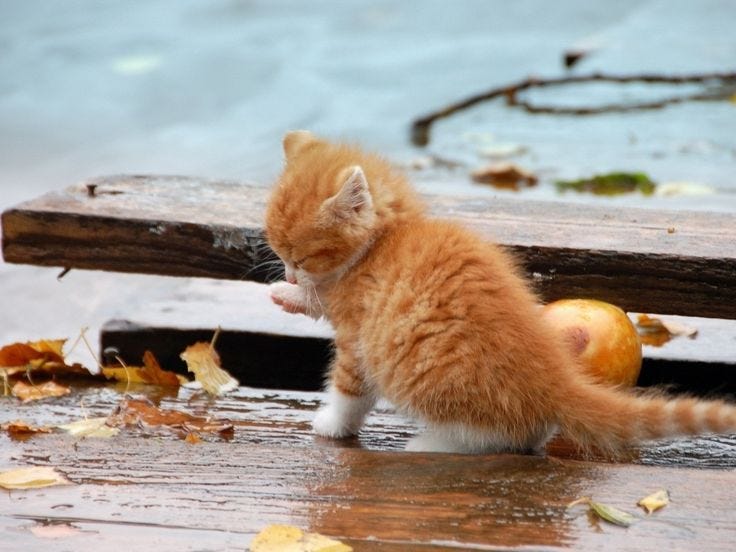
The rain came down in sheets that October evening, turning the alley behind Moreno’s Bodega into a maze of puddles and shadows. Tucked behind a water-stained mattress someone had abandoned weeks ago, a small orange kitten shivered, his fur matted against his tiny frame. He was no bigger than a man’s hand, with eyes still blue from kittenhood and ears too large for his head.
He had been searching for food—anything, really—when he heard the voices. His mother’s desperate yowl. The metallic clang of a cage door. The rumble of an engine fading into the distance. Now, hours later, he remained frozen behind the mattress, too frightened to move, too young to understand that his family was gone.
The city hummed around him with indifferent noise: car horns, distant sirens, the hiss of bus brakes. Above, a sliver of sky showed between the buildings, gray and unforgiving. The kitten mewed softly, a sound swallowed immediately by the rain.
He didn’t know that his mother and siblings had been discovered that morning by Carlos Moreno, the bodega owner, who had called animal control with the best intentions. He didn’t know they were safe now, if separated. He only knew the gnawing emptiness in his belly and the cold that seeped into his tiny bones.
Carlos arrived at dawn the next morning, keys jangling as he unlocked the back door of his shop. He’d owned Moreno’s for thirty-two years, and in that time, he’d seen the neighborhood change a dozen times over. The bodega remained constant—a beacon of fluorescent light, fresh coffee, and the smell of the grill where he made breakfast sandwiches for the morning rush.
Today, he’d decided to finally clean the alley. The mattress had been there too long, and Mrs. Chen from the dry cleaners next door had complained about rats. He propped open the back door, letting the morning air into the stockroom, and began dragging trash bags toward the dumpster.
That’s when he heard it—a sound so faint he almost missed it. A mew, thin and desperate.
Carlos stopped, listening. There it was again.
He moved toward the mattress, his knees protesting as he crouched down. Behind it, pressed against the brick wall, was the smallest kitten he’d ever seen. Orange fur stuck up in wild tufts. Ribs visible beneath the skin. Eyes that looked too large, too knowing, for such a tiny creature.
“Ay, Dios mío,” Carlos whispered. “You’re the one that got away.”
The kitten didn’t run. He didn’t have the strength. He simply looked up at Carlos with those enormous eyes and mewed again, a sound that broke something in the old shopkeeper’s chest.
Carlos scooped him up gently, feeling the rapid flutter of the kitten’s heartbeat against his palm. The little thing was soaked through, trembling violently. Without thinking, Carlos tucked him inside his jacket and carried him into the warmth of the bodega.
Inside, Carlos set the kitten on a folded towel near the space heater in the stockroom. The kitten swayed slightly, then collapsed onto his side, too exhausted to hold himself upright.
“Okay, okay,” Carlos murmured, moving quickly now. He heated some milk in the microwave—not ideal, he knew, but it was what he had—and added a little water to cool it. Using a clean eyedropper from the first aid kit, he coaxed drops of milk into the kitten’s mouth.
At first, nothing. Then a tiny pink tongue appeared, licking weakly at the dropper. Carlos felt a surge of relief. The kitten drank, slowly at first, then with more urgency. When he’d had enough, Carlos used the towel to gently dry the matted fur, rubbing warmth back into the small body.
By the time Carlos opened the shop at six, the kitten was asleep in a cardboard box lined with towels, his breathing steady and deep.
Throughout the morning, between customers, Carlos checked on him. He called the animal shelter during his break, learning what he already suspected—they were full, and a kitten this young, without a mother, would be at risk. They could take him, but there were no guarantees.
Carlos looked at the sleeping kitten and felt the weight of responsibility settle on his shoulders. He couldn’t keep him. His wife was allergic, and they already had her mother living with them in their small apartment. There was no room for a cat.
But he couldn’t send him to an uncertain fate either.
He was still wrestling with this dilemma when the bell above the door chimed, and Samuel Rothstein shuffled in.
Samuel came to Moreno’s every day at eight-thirty, regular as clockwork. He bought a coffee—black, no sugar—and a newspaper, and he always asked Carlos how business was. They’d been doing this dance for fifteen years, ever since Samuel’s wife, Ruth, had passed away.
Today, Samuel noticed immediately that something was different.
“You look troubled, my friend,” Samuel said, his voice carrying the faint accent of his childhood in Brooklyn.
Carlos sighed. “Come, I’ll show you.”
He led Samuel to the stockroom, where the kitten had woken and was now sitting up in his box, looking around with curious, uncertain eyes.
Samuel stopped in the doorway. His hand, spotted with age and holding his coffee cup, began to tremble slightly.
“Oh,” he said softly. “Oh my.”
He set down his coffee and approached slowly, as if the kitten might vanish if he moved too quickly. “May I?”
“Of course.”
Samuel knelt—a process that took some time—and extended one gnarled finger toward the kitten. The little orange cat sniffed it, then, to both men’s surprise, rubbed his face against Samuel’s hand and began to purr. The sound was like a tiny motor, disproportionately loud for such a small creature.
Samuel’s eyes filled with tears.
“Ruth loved cats,” he said quietly. “We had one, Mitzi, for seventeen years. When she died—the cat, I mean, two years after Ruth—I said never again. Too painful.” He stroked the kitten’s head with infinite gentleness. “But this little one... he’s been through something, hasn’t he?”
Carlos told him the story. Samuel listened, never taking his eyes off the kitten, who had climbed into his lap and curled up as if he’d always belonged there.
“I can’t keep him,” Carlos finished. “But I can’t send him to the shelter either.”
Samuel was quiet for a long moment. The kitten kneaded his leg with tiny paws, purring steadily.
“I live alone,” Samuel said finally. “In a rent-controlled apartment that’s too big for one person. I have a pension and too much time.” He looked up at Carlos, and there was something in his eyes that hadn’t been there before—a spark, a purpose. “I could give him a home. If you think... if you think I’m not too old.”
Carlos smiled, feeling the tightness in his chest release. “I think you’re exactly right.”
That evening, Samuel returned with supplies: a proper carrier, kitten food recommended by the pet store clerk, a small litter box, a soft bed, and an assortment of toys that seemed excessive for one small cat.
“I may have gotten carried away,” Samuel admitted, looking slightly embarrassed at the pile of purchases.
“He’s a lucky cat,” Carlos said, helping to settle the kitten—who Samuel had decided to name Moishe, after his grandfather—into the carrier.
As Samuel prepared to leave, he turned back to Carlos. “Thank you,” he said. “You don’t know what this means. The apartment has been so quiet. Too quiet. I didn’t realize how much I needed...”
He didn’t finish the sentence. He didn’t need to.
Three months later, Carlos was restocking the coffee when Samuel came in for his daily visit. But he wasn’t alone. In his arms, wrapped in a small blanket, was Moishe—now considerably larger, his orange fur glossy and full, his eyes bright with health and mischief.
“He wanted to come visit his uncle Carlos,” Samuel explained, beaming. “I hope you don’t mind.”
Carlos came around the counter to scratch Moishe behind the ears. The cat purred and headbutted his hand affectionately.
“He’s beautiful,” Carlos said. “You’ve done well.”
“We’ve done well,” Samuel corrected. “He’s taught me something important. I thought I was done, you know? Done with love, with caring for something, with having a reason to get up in the morning beyond habit.” He looked down at Moishe with such tenderness that Carlos had to look away. “But this little one, he needed me. And I needed him. Funny how that works.”
As Samuel left, Moishe peering over his shoulder at the bodega with those knowing eyes, Carlos thought about the alley out back. About rain and cold and loneliness. About how sometimes salvation comes in the smallest packages, and how love—real love—has a way of finding those who need it most.
The bell chimed as the door closed, and Carlos returned to his work, smiling.
Outside, the city hummed on, indifferent as always. But in one rent-controlled apartment uptown, an old man and a young cat were curled up together on a couch, both of them finally, blessedly, home.
© 2026 Smiling Through the Tears. All rights reserved.
I want to offer you our paid subscription for just $2.49 monthly or $24.99 per year. That’s 50% off our normal rate. I’m trying to grow this page, and that rate is good for life.
Thank you for considering it. I greatly appreciate your support!

No posts
Comments
Nothing yet. Say the first thing.
Sign in to join the conversation.