
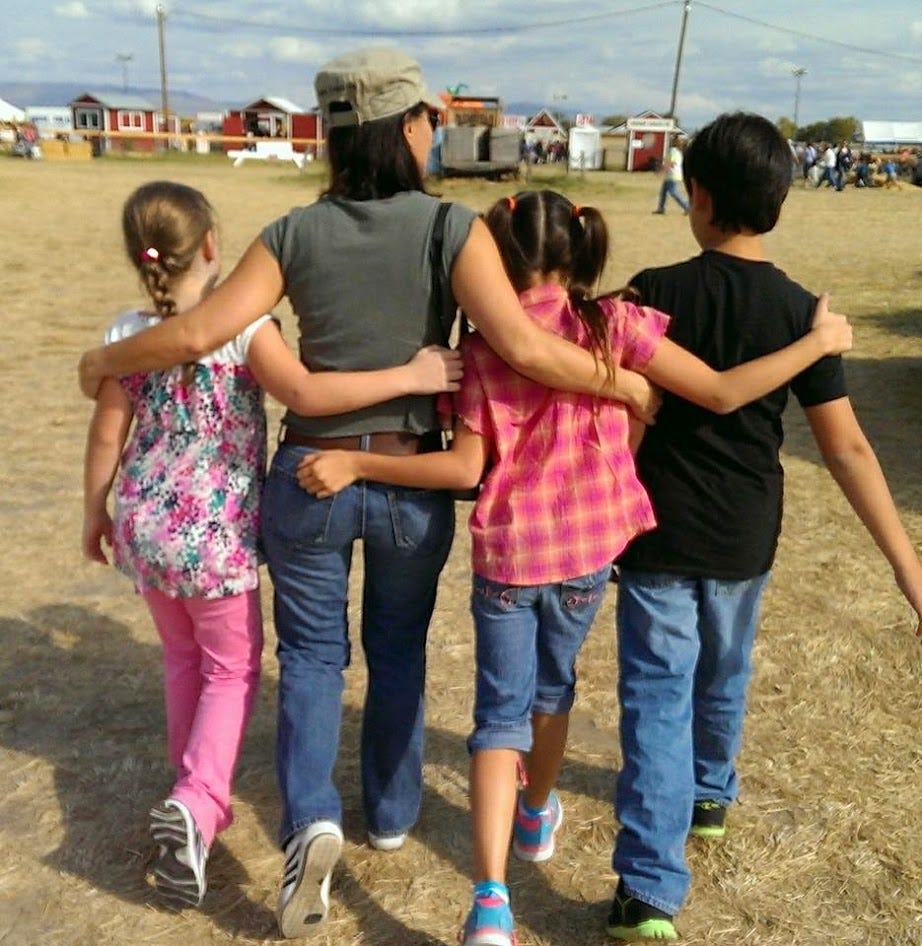
Aaron had never believed in love at first sight until he watched his daughter Kamryn grab Selena’s hand at the playground and declare them best friends within thirty seconds of meeting. The two girls ran off toward the swings, Frankie trailing behind them with an easy grin, and Aaron found himself standing next to a woman with laugh lines around her eyes and a smirk that suggested she found the whole universe slightly ridiculous.
“Well,” Rose said, watching the kids disappear into a tangle of limbs and laughter, “I guess we’re stuck here for a while.”
“Could be worse,” Aaron replied.
“Could be better. You could offer to buy me a coffee from that sad little cart over there.”
He did. They talked for two hours while the kids played, and by the time the sun started setting, Aaron had learned that Rose worked in medical billing, had been divorced for three years, made jokes when she was nervous, and had a laugh that sounded like wind chimes. She learned that he shared custody of Kamryn with his ex-wife, worked as a project manager for a construction company, and cooked like someone who’d learned to express love through food because words had always been rationed in his childhood home.
“My parents felt that you showed people you love them more than telling them,” he told her, surprising himself with the honesty. “But my pop taught me to make my grandmother’s Italian recipes. I think that was his way of saying things he didn’t say out loud too often.”
Rose had touched his hand then, just briefly. “Cook for us sometime.”
He did. The following weekend, he made his grandmother’s chicken parmesan, red-sauce spaghetti and roasted vegetables that Frankie actually ate without complaining. For dessert, a chocolate cake that made Selena’s eyes go wide. The kids sat around his small dining table like they’d been doing it for years, and Rose helped him wash dishes while trading stories that made him laugh so hard he had to set down the plate he was drying.
“You’re trouble,” he told her.
“You have no idea,” she said, and kissed him for the first time with soap bubbles still on her hands.
Three months later, they moved in together.
Everyone said it was too fast. Aaron’s ex-wife raised her eyebrows. Rose’s sister asked if she was sure. But when you found something that felt this right, this easy, why wait? The kids were already inseparable. Kamryn cried on the days she had to go to her mom’s house because it meant leaving Frankie and Selena. Rose’s humor paired well with Aaron’s frequent goofiness. His cooking filled her house with warmth it hadn’t known in years.
They were a family. It was perfect.
Until it wasn’t.
The first time Selena slammed her bedroom door, Aaron stood in the hallway, stunned. He’d asked her to clean up the art supplies she’d left scattered across the living room floor—a simple request, reasonable, the kind of thing any parent would ask. She’d looked at him with something like betrayal in her seven-year-old eyes and said, “You’re not my dad,” before storming off.
The door slam echoed through the house.
Rose had been in the kitchen. She came out, saw his face, and said gently, “She’ll cool down. Just give her a minute.”
But Aaron’s hands were shaking. In his childhood home, a slammed door would have meant a spanking, a lecture about respect and obedience, hours of silent treatment from his father. The strict religious household he’d grown up in had no tolerance for displays of emotion, for anything that looked like defiance.
“She can’t just—” he started.
“She’s seven,” Rose said. “And she’s adjusting.”
“Kamryn doesn’t act like that.”
Something flickered across Rose’s face, but she just nodded. “Every kid is different.”
It became a pattern. Aaron would ask Selena to do something—put away her shoes, come to dinner, get ready for bed—and she’d resist. Sometimes with attitude, sometimes with tears, sometimes with that door slam that made his chest tight with frustration and something that felt uncomfortably like failure.
He didn’t understand it. Frankie responded well to clear expectations and gentle reminders. Kamryn had always been easy, compliant, and eager to please. But Selena seemed to push back against everything Aaron said, and the more he tried to assert authority the way his parents had taught him, the more she withdrew.
“She just needs to learn respect,” he told Rose one evening after Selena had refused to turn off the TV when asked, leading to a standoff that ended with her in tears and him feeling like a monster.
Rose had been quiet for a long moment. “She’s not being disrespectful. She’s being seven.”
“I would never have gotten away with this kind of behavior.”
“I know,” Rose said softly. “But maybe that’s not something to replicate.”
The words stung more than they should have.
The breaking point came on a Saturday afternoon in November. They’d planned a family outing to the pumpkin patch, and Aaron had told everyone they were leaving at two o’clock. At 1:55, Selena was still in her pajamas, absorbed in building an elaborate Lego castle on the living room floor.
“Selena, we’re leaving in five minutes. You need to get dressed now.”
She didn’t look up. “I’m almost done.”
“Now, please.”
“Just let me finish this part—”
“Selena.” His voice had an edge to it, the tone his father had used. “I’m not asking again.”
She looked up then, and her eyes were already filling with tears. “You’re so mean! You never let me finish anything!”
“That’s not true, and you know it. Get dressed. Now.”
“I hate you!” She swept her arm across the Lego castle, scattering pieces everywhere, and ran to her room. The door slam was louder this time.
Frankie and Kamryn sat on the couch, wide-eyed and silent. Rose stood in the kitchen doorway, and when Aaron looked at her, he saw something he’d never seen before: disappointment.
“What?” he said, defensive. “What was I supposed to do? We had plans. She can’t just ignore me.”
“You could have given her a warning,” Rose said quietly.
“I told her we were leaving at two!”
“You told all of us at breakfast. That was four hours ago. For a seven-year-old, that might as well be next week.”
“So I’m supposed to just let her do whatever she wants?”
“That’s not what I’m saying—”
“Then what are you saying, Rose? Because it seems like every time I try to parent your daughter, I’m doing it wrong.”
The words hung in the air like smoke. Frankie quietly took Kamryn’s hand and led her outside to the backyard. Rose’s face had gone very still.
“My daughter,” she repeated softly.
Aaron felt something crack in his chest. “I didn’t mean—”
“You did.” Rose sat down at the kitchen table, suddenly looking tired. “And maybe that’s the problem. You’re trying to parent her the way you were parented. The way you parent Kamryn. But Aaron, Selena isn’t Kamryn. She’s not you. She’s her own person, and she needs different things.”
“I don’t know what that means.”
“I know you don’t.” Rose looked at him, and her eyes were sad but not unkind. “And I’ve been waiting for you to ask.”
The words hit him like cold water. Pride. That’s what this was. He’d been so sure he knew how to be a parent, so certain that his way was the right way, that he’d never once asked Rose—who had been parenting Selena for seven years—what might actually work.
He sat down across from her, his hands flat on the table. “I’m asking now.”
Rose reached across and covered his hand with hers. “Selena needs time to transition. She gets absorbed in what she’s doing, and when you pull her out of it suddenly, it feels violent to her. Like you’re ripping her away from something important.”
“But I told everyone at breakfast—”
“And she heard you. But four hours is too long for her to hold that in her head. She needs reminders. Warnings. ‘We’re leaving in thirty minutes. We’re leaving in fifteen minutes. We’re leaving in five minutes.’ It gives her time to finish what she’s doing, to prepare herself mentally.”
Aaron thought about his own childhood, where his father’s word was law and immediate obedience was the only acceptable response. The idea of giving warnings, of accommodating a child’s need for transition time, would have been seen as weakness. Permissiveness.
But Selena wasn’t being raised in that house. And he didn’t want her to be.
“Fifteen minutes,” he said quietly.
“It’s not a magic number. But it’s usually enough time for her to wrap up what she’s doing and shift gears. And when she feels like she has some control, some agency, she doesn’t fight you.”
“I’ve been making her feel powerless.”
“You’ve been parenting the way you were taught.” Rose squeezed his hand. “But you can learn a different way. If you want to.”
He did want to.
That evening, after they’d canceled the pumpkin patch trip and ordered pizza instead, Aaron knocked on Selena’s door. She was lying on her bed, her face blotchy from crying.
“Can I come in?”
She shrugged, which he took as a yes.
He sat on the edge of her bed, careful not to crowd her. “I’m sorry about earlier. I should have given you more warning about getting ready.”
She looked at him suspiciously. “Mom told you to say that.”
“Mom told me that you need more time to finish what you’re doing before switching to something new. And she was right. I wasn’t thinking about what you needed. I was just thinking about the schedule.”
Selena was quiet for a moment. Then, in a small voice: “I don’t really hate you.”
“I know.”
“I just wanted to finish my castle.”
“I know that too. And next time, I’ll give you more warning. Okay?”
She nodded, and something in her face softened. It wasn’t forgiveness exactly—that would take time—but it was a beginning.
Over the next weeks and months, Aaron practiced. “Hey, Selena, we’re having dinner in fifteen minutes.” “Selena, we need to leave for school in fifteen minutes.” “Selena, bedtime in fifteen minutes.”
And it worked. Not perfectly—she was still seven, still learning, still occasionally slamming doors when her feelings got too big for her body. But the constant friction between them eased. She started smiling at him again. Started showing him her drawings. Started letting him braid her hair in the mornings when Rose was running late.
One night, about six months after their fight, Aaron was cooking dinner when Selena came into the kitchen and wrapped her arms around his waist from behind.
“What’s this for?” he asked, surprised.
“Just because,” she said, and squeezed tighter before running off to play with Kamryn.
Rose, who’d witnessed the whole thing, had tears in her eyes. “You did that,” she said.
“We did that,” he corrected.
The family they’d built wasn’t the easy, perfect thing it had seemed in those first magical months. It was harder than that. More complicated. It required Aaron to unlearn things he’d carried since childhood, to humble himself, to ask for help. It required Rose to be patient while he stumbled through learning. It required all of them to understand that love wasn’t just about the good feelings—it was about the work of truly seeing each other.
But on the nights when all five of them sat around the dinner table, passing dishes and trading stories and laughing at Rose’s terrible jokes, Aaron looked at his family—this complicated, imperfect, beautiful family—and knew that every hard moment had been worth it.
Selena caught his eye and grinned, tomato sauce on her chin.
“What?” she asked.
“Nothing,” he said. “Just glad you’re here.”
“Me too,” she said, and went back to her pasta.
It was enough. It was everything.
© 2026 Smiling Through the Tears. All rights reserved.
I want to offer you our paid subscription for just $2.49 monthly or $24.99 per year. That’s 50% off our normal rate. I’m trying to grow this page, and that rate is good for life.
Thank you for considering it. I greatly appreciate your support!

No posts
Comments
Nothing yet. Say the first thing.
Sign in to join the conversation.