
In my previous post, I wrote about depression and how it has affected me throughout my life. It is both interesting and a dubious privilege to experience, within the same year, two different states that are commonly referred to as depression: severe biological depression on the one hand, and grief on the other. If you ask the average person what depression is, or how a depressed person feels, the answer will probably involve sadness, crying, and a loss of interest in life. Perhaps something difficult has happened—a relationship has ended, or they have lost their job. The very foundations of their life have been shaken, and it is hardly surprising that their thoughts and emotions are shaken as well. If that is one’s image of depression, it can be difficult to see it as an illness requiring treatment with medication or, even more so, electroconvulsive therapy (ECT). As a psychiatrist, however, that is not what I typically encounter or mean when I speak of depression. Unfortunately, the DSM’s criteria-based definition of a depressive episode has become so broad and almost devoid of specificity that this distinction is not always apparent (see my previous post on psychiatric diagnosis). One well-known researcher in psychiatric genetics once remarked that searching for the genes behind depression using DSM criteria is like searching for the genes behind diarrhea!
Grief is something most of us experience at some point in our lives, and we cope with it with varying degrees of success. Sooner or later, we lose loved ones to death or to the end of a relationship. This is often followed by an acute reaction in which we struggle to orient ourselves in life and to understand what will now give it meaning. Perhaps the person we lost was also the person we turned to with our innermost thoughts and to whom we had become so strongly attached that our emotional regulation had, in practice, become intertwined. The extent to which this occurs depends partly on one’s attachment style: whether it is anxious, avoidant, or secure. We experience something resembling withdrawal, where, like a person suffering from addiction, we do everything we can to reconnect with the person in order to relieve the almost physical pain we feel. After all, it is called a broken heart. We may struggle to sleep and lose our appetite.
In the initial phase, it is difficult to understand what has happened. We reflect, search for explanations, and try to make sense of the loss. This is something often depicted in popular culture and classical literature alike. I think, for example, of Goethe’s The Sorrows of Young Werther, in which the grieving Werther loses his beloved Lotte and takes the loss so hard that he ultimately ends his own life. Fortunately, grief is rarely that severe. Most of us make it through with more or less our skin intact. In fact, people who allow themselves to experience intense grief and anxiety after a breakup, rather than suppressing their feelings, often tend to grow and become stronger over time. For psychological reasons, it is often beneficial, at least initially, to avoid contact with the person one has left or been left by. This can help loosen the powerful attachment bond and allow the grieving process to move forward.
In socially monogamous humans, love is deeply rooted in evolution. Unlike the majority of animal species, humans typically have only one partner at a time, though perhaps several different partners over the course of a lifetime. This arrangement is naturally advantageous when two people must care for a child who may require nearly twenty years of support before becoming independent.
As an elaboration of the attraction systems found in mammals and birds, humans possess what we call romantic love. Research in mammals has shown that mate selection is closely linked to activity in the brain’s dopaminergic reward system.
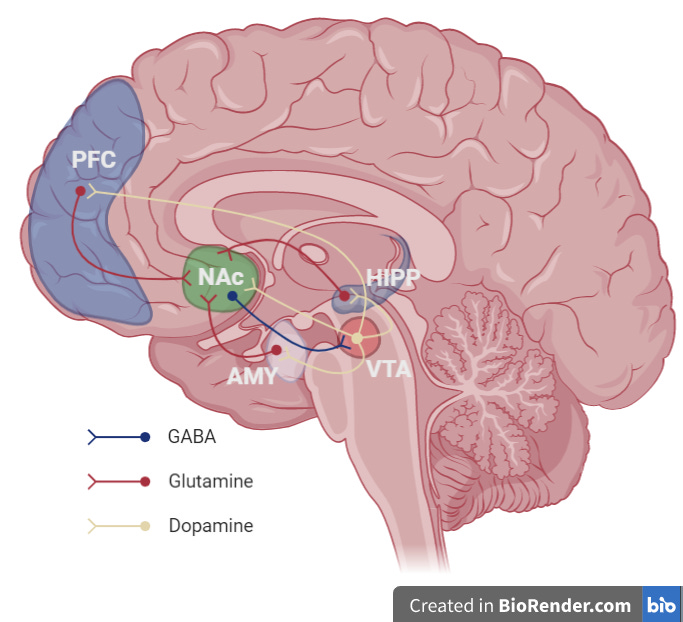
When researchers studied seventeen individuals who were intensely in love and fifteen who had recently been rejected by a romantic partner while undergoing functional MRI scans, they observed activation patterns similar to those seen in other mammals when the participants viewed photographs of their beloved (see here).
Among those who were newly in love, activation was observed in the ventral tegmental area (VTA) and the caudate nucleus. The caudate is part of the dorsal striatum and plays a central role in motivation, goal-directed behavior, and the anticipation of future rewards. Whereas the nucleus accumbens is often associated with the immediate attraction of a reward, the caudate is more involved in the drive to pursue and attain it.
Among those who had been rejected, researchers observed activation of the same reward circuits seen in those who were still happily in love, but also activation in regions such as the orbitofrontal cortex. The orbitofrontal cortex helps us evaluate social relationships, reassess their significance, and adapt our behavior when circumstances change. Following a breakup, this activity may reflect the brain’s attempt to understand the loss and reevaluate a person who previously held enormous emotional and biological significance.
Perhaps the most fascinating finding, however, was that those who had been rejected still exhibited activity in the very same dopaminergic motivational systems as those who were newly in love. In other words, the brain continued to treat the lost partner as a highly valued goal despite the fact that the relationship had ended. This offers a possible biological explanation for why heartbreak is often characterized by intense longing, obsessive rumination, and an inability to let go. The system that once created romantic love does not simply switch off overnight. There are obvious parallels with what happens during drug withdrawal. One feels physically unwell, constantly thinks about the substance, and searches for ways to obtain it.
The initial stage of romantic infatuation is probably distinct from, though not entirely separate from, sexual desire, which involves partly different brain regions and signaling systems, including sex hormones such as testosterone. The two systems are not independent, however, as illustrated by the effects of antidepressant medications on sexuality. While selective serotonin reuptake inhibitors (SSRIs) often reduce sexual desire, medications that enhance dopamine signaling, such as bupropion, may increase it.
If infatuation serves to bring two individuals together, attachment serves to keep them together over time—sometimes for life. Animal studies have demonstrated that attachment depends on neuropeptides such as oxytocin and vasopressin. One famous example involves prairie voles, which, unlike many other animals, form lifelong pair bonds. Receptors for these neuropeptides are found in the reward-related brain regions described above, illustrating an elegant connection between the systems (see review here). When these systems are activated simultaneously, a lasting partner preference emerges—the biological equivalent of what attachment theory calls an attachment figure.
Love therefore appears not to be a single emotional state but the product of several interacting systems involved in social recognition, reward, and security. When a relationship ends, it is not merely a person who is lost, but also a central component of the mechanisms that have helped regulate stress, emotions, and well-being. Much as a child deprived of access to a parent may feel distressed, a heartbroken person may experience an intense need for their former partner a d find it difficult to regulate their emotions independently.
The role of oxytocin and vasopressin in attachment is particularly intriguing given oxytocin’s involvement in orgasm, breastfeeding, and physical touch. There are many ways in which human beings experience closeness and form emotional bonds with one another.
One of the most important features of grief, beyond the longing and preoccupation with one’s former partner, is that despite the intensity of the pain, other emotions remain accessible. Mood and feelings tend to fluctuate, and people do not usually place all the blame for the breakup solely on themselves.
Although grief does not proceed in a straight line from loss to acceptance, it generally follows a trajectory. From the initial emotional storm, one eventually reaches calmer waters and, hopefully, develops new attachment figures or strengthens existing relationships and meaningful activities.
As someone who has experienced heartbreak this spring, I can attest to how one may feel devastated one moment and joyful the next. A particularly emotional song may bring tears while simultaneously evoking gratitude for having experienced the relationship at all.
This ability to still experience joy, hope, gratitude, and meaning amid the pain is perhaps the most important difference between grief and major depression. Grief fluctuates and evolves over time, whereas depression is something far more pervasive.
So what does a more typical major depression look like? It is not independent of life circumstances, and grief itself can become the stressor that precipitates a depressive episode. I believe that this is partly what happened to me.
In a typical major depression, life can lose its meaning entirely. Both the future and the present appear dark and threatening, and existence itself becomes so painful that thoughts of suicide may seem like a solution. Personally, I found it difficult to feel much of anything at all, apart from perhaps some sadness. Depression convinced me that life had always been miserable and always would be.
My body felt heavy, and even the simplest tasks required disproportionate effort. It is in states such as these that healthcare professionals turn to treatments such as antidepressant medications or, in more urgent cases, ECT—not only to relieve suffering but also to prevent dangerous outcomes. Fortunately, I received help from the healthcare system, and within a month I felt not entirely cured, but at least largely free from the depths of the depression.
But then life remains. Grief must be lived through; it does not disappear on its own. I could once again cry every day and struggle to concentrate while simultaneously finding moments of joy and appreciating music and good food. Physical exercise provided temporary relief from the anxiety of the breakup and helped redirect my thoughts. This stands in marked contrast to severe depression. The dark blanket had been lifted. The sun could reach me again—but so could the rain. That is the nature of life: where there is love, there is also grief.
No posts
Comments
Nothing yet. Say the first thing.
Sign in to join the conversation.