
In the previous post I wrote about consciousness and how one might think about where it begins; that it is like a wave without a clear start or end. We know ourselves that we exist and that our own thoughts are real. In that way, consciousness is something tangible and concrete. This was already noted by René Descartes: cogito ergo sum (I think, therefore I am). In a world where nothing can be taken for granted a priori, in the end one’s own thoughts are the only thing we can be certain of.

We also believe that our fellow humans have consciousness, and with the help of empathy and what is called theory of mind we can get some sense of what they are experiencing. This ability develops in children around the age of 4–5 years and matures into the teenage years, in parallel with the development of the prefrontal cortex (see, for example, this PET study in adults where even the cerebellum is activated). The same ability is also found phylogenetically: certain species—such as primates and other more developed mammals—show signs of understanding the intentions of other individuals.
The late philosopher Daniel Dennett wrote about this in terms of what he called the intentional stance: an approach where, for the sake of reasoning, one assumes that an object or an individual has intentions and will. We can never know for sure whether there is an intention behind it, but pragmatically it helps us predict the future. Take, for instance, a robotic vacuum cleaner that avoids running over socks; is it because the vacuum “knows” it would be bad, or simply because it is programmed that way? The same applies to animals—how can we really know what animals think? We can observe how they behave, how they adapt to their surroundings, and possibly to how we act. Anyone who has been close to dogs knows how they can learn new things and somehow sense when their owner is not behaving as usual. (As a cat owner, I believe my cat understands quite a lot of my intentions, but she chooses to ignore them.)
Among humans, this social intelligence is something we take for granted—and in multiple layers. When it fails, it is often very noticeable and leads to problems in private life and at work.
I think you’re annoyed because you think I don’t care about you anymore.
This is something many in a relationship have thought or experienced. We can not only put ourselves in others’ thoughts and feelings but also understand how those in turn depend on other factors. This ability is crucial for the social game: who can I trust? Who has the highest status? Keeping track of all the interpersonal relations in a group is an enormously complex task!
Perhaps it is the social game and human language that have made us rulers of the earth—something that was enabled by and occurred in parallel with the expansion of the neocortex in the human brain. This was empirically studied by the British researcher Robin Dunbar. In one study he examined how the size of the neocortex in primates (relative to the rest of the brain) correlates with the average size of social groups across species. By this trick, one avoids measuring the individuals’ social intelligence—whatever that is—directly, and instead assumes that group size is proportional to it.
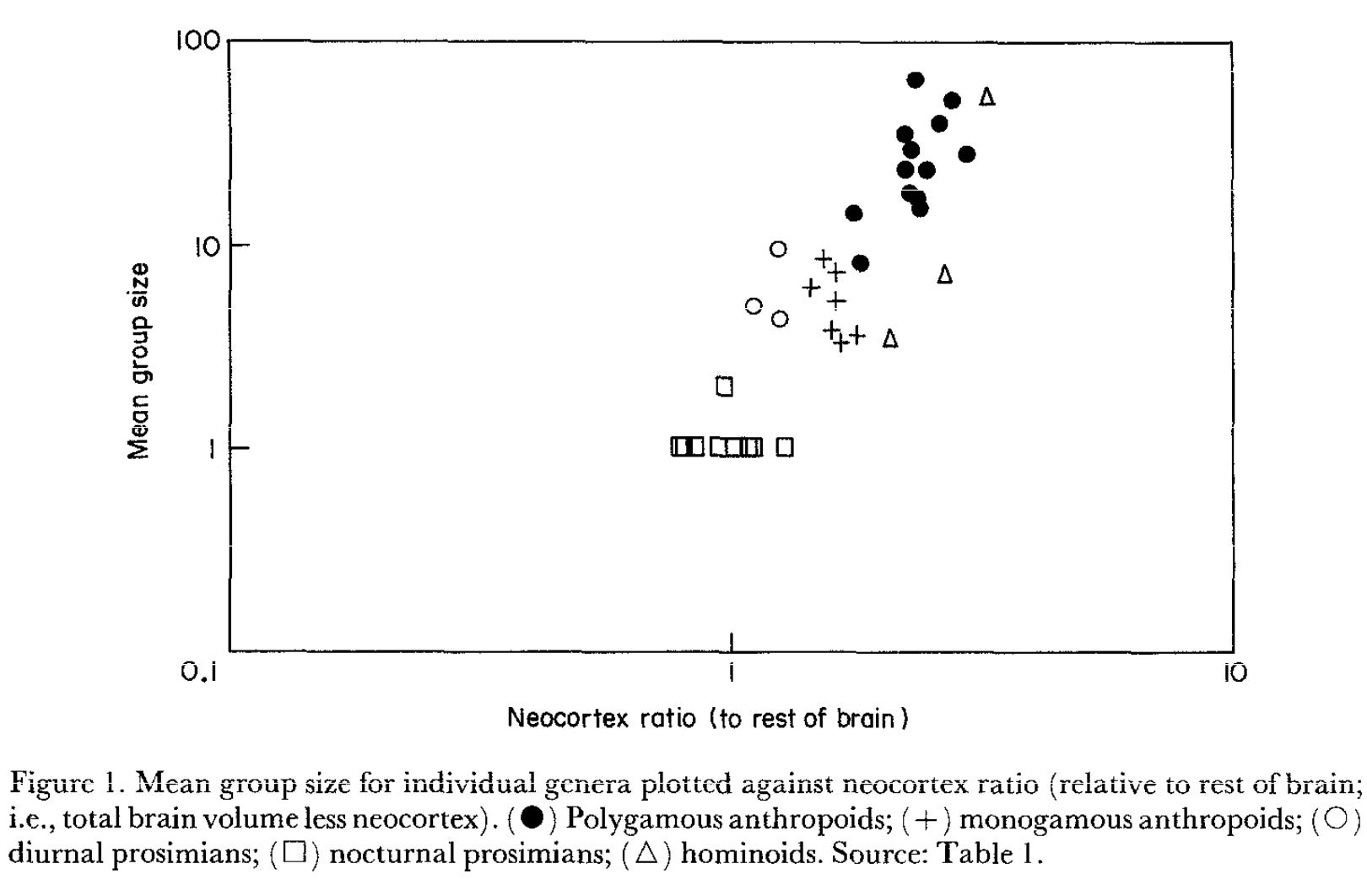
As seen in the figure above from Dunbar’s article, there is a clear linear relationship between neocortex size and the logarithm of group size. Of course, there are many complications with this—apart from it being a mere correlation—but it is nevertheless a strikingly strong one. The three triangles correspond to the hominids: human, gorilla, and chimpanzee. One interpretation offered in Dunbar’s article is that the number of neurons in the neocortex sets an upper limit to how many individuals a social group can consist of without collapsing. In a group that is too large, one cannot keep track of the interindividual relations, which is an extremely complex and computationally demanding task. In that context, it is dizzying to think about how the internet and social media have stretched these limits—and what possible effects this has on us humans.
So it is that we often interpret other individuals and objects as intentional or conscious depending on how they act. Animals are assumed to behave in certain ways because they are good or evil, and not because they have evolved to do so. Even large language models like ChatGPT are seen as “stupid” when they do not give us the answers we want! But if such a language model is advanced enough to produce reasonable answers that make us hesitate as to whether there is a human behind them, is there then any way to find out if there really is?
This is what the British computer scientist Alan Turing considered in his classic 1950 article Computing Machinery and Intelligence. Instead of answering the question of whether machines can think, he tried to operationalize thinking. He proposed an “imitation game” (later called the Turing Test), in which one asks a number of questions to see whether the machine can imitate a conscious being. Turing himself probably believed that a machine could be considered intelligent based on the answers it gives.
Other thinkers, like John Searle, have challenged this conclusion with examples such as the Chinese Room. A person without knowledge of Chinese sits in a room with dictionaries and rules and can thereby produce syntactically correct answers to Chinese questions—without understanding the language. The person outside the room would still believe that he understands Chinese. The conclusion: syntactic processing is not the same as semantic understanding.
There is thus something in the phenomenon of consciousness that is not captured by a syntactic parrot. It is the feeling of experiencing something—being in love, feeling hungry, or being disappointed. This is what the philosopher David Chalmers called the hard problem: why do humans (and probably other animals) have subjective experiences (qualia)? Dennett, on the other hand, argues that qualia is a meaningless concept and advocates a functionalist view: it is the functions, not the substrate, that matter. Consciousness can therefore in principle be realized in software, not only in biological brains.
No posts
Comments
Nothing yet. Say the first thing.
Sign in to join the conversation.