
The other evening, I rewatched the excellent film Awakenings, starring Robin Williams and Robert De Niro. It is based on a book by the late British neurologist Oliver Sacks. The story follows an unexperienced but dedicated doctor trying to understand the symptoms of patients with chronic neurological and neuropsychiatric conditions. These patients appear locked in—one might say catatonic—and are unresponsive except for an almost automatic ability to catch balls thrown at them. Sacks hypothesizes that their condition is an extreme variant of parkinsonism (characterized by rigidity, tremors, and bradykinesia) and therefore tests the then-new drug Levodopa. This precursor to dopamine crosses the blood-brain barrier and increases dopamine concentration in the brain (specifically in the striatum in Parkinson’s disease). Almost magically, the patients come back to life, able to move and interact with the world.

Unfortunately, the effect does not last forever. After a while, symptoms of dyskinesia and spasms (twitching and other involuntary movements) begin to appear. As these side effects become more severe, treatment is discontinued, and the once-liberated patients are again trapped in their mental prisons.
What is the condition these patients suffered from? What we know is that they had previously experienced what is called lethargic encephalitis, also known as European sleeping sickness. This disease was first described in 1915 (during World War I) by Austrian neurologist Constantin von Economo. It initially presented with prodromal symptoms such as fever, sore throat, and headache, followed by double vision and sleep cycle disturbances. Some patients progressed to a state of parkinsonism and catatonia. While adults typically exhibited more motor symptoms, children were often affected by psychiatric symptoms, such as disruptive behaviour. It is estimated that around one million people were affected by the epidemic, with young adults being the most vulnerable. Approximately half—about 500,000—died.
An early hypothesis suggested that the condition was caused by the Spanish flu, which was spreading as a pandemic at the time. The Spanish flu was caused by the H1N1 influenza A virus and, in the aftermath of war, malnutrition, and widespread hardship, resulted in a devastating global pandemic. However, no clear evidence has been found that the influenza virus directly infected the brain and remained detectable. This does not rule out the possibility that the virus—or another pathogen—triggered a reaction in the brain. Many pathological studies have found damage to the substantia nigra, which aligns with the development of parkinsonism.
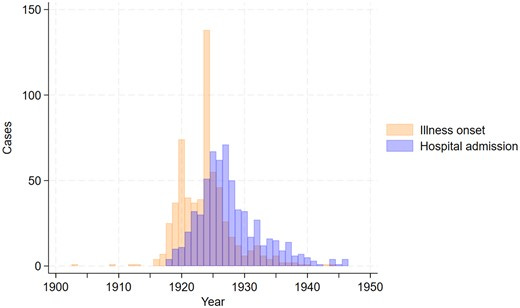
Last year, a study reviewed medical records of 614 patients diagnosed with lethargic encephalitis who were admitted to neurological wards in England. The distribution of disease onset and subsequent hospital admissions peaked around 1925.
Researchers also established a smaller control group (about 60 individuals) with other neurological diseases to investigate, using regression analysis, whether the condition was associated with a fever episode or environmental factors.
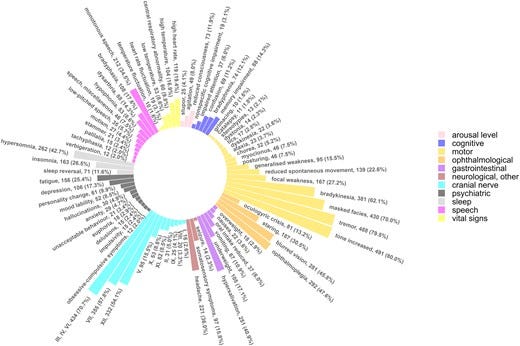
The graph above shows the distribution of symptoms in the group with lethargic encephalitis. Almost all patients had motor symptoms and cranial nerve involvement. Sleep disturbances were observed in 60% of cases, and psychiatric symptoms in half. Among those who underwent lumbar punctures, 12% showed elevated white blood cell counts (a sign of inflammation).
Among the lethargic encephalitis patients, 30% had experienced a fever within a year before onset, a higher proportion than in the control group. However, this could be due to recall bias, meaning that sick individuals are more likely to remember and seek out explanations for their condition. No evidence was found that environmental factors played a significant role.
Alternative diagnoses include catatonia, but this was observed only in a minority of cases. Another possibility is autoimmune encephalitis, particularly NMDA receptor encephalitis, but clinical criteria indicated this in only a small number of cases.
In summary, the study confirms that lethargic encephalitis is a distinct condition, often—but not always—preceded by a febrile illness. Whether there is a single cause or multiple causes remains to be determined.
A pressing question is whether lethargic encephalitis could re-emerge. Given the recent COVID-19 pandemic (caused by SARS-CoV-2) and the likelihood of similar outbreaks in the future, this is an important and concerning issue. However, there are key differences between then and now:
The COVID-19 pandemic demonstrated our ability to rapidly develop vaccines and antiviral treatments, which could reduce the risk of secondary effects on the nervous system.
We now have vastly superior diagnostic capabilities, including lumbar puncture and brain imaging, allowing us to detect brain involvement and inflammation early.
If a new pathogen were to cause a similar condition, it would not necessarily produce the same syndrome as lethargic encephalitis. If the condition is post-infectious and autoimmune in nature, its characteristics would depend on the pathogen’s structure and the immune response it triggers.
During the COVID-19 pandemic, most people experienced respiratory symptoms, while a smaller proportion—mainly older individuals with comorbidities—developed severe and sometimes fatal complications such as pneumonia and blood clot formation. Many patients were hospitalized for weeks, some requiring intensive care and mechanical ventilation. Persistent symptoms in such cases are not entirely unexpected.
At the same time, some individuals who had only mild initial COVID-19 infections later developed severe lingering symptoms, including fatigue and autonomic dysfunction (e.g., sweating, fever spikes, and heart palpitations). The exact cause of these post-viral symptoms remains unclear, though some high-profile studies suggest an organic brain origin.
I will return to this topic in a future post.
No posts
Comments
Nothing yet. Say the first thing.
Sign in to join the conversation.