
Hello, hello. I’m writing from my desk, eating Concord grapes. Usually I love a C.G., but these are weirdly tannic, the chalk-sour notes of grapeseed somehow having taken over the fruit itself. Weeks ago I was in Tunisia and Sicily, where I ate really good, luscious fruit almost daily. It was a discovery of adulthood, that this was a thing that brought me small vivid joy, that produced in me the feeling I am living the life I want.
Some people know, have always known, what they want and what to do. I’m not one of them. I’ve lived most of my years as a series of experiments, held questions, adventures in curiosity. Just a dog trotting nose-first through the world. You believe this, maybe, the voice in my head goes, so then what? Is it true? Is it true for you? So what would happen if—
A while ago, the writer and editor Samantha Paige Rosen asked me to write about what came of one of those experiments of mine, for an anthology she was putting together called Living, Together. Specifically, she wanted me to write about my time organizing in the early 2020s, specifically around mutual aid during the COVID-19 pandemic.
I demurred at first. Back then, when I was organizing, I’d had a bunch of rules for myself, and correctly or wrongly many of them involved not sharing, or sharing judiciously—avoiding as much as possible the temptation to livetweet or subtweet, refusing profiles and redirecting journalists to do more survey-type pieces, that sort of thing. Organizing happens at the speed of trust, and I wanted the people I did this work with to trust me and my sense of discretion. I also was trying to be, and wanted to be thought of as, a writer of fiction. And frankly, I felt mad ambivalent about the social-justice-clouty-activist-influencer economy of the era. So I avoided, for years, sharing much publicly, using the first person, about this work and time in my life.
But time had passed. Living, Together had sold, and Sam was interested in perspectives that examined communality outside the household itself. She persisted with me, and I’m glad she did. I wrote the thing, in first person.
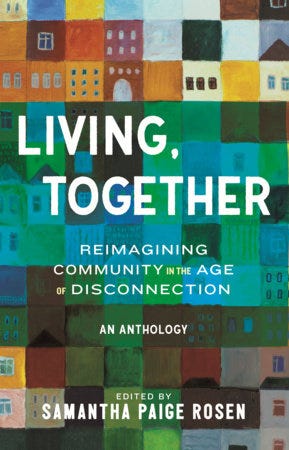
Living, Together is out now, and it is already an indie bestseller. HUGE CONGRATULATIONS, SAM AND TEAM!! Sam asked me to share part of the essay I wrote with you all via the pudding, and I will in a minute. But I also want to say that there’s so much richness, just a bunch of interesting and moving material in the book as a whole, which has essays from brilliant writers like Rhaina Cohen, Kim Stanley Robinson, Kristen Arnett, and many others. You can get it at your local indie, your library, or here.
ALSO. If you live in NYC and you’re interested in this sort of thing, may I rec coming out to Living, Together’s Thursday 7/30 event at Books Are Magic (Montague location) at 7 PM. I’ll be there, and would love to see you.
But this is a personal essay not an oral history. I founded Bed-Stuy Strong in a time of desperation. Together we all made it what it was. For me, it was a multi-authored attempt during a time of crisis at what the historian Kristin Ross calls the commune form, at trying to begin to imagine the unit of the neighborhood itself as a communistic space.
— from my essay The Opposite of Loneliness, out now in Living, Together: Reimagining Community in the Age of Disconnection, excerpted below
I think a certain kind of subject matter gets dismissed these days as hopecore off the bat, the aesthetics of something other than a corroded nihilism corrosive to many a nihilist. But at the marrow of it, hope is not innocence but the exercise of will. There is of course no panacea against the facts of life: things end, times change, love of every form ferments eventually into something new, sometimes your grapes are Edenic and sometimes they taste a little bit like ass. What I enjoy deeply about the essays in this book is that they show the stickiness, uncertainties, pessimisms, and rough-textured realities that beset us all—and give us people attending to their curiosity and constraints and desire. We see them exercising will, following their noses to somewhere interesting.
one
In the language of the meme: within me were two clowns; one romanticized community; one romanticized isolation. In my twenties and early teens I had spent an inordinate amount of time thinking about the seductive subtle dangers of a life organized exclusively around the couple form, the suburban-propertied form, the form of the traditional nuclear family. These all seemed to be a recipe for long-term loneliness, and to my young self, loneliness was a long desert I had achingly traversed and hoped never to set foot in again. People are the answer, I intoned to myself, again and again, as I traveled from the ages of twenty to twenty-eight.
Time confounds. So does real experience: the kind that leaves you calloused or scarified or in possession of smile lines or perhaps the real tell: respectful of the difficulty and complexity of doing anything. I look back now and I think: did that really happen, and how.
Well, it did happen. Here is the shortest telling I can manage: I turned twenty-nine and as COVID-19 began its long ravage of the United States, I started a mutual aid collective in Central Brooklyn. It was an endeavor that began with putting up flyers on traffic poles in my 165,000-person neighborhood of Bedford-Stuyvesant, days before shelter-in-place policies were put into effect. The mutual aid collective was called Bed-Stuy Strong. It was needfully coordinated online, hosted on the messaging platform Slack. Mere hours after the first hundred flyers were put up, it began to explode with activity. At its most robust, Bed-Stuy Strong had over five thousand active members and working groups on everything from sourcing high-quality PPE for healthcare workers to leftist political education to support for neighbors who had recently been released from prison. The collective, over the first year and change of its COVID-era food security operation, raised over $1.2 million dollars from regular people and redistributed it to over 28,000 people, through cash assistance and through grocery delivery. People who did not live through that time in New York, and even some people who did, forget how steeped in death and loss and fear the city was. BSS, as members called our mutual aid network internally, became, for some modest number of people, a place of togetherness, comfort, cooperation, and dreaming, which is to say, a space of life in a time of death.
The network changed as years moved through it and as the emergency it was formed in response to transformed in its nature. I stepped down from leadership to focus on other projects, including my burgeoning work as a novelist and writer. BSS is still active today, in a smaller and focused form, a bantam and determined collective of people that works to do what we did from the beginning: support and care for each other and try to make sure people’s basic needs for survival are being met while making space to question why, in the richest nation in the world, these needs exist in the first place.
A more detailed how of it all is a trickier needle to thread.
What turned into Bed-Stuy Strong began as a spiral of anxiety and rage. Late winter of 2020 I was in the process of surfacing from a profound depression, a diver rising slowly from black water towards the light. The depression had some circumstantial backing. I was making a poverty-line amount of money. I had left a stable career to try to be a writer while freelancing and doing gig work, and this endeavor had not been bearing fruit. I’d been doing badly, but I was getting better. And I’d been reading international news coverage of an emergent coronavirus and reckoning with the real possibility that New York, where I lived, might be about fourteen days behind Italy, which was then under full lockdown.
I remembered my next-door neighbor, who I talked to often, who was not in great health. I wondered if he would be okay. Two thoughts danced inelegantly around my brain: Nobody may come to help us in time; we are all we’ve got. We need to quickly organize, online and geographically.
After looking to see if what I wanted existed already, I mapped out different ideas, sketching them on a legal pad – a series of connected private Facebook groups, branching WhatsApp phone trees – feeling increasingly unsatisfied, and then it hit me. Housing a neighborhood-based network on the messaging app Slack would work well, at least as a start, and we could set up a phone number for neighbors without reliable internet access. I built out the Slack infrastructure in about forty-five minutes, with lighthearted channels like #pictures_of_pets, as well as channels for people to share what they needed or wished to organize around. I made a quick how-to resource in case other people might want to do this for their own neighborhoods, and dropped it on what was then called Twitter.
two
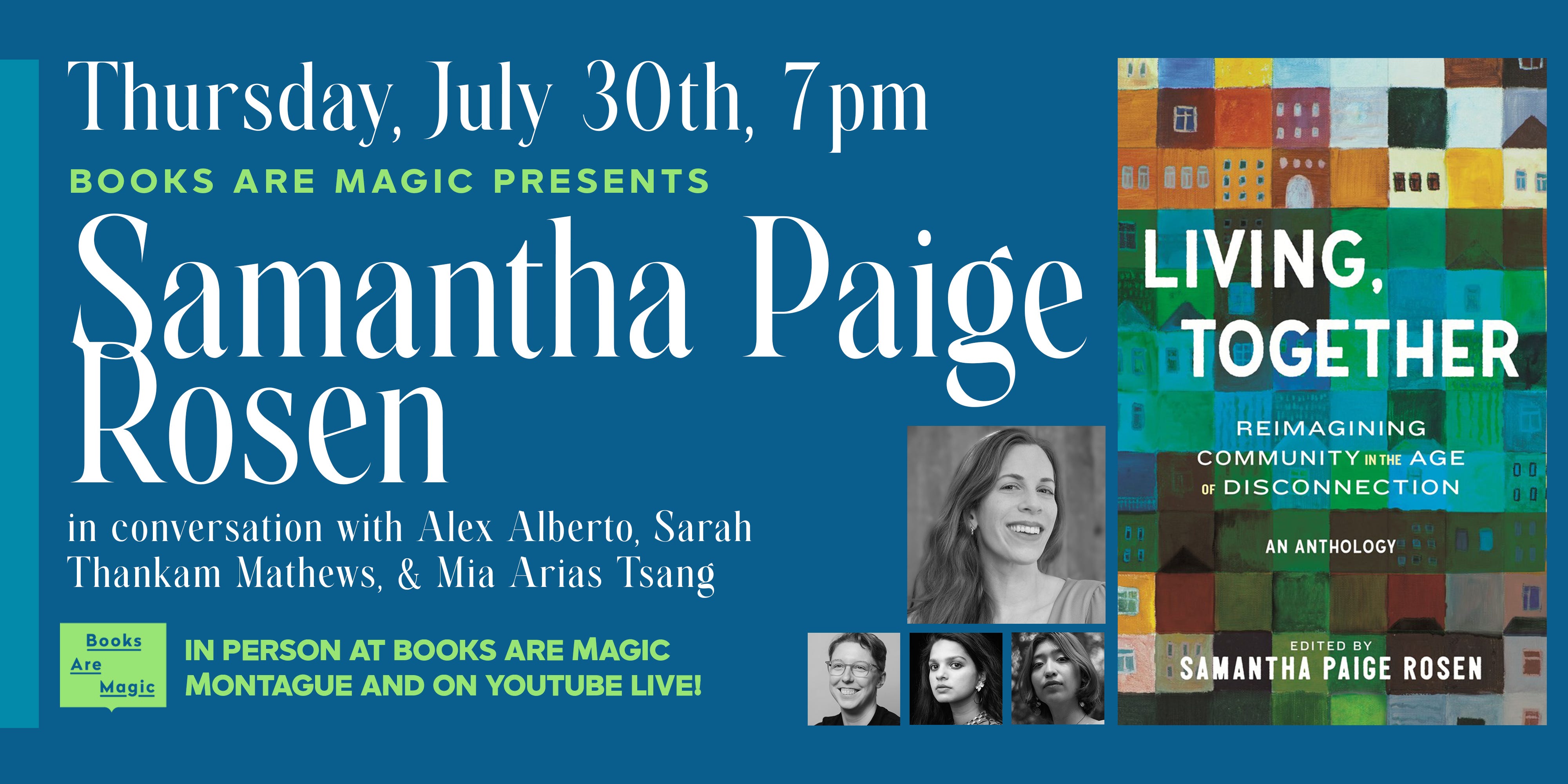
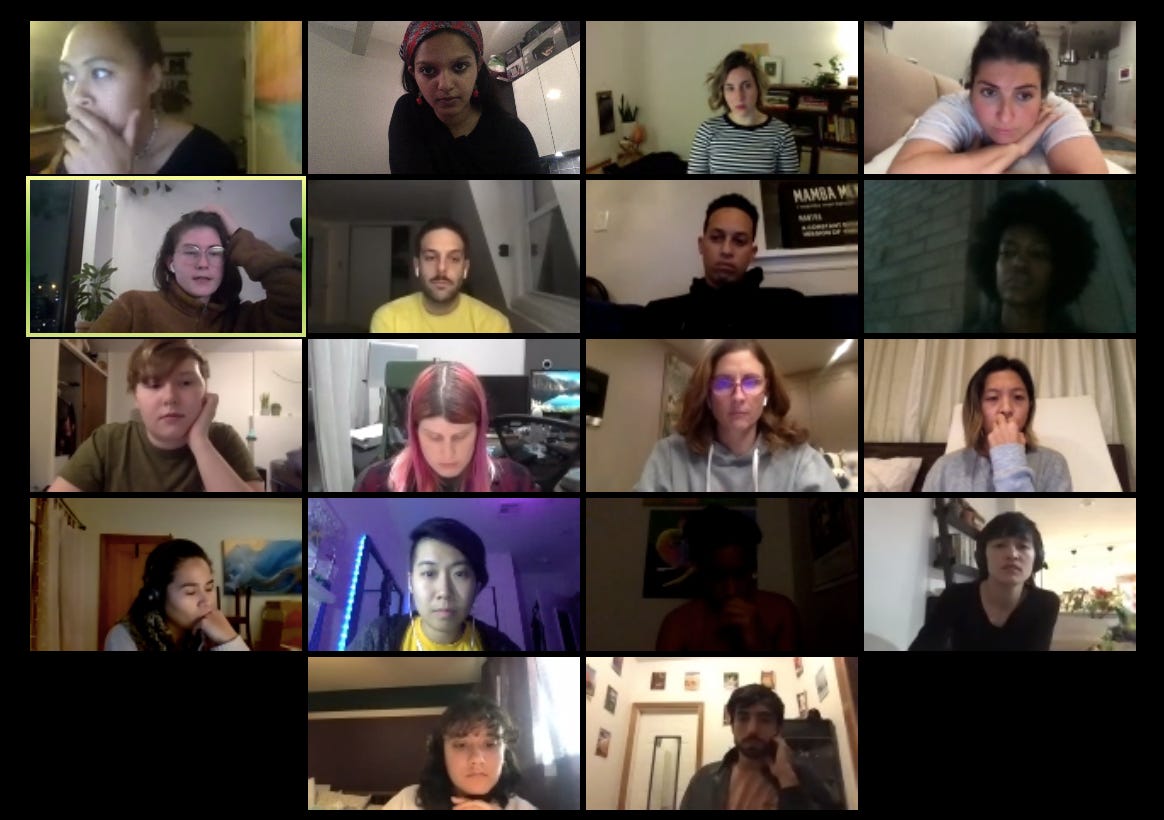
The we of Bed-Stuy Strong is what electrified and astonished me. We: my neighbors, my fellow organizers, the eventual thousands of ordinary people who raised a hand and said, I want to do something. We made a phone number on day two. We had an organizing meeting on Zoom: day four. We made a new bilingual flyer and thirty volunteers papered the neighborhood with it: day six. We set up a rudimentary system: A neighbor would leave a message on the hotline; a member would call them back and find out what they needed, and post it on Slack for other neighbors to respond to, or offer to contribute money. Most neighbors calling needed groceries – they were older people or immunocompromised, they couldn’t leave the house or they had been laid off and had no funds. We began to receive thirty to fifty calls each day. We set up a community fund to buy those groceries, stitching together cash apps like Venmo and PayPal and Zelle to a personal bank account: That, I think, was day eleven. Some of our members who had backgrounds in tech raised their hands to offer to try to build a more sophisticated system so we could help more people and faster, given that hunger is a pretty immediate need. We put it in motion. By the end of the first two weeks over a thousand people had joined. This was terrifying, and exhilarating too.
three
All of this was true and sincere and also, in the interstices of my words, looking back from years later, I see the culture of the moment I was writing from: a stormy time of reckoning, awareness of structural and historical injustice, the George Floyd uprising, the specter of online callouts and cancellations, the massification (and co-optation) of mutual aid in a way where an increasing number of people understood it to mean “virtuously helping people less fortunate,” and what would later dismissively get called wokeness. Bed-Stuy is a historically Black neighborhood with a rich tradition of self-determination. In the early 2020s it was continuing to gentrify rapidly, aided by city policies and legislators who were uninterested in reigning in real estate interests in any meaningful way. While BSS had Black members and lead organizers, they were not in the majority. White guilt and shame reverberated through the network, as they were reverberating through American society at large, producing effects both useful and exhausting. The anxieties and ambivalences and confused etiquettes of the time showed up, again and again, in the work behind the scenes.
It is worth asserting that mutual aid is something deeper and more interesting than “helping people:’ Mutual aid is premised on the recognition that everything in our society lives and dies by resource allocation: the ordering of shelter and food and care and money. It is, as a principle, interested in the idea that we might cooperatively allocate resources by something other than the profit motive, with an eye to solidarity, to the survival and flourishing of all. Mutual aid is practiced most easily in homogeneous environments, as an in-community tool, or as a tactic of community recruitment. Churches and mosques, gay people and men, Native and Black and South Asian people, all have their histories with the practice. Even some white supremacist groups practiced mutual aid. The success and challenge of Bed-Stuy Strong was inextricably tied to its insistence that everyone had needs and everyone could help and that something quietly radical could take place once a group of people’s help met their own needs when the state was failing.
I’m not sorry for the time I spent, and I believe the work I put in to help members resolve their conflicts genuinely helped the collective have a lifespan of longer than a few months. But these dynamics, and the grinding and unpaid work in general, took a toll on me.
four
I have often felt weird speaking about Bed-Stuy Strong as an I, a single self. For years I mostly managed not to, when I wrote emails asking for money; spoke with reporters looking to tell a trend story; or DMed with people explaining that no we were not a nonprofit or a food pantry with 501c3 status, we were a membership-based organization and they were welcome to join. The we seemed easier and more truthful. Because BSS was the work of literally thousands of people, and in particular the collectively-harnessed genius and rigor of about nine organizers whose decisions and work shaped what the organization became. Because I know that the story of BSS would probably look really different, depending on who was doing the telling, whether it was Hanna or Jackson–the lead organizers of our warehouse operation, among much else–or one of the moms receiving grocery support while using her car to get food for other families, or one of the many people who signed up to “help out” and after completing a shift or four returned to their lives.
But this is a personal essay not an oral history. I founded Bed-Stuy Strong in a time of desperation. Together we all made it what it was. For me, it was a multi-authored attempt, during a time of crisis, at what the historian Kristin Ross calls the commune form, at trying to begin to imagine the unit of the neighborhood itself as a communistic space. I helped run it for two years and then sometime during my third year with the group, I stepped down from it, truthfully citing a lack of time. I left unsaid something more complicated: that I was exhausted and aching for a hundred reasons, that I wanted to be a writer who had enough peace to think, that I wanted to be small and ordinary and have no good answers and be cared for anyway. I was proud of what we did together, a pride all the fiercer for being shot through with mourning. The collective gifted me with some of my closest friendships. It gave me the deep joy of putting principles into applied practice with clever and humble and determined people and watching them actually work. It exhilarated me, it taxed me, it wounded me, and it changed my life.
five
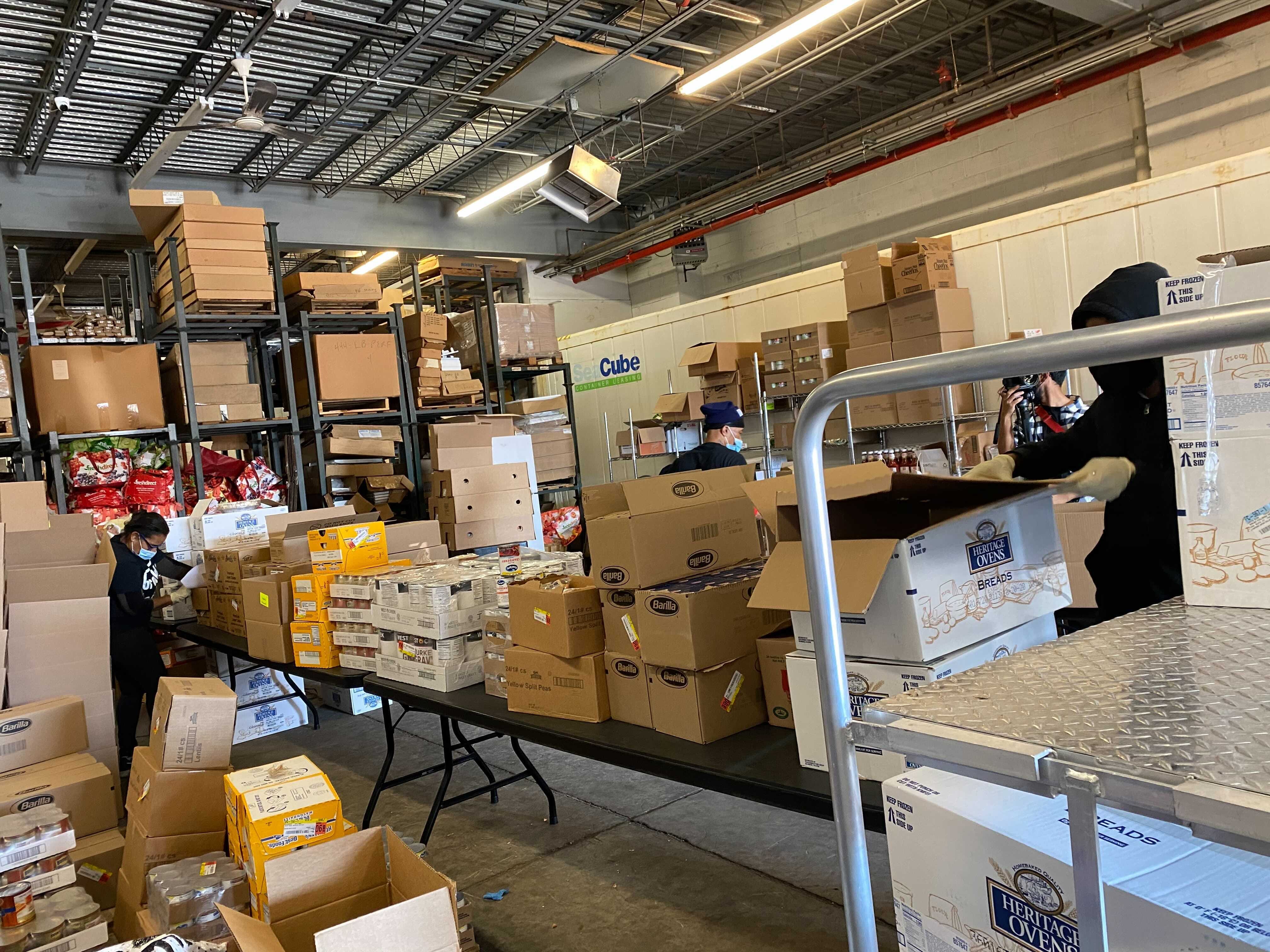
I don’t know if people are the answer. But for me, they will always be the question. After everything, the profound, dizzying pleasure of togetherness is my lasting impression of the early years of Bed-Stuy Strong. I think of vigils and Free People’s Markets and block parties in Herbert Von King Park organized by people including Sky Hollenbeck, Derek Smith, and Alyssa Dizon. I think of Hadass Wade, who came to BSS after years of waiting tables, who indefatigably managed over a million dollars in our community fund and personally disbursed and tracked over 30,000 individual Venmo transactions. I think of Hanna King and Jackson Fratesi masterminding a warehouse operation in Brownsville with the worker-owned cooperative Brooklyn Packers, which allowed us to feed thousands more people at scale. I think of Alex, Nia, George, Sam, Unis, Hannah, Ivonne, and so many others who labored to make something startling and moving in its enormity. I think of spreadsheets and pallet jacks and weepy voicemails from strangers who got to put food on their families’ tables in a time of social breakdown. I remember parties and dinners and cry-laughing on Zoom. I remember street cleanups and dancing in the sun. I remember having a place to always turn to when bad things happened: what a shocking, precious gift. I remember sitting deathly sick on my stoop and having Chris Xu, a then-stranger who became one of my closest friends, glide up on rollerblades to drop off medicine, looking like they’d materialized straight out of a Sega Dreamcast. I remember some of the deepest joy I’ve ever known, some of the fiercest exhilaration, the truly bodily-felt knowledge that we were powerful, because we were together. It was the opposite of loneliness, all of it, the struggle and the triumph alike. That’s what I’ve kept in my life ever since; it’s what I wish for everyone.
Excerpted from Living, Together: Reimagining Community in the Age of Disconnection edited by Samantha Paige Rosen (Beacon Press, 2026). Reprinted with permission from Beacon Press.
Comments
Nothing yet. Say the first thing.
Sign in to join the conversation.