
Let me be direct about what the charts are telling us heading into this weekend. On Friday, both SPY and QQQ finished below — or right at — their 50-day simple moving averages. SPY closed clearly below its 50 SMA. QQQ is hanging on by a thread, sitting just barely above it. That is not a small detail. The 50-day is one of the most-watched lines in the market, and when the major indexes start losing it, the message is simple: the market is cracking.
But cracking is not the same as broken. And that distinction is the entire story this weekend.
Here is the nuance that matters. Even though the indexes have slipped below this key moving average, the market is still holding above the extreme selloff lows we flagged in the first week of June. Remember that stretch — the Broadcom shock, the semiconductor earthquake, the global contagion that dragged the Kospi down over 5%. That was the moment of maximum fear. And as ugly as the tape feels right now, we are still holding above those early-June lows.
At the same time, we are sitting below the levels the market reached on its post-FOMC reaction. So picture where that leaves us: above the panic lows, but below the optimism highs. The market is trapped in the middle, contemplating. It is caught between the reassurance of the Fed and the weight of all the other background news — and it has not yet decided which way to resolve.
That indecision is exactly why this is not a moment to force a position.
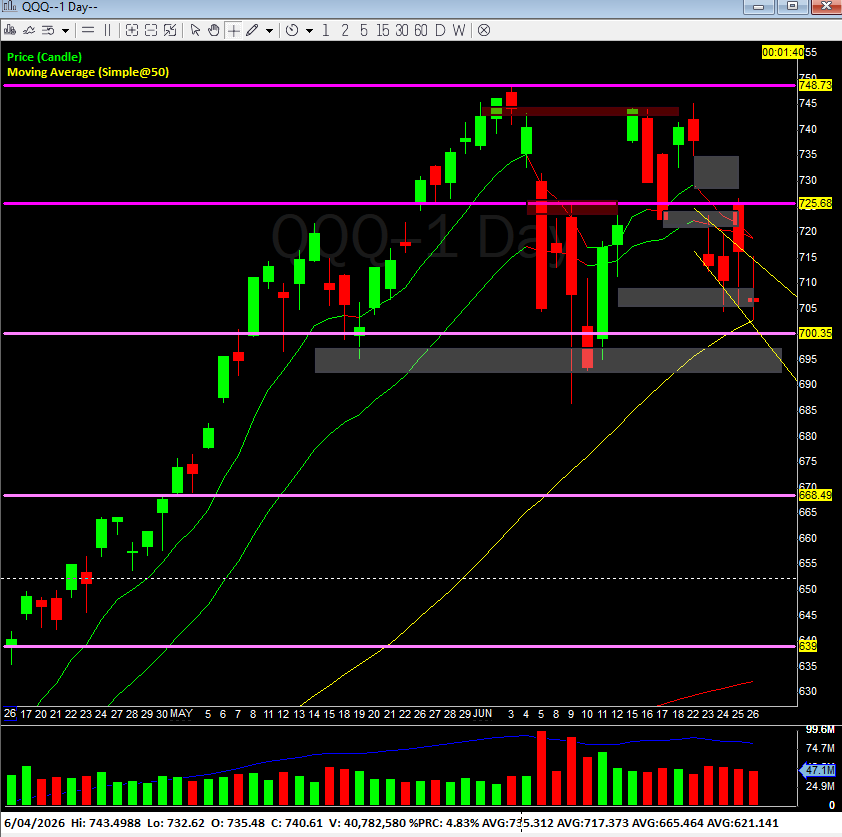
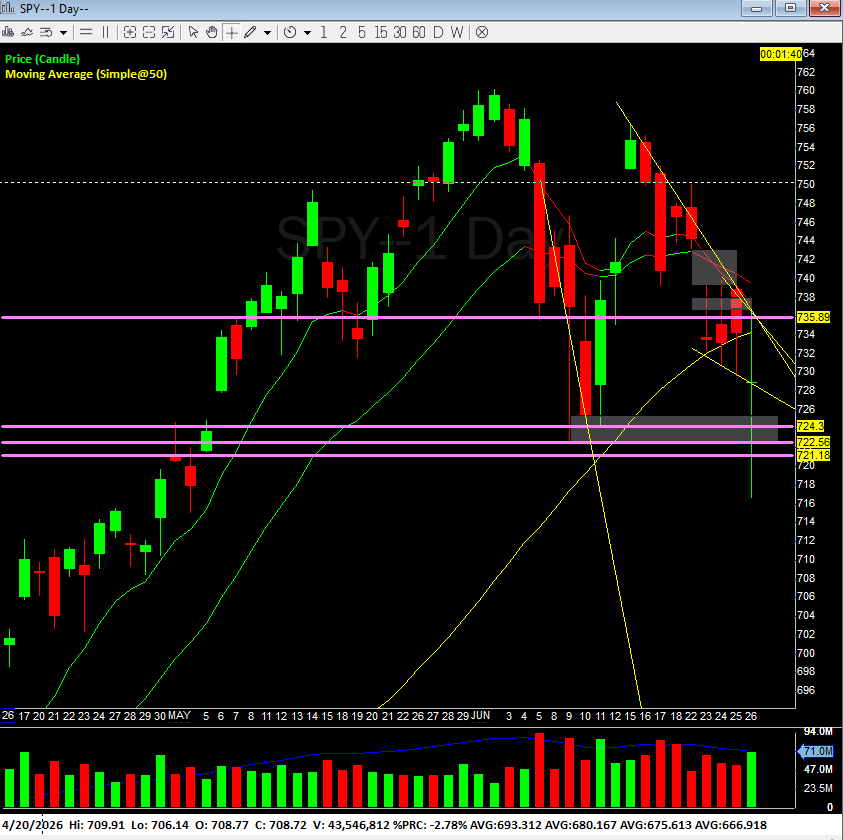
I do not want to sugarcoat what is happening beneath the index level. A lot of stocks have been crushed. The semiconductors, the computer hardware names, the Magnificent Seven — many of them are sitting in severely red conditions right now. The leadership that carried this market for the better part of a year has taken real technical damage. When the generals get hit this hard, you have to respect what it means for the broader tape, even if the indexes themselves are masking some of it.
This is the difference between reading the headline index number and reading the actual condition of the market. The indexes are holding up better than the names underneath them. That is a warning, not an all-clear.
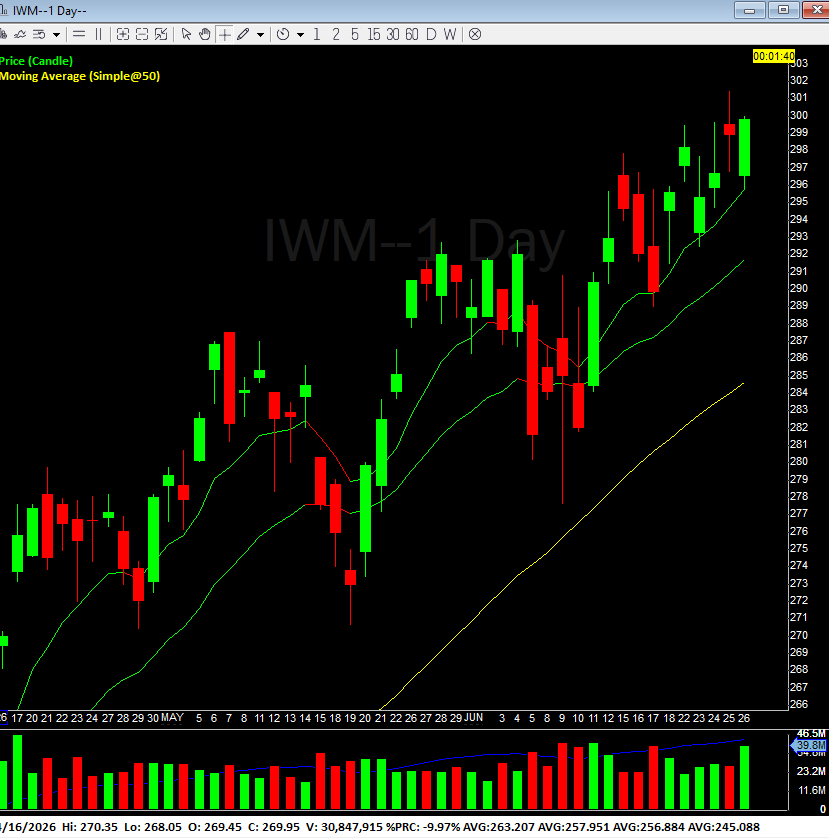
Here is a detail worth paying attention to, because it complicates the picture in an interesting way. While the semis and mega-cap tech are getting crushed, the small caps (IWM) and the Dow (DIA) are actually holding up strong — both trading above their 9 EMA, showing real relative strength while the former leaders bleed.
On the surface, that is the bullish interpretation: it looks like healthy rotation. Money leaving the crowded, broken tech trade and flowing into the parts of the market that have lagged. And it might be exactly that.
But here is the part that keeps me cautious, and it comes from watching enough cycles to respect the pattern. Small caps breaking out late — after the leadership has already topped and started to roll over — is very often the last thing that happens before everything comes down together. It can be the final leg of a move, the last group to get the memo, rather than the start of a fresh new uptrend. When the most speculative, risk-sensitive corner of the market catches a bid right as the generals are falling, it sometimes signals the tail end of the cycle, not the beginning of a healthy rotation.
Now, I want to be fair: it is genuinely too early to say which of these it is. Rotation and late-cycle blow-off can look identical in real time — the same way an aggressive range move and a real breakout look identical at birth. I am not going to pretend I know which one this is yet. But when I weigh the broken leadership, the indexes losing their 50-day, the elevated volatility, and now small caps catching a late bid, the balance of evidence tells me the same thing: risk-off is the way. The small-cap strength is interesting, but it is not enough to pull me off the sidelines. If anything, the reason it’s strong is the thing I want to understand before I trust it.
I will tell you exactly what I am doing, because I believe in being transparent about my own positioning. I have been largely in cash for the last two to three weeks. And I am going to continue to stay in cash until the market clears up and shows me a direction.
This is a risk-off environment. Full stop. When the indexes are losing key moving averages, when leadership is broken, when the market is caught between competing narratives and volatility is elevated, the smartest position is often no position. I would rather sit on my hands and protect my capital than force a trade into a tape that is showing erratic, unpredictable behavior. There is no rule that says you have to be in the market at all times. Cash is a position — and right now, it is the one I am most comfortable holding.
I am not bearish forever, and I am not calling for a crash. I am simply waiting. The market is digesting a lot at once — the Iran situation and the geopolitical overhang, the Fed’s path, the damage in tech. I want to give it time to settle and work through all of it. Once the dust clears, the picture will be far easier to read, and the right opportunities will present themselves with much better odds.
Specifically, I want to see the indexes reclaim and hold above their key moving averages, the broken leadership stabilize rather than keep bleeding, and volatility calm down to the point where price action becomes orderly again instead of erratic. When the market is ready, I will be ready. But I am going to let it prove itself first rather than trying to guess the bottom in the middle of the chaos.
This is the hardest lesson for most traders, and it is worth stating plainly. Doing nothing is a decision, and often it is the most profitable one. In a volatile, directionless, risk-off tape, the trader who forces action is usually the trader who gets chopped to pieces. The capital you protect today is the capital you get to deploy aggressively when the real opportunity finally arrives. Patience is not passivity. It is preparation.
The market will hand us a clear setup again. It always does. The job right now is simply to still have our full account intact when it does.
The market is cracking but not broken — holding above the early-June lows, but below the post-FOMC highs, caught between the Fed and everything else. The damage under the surface is real, the environment is risk-off, and the responsible move is to wait for clarity rather than force conviction where none exists. I am in cash, I am patient, and I am watching closely.
Sometimes the best trade is the one you don’t take. Protect your capital, respect the volatility, and let the market come to you.
This is exactly the kind of environment where having a clear head and a disciplined community matters most. If you want to navigate this carefully with us — and be ready to move when the market finally gives the all-clear — come join us.
👉 TheSmartTraders.com
This content is for educational purposes only and does not constitute financial advice. Trading futures involves substantial risk of loss. Always do your own due diligence.
Comments
Nothing yet. Say the first thing.
Sign in to join the conversation.