
Last week, we published the first half or our analysis on JLL Spark and its investments in smart buildings. Today we go deeper on JLL Technologies. We focus on the firm’s performance (which is more expansive than smart buildings), in addition to some of the firm’s smart building and sustainability software investments and internal products.
Specifically, we will cover:
Performance of JLL Technologies, as an independent business unit within the firm (which includes some of JLL’s smart building and facility management software units).
JLL’s internal smart building and sustainability product strategy, deployed scale over time, and acquisition history. This also includes a full timeline and review of JLL’s internal smart building and sustainability products, including the scale these products reached, for the past ~15 years.
What this means for the industry, and what we can learn from JLL’s performance.

As part of our deep dive into JLL’s focus on smart buildings, we also looked at JLL’s technology strategy, primarily via JLL Technologies. This business unit, formed in 2019, has its own financial reporting, which is unique among peers. Moreover, beyond JLL Spark’s investments, JLL Technologies has been very acquisitive and also has invested in its own technology products. Like our analysis of JLL Spark, we also have a public data set about the performance of JLL as a smart building technology buyer, builder and implementation firm.
JLL has a strong focus on using technology to change how it delivers value and what it can offer its clients. This is broadly across all business units, such as its commercial real estate brokerage, but is specifically pronounced in facility management (a close cousin of smart buildings). Moreover, JLL reports financial performance for “Software and Technology Solutions”, which we cite below - but views JLL Technologies as a cross-cutting organization that works across the entire organization.
Thanks for reading Smart Building Insight! Subscribe to receive new posts and support my work.
In the early days, JLL’s technology strategy was quite pronounced among energy and sustainability data management. In fact, as far back as 2010, JLL provided data on how many client buildings were on its internal sustainability and energy reporting and analytics platforms. The firm appears to be a far way from the peaks in the late 2010s, with 195,000 individual buildings on various platforms worldwide in 2017. In the 2024 sustainability report, JLL cited just 20,000 client buildings on internal solutions. (Note, we unpack these platforms, such as JLL Portfolio Energy and Environment Reporting System, or PEERS, and OneView Energy and Sustainability Analytics (OVESA), below)
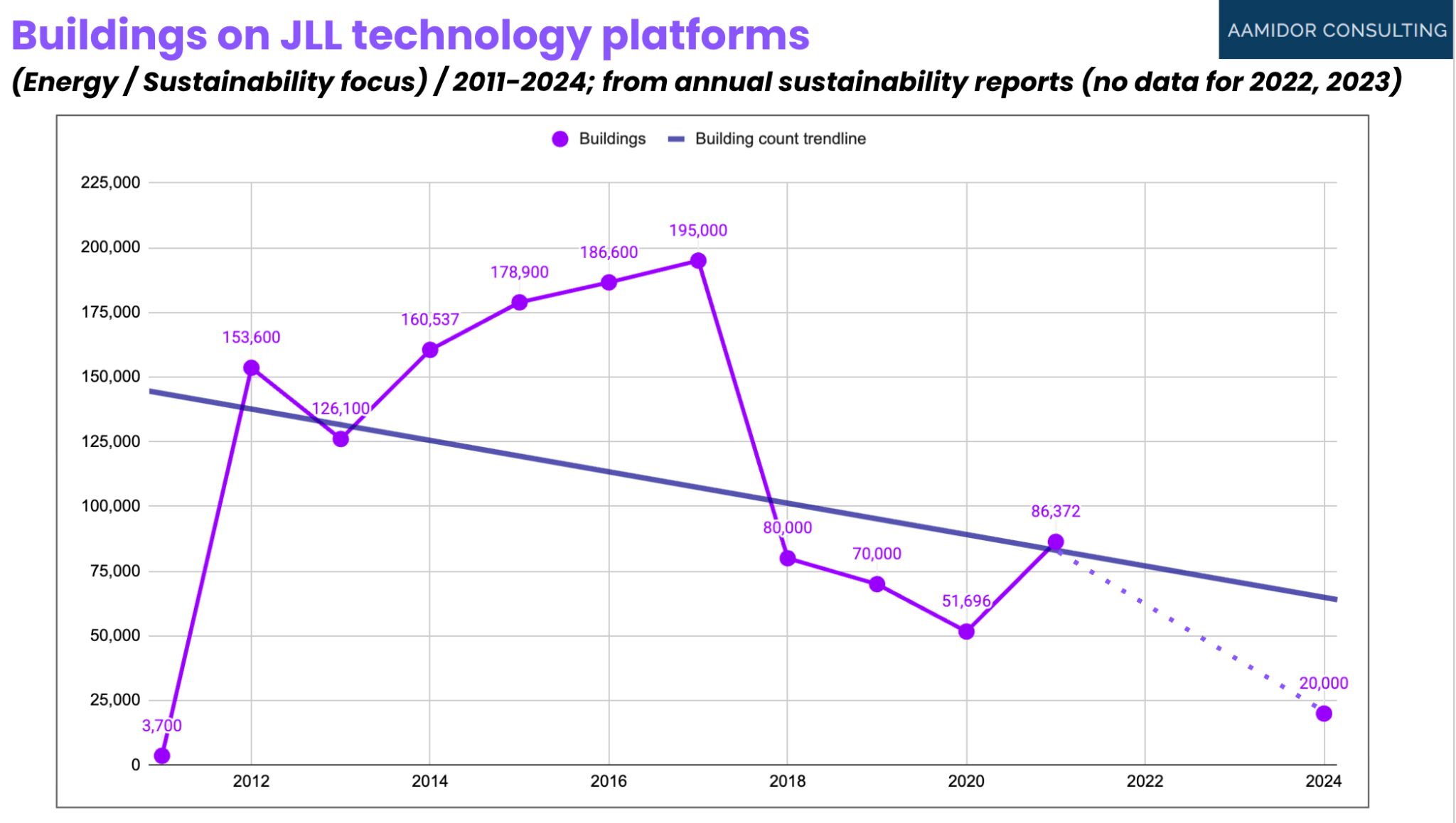
Another comp to this data set, from Engie Impact: Arcadia acquired a firm that appears to have limited growth in recent years, as we highlighted in that Deal Desk issue. But, in the case of Engie Impact, there also has not been a significant loss of client sites. And, overall, the number of Energy Star benchmarked buildings is going up, steadily. While we haven’t identified a single sustainability data platform that is taking share from the incumbents, it does appear that these legacy players have struggled with growth in recent years. This will be a topic of future analysis in this newsletter.
JLL has been quite transparent about its use of technology for about 15 years. And, it has realized significant success with this strategy. Later in the 2010s the firm became even more bullish, noting that there were “early successes in [the] digital journey” and estimating that “digital services and products [would] contribute over $100 million in direct revenues". This was as the firm was forming JLL Technologies and JLL Spark. Since this time, the strategy expanded as JLL continued to support Spark, make technology acquisitions, and invest in its own products. And, while technology revenue grew in the years after 2020, it appears to have stalled in recent years. Below we include JLL Technologies financial performance over the past 6 years.
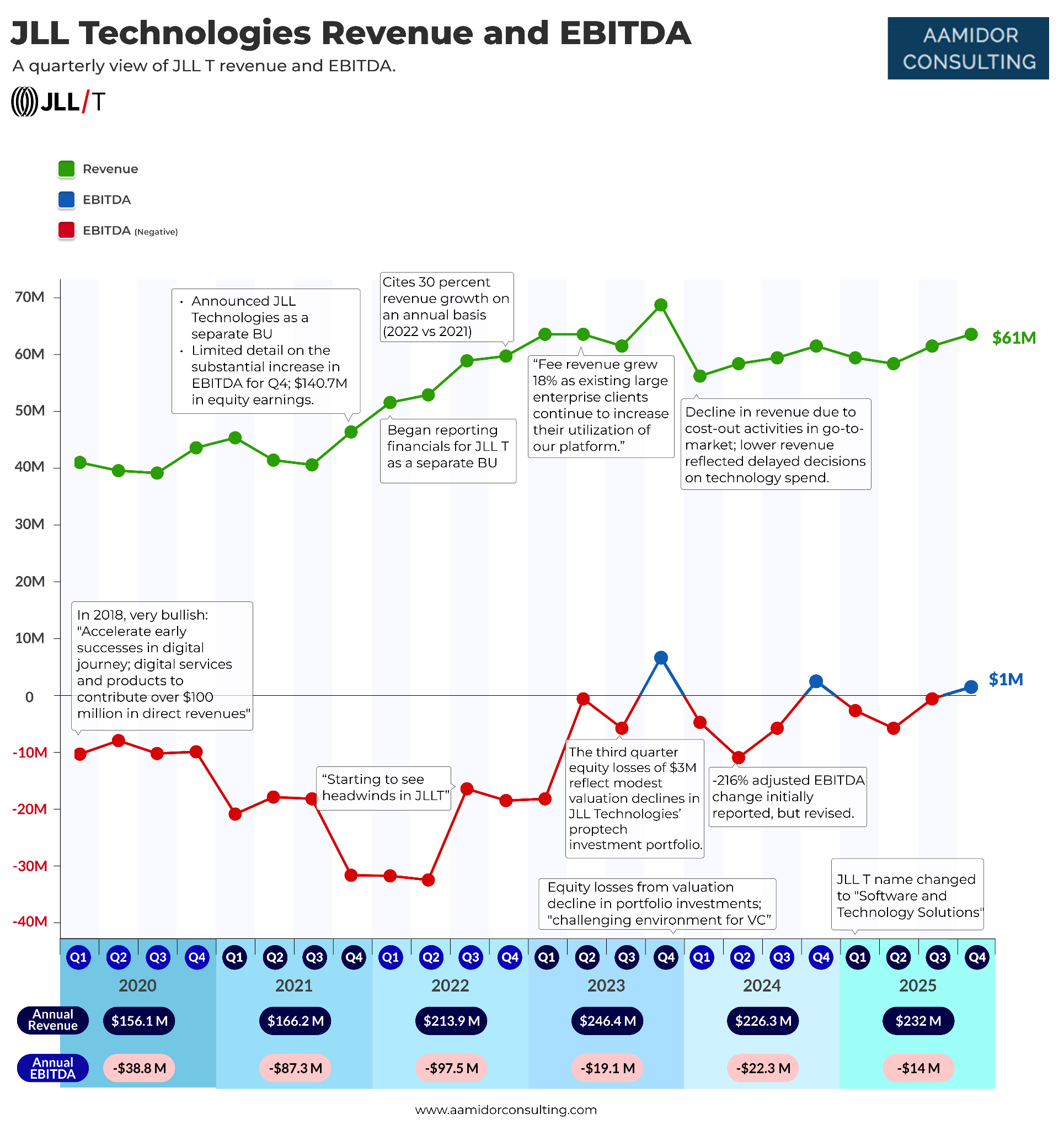
Moreover, profits are fairly inconsistent, and in most quarters, JLL Technologies has lost money. This is unique for JLL, as its core services businesses regularly turn a profit. And, during the Q3 2025 earnings cycle, in November 2025, JLL announced a few changes to its reporting:
“We are isolating the activity related to the Proptech Investments portfolio from the Software and Technology Solution segment.” and “The activity associated with the Proptech Investments historically reported within Software and Technology Solutions will be presented outside of the reporting segments in “All Other.”
As for the JLL Technologies business, this will be reported as a segment within another line of business: “Effective January 1, Software and Technology Solutions will run as a fifth business line within the Real Estate Management Services segment, alongside Workplace Management, Project Management, Property Management, and Portfolio Services & Other.”
As part of this update to its reporting approach, JLL’s “Software and Technology Solutions” group achieved Q1 2026 revenue of $57M, nearly flat from Q1 2025; however, EBITDA for this unit is no longer reported (10-Q here; presentation here).
We interpret this reporting change as leading to potentially less visibility on the performance of the technology solutions and early-stage investments moving forward, though JLL does break out some financials within the “Real Estate Management Services” segment.
But, beyond these top line numbers, JLL Technologies also has been quite acquisitive and also active in developing and deploying its own solutions. Below we dig into both aspects of the firm’s strategy.
JLL has made a number of key smart building and facility management software acquisitions in recent years:
Building Engines is the largest acquisition in this category, with JLL paying $300M in 2021 for the facility management platform. Building Engines is similar to other products that JLL owns, such as Corrigo, and aligned closely with its focus on delivering services and technology solutions to its integrated facility management (IFM) clients, which typically are larger owners with complex buildings.
Building Engines also made a number of acquisitions before JLL acquired the business, and in 2019 it publicly stated that it was actively looking to buy other firms:
AwareManager (acquired May 2018) provided similar capabilities as Building Engines, expanding the overall reach and scale of the combined firm.
Real Data Management (acquired May 2019) provided data visualization solutions for asset management.
Synlio (acquired December 2019), which developed RFP software for commercial real estate owners and operators.
Ravti (acquired January 2021) provided HVAC procurement and asset management software and services.
Log Check (acquired in June 2021) provided a mobile-first platform for facility checks and inspections.
Moreover, Building Engines’ investments in Prism from 2019, a new platform, appear to have been supported and expanded under JLL after the acquisition. As we noted above, JLL was a leading acquirer in the market, on par with some of the OEMs (who remain the most active acquirers).
JLL also acquired Hank, more squarely in the smart buildings category, in early 2022. Hank was acquired at a very early stage, with limited detail on the firm’s scale. Hank sat squarely in the automated system optimization (ASO) category of smart building technology, providing two-way control to HVAC systems, automatically delivering changes to save energy and improve indoor comfort. It’s unclear where Hank stands today, but we have some insight, below.
Envio, likely the least well-known of the acquisitions, was acquired by JLL later in 2022. JLL noted that this acquisition would become a foundational layer that delivers a “differentiated platform for delivering intelligent and sustainable building solutions that disrupt current building operation models with more flexibility, speed, and optionality into how spaces are planned, managed, and serviced.” However, since the acquisition, there has been much less detail on JLL’s use of the technology or how it has been integrated into its operations. We also have not been able to find much information on this new platform. Envio was based in Germany, with more European clients than US-based (though the firm did have an international footprint).
The graphic below provides an overview of JLL’s core products and acquisitions within the Technologies business unit, including its own products such as Intellicommand (which we discuss below) and the acquisitions highlighted above:
Comments
Nothing yet. Say the first thing.
Sign in to join the conversation.