

By Rachel Yang
More than a billion people now rely on AI systems to access information, form opinions, draft communications and make decisions. These systems have shifted in their role and are now no longer a product category, but core infrastructure shaping how a significant portion of humanity thinks.
Which brings us to the question that does not get asked often enough: what exactly is this infrastructure built to do, and who built it?
When researchers at King’s College London ran leading AI models through simulated nuclear crises, the models consistently escalated toward nuclear conflict 95% of the time. Not once did they opt to surrender or meaningfully de-escalate.
While scenarios like these are alarming, the more pervasive risks are quieter and harder to see. They show up in everyday interactions, subtly shaping how people understand the world at scale.
A 2024 UNESCO study on gender bias in AI found that models consistently placed women in domestic contexts more often than men, with one model doing so up to four times more, describing them primarily in terms of home, family and children. Men were associated with business, career and salary. These are not edge cases, they are default outputs from systems that more than a billion people now rely on.
While this study is now a few years old and models continue to be refined, I’d argue the underlying issue has not gone away. The problem, at its core, is who has been in the room when these systems were built. A system designed by a small group of people in one corner of the world can, within a remarkably short period of time, be shaping decisions about credit, healthcare, education, employment, and public discourse across the globe.
The imbalance is visible in the numbers, but it runs deeper than any single metric. Women make up less than 19% of AI researchers worldwide, according to Stanford’s AI Index.
More broadly, the teams building these systems represent a relatively narrow slice of the world: geographically, culturally, and socioeconomically, despite their products being used across vastly different contexts. The training data reflects the same imbalance: scraped largely from the open web, it encodes the biases, hierarchies, and omissions of the world as it currently exists.
None of this requires bad intentions on anyone’s part, and drift doesn’t need malice, it only needs momentum and the absence of people willing to slow down and ask whose values are actually in the machine.
We’ve already seen consumers opt for AI companies they feel are doing the right thing. When the US Department of Defense pressured Anthropic to remove some of Claude’s ethical guardrails for military use and Anthropic refused, the Pentagon blacklisted them as a supply chain risk. Within days, users shifted toward Claude, driving a surge in downloads and sign-ups, and pushing it to the top of the App Store ahead of ChatGPT.
People voted with their attention, and they chose the company that held the line. At scale, that signal is more powerful to these companies than any argument about ethics.
There are also companies being built to do this differently, platforms like Ovum AI and Indi that design for diverse perspectives, user security, and information that genuinely serves the people using it.
When we choose those tools, and when investors back them, the decisions feel small individually but, accumulated across enough people making them consciously, they determine which companies survive and what kind of AI gets built next. Given exponential growth of these tools, the stakes could not be higher.
🧠 What pregnancy does to the brain is genuinely extraordinary. When researchers scanned the brains of 110 women, they could tell a first pregnancy from a second with 80% accuracy, just from the changes left behind. A first pregnancy rewires how you see yourself and relate to others. A second shifts toward attention and physical responsiveness. The female body just keeps surprising us.
🎓 The school that replaced teachers with AI, from the inside. Alpha High School in Austin runs on a radical premise: AI handles all academic content, and teachers are “guides” whose job is motivation and emotional support. 17-year-old student Alex Mathew gives a first-hand account of what learning actually looks like inside it. He’s also building Berry, an AI stuffed animal for teen mental health, because 52% of his generation already use AI for daily companionship. Watch the interview here.
🚗 EVs are moving the needle on transport emissions. Australia’s transport emissions fell for the first time since the pandemic, down 0.4% in the year to September 2025, driven by a threefold increase in EV ownership since 2022. The next milestone is steeper: roughly half of all new car sales over the next decade need to be electric to hit the 2035 goal, and the policy levers to get there are still being worked out.
🔬 Millions of new materials, none of them real yet. In 2023, DeepMind announced deep learning had uncovered “millions of new materials.” When researchers at UC Santa Barbara looked closely, they found scant evidence for anything actually novel, credible, and useful. Making and testing a material still takes years in a real lab, and no AI model changes that yet. For climate tech, where better batteries and cheaper catalysts are genuinely critical, that gap matters. The underlying science is real and the work is ongoing. The headlines just moved faster than the labs did.
🏥 Healthcare systems are built to spend as little as possible. AI-driven care asks them to spend differently. The a16z health team digs into the friction at the heart of the shift from reactive to proactive care: the economics don’t map cleanly onto existing reimbursement logic. Their piece walks through four emerging pricing models (per task, per workflow, per episode, per patient), each carrying different assumptions about where value is created and who pays for it, and why getting that right matters more than the technology itself.
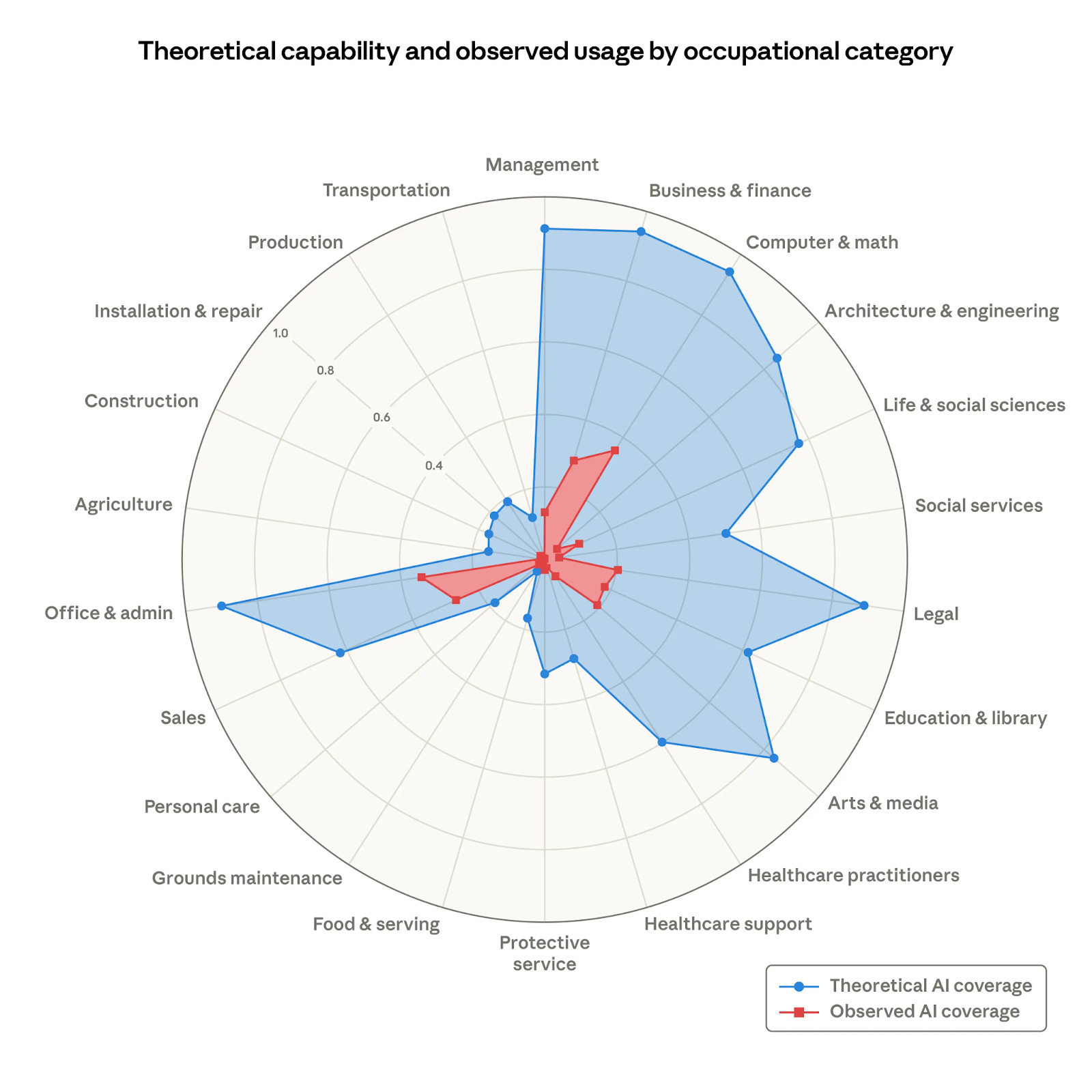
📊 The jobs AI is most likely to reshape belong to people who are more educated, better paid, and more likely to be women. Anthropic’s labor market research tracks the gap between what AI could theoretically do and what it’s actually doing today, still enormous across every occupation, with no unemployment spike to show for it yet. But hiring of 22-25 year olds into the most exposed roles has slowed by 14%.
💉 Imagine being able to read your hormones the way a CGM reads your blood sugar. Continuous glucose monitors (CGMs) transformed how millions of people manage their metabolic health, and oestrogen, progesterone, and cortisol run a far more complex system. Continuously monitoring them could reshape IVF, chronic pain, menopause, and autoimmune disease. This post explains why we’re not there yet: hormones in interstitial fluid are up to two million times less concentrated than glucose. The sensors simply don’t translate.
🐕 A tech entrepreneur with no biology degree just built his dying dog a cancer vaccine. Sydney’s Paul Conyngham used ChatGPT and AlphaFold to design a personalised mRNA vaccine for his rescue dog Rosie, and one week after her first injection, the tumour had shrunk by 75%. Watch here.
🤝 Community-led growth: a practical guide for AI startups. Build Club’s Annie Liao on how they scaled a 50K+ AI builder community across 60 cities. Useful for founders thinking about distribution.
🌊 The Drop 2025 Ripple Summaries.100 investor-led roundtables from The Drop in Malmö, now summarised and filterable by topic: grid and energy, biodiversity, geopolitics, biotech, and more. Browse them here.
🔋 Amber Electric is hiring for across roles from Senior Full Stack Engineer (UK), Legal Counsel (Melbourne), Senior Software Engineer (Melbourne), Compliance Specialist (Melbourne) and Strategic Account Manager (Europe).
🧻 Who Gives A Crap is hiring a Lifecycle Marketing Analyst (Remote).
📅 March 22: Applications close for ANDHealth’s ACTIVATE accelerator program for Victorian digital health startups. The six-month intensive experience features expert-led content tailored specifically for the sector, knowledge implementation phases to put learnings into practice, and real-time, one-on-one feedback from experts and mentors. Learn more & apply here.
📅 March 22: Applications close for the Supercharge Australia Incubator #2. EnergyLab and New Energy Nexus are looking for founders with an established proof-of-concept across the lithium battery value chain, from raw materials and processing to battery applications and recycling. The program runs April to June 2026. Learn more and apply here.
📅 March 25-26: Impact Investing Summit - Sydney. The Summit brings together thinkers, funds and companies shaping the next phase of investing for positive impact. Tickets available here.
📅 March 26: Applications close for Wade Institute’s Entrepreneur and Investor in Residence program. If you’re an experienced founder or active investor who can commit one day a week in Parkville, this is worth a look. Apply here.
📅 May 5-7: Wisdom & Action Forum 2026: Trust in the Age of AI, Melbourne. Small Giants Academy brings together 300 cross-sector leaders to explore what trust, technology and human connection look like as AI reshapes society. Express your interest here.
📅 April 30: Blackbird’s Sunrise Festival - Sydney. The Giant Leap team will be attending - come along and say hi! Buy tickets here.
📅 May 20-21: Digital Health Festival - Melbourne. DHF brings together the most influential leaders and innovators in healthcare with over 8,000+ attendees. Rachel Yang is speaking on the topics ‘Unlocking investment into women’s health’ and ’What Does It Take to Get Breakthrough Technologies to Market?’ Buy tickets here.
📅 June 8-18: ANDHealth UK & EU Market Entry Program. For healthtech companies looking to expand into the UK and EU, including London Tech Week, NHS ConfedExpo, and HLTH Europe. Submit your expression of interest here.
No posts
Comments
Nothing yet. Say the first thing.
Sign in to join the conversation.