

By Will Richardson
A founder made an observation recently that has stayed with me. AI agents, he said, make performance management easier because you can be brutally explicit with a system in ways that make managers anxious with their reports and rightly so. That is true, up to a point, but it misses something important. The more interesting surprise is what humans do that no prompt can anticipate: judgment shaped by experience, the unexpected admission, the read of the room, the instinct that something’s off before the data confirms it. These things are less likely to show up in a performance review, but they’re often what separates good work from great work.
That tension is more instructive than most of what passes for AI commentary. The public debate has calcified into a false binary: either AI disrupts half of white-collar work, as Dario Amodei’s social media pronouncements suggest, and/or it delivers the productivity boom that deficit-laden governments desperately need. Neither position tells you much about what companies are actually doing.
Three early movers illustrate the range: Klarna, Atlassian and Canva. AI is not producing one future of work rather firms are running three experiments simultaneously.
Substitution, restructuring, augmentation
Klarna is the clearest case of AI as a labour replacement strategy. In February 2024, the buy-now-pay-later company said its OpenAI-powered assistant handled 2.3 million conversations in its first month, covering two-thirds of customer service chats and doing work equivalent to 700 full-time agents. Klarna attributed an estimated US$40 million profit improvement to the tool. That is a story stock markets can price quickly; lower labour costs, leads to superior margins and enterprise value uplift.
Atlassian’s March 2026 team update took a different position where AI changed the mix and number of skills required. It described the shift as “primarily about adaptation,” distinct from simple substitution.
Canva points toward a third mode. Its acquisitions of Affinity and Leonardo.Ai in 2024, followed by MangoAI, Cavalry, Simtheory and Ortto, suggest a company trying to own more of the creative workflow from asset creation to motion to campaign execution.
Who bears the cost
The labour effects are unlikely to be evenly distributed. Researchers at Stanford’s Digital Economy Lab found that junior workers aged 22 to 25 are the most AI-exposed occupations experiencing a 13% relative decline in employment following widespread adoption of generative AI. The International Labour Organisation (ILO) ILO’s 2025 update found female-dominated occupations were almost twice as likely to face automation exposure as male-dominated ones 29% versus 16% largely because women remain more concentrated in clerical and administrative roles.
Additionally, underneath the headline AI story, a large share of AI still depends on people doing the manual work the product demo never shows: labelling data, grading outputs, writing prompts, correcting responses. The ILO has called this the illusion of AI autonomy systems celebrated as automated and often rely on an invisible workforce performing low-paid, precarious tasks known as “ghost work”. The strange feedback loop of this moment is that workers displaced by AI can end up helping train the systems that narrowed their own labour market.
What firms get wrong
People who keep their jobs are not automatically stepping into frictionless “higher-value work.” In many firms, AI does not remove management so much as make it more technical and more complex.
This is where the founder’s observation resurfaces. A machine does not get embarrassed, discouraged or unexpectedly brilliant. It does not force you to confront the discomfort of judgment. That may make parts of management feel easier. It may also create a pathway for companies to slowly lose sight of what gives them genuine advantage; human teams that understand value for customers and actually care about delivering it.
Atlassian’s own 2025 AI research found only 4% of executives reported meaningful ROI from AI, while 96% did not. Its interpretation: scattered adoption is not enough. Teams need a system that connects knowledge, goals and execution. AI does not drop into an existing organisation and improve it. It exposes how well, or badly, that organisation already works. We wrote about AI and alignment in a Small Steps piece.
What investors should be watching
Markets will reward visible cost reduction first. Firms that cut labour and show cleaner margins will look like early winners, particularly where customers tolerate self service that can be 24/7 over 9-5pm call centres. But not every margin gain results in a stronger business. The harder question is which companies are rebuilding work in a way that compounds: keeping human judgment where it matters, automating where it genuinely helps, and redesigning workflows so software and people are not working at cross-purposes. The meaningful divide is between firms that treat AI as a cost-cutting instrument and firms that use it to rethink how work is organised and AI augmented human teams work together.
Conclusion
Klarna, Atlassian and Canva matter because they offer an early read on how AI is likely to reshape the modern company. Klarna is the clearest example of substitution, where automation becomes part of the corporate story told to markets. Atlassian points to something adjacent: a reset in how productivity is measured and how lean a business believes it can run. Canva, by contrast, suggests the more ambitious play may be augmentation; using AI to lift the output of an already capable workforce rather than simply cutting around it.
We all agree AI can produce some impressive work; however, the value still sits with people who know what good work looks like. Knowing how to apply AI inside a workflow, where to trust it, where to override it, and how to manage the downstream consequences are still fundamentally human judgments. Models can generate answers but they cannot carry accountability in the way organisations require. AI is excellent in closed systems whereas business is not a closed system. It is messy, political, contingent and shaped by incentives that shift faster than any model update. AI is better at chess where the constraints are known and humans at poker where there are far more unknowns - We wrote more on that idea in a recent Small Steps article.
That is why the long-term opportunity is unlikely to sit with the raw capability itself. As large language models become more widely available, the advantage moves up the stack; into products, workflows and operating models that solve real customer problems. This is also why job cuts are a shallow measure of AI success. The more important test is whether a company can use automation to increase speed and output without hollowing out judgment, weakening culture or damaging the customer experience.
In the end, AI will not reward companies simply for automating work. It will reward those that turn automation into better decisions, better products and more durable customer value.
🧠 The fog isn’t from the work. It’s from supervising the AI. A new HBR study of 1,488 US workers calls it “AI brain fry”: mental fatigue from oversight, checking outputs, juggling tabs, second-guessing each step. Workers describe a buzzing fog and headaches that have them stepping away from the screen to reset. The catch: replacing routine tasks lowers burnout, but doesn’t touch the mental load of supervising the AI itself.
☕ What stays scarce when AI does everything. Starbucks just rolled back its automation push. Handwritten notes and ceramic mugs drove satisfaction more than mechanised efficiency. Alex Imas reads this as a leading indicator: as AI cheapens production, what people actually pay for shifts. His research finds people pay 44% more for human-made art than AI-made when functionally identical. The durable jobs ahead, he argues, sit in the relational sector.
✈️ What actually happened to travel agents. Ernie Tedeschi looks back at travel agents, the textbook case of tech displacement, for cues on what AI might do to white-collar work. Agent jobs went from 340,000 in 2000 to 60% fewer today. The decline wasn’t gradual: layoffs hit in recessionary bursts after the dot-com bust. The agents who stayed pivoted upmarket and pay rose from 87% to 99% of the average wage. And aggregate employment fully recovered, as workers went elsewhere.
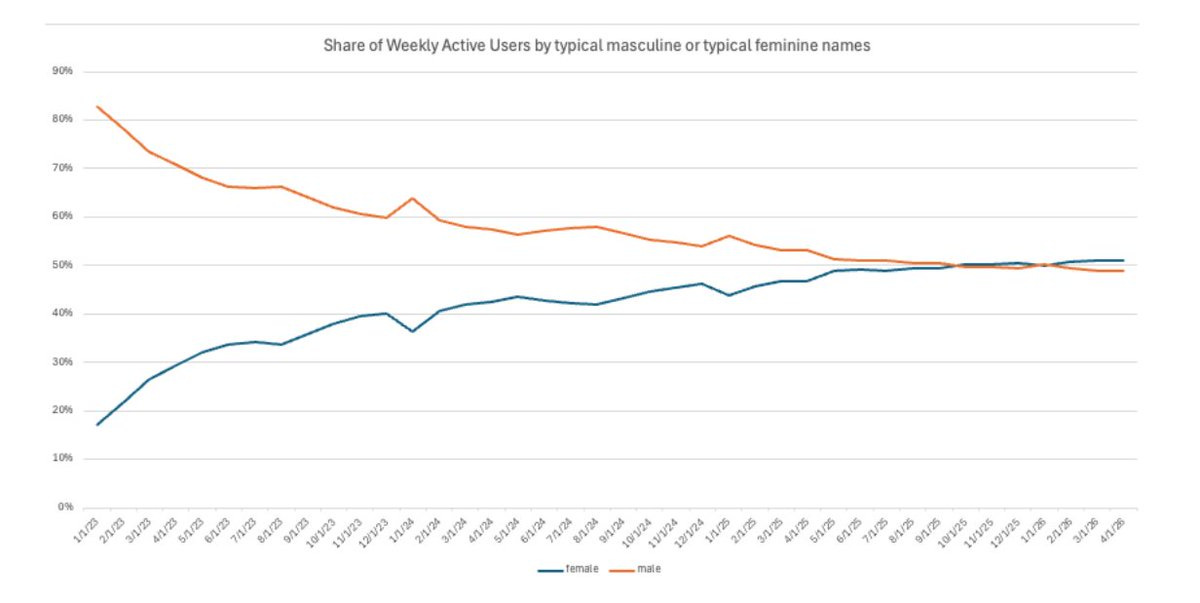
💬 ChatGPT started 80% male. The gap is now gone. When ChatGPT launched in late 2022, roughly 80% of its weekly active users had typically male first names, according to OpenAI’s anonymised data. The share dropped steadily until the lines crossed in late 2025. As of April 2026, women slightly outnumber men in weekly use.
🧠 In Australia, an ADHD diagnosis is a postcode lottery. A new Four Corners investigation maps Australia’s adult ADHD prescribing for the first time, finding enormous variation between neighbourhoods with no single explanation. Diagnosis costs thousands of dollars and depends on a psychiatrist; telehealth has filled some of that gap, though clinicians warn assessments have patchy quality. In low-advantage areas (the so-called “ADHD deserts”), up to 90% of adults with the condition may be going undiagnosed and untreated. There’s no publicly funded service either way.
📚 The startup playbook only works until everyone’s read it. A new essay by VC Jerry Neumann argues that 30 years of startup methodology (Lean Startup, Customer Development, design thinking) has produced zero systematic improvement in survival rates since 1995. The argument: the moment a method goes mainstream, it stops conferring advantage. If everyone in your cohort runs the same playbook, the only way to win is to do something else.
🔌 Two world orders, one transition. Saul Griffith frames the energy transition as a contest between two systems. The petro-bloc moves 120 EJ of fossil fuels across borders every year through tankers and pipelines. Pax Electricana, the emerging system, runs on renewables, and the economics flip: commodities get scarcer with extraction, technologies get cheaper with scale. Saul’s pitch is cooperation: Australia, Canada, Japan and the EU pooling renewables, minerals and demand to build it together.
💰 How to actually give money away. GiveDirectly CEO Nick Allardice has been giving 10-20% of his income for 17 years. His essay distils what he’s learned across that time and a career processing donations at scale into six things donors actually need to do.
💗 What would it take for Australia to lead women’s health innovation? MECCA M-Power, Women’s Agenda and Sentiment recently brought a group of women together to discuss exactly that, with Giant Leap’s Rachel Yang and Ovum’s Dr Ariella Heffernan-Marks in the room. Read more here or listen here.
✈️ FlyORO was included in 2026 APAC Cleantech25, which spotlights the top private companies driving transformative innovation across Asia-Pacific’s markets.
🧻 Who Gives A Crap has been named in the TIME100 Most Influential Companies as one of the Top 10 Social Good of 2026.
🩺 Mindset Health has been accepted into CMS ACCESS, the first Medicare payment model built for tech-enabled chronic care, structured as a 10-year outcome-based pilot. Congrats to the Mindset team!
💊 Perx published new real-world evidence in Frontiers in Digital Health: older adults using the app hit 95% median medication adherence and stayed engaged for a median of 595.5 days. Far above digital health norms. Kudos to the Perx team. Read the study here.
⚡ Amber is hiring across a range of roles including Director of Product (Melbourne), Executive Assistant & Office Manager (Melbourne), Customer Operations Manager (Melbourne), Strategy & Operations Analyst (Melbourne), Legal Counsel (Melbourne), Senior Software Engineer (Melbourne), Senior Full Stack Engineer (UK/Europe) and Strategic Account Manager (UK/Europe).
🧻 Who Gives A Crap is hiring across a range of roles including a Director of Brand Growth, US (Remote), Influencer & Partnerships Manager, UK (Remote), Performance Creative Lead, US (Remote) and Senior NetSuite Consultant and Integration Specialist, Australia (Remote).
🤖 Indi is hiring a Full Stack AI Engineer (Remote).
🧠 Foremind is hiring a Clinical EAP Manager (Remote).
✨ MoreGoodDays is hiring a Partnerships & Growth Lead (Remote).
📅 May 14: EnergyLab’s Grants and Non-Dilutive Funding for Climate Tech Founders - Sydney. Learn from EnergyLab alumni and grant experts on finding and winning non-dilutive funding. Register here.
📅 May 19: FemTech Unfiltered: What Will It Take To Advance Women’s Health Innovation in Australia? The session is designed to go beyond the familiar talking points and focus on practical steps that can accelerate progress. Register here.
📅 May 20-21: Digital Health Festival - Melbourne. DHF brings together the most influential leaders and innovators in healthcare with over 8,000+ attendees. Rachel Yang is speaking at the ‘Unlocking investment into women’s health’ session. Buy tickets here.
📬Applications now open for EnergyLab’s Climate Tech Charge Program. The program is a 12-month pre-accelerator for pre-seed climate tech founders, with weekly workshops, 1:1 mentorship and access to EnergyLab’s Sydney co-working space. Apply here.
📬 May 7: Submissions for the Amazon Sustainability Pilot Program close. The program is designed for climate tech startups working on sustainability challenges across large-scale supply chains and will pitch directly to Amazon teams for North American pilot opportunities. Apply here.
📬 May 18: Apply for the UNSW Founders 10x Accelerator. $100K uncapped SAFE investment, expert coaching, and UNSW’s R&D ecosystem. Health and climate accelerator programs are open to any startup in Australia. Apply here.
📬 May 21: Apply for the MIT Solve 10th Anniversary Global Challenge. The challenge will identify ten bold solutions to scale with $100,000 in unrestricted funding and a stage during NYC Climate Week. Find more details here.
📬 May 28: Apply for the Future Investment Initiative Innovators Pitch. For builders using AI in Robotics, Sustainability, Health, and Education. Apply here.
No posts
Comments
Nothing yet. Say the first thing.
Sign in to join the conversation.