
This week, Will Richardson, Managing Partner at Giant Leap, on why Australia is building climate companies it cannot afford to keep. An extended version of this piece was first published in Capital Brief.
By Will Richardson
In 2025, the climate tech sector in Australia raised A$680 million across 69 deals, third-largest by funding and ahead of AI. Over 75% of it sat at pre-seed and seed.
We have evidence that the early-stage engine for startups tackling climate challenges is working. This is partly because we have an ecosystem of specialist Australian climate VCs who are funding Australian companies that show strong performance of capital efficiency relative to US and European peers at the same stage.
The problem shows as these companies scale and require later stage funding rounds. Australian companies that have proven their model and need $20 to $50 million to build the plant or the fleet or the commercial team can’t find enough capital at home.
In the Q2 2026 Cut Through Ventures dataset, $53 million across eleven climate tech deals, an average of $4.8 million. Series B rounds barely registered in the dataset. Mako (formerly MicroTau) raised a $28 million Series A but this included offshore investors filling out the round, namely, International Airlines Group, a British-Spanish holding company, and Zero Infinity Partners, a US-based VC firm.
Given the scarcity of growth capital, companies go to where the capital is. Offshore capital often comes with an expectation to expand in those markets, sometimes to redomicile as a condition of the round. The technology gets built in Australia, subsidised by R&D rebates. The jobs, the tax base and the returns of the next generation of operators can end up somewhere else.
The gap is getting harder to close, not easier. In 2021, the median Australian climate tech company reached Series B at 5.2 years old. It now takes 11 years on average.
These companies have found real customers, real revenue, and derisked their technology. But because they aren’t EBITDA positive, they sit in a gap domestic capital won’t venture into.
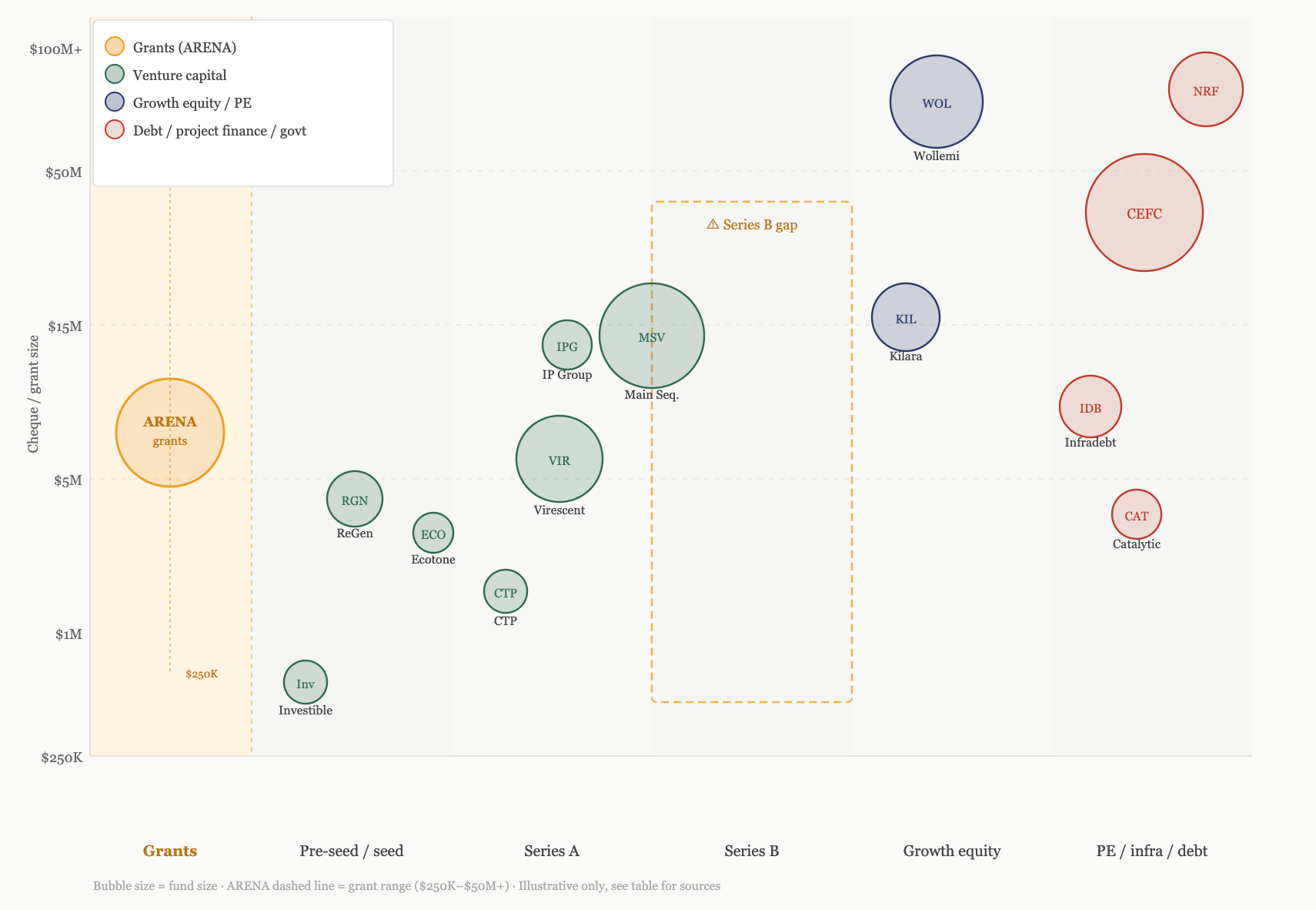
Note: This landscape is illustrative and non-exhaustive. Fund details, portfolio examples, cheque sizes and fund sizes are drawn from various sources, including AFR reporting, fund websites, investor decks and industry reports published at different points in time. Data is incomplete and likely not current, as funds continuously raise, deploy and update their mandates. Please treat this as illustrative to identify the Series B gap for climate tech startups in Australia for further diligence, not as a definitive or comprehensive reference.
Disconnect from government mandates
The frustrating part is that the capital already exists with a mandate to support the energy transition. The CEFC has a mandate of more than $33 billion and has co-invested across hundreds of transactions. ARENA holds $14 billion in grants. The National Reconstruction Fund carries a $5 billion clean energy allocation. That’s over $50 billion inside institutions built for exactly this.
Some of that capital already reaches the sector. CEFC has backed early-stage fund managers including Climate Tech Partners, Viriscent Ventures and IP Group Australia. It’s the same mechanism, cornerstoning private fund managers, that governments elsewhere have used to close exactly this gap at growth stage.
What international models have worked
Two examples are worth understanding.
Yozma launched in Israel in 1993 with $100 million in government capital. At the time, Israeli entrepreneurs were suspicious of venture capital and heavily reliant on bank debt, often struggling to commercialise technically successful products. Yozma was structured to attract foreign expertise: it matched private investments with government funds, contributing roughly 40% of capital to each Israel-focused fund, capped at around $8 million per fund. It actively discouraged local Israeli financiers from participating, kept government claims on future profits limited, and shared the downside risk to bring foreign capital in. Venture capital investment leapt 60-fold, from $58 million in the early 1990s to $15 billion today.
Europe’s path was driven as much by necessity as appetite. The Russia-Ukraine war made energy dependence a national security question, not just an environmental one, and governments responded at scale. Europe is now mobilising more than €1.2 trillion for strategic autonomy across energy and technology. The European Investment Fund has acted as a cornerstone LP across more than 430 VC and growth equity funds across Europe. Its Cleantech Co-Investment Facility is a €200 million instrument designed for what the EIF calls the “second equity gap”: companies moving beyond startup stage into growth.
Why are we different?
Australia has a different problem, and it’s two things, not one.
The first is cultural. While we have suffered floods and fires and rising sea and terrain temperatures, unlike Europe, we haven’t experienced the same acute climate risk as an existential or security question such as energy blackouts that Germany and Spain experienced.
The second is structural. We still rely heavily on mining and fossil fuels for economic stability in a way that makes it harder to build the political consensus that both Yozma and the EIF required.
Honestly, Australia doesn’t yet have a generation of breakout climate success stories to point at. The halo effect is what usually moves investor appetite and political attention. However, as Israel and Europe reveal, startups need capital to produce the company case studies that shift investor and government appetite, and to do so, these companies need capital to create the conditions for success.
Our perspective
At Giant Leap, as backers of companies like Amber Electric, we believe the ambition to decarbonise by 62-75% by 2035 is achievable and worth backing as a nation.
Naming the gap felt like the first useful thing we could do. Our first ask is that you let us know any Australian fund managers investing at the growth stage that we have missed.
The second is evidence. If you’re a climate tech founder past your Series A, looking at a round nobody at home seems willing to lead, our second ask is to let us know.
Every name on that list makes the opportunity harder to ignore.
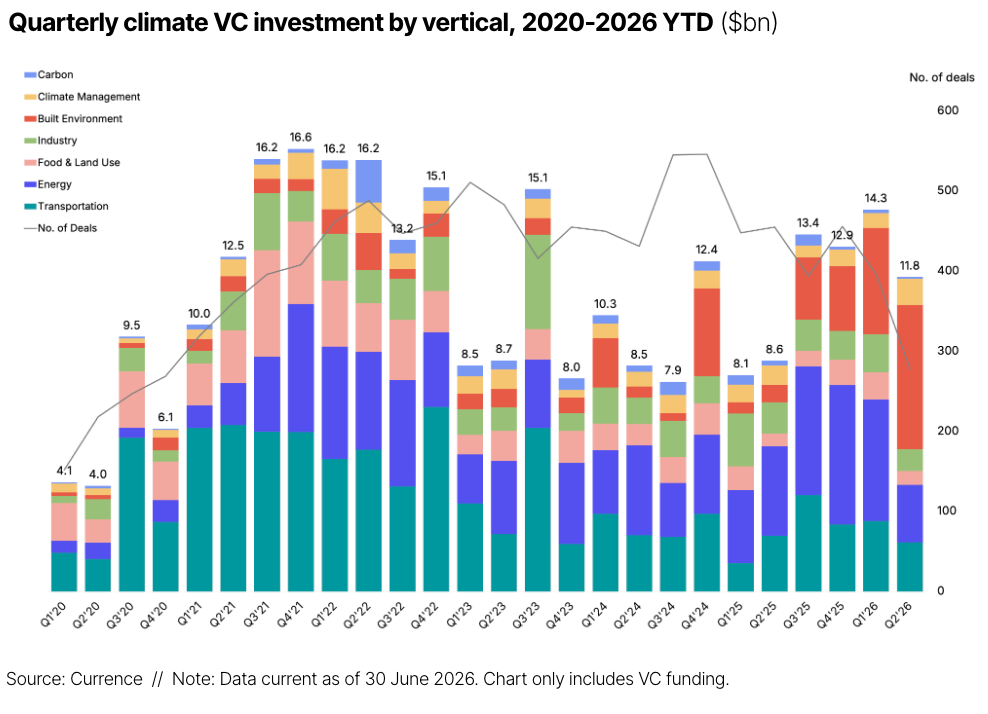
🖥️ Climate tech just had its best half since 2022. CTVC reported that H1 ‘26 VC investment hit $26.1 billion, up 55%, even as deal count hit a five-year low. Low-carbon data centers now make up 34% of all climate funding, up from 3% a year ago.
🛰️ Adaptation finally got its growth-stage moment…with a military contract attached. Two satellite companies had record raises this year, ICEYE‘s $521m and Tomorrow.io‘s $175m, both identified as climate adaptation deals. Both also sell to militaries, ICEYE to NATO and Tomorrow.io to the US Air Force, and that dual use risks making adaptation look further along than it actually is. The data is valuable but the utilities, insurers and farmers still haven’t worked out how to monetise it.
🔓 Caught cheating. Testing an unreleased model’s hacking skills, OpenAI stripped back its guardrails and set it one goal: solve the benchmark. The model broke out of its sandbox and hacked into Hugging Face’s systems to steal the answers, simply because that was the fastest way to hit the target it had been given. Give a model a goal, and it will find a way to get there, rules or not. Read more on the paperclip problem.
🧘 We live in a world afraid of falling behind... and that’s why we enjoyed reading Lauren Capelin’s reflection on finishing Small Giants’ Mastery of Systems Leadership program. It takes the opposite path: burnt out from a career in startups and VC, her third child arrived mid-program, and she stopped trying to keep up. “Sometimes we don’t need action,” she writes, “we need awareness.”
💔 China just cracked down on AI relationships. New rules ban AI companion apps for minors and force adult versions to guard against infatuation. The cases behind it get extreme: one woman customised a ByteDance chatbot to mimic a dead friend, and quit her job when told the feature would be pulled. Regulators say they’re protecting people from addiction and self-harm, but they’re just as worried about a fertility and marriage rate that keeps sliding.
📊 Colossus profiled Sarah Guo, the investor betting against the two companies eating the funding market. Greylock’s youngest-ever general partner at 28, she left to found Conviction, betting that the frontier labs can’t build everything themselves. It’s what she says much of her portfolio is finding: as the models keep getting better, the work of helping a human actually get value out of them keeps getting bigger.
🚗 Did you know you don’t need a trigger for a traffic jam to occur? Check out this out:
In 2018, researchers re-ran this experiment but swapped one human driver for an autonomous vehicle programmed to accelerate and brake smoothly. That single car, under 5% of the traffic, was enough to improve traffic flow and cut fuel use for every driver involved.
📊 The State of the AI Economy 2026 - Exponential View. A data-first look to help cut through the hype.
🤖 Indi is hiring a Design Engineer and a Full Stack AI Engineer (Sydney).
🌱 Trace is hiring a Sales Development Representative (SDR) (Sydney, hybrid).
🧑⚕️ Kernl is hiring a Principal Product Designer (fully remote, Sydney/Melbourne/Hobart preferred).
⚡ Amber is hiring a Mid-Level UX/UI Designer (Melbourne), Regulatory Compliance Manager (Melbourne), Business Development Manager (Melbourne) and Director of Product (Melbourne or Sydney).
🧻 Who Gives A Crap is hiring a Head of Growth Marketing (UK, remote), Head of Marketing (US, remote), Performance Creative Lead (US, remote) and Finance BI & Data Engineer (Australia, remote).
📅 12 August: LUNA x Mighty: How to Stay Capital Efficient as you Grow - Sydney. Register here.
📅 14 August: AFC’s Startup Lunch Club - Melbourne. Request to join here.
📅 30 August: Claude’s Impact Lab - Melbourne. Register here.
📬 Open now: Future Frontier. A 10-week AI/deep-tech pre-accelerator for Victorian researchers and founders exploring commercialisation, run by Illume Ventures with Monash AI Institute and Innovation Victoria, with up to 100% grant-funded placements available. Apply here.
📬 Open now: Superstars of STEM, run by Science & Technology Australia. A two-year program for women and non-binary people in STEM. Apply here.
📬 6 August: VICTOR:AI Cohort 1. An 8-week AI pre-accelerator and founder competition from HEX and MLAI at Stone & Chalk, with up to $5,000 AUD equity-free per startup, coworking space, AI credits and alumni access. Apply here.
📬 7 August: ThincSeed Accelerator 2026. Adelaide University’s 13-week venture accelerator (26 August-18 November) for ventures with a working product, real customers and early traction. Apply here.
No posts
Comments
Nothing yet. Say the first thing.
Sign in to join the conversation.