
Small Bites is a reader-supported publication. To receive new posts and support my work, consider becoming a paid subscriber.
Hey Small Biters,
There is an interesting thread running through almost everything that happened this week.
Limits.
A court tells the White House that changing election rules is not simply a matter of presidential preference.
Another court tells the administration that constructing a $400 million addition to the White House cannot automatically proceed without congressional authorization.
New documents raise uncomfortable questions about how far federal authorities can go when monitoring Americans engaged in political activism. Meanwhile, halfway around the world, another kind of limit is being tested. The United States says its blockade of Iran can continue indefinitely, but wars have a way of establishing their own boundaries—economic, political and human.
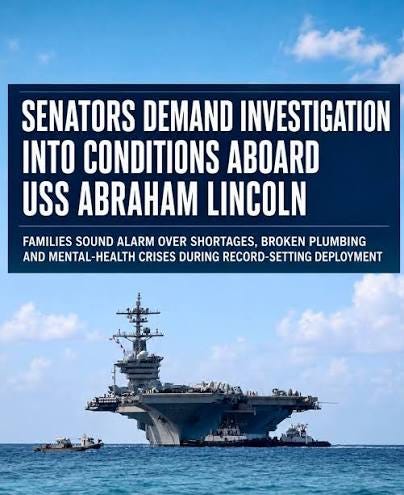
That last one deserves more attention. It is easy to talk about aircraft carriers as pieces on a strategic map. It feels different when we remember that sailors aboard the Abraham Lincoln have spent roughly eight months continuously at sea.
There are people inside every policy. That is something Washington forgets remarkably easily.
Election restrictions eventually become a person trying to cast a ballot. Immigration enforcement becomes a family waiting for an answer.
Inflation becomes someone standing at a gas pump watching the numbers climb.
Military strategy becomes a sailor counting another day away from home. Government becomes real at the point where policy reaches a human being. Maybe that is the small bite worth carrying this weekend. Our political arguments are important. Our institutions are important. The Constitution is important.
But none of them exist merely as abstractions. They exist because government possesses extraordinary power over ordinary lives. The question isn’t whether government should have power. Of course it must.
The more important question is whether we remain willing to ask where that power stops. Because democracy was never designed around finding the perfect leader. It was designed around something far more realistic:
the understanding that every leader needs limits.
Crisis Aboard USS Abraham Lincoln Raises Questions About the Human Cost of Deployment: The USS Abraham Lincoln has now spent a record 250 consecutive days at sea during an extraordinarily long deployment. Reports have described serious concerns about conditions and sailor wellbeing, including incidents involving crew members attempting to go overboard. The Pentagon disputes portrayals of deteriorating conditions, while President Trump dismissed concerns Friday and said 250 days at sea was “not nearly enough.” The USS George Washington is now heading toward the Middle East as the Navy begins shifting carrier responsibilities.
Trump Orders Navy Back to Steam Catapults: In one of the week’s stranger Pentagon developments, President Trump ordered the Navy to abandon electromagnetic aircraft-launch technology on future carriers and return to traditional steam catapults. Trump has criticized electromagnetic systems for years, arguing that they are overly complicated. The order affects the carrier now under construction and comes as the administration is also opening the door to building some Navy vessels overseas.
Federal Judge Blocks Trump’s Mail-In Voting Restrictions: A federal judge dealt the Trump administration a significant setback this week by blocking key portions of its effort to change how mail ballots are handled nationwide. The ruling freezes an attempt to impose new federal restrictions on a system traditionally administered by the states. The timing matters. With the November midterms approaching, election rules are quickly becoming one of the most consequential political fights in the country. Trump continues to question mail voting and push tighter election requirements, while opponents argue that the White House is attempting to claim powers the Constitution leaves largely to states and Congress.
Iran War Returns to the Center of American Politics: The Strait of Hormuz moved dangerously close to paralysis this week after two UAE-operated tankers were attacked, with the UAE blaming Iran. The United States says its naval blockade of Iran can continue indefinitely and is threatening additional economic pressure on Tehran. Six months into the conflict, the consequences are increasingly difficult to separate from American politics. Reuters reports that rising fuel costs and inflation are weighing on voters, while polling shows substantial public opposition to the war.
Court Documents Reveal Extensive Surveillance of Anti-ICE Groups: Newly disclosed court records revealed that federal agents conducted extensive surveillance of anti-ICE protesters, labor organizations, and progressive groups. According to reporting on the documents, investigators infiltrated meetings, entered private online discussions, and secretly recorded gatherings while investigating what authorities described as possible domestic-terrorism financing. Whatever one’s position on immigration enforcement, government surveillance of political organizations raises an old and uncomfortable American question: where does legitimate investigation end and monitoring political dissent begin?
Trump Takes His $400 Million White House Ballroom Fight to the Supreme Court: Yes, the White House ballroom has now reached the Supreme Court. The Trump administration asked the justices Friday to allow construction of the proposed $400 million project to continue after an appeals court kept a halt on above-ground work in place. The dispute centers on whether the administration can proceed without congressional authorization. The White House argues that the project includes security infrastructure and therefore carries national-security importance. Opponents argue that attaching security features to the project does not give the executive branch permission to bypass Congress.
“Power prefers an open door,
but democracy built a frame.
Courts, ballots, laws and questions—
small barriers with enormous names.The test is never whether power knocks.
The test is whether we still remember
why the door was there.”
Democracy depends on limits that still matter when they become inconvenient.
Foreign wars eventually find their way home—through prices, politics and the people asked to fight them.
Institutions are strongest when authority is questioned rather than simply assumed.
So glad you can be here today. Please consider becoming a paid subscriber of this community so we can do even more.. Your presence here matters. Thank you for choosing a newsletter that connects policy with people, headlines with humanity.
Thanks for paying attention and thanks for being a supporter—your presence makes space for thought that lasts longer than the scroll.
Warm regards,
Small Bites
Have a great weekend!!
When you use the referral link below, or the “Share” button on any post, you’ll get credit for any new subscribers. Simply send the link in a text, email, or share it on social media with friends.
When more friends use your referral link to subscribe (free or paid), you’ll receive special benefits.
Get a 1 month comp for 8 referrals
Get a 3 month comp for 18 referrals
Get a 6 month comp for 28 referrals
Comments
Nothing yet. Say the first thing.
Sign in to join the conversation.