
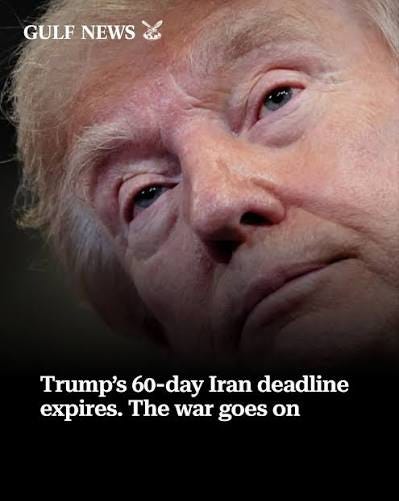
Trump Tells Iran to “Surrender” as the 60-Day Peace Deadline Expires
The temporary framework that was supposed to produce a lasting U.S.-Iran agreement has reached its deadline without a deal, and Trump is sounding considerably less interested in compromise. He said today that Iran should essentially surrender if it wants the conflict to end. Tehran, meanwhile, continues to demand an end to the U.S. blockade, American military withdrawals and compensation for damage from the war. Months after Washington first talked about a relatively quick conflict, the United States is still stuck with an Iran war that refuses to go away.
Trump Threatens to Bomb Oman — Yes, Oman — Over the Strait of Hormuz
In one of today’s more extraordinary foreign-policy developments, Trump threatened military action against Oman if the longtime U.S. partner interferes with Washington’s objectives in the Strait of Hormuz. Oman has been working with Iran on a proposal for reopening commercial shipping through the strait, but Washington objects to any arrangement that undermines its blockade. Threatening a friendly Gulf country that has repeatedly served as a diplomatic mediator adds an entirely new complication to a conflict already overflowing with them.
Trump Orders Major Reduction in U.S.–South Korea Military Exercises
Trump has ordered the Pentagon to scale back annual military exercises with South Korea, explicitly pointing to Seoul’s refusal to participate in the Iran war and his own relationship with North Korean leader Kim Jong Un. The decision is already drawing criticism from lawmakers and national-security officials who argue that the exercises are essential to keeping U.S. and South Korean forces prepared for a North Korean attack. It also sends America’s allies a fairly unmistakable message: disagreements with Washington elsewhere can now have consequences for longstanding security relationships.
Supreme Court Rejects Trump Again in the E. Jean Carroll Case
Trump lost another attempt today to overturn the $5 million civil judgment won by writer E. Jean Carroll. The Supreme Court declined his request to reconsider the case, leaving intact the jury’s finding that Trump sexually abused Carroll and later defamed her. The decision effectively closes the door on this particular judgment, although Trump is still fighting a separate $83.3 million defamation award involving Carroll. For a president who has repeatedly attacked the courts when they rule against him, this is another legal loss from a Supreme Court dominated by conservatives—including three justices he appointed.
Trump’s Approval Is Slipping Even Among Republicans — and the Midterms Are Getting Uncomfortable
With fewer than 80 days until Election Day, polling is beginning to show something particularly worrying for Republicans: dissatisfaction with Trump isn’t confined to Democrats and independents anymore. Axios reports erosion even among portions of the Republican electorate, with the Iran war, gas prices and persistent inflation contributing to the decline. Republicans were already fighting a difficult historical pattern—the president’s party usually loses seats in midterms. If enthusiasm among Trump’s own voters starts weakening too, the fight for Congress becomes considerably more dangerous.
Jon Ossoff Turns His Georgia Senate Campaign Into a Full-Frontal Attack on Trump
Georgia Sen. Jon Ossoff delivered one of his sharpest attacks on Trump yet, accusing the president of mishandling the Iran war and using the presidency for personal enrichment. Ossoff is running for reelection against Republican Mike Collins in a race that could help determine control of the Senate, so this wasn’t simply another Democratic speech attacking Trump. It was a preview of how Democrats intend to campaign this fall: connect the war, corruption allegations, economic frustration and Trump’s personal conduct into one argument about the administration itself.
Florida Votes Tomorrow — and Its New Political Map Has Scrambled Everything
Florida’s Tuesday primary is shaping up to be one of the final major tests before the midterms. Trump-backed Byron Donalds is competing for the Republican gubernatorial nomination, while former Republican David Jolly is among the Democrats seeking their nomination. The state is also choosing Senate and House candidates under newly drawn congressional boundaries designed by Republicans. Those maps have thrown several Democratic incumbents into unfamiliar territory and could ultimately help Republicans add House seats even if the national political environment moves against them.
Debbie Wasserman Schultz Finds Herself in a Brutal Redistricting Fight
Former Democratic National Committee chair Debbie Wasserman Schultz is fighting for her political survival in a dramatically redrawn Florida district. She is white and now running in a heavily Black district against several Black Democratic candidates, turning the contest into an unusually complicated argument about experience, race, representation and Republican gerrymandering. The race is a good example of how redistricting doesn’t merely change which party wins—it can completely rearrange political careers and force members of the same party into fights they never expected.
Trump Administration Pauses Controversial Border Construction in Big Bend
The administration has temporarily halted construction connected to its border project in Texas’s Big Bend National Park following surprisingly broad opposition. Environmentalists, local residents and politicians from both parties have objected to construction in one of the country’s most environmentally sensitive desert landscapes. Trump has made aggressive border enforcement a defining feature of his presidency, which makes the pause noteworthy: even in Republican Texas, there are apparently places where enthusiasm for building more border infrastructure has limits.
Trump’s War on DEI Is Now Reaching Alzheimer’s Research
The administration’s campaign against diversity, equity and inclusion programs is increasingly affecting scientific research that doesn’t look much like a traditional DEI initiative. Federal grants supporting Alzheimer’s research have been canceled at major institutions, including studies examining whether racial disparities and discrimination affect brain health and dementia risk. The administration argues that federal money should not support ideologically driven DEI programs. Researchers counter that eliminating studies simply because they examine racial disparities risks turning political terminology into a test for what scientific questions researchers are allowed to ask.
Comments
Nothing yet. Say the first thing.
Sign in to join the conversation.