
A note before we start. Cleopatra VII left us almost nothing in her own voice. One possibly authentic word survives on a papyrus, a royal authorization, and that is close to the sum of it. Everything else comes from Romans writing decades after she was dead, for an audience that needed her to be a particular kind of woman. So the voice below is mine. The facts are hers. Where the sources disagree I have said so, and where they admit they are guessing I have said that too, because their guessing is most of what we have. The exact date of her death is itself reconstructed. I have used the tenth of August, one of the dates modern scholars propose.
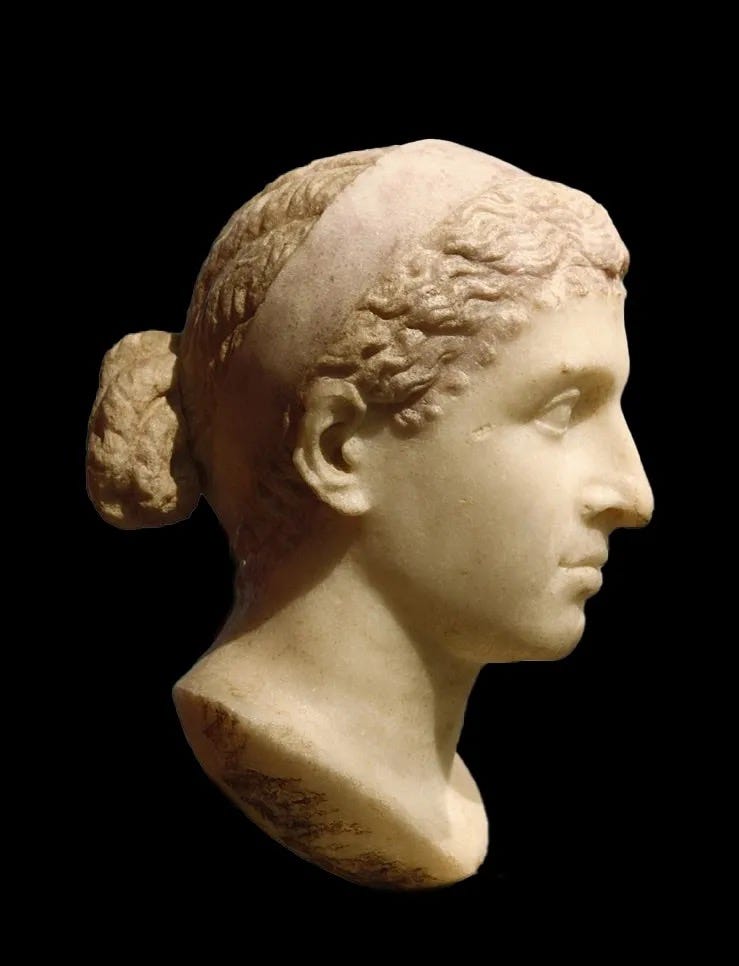
Marble portrait traditionally identified as Cleopatra VII, first century BCE.
The city outside this door has belonged to Rome for nine days.
Octavian's legions came into Alexandria on the first of August. My fleet went over to him without a fight. My cavalry went over to him without a fight, in the morning, while I watched from a height, and by that afternoon there was nothing left of twenty two years of work except this building and the people inside it.
Today is the tenth. I am thirty nine years old. I have been the pharaoh of Egypt since I was eighteen, which is longer than most Romans manage to hold on to anything, and as of last week I am the ruler of one room.
The room is on the upper floor of my own tomb.
I should explain that. It sounds insane and it is only mostly insane. Egyptian rulers build their monuments while they are alive. That is the practice, it has been the practice on this river for three thousand years, and mine has been going up beside the temple of Isis for years now with a treasury vault at the base of it, since I intended to be buried with my money in the way my family has always been buried with its money. When Octavian took the city I moved into it. Sealed the doors, took the treasure in with me, and let it be known that if he pushed I would burn all of it, which is the only leverage a person has left when they have no army: the ability to destroy the thing you came for. It worked, briefly. He wants the treasury intact, and he wants me intact more, and the distance between those two wants is the only reason I am still breathing this morning.
The building is not finished. There are workmen's marks on the stone at the far end and a section of upper cornice that was never dressed. The men doing it left when the Romans arrived, which I understand completely. So I have spent the past two weeks living inside my own unfinished tomb. If somebody else were making that joke I would laugh.
I have been awake since it was dark and I am not tired, which is how I know something in me has already decided without consulting me.
You may need the shape of this, so here it is quickly.
Egypt is rich enough to be wanted and not strong enough to prevent it. That is the whole problem and it has been the whole problem since before I was born. We grow grain Rome cannot afford to lose. We have been paying Romans to leave us alone for three generations, and my father borrowed from Roman financiers in order to pay Romans, and left the kingdom mortgaged to the men it was buying off, which is a trap you cannot climb out of by being clever, only by being useful.
So I was useful. At twenty one I was losing a civil war against my own brother, who I was also married to, which is a Ptolemaic arrangement I am not going to defend to you. Caesar arrived in Alexandria chasing an enemy. I got myself into his rooms, and yes, that story is true in outline, and I had a son by him, who is fifteen years old now, which is old enough for Octavian to consider him a problem.
Caesar was murdered. Rome split into two men, and the two men divided the world between them, and the eastern half came to Antony, which meant Egypt came to Antony. So whatever else he was to me, and he was a great deal, he was also the entire foreign policy of my country standing in a room.
Then the two men stopped dividing and started fighting. We lost the sea battle at Actium last September, and this summer Octavian came for what was left.
That is twenty two years in six paragraphs. Antony died on this floor nine days ago. Not quickly. He had been told I was dead. That was my doing. When the last of the fleet went over I shut myself in here with Iras and Charmion and let word go out that I had killed myself, and I did it to buy time, to make every man outside these walls stop and wonder what a dead queen might already have ordered done. I did not think about what the same message would do to Antony. That is the truest sentence in this account. I did not think about it at all. He heard it in the field, and he opened himself with his own sword and did not manage it cleanly, and then he was hoisted up through that window on ropes, since I would not open the doors. I want you to understand the physical fact of it. A dying man, in a sling, being pulled up the outside of a building by women, while he bled. I got him inside. He asked for wine. He told me to make my peace with Octavian.
I have thought about that instruction every day since and I still cannot decide whether it was love or simply the last instance of Antony telling somebody else what to do about a problem he made.
I want to be fair to him, since he is nine days dead and cannot argue. He was enormous and warm and he drank like it was a discipline. He was better in a room than any man I have known and worse on a map than any man I have known, and I understood that about him within a week and married him anyway and had three children with him, so let nobody tell you I was operating purely on strategy. I wanted him, and that is not the part they will get wrong. The part they will get wrong is that wanting him was the smallest of the reasons.
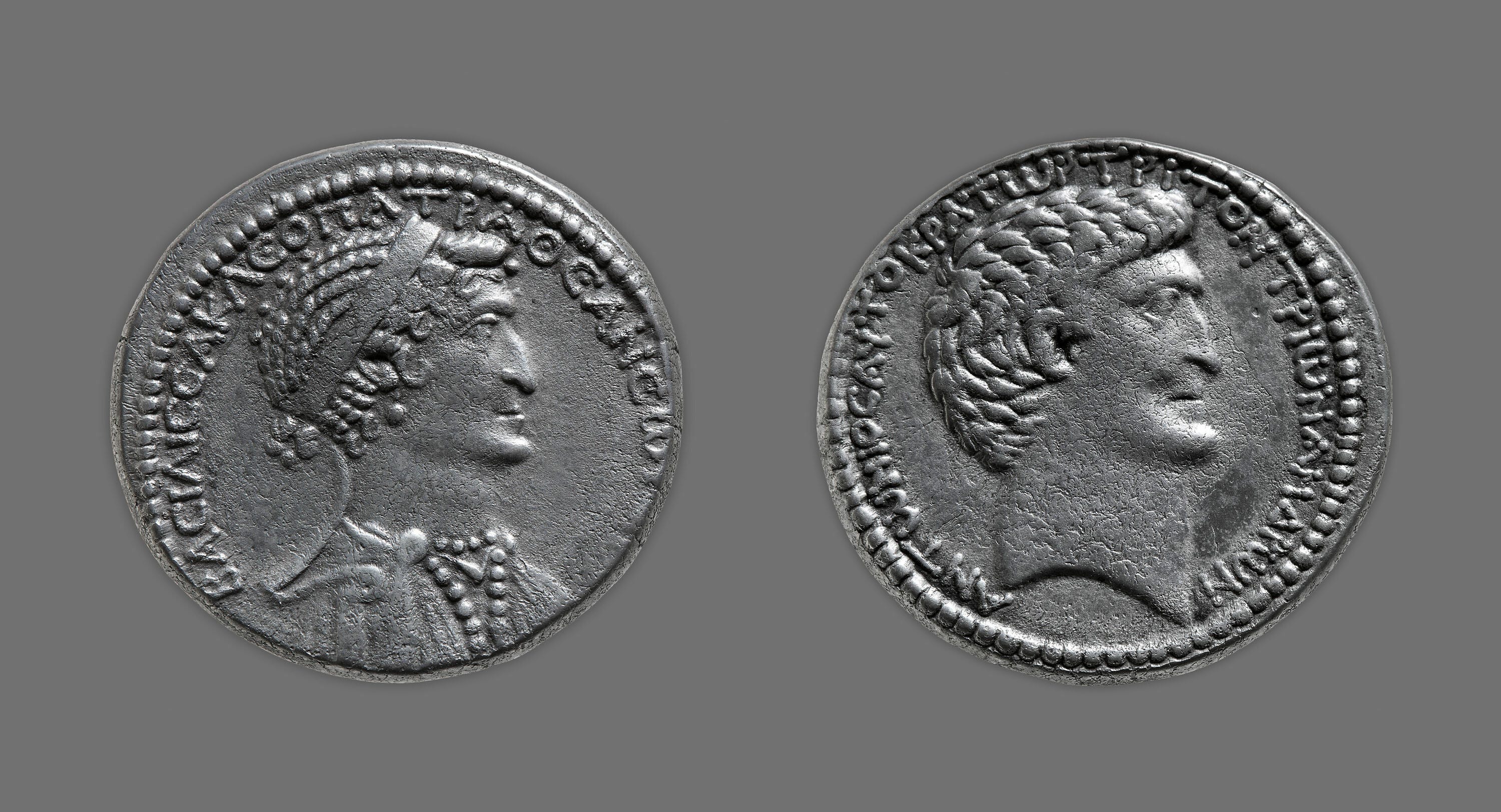
Silver tetradrachm depicting Cleopatra VII (left) and Mark Antony (right), struck at Antioch, c. 36 BCE.
Yesterday a man on Octavian's staff got word to me. His name is not important and I am not going to write it down even here. He told me that Octavian is leaving for Rome within three days and that I am going with him, and the children with me.
Twenty two years of work, and it ends in one sentence from a Roman who felt bad about it. He felt bad enough to tell me and then went back to work for the man doing it, and I imagine he sleeps fine.
I know what going to Rome means. It does not mean captivity, exactly. It means one afternoon, arranged in advance, in which I walk through that city in chains behind a wagon of my own property, past a crowd that has been told for ten years that I am a whore who bewitched two of their men, while somebody carries a placard explaining who I am in case they cannot tell. It means being the middle section of a parade. And then afterward, if the tradition holds, a room somewhere and a quiet ending, or worse, a long comfortable one where I am kept alive as evidence.
My sister Arsinoe was walked in a Roman triumph. In chains. She was a girl. The crowd was so uncomfortable watching it that Caesar had to let her live afterward, which everyone told me at the time was mercy.
I was in that city when Rome decided it felt sorry for my sister. I was living in Caesar's garden across the river with our son, and I understood something that day about the difference between pity and respect, and I have organized my entire life around it since.
So today is practical, and I am grateful for that, because the practical is the only thing holding me together. I have sent a letter to Octavian asking that I be buried with Antony, and he will grant it, because he understands the value of appearing generous about small things while taking everything else.
He came to see me last week and I want to describe it accurately. He is thirty two and he has a cold, and he sat in this room and would not look at me directly for more than a moment at a time, and he was very correct and very careful and he kept saying that I would be treated well. Men say that to you when they have already decided what you are for. His uncle looked at me. Antony looked at me. This one looks at the middle distance and talks about arrangements, and he is going to run the world for forty years, and I think those two facts are the same fact.
I have dismissed everyone except Iras and Charmion, and I should tell you about them, since nobody else is going to. Iras does my hair. Charmion has been with me since I was a girl in this palace with two sisters who wanted me dead and a brother who would later marry me. They are not servants in the way you are imagining. There is no word in your language for what they are. They are the two people alive who have seen me be stupid, be frightened, be twenty three and in over my head, and they have never once used it.
They know what today is. Nobody had to explain it, and Charmion started laying things out this morning without being asked.
I bathed. I ate an actual meal and I enjoyed it, which surprised me and then annoyed me and then stopped mattering. Figs came in. Alexandria in August, the fruit is obscene, and I sat there in my own unfinished tomb eating figs over a bowl like a woman with nothing on that afternoon.
Now Iras is doing my hair, and I have been dreading this hour more than the one after it. A decision is a thing you can hold. Her hands in my hair is not a decision.
The diadem goes on last. It is a band. That is all it is, physically, a worked band that sits above the brow, and it is worth less than the pins holding my hair under it. But it is the object that says I am not a prisoner, I am not a client, I am not a woman who was defeated in a naval engagement off the coast of Greece. It says I am the pharaoh, which is a thing I have been since I was eighteen and which nobody in Rome has ever fully accepted, and which is nevertheless documented in every temple on this river with my face on it in the correct posture.
They will find me wearing it. That is the point. The last document I will ever produce is my own body, arranged, and I have thought about the arrangement more carefully than I thought about Actium.
Which brings me to Actium, since I have opened that door myself. I did not flee. I have heard the version where I panicked and ran and Antony followed me like a dog, and that version is going to be extremely popular in Rome and I cannot stop it. What happened is that the position was lost, and I had sixty ships and the treasury aboard them, and I took the treasury out through the gap while there was still a gap. That is not fleeing. That is the correct decision, made quickly, by the person whose money it was. Antony followed me, which is true, and which is the part I would change.
And Tarsus, since we are doing this. The barge. Everyone will remember the barge.
I was twenty eight. Antony had summoned me to explain myself, which was an insult and was meant to be, and I understood immediately that I could arrive as a woman answering a charge or I could arrive as a god. So I came up the river with purple sails and silver oars and the rowers keeping time to flutes, dressed as Aphrodite, with boys fanning me, and I did not go to him. I made him come to me. Then I made him come back the next night and fed him things he did not have words for, and let him think the effect was the food.
It was not the food. I was twenty eight and I had been running a country since I was eighteen and I was extremely good at this, and he was a large handsome man who had never in his life been out-thought by someone he wanted to sleep with. He did not know what to do with his face. I have replayed that dinner more than I have replayed any battle.
It was theatre. Of course it was theatre. I was a twenty eight year old woman with a kingdom in debt, a Roman general who could erase me by writing a letter, and one advantage, which was that Rome had never seen anything like the wealth of Egypt and had spent two hundred years being both contemptuous of it and desperate for it.
I did the math and I put on the dress.
They will write that down as seduction. Fine. It was, partly, and I am not going to stand in an unfinished tomb on the last day of my life and pretend I did not enjoy the work.
What they will do with it is convert it. Every treaty I signed becomes a flirtation. Every calculation becomes an urge. A woman who calculates is unbearable to them, and a woman who calculates and wins has to be turned into something else, and the only version of me they can carry home without discomfort is one who was running on instinct.
I made bargains. I reformed the currency. I kept Egypt independent for twenty two years in a century when independence was going out of existence, and I did it by being useful to Romans until I was not, and every single one of those decisions is going to be recorded as flirting. I would like to say that this does not bother me, but Charmion is standing right there and would know I was lying.
It is not the parade I mind. I have made my peace with what would happen in Rome by making sure it will not. What I mind is that they will have to explain me. Some man will sit down in a hundred years, in a good house, with sources he cannot check, and he will try to work out what I was. He will not be able to. The shape I actually am does not fit anything he has a word for, so he will reach for the words he does have. Sorceress. The Egyptian woman. He will decide that Antony was bewitched. The alternative is that Antony chose, and if Antony chose then Rome lost him fairly, and Rome cannot have that.
And the worst of it is that he will not even be hostile. He will find me magnificent. He will write me sympathetically and at some length, and he will invent a death for me because he will not know how I died, and he will admit in the same paragraph that he does not know, and every person who reads him for the next two thousand years will skip that sentence.
I would rather be hated accurately.
They are going to make me a story about desire. It was never about desire. It was about a small rich country between two enormous armies and a woman trying to keep it, for twenty two years, mostly successfully, until the arithmetic ran out.
The light is going long. Iras has finished.
Octavian wants me alive more than he wants anything else in this city. That is the piece nobody outside this room understands. He does not want Egypt, Egypt is already his, the grain is loaded. He wants me walking behind a wagon in Rome. That is the image that makes him the man who ended the wars, and without it he is a young man with an army who murdered his way to the top like everyone before him. I am the last thing he needs and the one thing he cannot take by force.
He can take the country. He has. He can take my children, and he will take my eldest specifically. Caesarion is fifteen and has his father's name, which makes him a claim rather than a boy. I am not going to write any more about that. I have to stay upright for another hour.
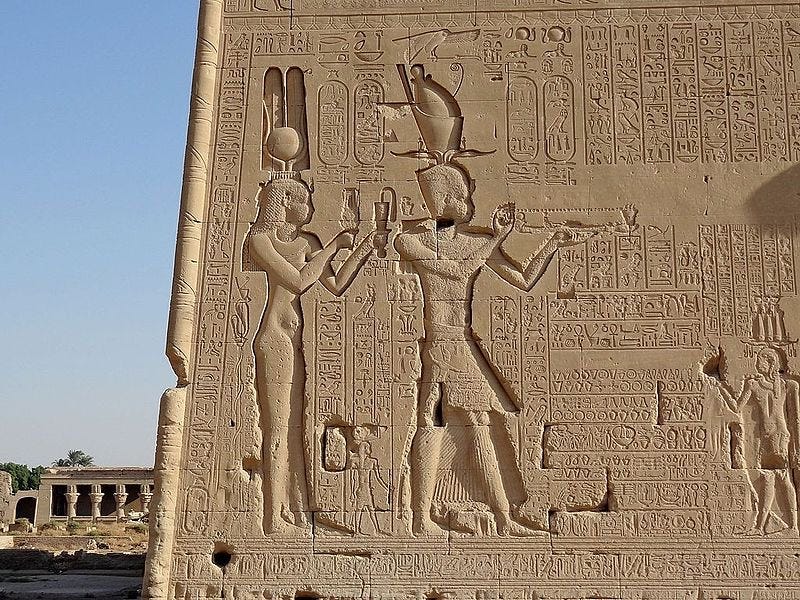
Relief depicting Cleopatra VII and her son Caesarion making offerings at the Temple of Hathor, Dendera, late first century BCE.
And since nobody is going to say any of it at whatever they hold instead of a funeral, I will say it myself and Charmion can look at me however she likes.
I inherited a kingdom mortgaged to Rome at eighteen, with a brother who wanted me dead. I was driven out of my own capital and I came back. I financed a Roman war and then financed the other side of it and survived both. I am the only ruler of my house in three hundred years who learned Egyptian. Three hundred years of my family sitting on this throne speaking Greek at people, and I am the one who bothered.
I kept Egypt independent for twenty two years in a century when independence was being abolished everywhere on the map. Every other kingdom in the east folded, most of them inside a season, most of them without anyone bothering to learn the name of whoever was in charge.
I was not beautiful in the way they are going to require me to have been. Look at the coins. I put a ruler on them, nose and all. I was interesting, which is better, and lasts longer, and cannot be inherited.
There. That is the obituary. Nobody else is going to write it.
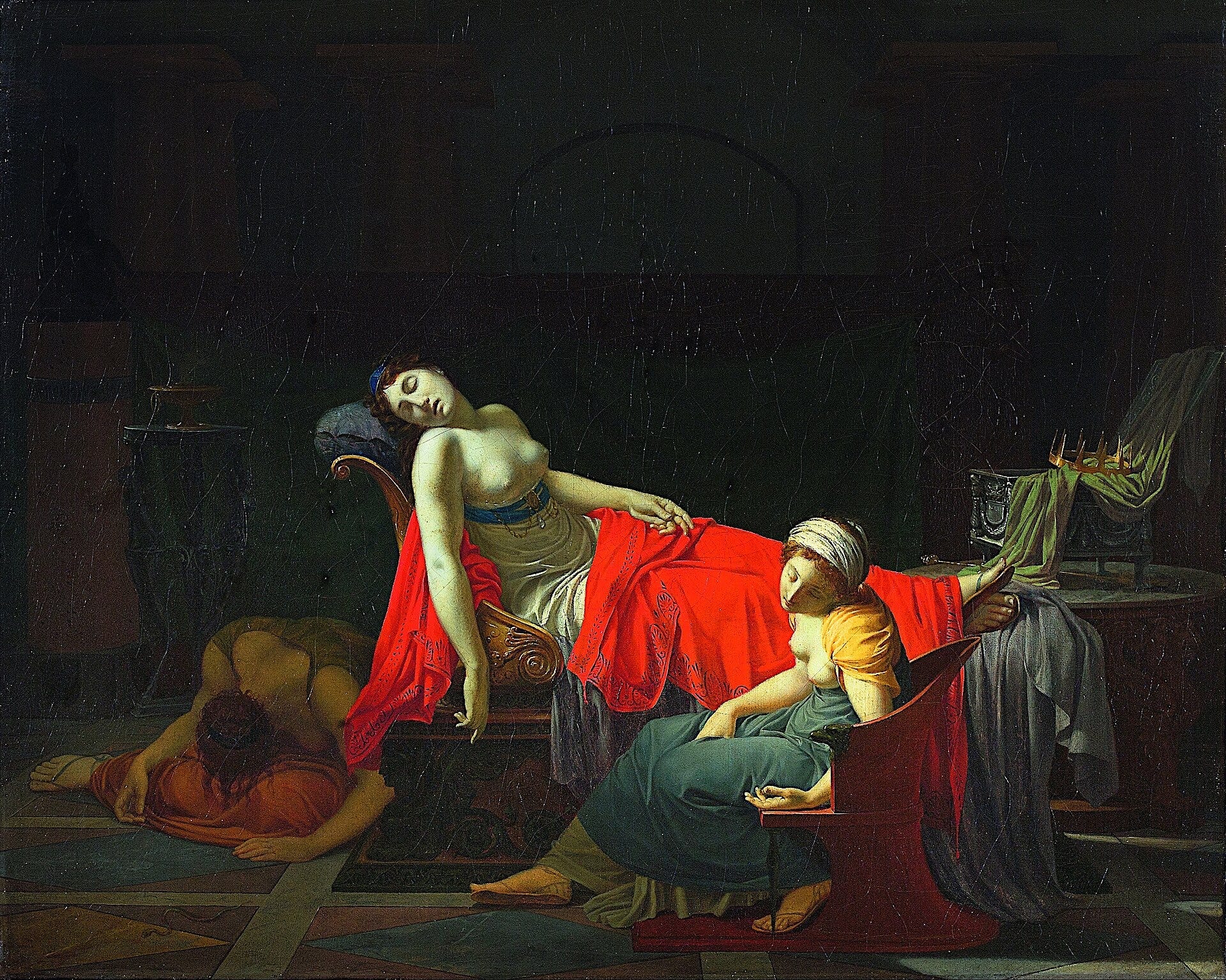
Jean-Baptiste Regnault, The Death of Cleopatra, 1796–1797. Oil on canvas.
But this. The hour, the arrangement, the diadem, the order things happen in. This is mine. It is the last territory I hold and it is very small and I am going to defend it perfectly.
There is a way to do this. I have known the ways for years, I am my father's daughter and this family has been poisoning itself for three hundred years, and there is more than one method in this room right now. I am not going to tell you which. Not out of drama. The moment I name it, it becomes the story, and the story becomes the reason, and in a hundred years there will be men arguing about the method who have never once asked about the decision. Let them find me and guess.
Charmion is crying and pretending not to. Iras has gone very quiet, which is how she gets.
I told them both they could leave. I want that on the record. I said it twice, and I meant it, and Charmion looked at me like I had suggested something obscene. So there will be three of us.
The couch is gold. The robes are the good ones, the ones from the coronation, and they are heavy and it is August and I do not care. The diadem is on. In a minute I am going to lie down and Charmion is going to check that the band is straight. She has checked it every day for twenty years and she is not going to stop today.
When they come through that door they will find a woman in full regalia on a golden couch, correctly dressed, correctly crowned, dead by her own arrangement, with two women who chose to stay.
They will not find a defeated queen. There is nothing in this room that can be walked through Rome behind a wagon.
No posts
Comments
Nothing yet. Say the first thing.
Sign in to join the conversation.