
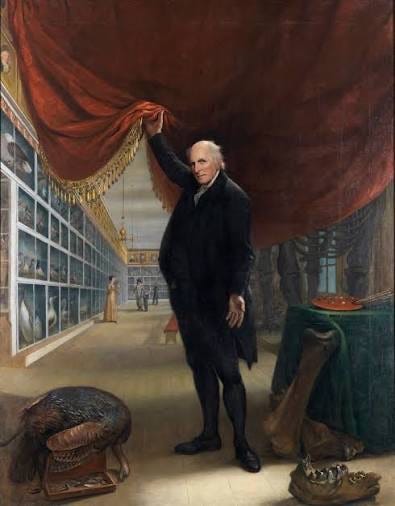
Charles Willson Peale, The Artist in His Museum, 1822
Charles Willson Peale put his museum on the second floor of Independence Hall, directly above the room where the Declaration of Independence was signed.
You could walk in off Chestnut Street, pay a quarter, climb the stairs past the chamber where a group of men had written down that all men are created equal, and arrive in a long room where the natural world had been arranged into a hierarchy on the wall. Birds at the top, ordered by genus, each one mounted against a painted landscape of the habitat it came from. Below them the mammals, and below those the minerals and the fossils, and along the upper register, running the length of the room above all of it, a row of portraits of the men who had done the writing downstairs. Washington and Franklin and Jefferson, painted by Peale himself, looking down at the order of creation with everything else arranged beneath them.
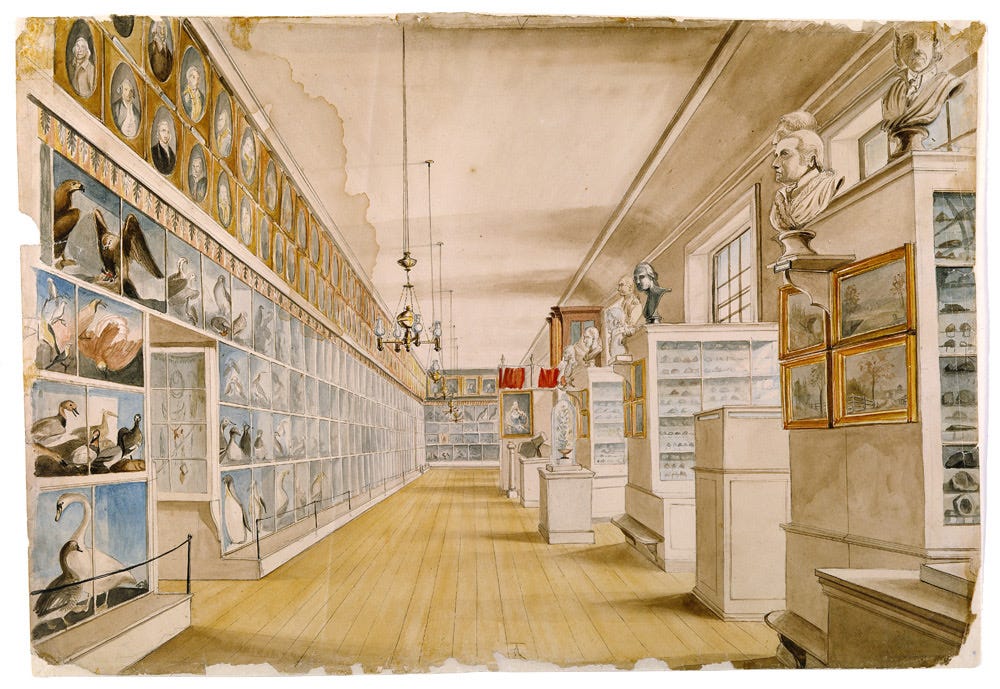
Peale's Philadelphia Museum in the Long Room of Independence Hall.
That is the founding document of the American museum and almost nobody reads it as one, because we file Peale as a portraitist with an unusual hobby. You have been inside his building. Not that one, but his building. Every natural history museum you were taken to as a child is a copy of a copy of that room, and you have never once been told whose room it was.
He invented the institution outright, and every building like the one I work in is still running software he wrote in the 1780s and 1790s, and the reason the field cannot simply patch the bad parts is that the bad parts and the good parts are the same parts, written at the same time, by the same man, for the same reasons.
Start with what he got right, because it is more than people expect and it is still the best argument the field has.
Peale believed the museum belonged to the public. Not to a subscriber list or a learned society or a gentleman carrying a letter of introduction, which is what every comparable European collection amounted to at the time. He wanted a ticket a working person could afford and objects labeled so that a visitor with no Latin could understand what they were looking at, and the labeling was the radical part. Before Peale, a cabinet of curiosities was a wealthy man's pile arranged to please other wealthy men, and the arrangement was aesthetic or alphabetical or whatever amused him that season. Peale arranged by Linnaean classification and then explained the classification, which is the kind of thing that sounds obvious until you try to write one and discover it takes four days. He mounted each animal in front of a painted version of the place it had lived, which nobody had done, and which is the direct ancestor of every habitat diorama on this continent, including the one you stood in front of at nine years old wondering whether the wolves were real. The conviction underneath all of it, that a person who pays at the door is owed an explanation, is the single best idea in the history of the profession and he had it first. He also once wrote to Jefferson about the museum with the energy of a man who has not slept, which is the correct energy for the job and one I recognize.
Then the mastodon, which is where the other inheritance begins.
In 1801 a farmer in Orange County, New York, hit enormous bones in a marl pit, and Peale went up there with funding from the American Philosophical Society, at sixty years old, and drained a swamp. To do it he built a wheel roughly twenty feet across that four men could walk inside, like hamsters, to power a chain of buckets, and he painted the whole scene afterward with himself in the middle of it gesturing at a diagram, because obviously he did. It was the first organized scientific excavation in the United States and it was powered by men jogging in a wooden hoop in a New York bog.
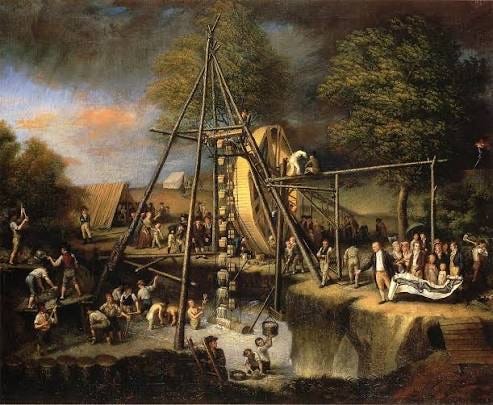
Charles Willson Peale, The Exhumation of the Mastodon, 1806.
He came back with enough bone to assemble the first nearly complete mastodon skeleton anyone had seen, his family raised it in the museum, and it went on view on Christmas Eve of 1801. Understand what he was walking into. The Comte de Buffon, the most respected naturalist in Europe, had gone on record that American animals were degenerate and stunted, that the whole continent produced smaller weaker versions of everything, and Americans had been seething about this for decades. Jefferson had a moose shipped to Paris over it. An actual moose, in a crate, across an ocean, to prove a point about size. So this was not a paleontology story, it was a national grievance with a skeleton in it, and Peale settled the argument with an animal the size of a room.
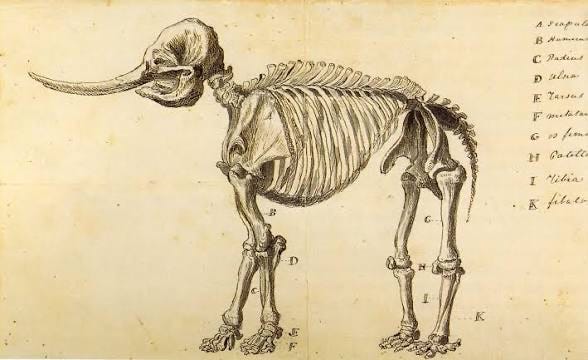
Early anatomical study of the mastodon skeleton
He charged extra to see it. The excavation had cost him roughly two thousand dollars, and within a year he recouped eighteen hundred and thirty one of it by charging visitors an additional fifty cents to enter the mastodon room specifically, on top of regular admission. By 1811 the mastodon had grossed seven thousand. He also threw a dinner party inside the animal. Thirteen men, a table, and a piano, set up underneath the ribcage, and they drank toasts to the American continent while sitting inside its largest resident. Nobody has topped this and nobody has tried. So the first great scientific discovery in American history was also the first special exhibition ticket, and the man who conceived of the museum as a democratic public good invented the surcharge in the same building in the same decade for the same object. He was not being a hypocrite. He was broke. He spent his life trying to get public money for that collection, petitioned the state and then the federal government on the argument that a national collection ought to be nationally funded, and was refused every time, and so he did what every museum director since has done, which is put the crowd pleaser behind a second door and charge for the privilege. Every timed-entry blockbuster you have paid for is descended from that fifty cents. The Tut show, and the Van Gogh immersive experience in a converted warehouse with the audio guide and the exit through the shop. Peale did it first, and he did it because nobody would fund him, and that is still the reason.
That is the founding financial condition of the American museum and nobody has resolved it since. European national museums were built on state money and largely still run on it. Peale asked for the same arrangement, was refused, and the American museum has been a nonprofit hustling private money ever since, which quietly determines a great deal about what gets shown. It is why exhibitions carry donor names, and why the collection a museum can afford to research is not always the collection that most needs researching. It is why the same twelve Impressionists tour the country indefinitely, a small group of Frenchmen doing more domestic travel than most Americans, while the storage rooms hold material nobody has opened in forty years. The public good was Peale's actual belief and the surcharge was his actual solution, and the profession inherited both without ever reconciling them, which is why there is a museum near you right now running a free community day once a month underwritten by the exhibition next door that costs thirty two dollars, and the free day exists because of the thirty two dollars, and everybody involved has made their peace with that in a slightly different way.
There was also a shop before there was a word for it. In the long room, under the birds, a man sat with a machine called a physiognotrace, which had an articulated arm that traced the outline of a sitter’s face onto folded paper, and for a small sum he would cut the silhouette and you would take your own profile home. The man had built a photo booth in 1802. You sat, you got your image, you left with it in your hand, and the only thing missing was the strip of four and the friend crammed in beside you. Tens of thousands were made. It was the first mass-produced portrait in America, available to people who would never in their lives sit for an oil painting, a genuinely democratic object and unmistakably a gift shop. You visit the collection, you have an experience, you buy a small souvenir version of yourself on the way out.
The man cutting the profiles was named Moses Williams, and Peale owned him.
Williams was born around 1777 in the Peale household to two enslaved people named Scarborough and Lucy. Peale voted for Pennsylvania's Gradual Abolition Act in 1780 as a member of the state assembly, and he freed Williams's parents in 1786, the same year he opened the museum as a repository for natural curiosities. Moses remained. Under gradual abolition he was held until twenty eight, and Peale released him at twenty seven, a year early, and one of Peale's sons wrote down the reason years later without appearing to find it awkward. The silhouette business had gotten so profitable that his father insisted on freeing him ahead of schedule.
A man's freedom was moved up twelve months as a reward for revenue performance, which is a bonus structure, which means the founding institution of American public education was running a performance review with a rather unusual line item on it, and the son wrote it down as proof of his father's generosity, and for two hundred years people read it exactly that way, including people who should have known better and including probably me at some point in graduate school.
Williams was trained in taxidermy and silhouette cutting and the making of displays. He was not taught to paint. Peale named his own sons after painters, Rembrandt and Titian and Raphaelle, which tells you everything about what that man expected of a child, and he taught all of them to paint, and they painted. Williams was given the machine and the counter. One household, two curricula, and you can guess which child got which without being told a single other thing about them. He almost certainly worked on the mastodon alongside Rembrandt Peale and the sculptor William Rush, which means the object that made the museum's reputation was assembled in part by a man the museum's founder legally owned. And when the physiognotrace was not in use he could be told to put on Native American clothing and stand in the galleries for the interest of visitors. In a museum that held Native American belongings. In a museum that held Native American human remains. A Black man ordered into a costume to perform a third people's culture, on a floor where that culture was already on display as specimen, for an audience that had paid a quarter at the door.
Which brings me to the part of Peale's estate the field is still actively litigating.
The long room sorted the world, and sorting is never neutral. Peale's arrangement was Linnaean, and the Linnaean system placed human beings inside the same taxonomy as everything else, with subdivisions, and the subdivisions were ranked. When a museum puts Indigenous belongings in the same building and the same logic as mounted birds and mineral samples, it has made a claim, and the claim is that these people are nature rather than culture, specimen rather than author, which is the founding error of American ethnographic display and the reason Native material sat in natural history museums for two centuries while European material of the same date sat in art museums across the street. It is why the Hall of African Peoples and the Hall of Ocean Life were ever in the same building, a sentence that should stop you cold and mostly does not, because you grew up with it and it seemed normal, the way the diorama with the family of mannequins seemed normal, the way it seemed normal that one continent got a hall and another got a wing full of paintings with names attached. Peale did not invent racial hierarchy, obviously, but he built the first American room in which a hierarchy of creation was presented to the general public as an educational experience with a ticket price, and the room worked, and everybody copied the room.
There is a specific thread you can follow out of it. A 2012 notice in the Federal Register, filed under the Native American Graves Protection and Repatriation Act, traces human remains that passed through a Peale museum to Samuel George Morton, the Philadelphia physician who assembled the largest skull collection in the country and used it to argue that the races could be ranked by cranial capacity. Morton catalogued the remains and accessioned a cranium into his holdings in the 1840s. That collection went to the Academy of Natural Sciences, then on loan to the University of Pennsylvania Museum in 1966, then formally to Penn in 1997, where it sat as the Samuel G. Morton Cranial Collection until the museum apologized for it in 2021 and began the work of returning people to their communities.
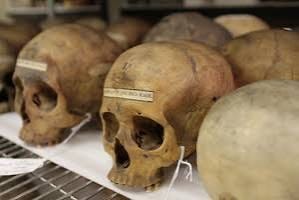
Skulls from the Samuel George Morton Cranial Collection
The line runs from Peale's long room to Morton's shelf to a repatriation notice in the Federal Register, one continuous line with an accession number at every stage.
We are very good at documentation, which is the horror of it and also the only reason anybody can be sent home, since the same impulse that let a museum treat a person as an object is the impulse that recorded where the object went, and the record has become the instrument of return. I do not know what to do with that and I have stopped waiting to.
The rest of the estate is easier to see once you know to look. Peale's ambition was encyclopedic, one institution holding the entire world under a single roof and explaining it, which is a magnificent idea and also precisely the idea that produced the British Museum's problem and the Met's problem and everybody's problem, because a collection that intends to hold everything must acquire everything, and acquisition at that scale is never clean. He collected without provenance standards, since there were none, and established the precedent that an institution's possession of a thing is largely self-justifying. That precedent is why the standard museum answer to how did you get this is still, functionally, we have had it for a very long time. He built the museum as a family business run by a director with total curatorial authority and handed down to his children, a model the American museum reproduced for a century and a half in the form of the founder-director with unchallengeable taste and a portrait in the lobby. And he established that a museum is a place you go to be entertained while being told you are being educated, which is the tension the field has been managing badly ever since.
The proof of that last one is what happened to the collection. Peale died in 1827, his children could not sustain it, and it was broken up and auctioned between 1848 and 1854. Most of the natural history went to P. T. Barnum, which is not a metaphor I constructed and which I would have rejected as too neat if I had. Peale's collection became Barnum's American Museum, the mermaid and the ticketed curiosity, and then Barnum's museum burned, more than once, and most of it is gone. The mastodon survived the fires and was shipped off to Europe by speculators hunting a buyer, which is how the animal that settled a continental argument about American greatness ended up as inventory. Some of the portraits were purchased by the City of Philadelphia and hang in the Second Bank building today, which means the men on the upper register outlasted everything that had been arranged beneath them.
The distance between Peale's museum and Barnum's museum was about eighteen months and a change of ownership. Same objects, in some cases the same cases, and the difference was entirely in what the label claimed to be doing. That should be uncomfortable for anyone in the profession and it is certainly uncomfortable for me, because it suggests the boundary between a museum and a sideshow was never a difference in kind. It was a difference in stated intent, and stated intent is cheap, and I have written a great deal of it.
So what is left of Peale. The habitat display and the classification on the wall. The label written for a stranger, the affordable ticket, and then the second ticket for the special exhibition. The shop. The permanent funding crisis and the donor name on the wing. The conviction that arrangement is an argument, that where a thing sits is a statement about what it is and what it sits above. The encyclopedic ambition and the acquisitions it required. All of it still operating.
And the last piece, which is that the labor building a collection is frequently performed by people the institution does not intend to credit, so that the object receives an accession number while the person receives a footnote if a footnote exists. Moses Williams cut tens of thousands of profiles and signed almost none of them. For most of two centuries he appeared in the record as Peale's assistant or Peale's servant, and the work was filed under the museum rather than under his name.
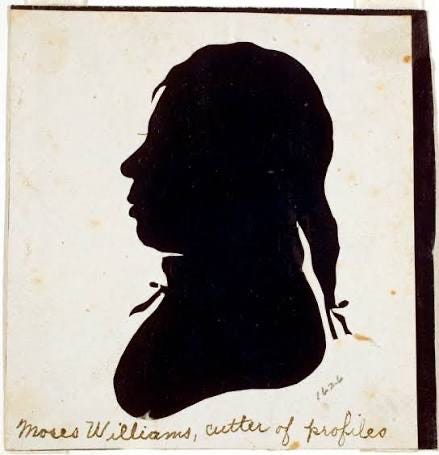
Moses Williams, “Cutter of Profiles,” silhouette portrait.
The Peale in Baltimore, the museum Rembrandt founded, now has a gallery named for him, and an installation called Cutter of Profiles that the institution describes as permanent and still being written as the research comes in. The gallery is where they run an apprenticeship in exhibition preparation and the preservation trades, which is the work Williams was trained to do instead of painting, taught now to people who get paid for it and whose names go on the wall.
We are all still working in the long room.
No posts
Comments
Nothing yet. Say the first thing.
Sign in to join the conversation.