
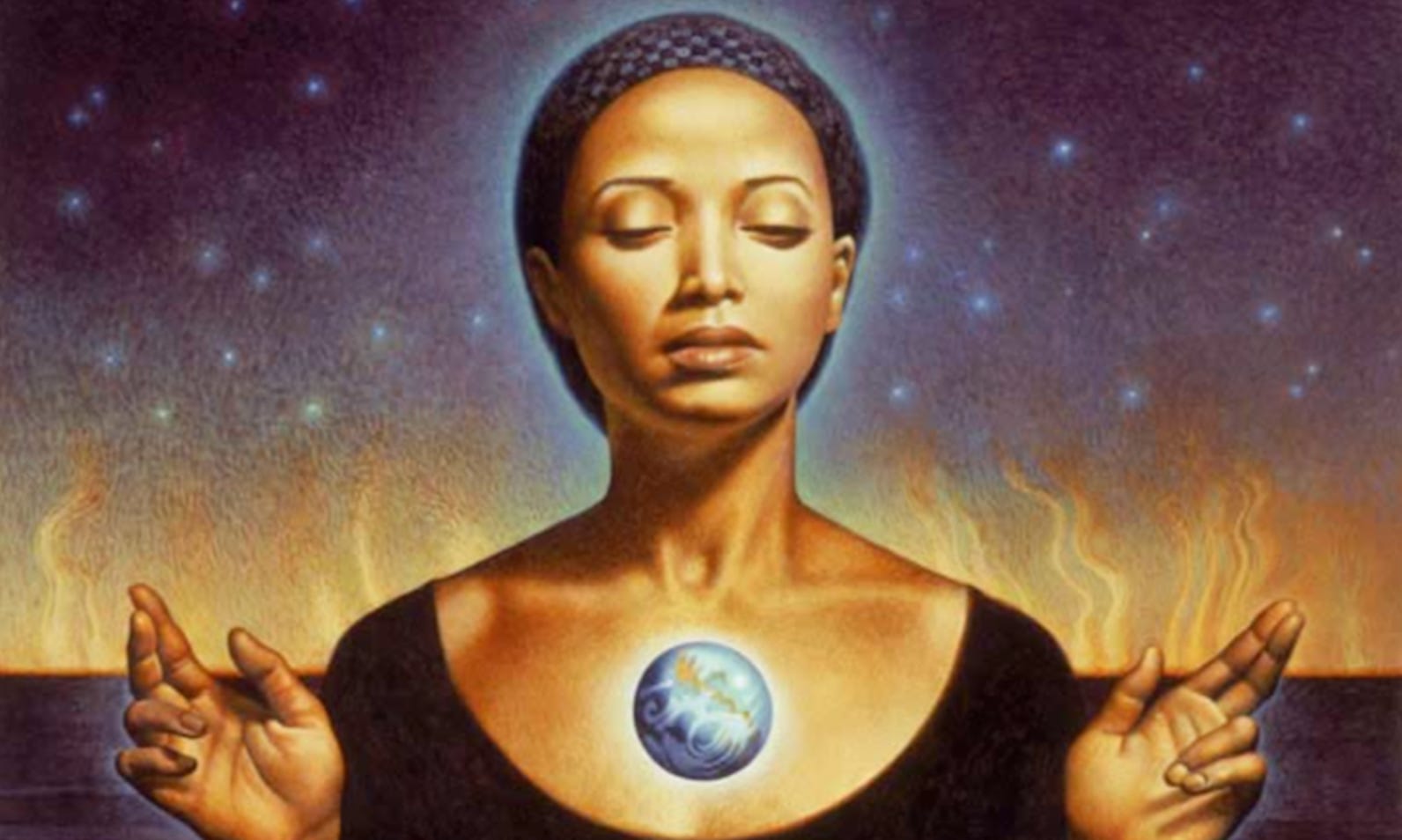
From cover art by John Jude Palencar for Parable of the Sower, by Octavia E. Butler
The time of terror to which I refer above is now, of course, in the literal sense of men with guns on rooftops and many more men with masks lurking in corridors outside courtrooms, seizing souls without apparent reason. It also refers to the president’s designation of “antifa” as a “major terrorist organization,” subject to investigation and arrest. If you’re thinking, “that’s awful, but it doesn’t effect me, I’m not antifa,” recall that there are no antifa membership cards. Who is antifa? Whoever Trump says it is.
Consider Stephen Miller’s words on “The Charlie Kirk Show” the Monday following the assassination, to guest host J.D. Vance, vowing to “channel all of the anger that we have” to hunt down “the actual organized cells” he claims are rotting American society from within. Cells. Secret societies. The members of which are known only to the administration. You may be a member, yourself; you won’t know until there’s a knock at the door.
The following Sunday, some 100,000 gathered for Kirk’s memorial in Arizona—among them nearly all of Trump’s cabinet and of course Trump himself. Much was made of Erika Kirk’s declaration of forgiveness for her husband’s murderer; less of her embrace for the president who said he would not forgive, that he hates his enemies. In between speakers Christian musicians played uplifting praise songs; the speakers spoke of their movement as the sword, the storm, the dragon.
It’s supernatural language, though not as strange as the fruits of technology, the AI videos of Kirk delivering sermons from the afterlife projected on giant screens in megachurches across the country, which in turn compare to many variations of Kirk sprouting wings with which to fly up to Heaven, where he’s greeted by Martin Luther King, Jr.—which must have been a surprise to Kirk, who not long ago called MLK “awful” and announced plans for “hitting him” in service of a campaign to undo the Civil Rights Act.
That’s the context for what follows. It’s a step away from the moment, from this unfurling terror. It’s my version of hope these days, notes toward an unfinished book about unfinished books—in the passage below, a never-published work that would have been called Parable of the Trickster, by Octavia E. Butler. I published this last year on a local Vermont newsletter, but this little story has been haunting me these past days. Another slant rhyme to the moment from books written, and unwritten, years ago.
***
After twelve successful novels of speculative fiction, Octavia E. Butler ended her days in 2006, just 58-years-old, trying to and never quite succeeding to her satisfaction at building a new world on which to rescue her characters from the dystopic collapse dreamed of by little men who imagine their moment, yet to come, in the powerlessness of others. Her characters were her people—herself and us, if we would follow.
She was a Black woman born into segregation, for most of her life poor or struggling, a hermit, a recluse. But she was not alone. She had her creations—people like her, trying to survive and transcend race war, decay, the poisoned ground. “I began writing about power,” Butler once said, “because I had so little.”
She was the only child of her mother, a maid, but the fifth born to her father, a shoeshine man. And yet she was his only remaining child, too: her four older brothers had died before she was born in 1947. Her father died shortly after. She was raised by her mother and grandmother: Baptist, strict, her life split at a young age between the rigidity of the Christianity into which she was born—a faith tempered hard and brittle by deep misfortune—and her imagination, innocent and lurid from a young age, angry and ecstatic, terrifying and magical.
In the real world she helped her mother clean white women’s houses. She was a serious, long-faced little girl, a prodigy, eerily alert to the currents of adult frailty and cruelty. Her brilliance was no reprieve from racism; she was never allowed to enter the front door. So she began imagining her own doors. Her life as a writer began when she was 12, as she watched a sci-fi movie called Devil Girl From Mars. “Geez,” she thought, “I can write a better story than that.” Then she thought, “Geez, anybody can write a better story than that.” And then—the epiphany that made her a writer—she realized, “Somebody got paid for writing that awful story.”
Getting paid: Walking through the front door. Better yet, a front door of one’s own, a door you could close to that which wounded you.
Before high school was out, she’d be getting paid for her stories, too. And before she graduated from community college, she had, in a sense, begun her life’s work of writing interrelated stories of race, space, aliens, and an empathy so profound it could kill you, which would ultimately not result in the masterpiece she died trying to realize, Parable of the Trickster.
Trickster was to be the final entry in a trilogy of novels that would break from all her previous fiction—the pulp of her early years and the critically acclaimed, academically fetishized work of her maturity—for the sake of a kind of fantastic realism, a dystopic/utopic future entirely rooted in the crises she saw all around her, racial, economic, environmental, political. She completed the first two volumes, Parable of the Sower (1993) and Parable of the Talents (1998). They were prescient to the point of prophetic, if we take “prophecy” in its old biblical sense as not prediction but a description of present evils.
In Butler’s Parables it is Butler’s prophetic dream that reveals the continuity between “the now” and that frightening future; between the Los Angeles that gave birth to Butler’s Parables, the L.A. of Rodney King’s beating, and the future L.A. of her fiction, “become as a widow,” as the biblical prophet Jeremiah declared of another city—the city, the very idea that we might live in peace together—in ruins.
How prescient is Butler’s vision? Gated communities, private police, water a scarce commodity, and, distant from Butler’s little band of survivors but coming ever closer in Parable of the Sower, an authoritarian populist president whose slogan in the 1993 novel is MAGA, “Make America Great Again.”
And yet, she had her doubts. Not about her power as a writer but about the very nature of power itself, about what it does to the imagination. “God is change,” declares the prophetess-heroine of the Parable novels, Lauren Oya Olamina, founder of a new religion called Earthseed, meant to save humanity by leading us to our destiny in the stars. And yet, in Parable of the Talents Olamina grows increasingly rigid—even brutal—in her commitment to her truths.
Butler planned the third, unfinished novel, Parable of the Trickster, as the revelation of power’s dilemma. More, she hoped, than merely a warning. It would be the revelation, and the redemption. All her life, Butler believed, she had been writing what she called “NO-BOOKS”—books that came, ultimately, to a bad end. She wanted at least once to write what she termed a “YES-BOOK.” Trickster was to be her yes; a happy ending; her real freedom.
But in 2006, at age 58, she died of a stroke. Her publisher thought Trickster had never even been begun. It wasn’t until 2013 that scholars discovered, among her papers at the Huntington Library in San Marino, California, “dozens and dozens” of partial drafts of the trilogy culmination—which, it turned out, was to stretch well beyond a trilogy. At her death she had decided she would need seven volumes to fully realize her dream of saving us and herself. But she kept starting the third book, over and over.
In the many false starts to Trickster, the heirs to Lauren Oya Olamina’s Earthseed religion would attempt to reinvent society on a new world. Butler wanted it to be a feminist utopia, and most of her fans believed that’s where Earthseed had always been headed. They did not have the advantage of reading her notes for the first two novels, in which we learn that Butler had conceived of her heroine as doomed from the beginning by her very study of power. Earthseed, Olamina’s attempt to respond to oppression, contained within it the seed of its own corruption. That was the problem, Butler realized. To know the enemy of her freedom—power itself, she came to think—she had to, again and again in her countless drafts, become it. She did not want to.
Which was why this prolific writer, her roots in pulp fiction, now acclaimed—certified a genius by the MacArthur Foundation—found herself in a kind of science fiction scenario, writing Parable of the Trickster over and over, seeking her YES-BOOK and finding only NOs. She needed a hopeful book, an affirmation, a way out of suffering. But ever since she was a lonely little girl, hiding in the library, writing her own disturbingly violent and sexual tales—as much as Devil Girl From Mars, she would say, her literary life was shaped in childhood by pornography she found in the trash—she’d never been able to pretend anything was prettier than it was.
She tried, though, with Trickster. “The possible plots begin to multiply beyond all reason,” writes scholar Gerry Canavan. “In some of the texts, the [planetary] colonists are in total denial about the fact they are all slowly going blind; in others, the blindness is sudden…. Sometimes Imara [Trickster’s heroine] is an Earthseed skeptic; other times she is a true believer… sometimes the colonists seem to encounter intelligent aliens who might be real, but might just be tokens of their escalating collective madness; and on and on and on.”
Throughout her vast collection of papers there recurs the notation aop. It stood for “as opposed to.” That was how she thought: dialectically. Every hero could be—was—a villain, and vice versa. Every space utopia bore the seeds of its dystopic demise. Every story, throughout her life as a writer, contained its double: a plot opposite the original, and then, somehow, through a strange physics, a third plot somehow “opposite” the second. And then a fourth, and a fifth, “and on and on and on,” indeed.
Perhaps the book that did not become Trickster represents a library of books that are not yet here, tales of our escapes—from fascism, from the futures dreamed and nightmared by Octavia Butler—as yet untold. I think, as I imagine this library, that this is what its invisible volumes really are: speculative fictions of our truer selves yet to be.
Comments
Nothing yet. Say the first thing.
Sign in to join the conversation.