
I’ll start with this: every patient who comes to a sleep clinic has a story to tell, and it’s theirs, and theirs alone.
Long before the referral is written or the sleep study is ordered, they’ve assembled a private theory of what is wrong: perhaps it’s stress…or maybe it’s about “just getting old’…or maybe it’s just the twenty pounds that appeared after that knee injury, after a slip on the ice…
Their spouse blames snoring. The smartwatch keeps flagging poor sleep. You notice that their primary care doc has prescribed meds for depression. Is “being tired” just part of being an adult?
Enter: the medical system…and its never-ending supply of labels!
The pulmonologist hears obstructive sleep apnea.
The dentist notes transverse maxillary deficiency.
The psychologist recognizes conditioned hyperarousal.
The endocrinologist can’t help but focus on insulin resistance.
The otolaryngologist sees turbinate hypertrophy and allergic rhinitis.
Each clinician is doing exactly what years of training have prepared them to do: recognizing familiar patterns within a particular domain of expertise.
None of them is wrong, but…
Somewhere along the way, the patient has…quietly…disappeared.

In my work, I talk a lot about the problem of silos, and about how the proposed solution is usually more collaboration, which brings up the uncomfortable idea that nobody really knows what that collaborative environment is supposed to look like. What’s evident is that different specialties have a hard time sharing a treatment plan when their language, cultures and norms for approaching a complex problem have diverged so much, they can’t even talk to each other.
Sleep medicine exposes this tension with unusual clarity because sleep refuses to respect disciplinary boundaries. Breathing, metabolism, inflammation, craniofacial development, circadian biology, neurochemistry, cardiovascular physiology, behavior, and mental health all converge during the same eight hours, and every clinician, researcher, and patient has skin in the game: everybody sleeps!
Patients rarely arrive in our office carrying a problem packaged neatly to only one of those systems; they arrive with a physiologic narrative that’s unfolded over years, sometimes over decades. Our task is not merely to identify the correct diagnosis but to understand how multiple physiologic processes interact with one another, to produce the hot-mess-lived-experience that’s sitting in front of us.
Specialization, of course, is one of medicine’s greatest achievements. Patients benefit because clinicians devote careers to mastering increasingly sophisticated areas of practice. The problem arises only when expertise becomes not simply a body of knowledge, but the lens through which every patient is viewed.
We naturally ask the questions that lead toward the treatments we know how to provide. Dentists become exquisitely sensitive to craniofacial contributors. Sleep physicians recognize respiratory physiology. Psychologists perceive behavioral and cognitive patterns. Endocrinologists identify metabolic dysfunction. Each observation may be entirely correct. Yet our professional identity quietly shapes our clinical reasoning until we become exceptionally good at finding the problems we have been trained to solve.
The patient, meanwhile, accumulates labels: sleep apnea, insomnia, bruxism, anxiety, reflux, obesity, psychological trauma, addiction.
Each diagnosis may be accurate. Together, however, they often leave patients feeling existentially fragmented. Some folks understand the names of their conditions better than they understand themselves. Labels describe what has been observed, but they do not explain why these conditions coexist, which are causes and which are consequences, or where meaningful intervention(s) should begin.
That realization has changed the way I think about interdisciplinary care, which means that the Rebis ecosystem (where I serve as Chief Medical Officer) has systematically overhauled the way our clinicians approach the transdiagnostic process. Complexity management is a team lift, the idea goes.
For years we have encouraged clinicians to break down silos by referring more frequently, collaborating more closely, or assembling larger multidisciplinary teams. Those efforts matter, but we see that they don’t automatically produce better thinking. A larger team might simply generate a larger collection of disconnected opinions, leaving the patient dangling someplace in the middle!
When you look, you see that the highest-functioning interdisciplinary teams out there share something much more fundamental than referral pathways or organizational structure. They converge around a shared mental model—a common way of organizing complexity before anyone begins trying to solve it. In other words: they begin with the same map before even talking about which roads to travel.
The language on the map must allow everyone with a stake in the game to understand the same patient’s unfolding physiologic story, with the same goal-posts in mind.
Consider a patient whose CPAP download is exemplary. She uses the device every night. Her residual apnea-hypopnea index is less than one. By conventional measures, treatment has been an unqualified success. Yet she returns saying, “Doctor, I’m still exhausted.”
Over here: she might receive a wake-promoting medication. Over there: a clinician checks an iron panel and recommends replacement. Still someplace else: she gets advice on light-dark exposure and nocturnal self-talk.
Which clinician is correct?
Perhaps all of them!
The mistake is not failing to recognize one explanation. The mistake is believing that any single explanation is sufficient, because—truth be told—there is usually more than one thing going on, and there’s usually more than one way to approach the problem!
The clinical question is no longer whether this patient has obstructive sleep apnea, folks. I don’t need to tell anybody this, but here goes: the age of wearables is here, and we’ll soon be inundated with more diagnoses than we can count!
The question all of us now need to square off with is: what comes next?
That is not a question of which specialist needs to see them…it’s not a pulmonary question, a dental question, or even a primary care question.
It’s a clarity-of-thinking question…a clinical reasoning question.
At Rebis, we’ve been calling our shared approach to the complexity of the patient’s lived experience narrative-based medicine, which is what I want to talk about below.
Narrative is often mistaken for something soft, explicitly compassionate or “touchy-feeley”. While our approach at Rebis is certainly compassionate, it’s also intellectually rigorous. The patient’s story is not an alternative to science; it is the structure that allows scientific observations to become clinical understanding.
Narrative based medicine can quickly become overwhelming, because sleep-wake problems overlap with and interact with each other! A shared language for unpacking this complexity is what’s needed. Our practical approach at Rebis has been to come to an agreement on how we’ll respond to three fundamental questions, on a systems scale:
WHAT IS THIS?
(what is the operational understanding of the complexity of Sleep Apnea?)
WHAT ELSE COULD THIS BE?
(what is the ecosystem’s transdiagnostic strategy?)
WHY SHOULD WE TREAT IT?
(what is the ecosystem’s framework for discussing the “WHY” of Sleep Apnea treatment?)
Let’s take these questions one at a time…
We begin with an operational definition.
Rather than defining sleep apnea simply as an elevated apnea-hypopnea index, we operationally decode this jargon to: unstable breathing during sleep that negatively affects health. From there, we recognize that this instability exists in two broad “flavors”—obstructive and central—and that each flavor arises from many interacting physiologic contributors rather than a single cause.
Framing the problem this way not only shifts the discussion away from labels and toward mechanisms, it also helps patients and providers better discuss the notion of health risks attached to sleep apnea, acknowledging that the physiologic repercussions of OSA and CSA events are different, and lots of folks have to contend with both.
The second question allows an explicit mission statement regarding the transdiagnostic approach in play.
At Rebis, we employ the Five Finger Approach, a simple cognitive framework that deliberately broadens the differential diagnosis by organizing contributors into five domains: circadian biology, pharmacology and chemistry, medical physiology, psychology and behavior, and the primary sleep disorders themselves.1
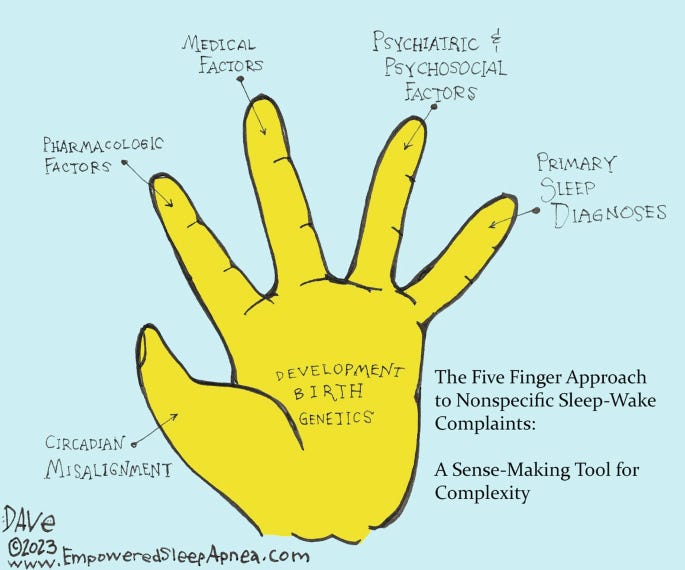
The framework is intentionally memorable and explicitly teachable, to other clinicians and to our patients themselves! It allows clinicians from different disciplines to explore complexity together without requiring everyone to become an expert in every field.
Finally, every discussion arrives at the question that matters most to patients.
The diagnosis alone (e.g.: “You have sleep apnea, that’s why!”) won’t motivate lasting engagement. Patients are motivated by outcomes that matter in their daily lives. At Rebis, we therefore organize treatment conversations around the Five Reasons to Treat from the Empowered Sleep Apnea project. What matters to the patient? Reducing future health RISK? Eliminating SNORING? Improving SLEEP quality? Enhancing daytime function during WAKE? Or having a positive impact on associated COMORIBIDITES?2
These conversations transform treatment planning from a discussion of diagnoses into a discussion of goals that patients can understand and help prioritize.
Notice what’s happened here: a pulmonologist, a dentist, a psychologist, an advanced practice provider, a health coach, and the patient can now participate in exactly the same conversation: they didn’t need identical expertise…what they needed was a shared vocabulary!
Once clinicians begin with the same language, collaboration becomes remarkably natural. The conversation shifts away from defending disciplinary territory and toward constructing a shared understanding of the patient’s physiology. Expertise does not become less important--if anything, it becomes more valuable, because the deeper one understands a specialty, the easier it becomes to recognize where that specialty ends and another perspective becomes indispensable.
Folks, I’m ready! I submit that this “connecting-the-silos” prompt is the next step for all of us, in this thing we call “Sleep Medicine”. The biggest opportunity lies in developing shared mental models that allow diverse experts—and the patients they serve—to reason together about complex physiology.
Every patient arrives with a singular story.
Our greatest responsibility is to give every member of the team a common language and process for understanding it.
References
McCarty DE. Beyond Ockham’s razor: redefining problem-solving in clinical sleep medicine using a “five-finger” approach. J Clin Sleep Med. 2010 Jun 15;6(3):292-6.
McCarty DE & Stothard E. Empowered Sleep Apnea: A Handbook for Patients and the People Who Care About Them (2022) BookBaby Press, NJ. Also see: https://www.empoweredsleepapnea.com/the-five-reasons-monument
David McCarty, MD, FAASM is the Chief Medical Officer of Rebis Health and co-creator (with Ellen Stothard, PhD) of the Empowered Sleep Apnea project. Dr. McCarty is an author, clinician, musician, illustrator, and he rocks a fedora better than most.
Comments
Nothing yet. Say the first thing.
Sign in to join the conversation.