
If you’ve ever found yourself scornfully thinking, It’s just easier if I do it myself, you are officially a practice owner.
Kendall still hasn’t called for a new sleep study. Leslie managed to fax the CMS1500 form sideways—again. And Cindy has more anime tattoos than you have operatories and still can’t remember that the morning huddle kicks off at 8am every day.
The only logical conclusion is that nobody cares as much as you do. That’s probably true, but it doesn’t help that you’ve built a business where every question can only be answered by you and every financial decision of more than $1 must be approved by you. Congratulations, you are the oracle. You’re the king, but the Sword of Damocles is hanging by a strand of your own hair.
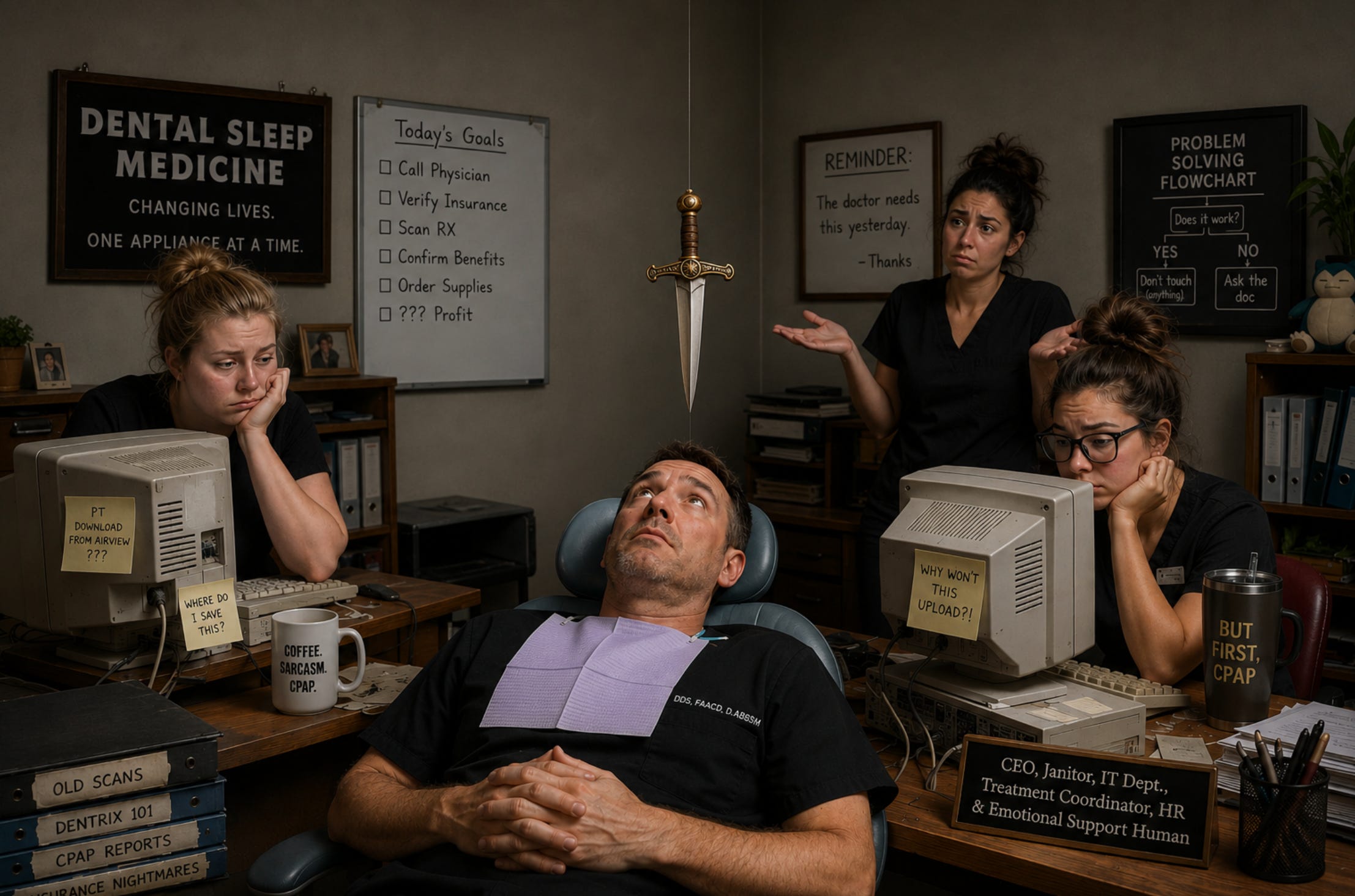
I’ve seen it in dental sleep medicine practices of every size. Doctors complain that their staff isn’t proactive while simultaneously requiring prior authorization to order scanner tips. You’re not delegating. You’re handicapping your team like a DSM Harrison Bergeron (if you don’t get the reference, look it up. I’ll wait here until you’re finished).
Hiring the right people is important, but that’s just the beginning. Exemplary teams don’t magically manifest because you found someone with a pleasant smile and some previous experience. They go from “good enough” to “GOAT status” because leaders intentionally create an environment where people can succeed. If you read my book, Transform Dental Sleep, you might remember the Four Es: Educate. Equip. Empower. Encourage.
People can’t make sound decisions if they don’t understand the proverbial “why.” You can send your team to courses, subscribe to online training continuums, and hire a third party biller, but don’t you dare—for even one second—make the mistake of assuming attendance equals learning. Education crystallizes into knowledge and becomes our DNA only when we understand why it matters.
What are they doing and why are they doing it? What happens if they don’t do it? What are the immediate and the downstream effects of slacking off?
Give your team the information they need to do the job. Teach your treatment philosophy. Explain how insurance works. Show them why physicians refer—or don’t. Help them understand the patient journey from initial outreach to annual follow-up. When team members understand the entire system instead of just their tiny slice of it, they stop acting like box-checkers and start acting like miracle-workers.
Remember when Tiger Woods teed up on the 18th hole without clubs?
Close your eyes and imagine JAY-Z walking onstage without a microphone.
Keep your eyes closed, and picture Billy Joel onstage, but there’s no piano for the Piano Man.
It sounds ridiculous, right?
It’s no different than expecting your treatment coordinator to present treatment without having high-quality sample appliances to show patients or relying on your front desk team to manage the schedule, patient communication, and billing for your growing practice using a decade-old Dell that sounds like it’s preparing for liftoff every time they send a digital fax.

You have to give your team the tools they need to do the job. Too many practice owners pinch pennies on the tools that have potential to produce dollars.
Get the EHR. Invest in decent computers and speedy internet. Purchase kick-ass scanners. When the time is right, hire a virtual assistant or ten. These aren’t luxuries. They are the necessary tools to operate the business you want to own.
Delegation involves empowerment. You’ve educated your team and given them the necessary tools to do the job. Have you given them autonomy though?
This is where most leaders stumble. It’s paramount that you clearly define what success looks like, lay out the guardrails, and then get out of the way.
I can hear you saying it now, “But won’t they eff up?”
Look, I can’t guarantee that the sun will rise tomorrow, but if it does, I will take zillion-to-one odds that someone on your team will make a mistake. And that’s OK.
Ask them what led them to the make the decision they made. Explain why it was less than ideal and ask what they might do differently next time. In many instances they’ll probably you exactly how it should be done. Then you can give congratulate them on their great idea, and encourage them to do it that way next time. If they don’t offer the preferred solution, you can give it to them, explaining why it is the right way to manage the situation, and clearly state what the expectation is going forward. Most people don’t make mistakes because they are defiant or malicious. It’s usually ignorance, not ineptitude.
Get into the uncomfortable habit of asking, “What do you think we should do?” At first they’ll hesitate, but eventually they’ll start bringing solutions instead of problems. Let them know this is a safe space. No, I don’t mean the stuff you’re tired of hearing about on the news. I’m talking about a place where it’s encouraged that you take risks and make decisions. As long as no one jeopardizes patients’ health, they won’t be fired.
When a team member walks into your office carrying a problem, and you instinctively solve it yourself, you are now the humiliated owner of their gremlin. If you keep that up, by lunch your office will look like that movie theater scene toward the end of the movie. Don’t steal other people’s gremlins. It makes your life a living hell and deprives your team member of the opportunity to learn, grow, and develop.

My parents were like, “You got an A, why didn’t you get an A+?” Most bosses have 20/20 vision when it comes to identifying errors, but they are legally blind when someone does excellent work.
I’m not suggesting you heap undue praise on your team for elementary work. I’m the first one to say that not everyone is a winner, and they certainly don’t deserve a trophy (maybe a prophy).
However, just as you spotlight areas for improvement, you should highlight jobs well done. You’d never say, “Lousy job today, Diamond.” No, you’d specifically address shortcomings and offer suggestions for improvement. This should be done in private…always coach privately.
On the flip side, specific praise should be provided publicly. Don’t simply say, “Great work this morning, Brandie.” Instead, during a team meeting, share specific feedback like, “Excellent job making Mrs. Dolphin feel heard and turning her mood around. That was a masterclass in conflict resolution.”
Avoid vagueness; be specific. “Really great work filling in those cancellations at the last minute today. Both patients are moving forward, so that made a huge difference. Great job, Stevie.”
Specific feedback reinforces which behaviors you want repeated. You know this is true with your kids. You know it’s applicable in your own life. Why would you treat your team any differently? Encourage them to become the best version of themselves.
The tighter you hold the reins, the slower your practice usually grows. You don’t want to be indispensable. You don’t want to be the single source of truth for routine, daily decisions.
Educate people so they understand the mission and know what they’re talking about.
Equip them with the right tools to do the job.
Empower them to make decisions and own outcomes instead of waiting for your permission.
Encourage them frequently enough so they know you care.
Do those four things consistently and something spectacular happens.
Your practice becomes less dependent on you. It runs more efficiently. Your team has more confidence. The practice grows. You have more time and bandwidth to work on the business rather than in the business.

Comments
Nothing yet. Say the first thing.
Sign in to join the conversation.