
Welcome to the desert of the real!
If you desire the comfort of neat conclusions, you are lost in this space. Here, we indulge in the unsettling, the excessive, the paradoxes that define our existence.
So, if you have the means and value writing that both enriches and disturbs, please consider becoming a paid subscriber.
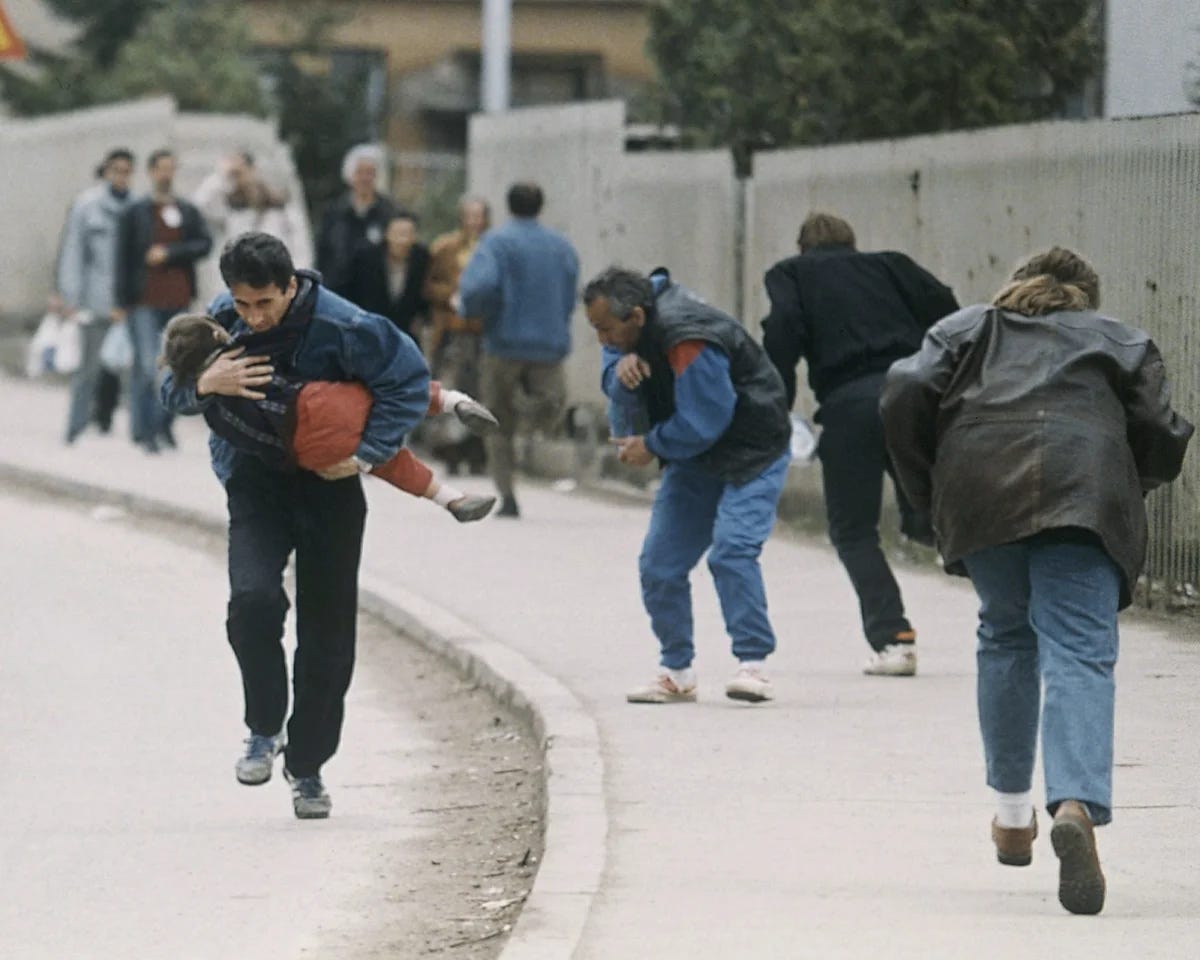
(Picture: a Bosnian man cradles his child as they and others run past one of the worst spots for snipers in Sarajevo, 11 April 1993. Photograph: Michael Stravato/AP)
There is a form of perversion at work today which allows us to avoid shame: we exclude ourselves from social reality (a reality regulated by some symbolic authority, what Lacan called the “big Other”) and intervene in it from a safe distance, so that our acts are not exposed to the gaze of the big Other which makes us ashamed. An exemplary case of such a perversion is provided by Sarajevo Safari (Miran Zupanič, Slovenia 2022), a documentary about arguably the most bizarre pathological event that took place during the siege of Sarajevo from 1992 to 1996.1 When this documentary was released, officials from Republika Srpska and war veterans’ associations sharply denied all allegations, calling them “propaganda” and “heinous lies” directed against the Serb people. Lately, with a delay of four years, criminal investigations are finally discovering facts, especially in Italy, and individuals will soon be prosecuted.2
It is well known that snipers on the hills surrounding Sarajevo, occupied by Serb forces, were shooting arbitrarily at residents on the streets below them. It was also well known that selected Serb allies (mostly Russians) were invited to shoot a couple of shots on Sarajevo, but this was considered an honor, a sign of special appreciation, not a business. Now we have learned about the real business: dozens of rich foreigners (mostly from the US, UK, and Italy, although some also from Russia) paid high fees for the chance to shoot at the residents of besieged Sarajevo. The trip was organized by the Bosnian Serb Army: the customers were transported from Belgrade to Pale (the capital of Serb Bosnia in the mountains near Sarajevo) and then brought to a safe place with a view of Sarajevo down in the valley. Prices were fixed – for example, to kill a young child cost more than to kill an adult.
We learn from the documentary that not only the top command of the Bosnian Serb Army but also NATO peacekeeping forces in Bosnia were aware of this safari – so why didn’t they make it public or simply bomb the sniper positions? But what is of special interest here is the form of subjectivity of a safari “hunter”: victims were not personalized, they remained anonymous, and a symbolic wall separated the hunter from the target. It was nonetheless not a video game; victims were part of reality, and the awareness of this fact accounts for the perverse thrill of such “hunting.” To be more precise, it is not the victim who was here de-realized, it was the “hunter” himself who excluded himself from ordinary reality and perceived himself as located in some safe place above reality. This is how reality itself became part of a spectacle in which the hunter can pretend that he is not personally involved.
Comments
Nothing yet. Say the first thing.
Sign in to join the conversation.