
All Michigan Democrats Have to Do to Win Is to Find Peace Over the Middle East
One of the state’s prominent Democrats explains why he’s not ready to endorse Abdul El-Sayed—at least not yet.
Sign up for the Slatest to get the most insightful analysis, criticism, and advice out there, delivered to your inbox daily.
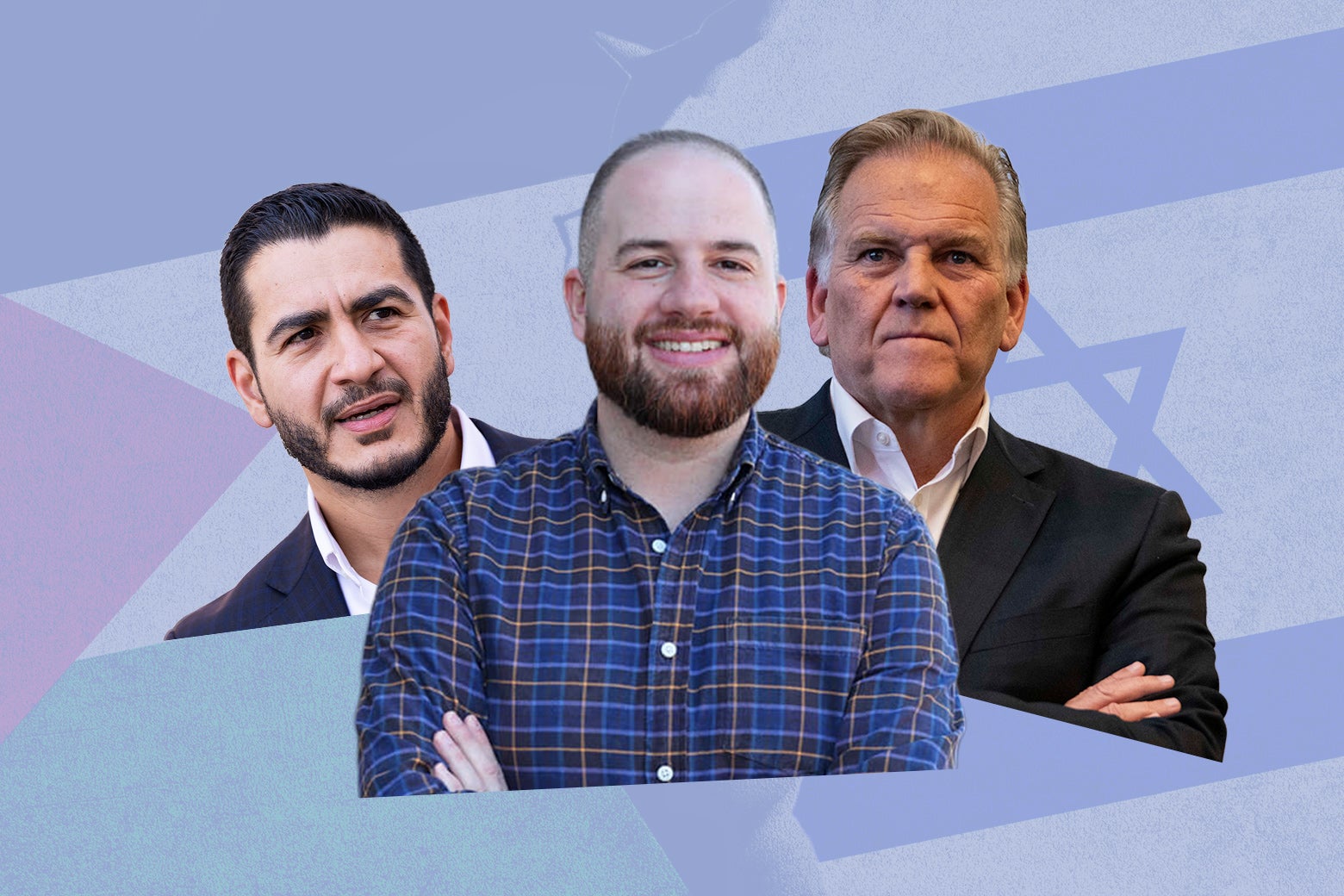
Jeremy Moss and Abdul El-Sayed are young, diverse progressive millennials in Michigan who are on the ballot for federal office in November. But Moss says he’s not yet ready to endorse his party’s nominee for Senate.
Moss is the Democratic nominee for Congress in a safe suburban Detroit seat. He is eager to come to Washington with Democratic majorities in both chambers of Congress. “We need to ensure that Trump’s cruelty and chaos is stopped, and specifically also to ensure that Trump isn’t capable of selecting younger and more conservative and extreme judges who will serve a lifetime,” the 40-year-old Moss told Slate.
That desire for a majority—and for a check on Donald Trump—is not all that Moss shares with El-Sayed, the Democratic Senate nominee in Michigan. “Abdul and I have agreed on some really big issues. There’s no daylight between us on abolishing ICE, attacking billionaires, and having a bolder, tougher, stronger Democratic Party with new leadership,” said Moss.
Like El-Sayed, Moss is a progressive millennial who has long been a rising star in Michigan Democratic politics. He was the first openly gay state senator in Michigan history and has risen into legislative leadership during his decade of service in Lansing. In many ways, he even sounds like El-Sayed in his view of politics. In Moss’ opinion, “The Democratic Party has to be bolder, tougher, and stronger. The line I use on the campaign trail all the time that always gets a rise out of people is ‘We can no longer be a party that shows up to the knife fight carrying a pie chart.’ ”
However, Moss tells Slate, he is not yet ready to back El-Sayed himself in the U.S. Senate race. That’s true even as El-Sayed runs against Republican Mike Rogers, whom Moss describes as “an election denier, somebody who’s going to keep Trump’s ICE running and rubber-stamp his extreme judicial nominees.”
But Moss is Jewish, is running to represent a district with a strong Jewish community, and is a supporter of Israel. His backing of a two-state solution and disdain for Benjamin Netanyahu had traditionally been Democratic orthodoxy. However, that’s no longer the case.
In contrast, El-Sayed is a virulent critic of Israel. Earlier this summer, he told CNN: “Every definition of a Jewish state ends up in some articulation of illiberal values, every single one.” And he said that if you’re “a Democrat and you believe in human rights,” the only reason one could support Israel is campaign contributions.
The candidate, who is Muslim, also said, “My commitment to Jewish safety is the same as the commitment I’ve got to my own kids,” but to many, his criticism of Israel has veered into antisemitic tropes. That’s particularly true after he campaigned with Hasan Piker, who has made antisemitic remarks and praised Hamas. The result has left many in Michigan’s Jewish community wary of El-Sayed and looking for outreach from him and his campaign to assuage their concerns.
“I think we both recognize it’s going to take Jeremy Moss voters and Abdul El-Sayed voters to vote for the same ticket to beat Mike Rogers and Donald Trump and MAGA extremism, and as we saw on Tuesday night’s results, there is a lot of overlap there,” Moss tells Slate. “But we’re going to sit down, and Abdul’s going to have to demonstrate some serious outreach to Oakland County’s Jewish community.”
As the political season turns from primaries to the general election, much has been made of the tension between centrist and progressive candidates. But some of those divides are more easily healed than others. Democratic differences over healthcare can be brushed aside by all parties involved, agreeing that their positions are superior to the GOP approach. Same with questions about policing or immigration or a host of other issues. But it remains to be seen if the divide in the conflict between Israel and the Palestinians can be bridged when a growing number of Democrats no longer support Israel’s existence as a Jewish state—and when, at times, anti-Zionist rhetoric has spilled over into antisemitic rhetoric.
Jewish Americans have long been one of the most consistently pro-Democratic demographics in the country. The last time a plurality of American Jews did not support the Democratic nominee for president was in 1920. However, many in the party have in recent years become increasingly hostile toward Israel, whose existence is supported by a vast majority of American Jews.
At the same time, a growing Muslim American population has viewed strident condemnation of Israel in the aftermath of the Oct. 7 terrorist attack, if not opposition to its very existence, as a threshold issue. It also has faced plenty of discrimination, with some Republican lawmakers insisting that Muslims should not be allowed to hold office in the United States.
This tension is particularly pointed in metro Detroit, which has the largest Arab American population in the country, as well as a significant Jewish population. And the issue has become more salient since the Oct. 7 Hamas attack on Israel and the ensuing Israeli military campaign in Gaza.
Rogers’ campaign has already been actively reaching out to Michigan Jews concerned about El-Sayed’s rhetoric and has found some Democrats willing to back him. There are over 100,000 Jews in Michigan, and Rogers lost his 2024 Senate race to Democrat Elissa Slotkin by less than 20,000 votes.
Moss’ primary win came only months after his congressional district witnessed a terrorist attack on a synagogue where an armed Hezbollah-inspired attacker drove a car rigged with explosives into the building, which had a preschool in session at the time. A security guard shot the attacker before any children were harmed.
The attack still lingers in metro Detroit’s close-knit Jewish community, which is centered on Moss’ congressional district. As he recalled, growing up he learned about antisemitism “in history books, black-and-white photos, and film reels.” But the attack on Temple Israel was in “real color … it wasn’t in Germany or Poland, but it was in West Bloomfield, where terrorists had the means and motive to kill 100 children.”
In Moss’ conversation with Slate only a few days after his early August primary victory, it was clear the Michigan Democrat wanted to support the Democratic nominee for Senate, but he just wasn’t there yet. “There are areas of disagreement, and there’s still a lot of Jewish pain in this district, especially after the Temple Israel attack here, and I’ve talked to Abdul about this over the last year in real time, and we’ve had an ongoing dialogue.”
The conflict faced by Moss is not unusual. He noted that at a time when there is hostile language on the left toward American Jews and Israel, “we have to make sure that the liberal Jewish community is not politically homeless.” He stated that his victory “really demonstrates that there is a lane for that community here in our party, and you know I’m representing that, as well as representing a lot of other big Democratic issues that this community voted for, that this district voted for.”
Moss said he has been a “leader on some of these consequential fights in Michigan, from gun safety to voting rights—lent me a lot of credibility as somebody who took on progressive issues.” He added: “And so to be able to stand up and say ‘Hey, it is not incompatible to be a Jewish leader and a progressive leader’ is something that clearly voters agreed with and embraced.”
These tensions spilled over not just into the Senate race, in which El-Sayed narrowly edged out his pro-Israel Democratic opponent Rep. Haley Stevens, but into Moss’ successful primary campaign. His opponents in his primary flirted with antisemitic tropes attacking him, claiming that he put “Israel first” and repeatedly trying to associate him with AIPAC, the lobby group that supports the U.S.–Israel alliance, despite the fact that the group did not back him. As Moss told Jewish Insider at the time, those attacks “touch many people’s ears as if it’s trafficking antisemitism.” Even after winning his primary, disinformation about Moss that delved into antisemitism has circulated widely.
Remarkably for the candidate, his experience as an activist leading the charge for LGBTQ+ rights—fighting for antidiscrimination protections at a time even before the Obergefell decision, which legalized gay marriage—has prepared him for life as a Jewish elected official in these fraught times. He noted that the best antidote to prejudice is “getting elected and representing a community and dispelling myths and dispelling conspiracies and dispelling lies in order to show up as your true, authentic self and better explain what a community is about.” He added: “And so I’ve done that, being the only LGBTQ member of the Michigan Senate, and I’ve done that being the only Jewish member of the Michigan Senate.”
The result, he said, has helped make inroads with colleagues who “see quick clips on TikTok about what’s going on thousands of miles away, and not letting that be the only thing that dictates their opinions and their values and their policies, and digging a little bit deeper to explain the nuances of an incredibly complicated conflict.”
For Moss, outreach by El-Sayed is important not just because of the high political stakes involved and the urgent need he felt to ensure that Democrats could hold a swing Senate seat. As a lifelong Michigander who values the state’s diversity, he doesn’t want to see divisions grow.
“For us to figure out the path forward, and not even in a political sense, not even in the context of an election, in order for a very vibrant Jewish community and a very vibrant Arab American community to be able to continue to live here as neighbors, there has to be figuring out the path forward to continue to come together,” he said.
As Moss noted, “We don’t always agree, and we have a different lens on this conflict, but we are all trying to make sure that the conflict thousands of miles away does not come here at home … We’re all still here together as neighbors, and we have to make sure that these two communities can continue to live side by side here as neighbors.”
Moss and El-Sayed have been in touch. Their divide is far more soluble than that of the underlying conflict in the Middle East, but bridging it still remains a work in progress.
Comments
Nothing yet. Say the first thing.
Sign in to join the conversation.