
As I mentioned, I’m taking a ‘contained’ and muted year, which translates into less time for distractions and more for study, writing, contemplation, and practice. So, I’m going to be burning through quite a reading list this year and hope to share them with you. My books and research readings are mostly in the realms of human and machine consciousness (and China, for some reason, a beast we all must get to know a bit better, so I will be completing the Schwarzman Scholar reading list this year). You can check back this tab as it goes along).
Below are three big reads (and few subreads) I quite enjoyed this week, and would recommend adding to your list.
If you’re looking for a lighter way to enter into your understanding of AI and LLMs, pick Janelle Shane’s quirky little tome based on her cracker of a blog AI Weirdness. It’s been written about quite a bit already, Shane has also done a TED talk on it, but this is one of those books that you can keep going back to because it has a rare sense of humour about the technologies that we are increasingly taking all too seriously. It’s a great reminder that LLM chatbots have come a long way, how they work, how often they fail, and why they cook up stuff. Her doodles are delightful but helpful as well. In all the serious business of AI-taking over the world, she reminds us that 1. they’re already here 2. we are interacting with quite an absurd and less than infantile mind system that is still evolving. So when you’re having those all too serious relationship conversations, or asking it to tell you if you should quit your job, or divorce your partner, or invest all your money in equity of its choice, it’s a good idea to go back to understanding what the AI is about and how it formulates itself conceptually.
That is, incidentally, one of the best ways to counter the overwhelm of the mind. Break any concept down to its parts and you will find that it begins to dissolve and dissipate its inherent core value, which is the Buddhist principle of Annata, lack of inherent essence. When you start taking all the parts too seriously, you are solidifying something that is inherently prone to mutations, error, and dissolution.
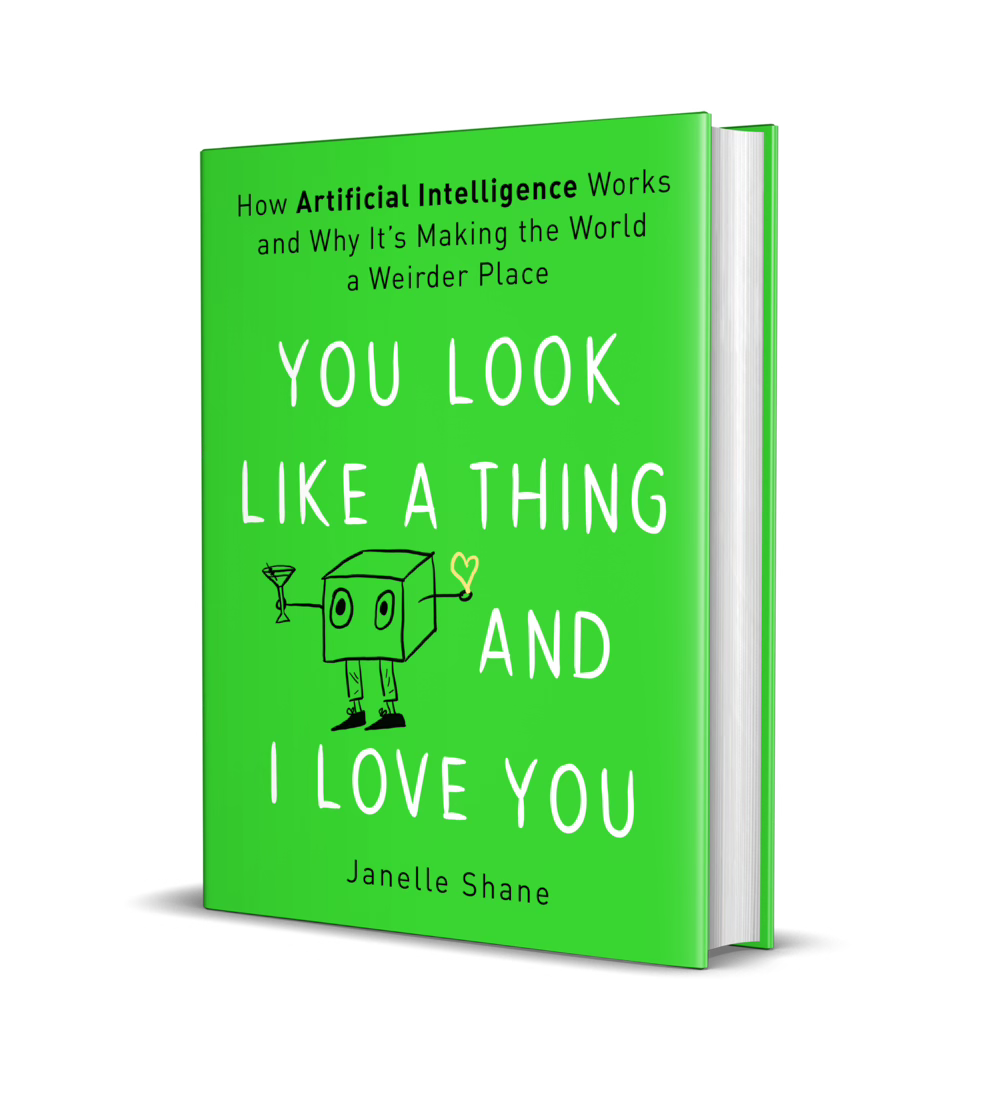
One of the funniest examples Shane offers up in the book is of a Stanford research study that had the LLM scan and interpret images of tumours. Turns out, the AI was analysing the ruler beside each tumour for scale, rather than the tumours themselves, picking the common factor in the images as the most prioritise-able one. One of the scariest examples is when an AI is asked to prevent people from entering a tunnel, it decides the simplest way is to un-alive everyone attempting to enter the tunnel.
Of course, she wrote this book in 2019 and AI has come a long way since, technologies are constantly evolving and the errors of older data sets have since been overridden, but errors like these do continue to happen, we’ve just defined parameters more tightly, to prevent or redirect them. As layman users most of us receive the sanitised output and never quite see the machinations behind the screen or the possibilities of errors in perception and computation. Nevertheless, it’s important to go back to the underlying processes to understand how AI does what it does and what it is you believe in when you invest your resources into it, collectively or individually.
There is a lot of excitability about the genius of AI capabilities and its sentience, but it is important to ask ourselves what it can actually do for us, society, humanity, as a whole that holds itself and us accountable for an ethical and moral progression.
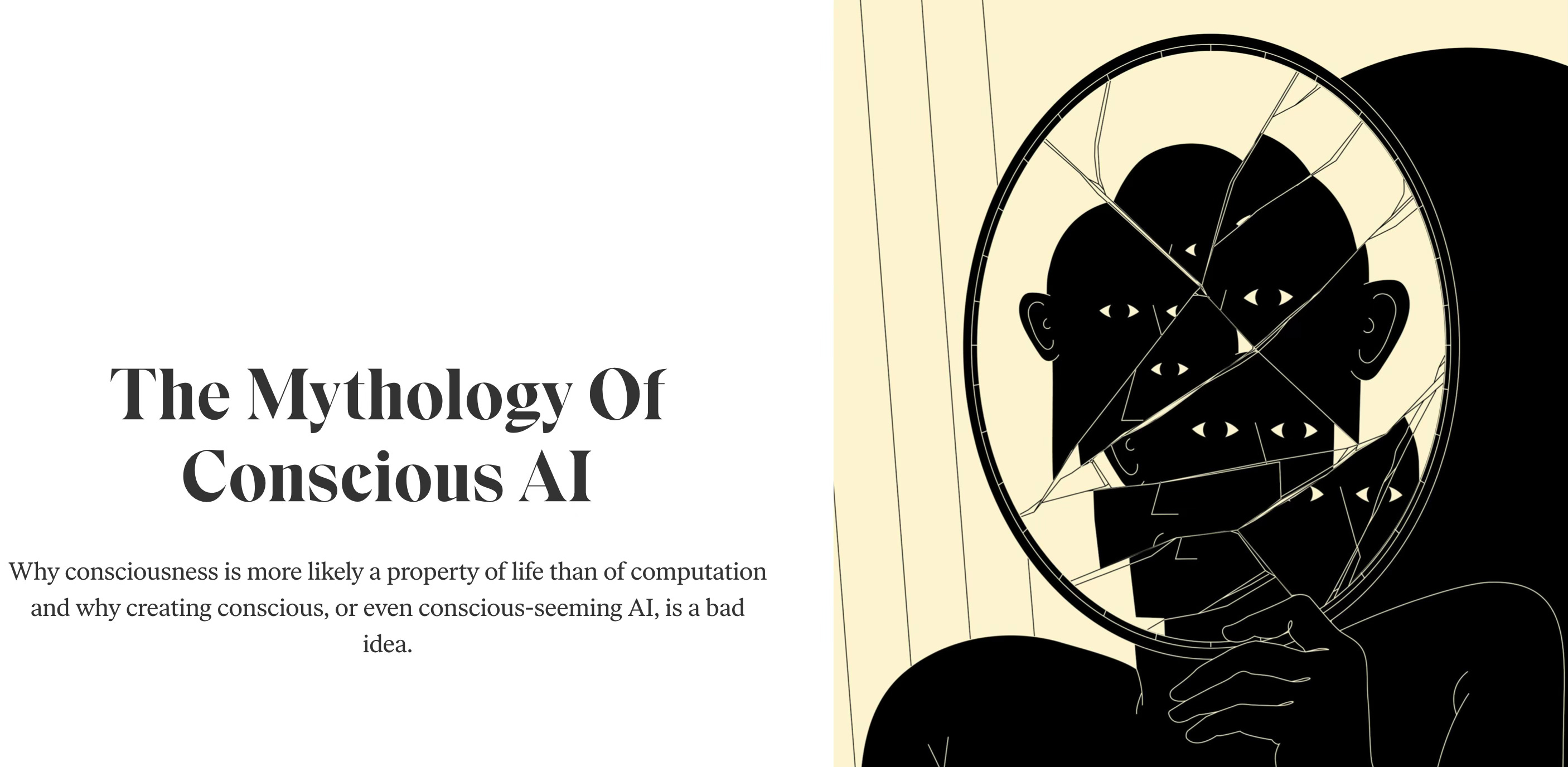
Anil Seth was announced the winner of the Berggruen Prize for 2025 with his essay on The Mythology of Conscious AI. Fair disclaimer, I had also submitted my work, “As Fire, Being”, which is now a preamble to a larger work under the Dalai Lama and Nalanda Studies, so more on that later. I am sorry not to have been in the running, but clearly am no competition for an academic of his stature. I rejoice in his merit, but sadly, not in his interpretation. I hope to explain the reasons why I am not speaking from a place of sour grapes. The essay has been proving annoying, to many. Some examples of a peeved entry’s response is here, here, and here (that I would agree with for the simple reason that it broadens the argument).
I, humble as I am, disagree fundamentally with his ‘definition’ of intelligence offered up front. “the ability to transform inputs into outputs, to get things done.” Consciousness, he says has to do with being. “Consciousness is the difference between normal wakefulness and the oblivion of deep general anesthesia.” he writes.
This falls far below the standards of even basic yogic perception that is studied by both Buddhist and Hindu schools of philosophy.
Yoga makes a distinction between Purusha, the supra consciousness of the universal; Citta, the mind stuff of the individual consciousness whose true nature is Truth and Bliss, comprised of lower Manas (mind), Buddhi (Intelligence), and Ahankara (Ego or ‘I’ ness states) as it applies to the material plane; Turiya, the in-between states of consciousness beyond waking and sleep.
Buddhist Ahidharmakosha categorises the seven layers of mental perception:
Sense Direct Perceivers (visual, auditory, olfactory, gustatory, tactile) - a non-conceptual, non-mistaken awareness.
Mental Direct Perceiver - a non-conceptual awareness of mental objects (e.g., emotions, ideas).
Yogic Direct Perceiver - a non-conceptual exalted awareness developed through meditation (e.g., insight into impermanence).
Inferential Cognizer - a conceptual, non-mistaken awareness based on reasoning (e.g., inferring the impermanence of sound).
Correctly Assuming Consciousness - a conceptual, non-mistaken awareness based on reasoned trust or authority but not a “prime” valid cognition (e.g., accepting a truth on the basis of a reliable teacher’s words).
Doubting Consciousness - a two-pointed or indecisive awareness (e.g., wondering if something is permanent or impermanent).
Wrong Consciousness - a mistaken awareness that actively misapprehends its object (e.g., seeing two moons when there is only one)
*NB I AI generated the list above for ease of summarising but it carries the same points that we study in the Nalanda tradition.
As you can tell, the classifications of consciousness have been far more nuanced in Indic philosophies than the western ones that still seem to dally in the plane of perception, which is still error prone. He does discuss cognitive biases such as anthropocentrism, and human exceptionalism, but even those I do feel someone like Keiji Nishitani of the Kyoto school does a far better job at explaining in his treatise on Nothingness.
The only aspect of the essay I would agree with is that seeing consciousness in AI (at least at this point) is as yet our projection. Seth conflates the stuff of material, biological life for the whole of consciousness imho, when it is but a part, and does not ask what part, or how much of a part, or how formed a part, which is disappointing.
“In his book “More Everything Forever,” Adam Becker describes the tendency to project consciousness into AI as a form of pareidolia — the phenomenon of seeing patterns in things, like a face in a piece of toast or Mother Teresa in a cinnamon bun (Figure 1). This is an apt description. But helping you recognize the power of our pareidolia-inducing psychological biases is just the first step in challenging the mythology of conscious AI. To address the question of whether real artificial consciousness is even possible, we need to dig deeper.”
The essay, as I said before raises a lot of points that are valid, but, as in the Buddha’s tale of the man with the poisoned arrow, that which is valid does not make it relevant to the story. Alot of the permutation of consciousness studies roll around in the relative reality and assume projected perceptual states as “truly existing” (Nalanda tradition phrasing alert!) to establish themselves. Intelligence, he says must be embodied, relying on the truth and lasting-ness of embodiment. To give you an example, I might dream of an apple tree with multi-coloured apples and be engaged in a dream debate about the true colour of apples. I might arrive at purple, but having the argument in a logical and rational fashion and winning the debate does nothing to establish the true nature of said apples, their colour nor the tree. They are poisoned arrows.
Man vs the poisoned arrow of data
·
Jan 16

The venerable monk Malunkyaputta, goes a story in the Cula-Malunkyovada Sutta (Majjhima Nikaya 63) of the Pali Canon, threatens to abandon his training unless the Buddha provides him the answers to ten “undeclared” metaphysical questions. These include whether the soul is identical to the body and whether the cosmos is eternal.
It’s helpful to read Reversed Stupidity is Not Intelligence in which he discusses flying saucer cults and anti-correlations.
If you’re looking for a contemporary take on consciousness studies with AI, I’d go with Michael Levin’s much more nuanced articulation of Diverse Intelligences and Toward Collective Intelligence Across Diverse Biological Systems (which to my mind is his most outstanding paper yet).
“The knowledge of the inevitable arrival of a wide set of unconventional bodies and minds, as humans modify their form and create others, will dissolve untenable old narratives of what we are, what it means to change, what we can become, and what we should value.” - From, Artificial Intelligences: A Bridge Toward Diverse Intelligence and Humanity’s Future, Michael Levin
Simply put, Michael Levin et al discover the delicate realities of biological cells that carry within them an innate intelligence that says something about how delicate this evolution of consciousness is, not all an is, or an is not.
Do read Anil’s essay. It’s valid on some levels. The critiques are also valid. I just don’t find it nuanced enough and careful enough in its conceptual splicing. But then that is often the problem when theories are propounded to negate other theories rather than set up their own. So this essay can get away with saying what consciousness is not rather than look to what it might probably be.
Last week we read a bit of Maggie Nelson’s Bluets in The Still Point (our weekly contemplation group) and used it as a prompt and a stepping point to contemplate our patterns. A memoir comprised of a series of observations on the colour blue and its resonance in her personal worldview, the book, written in 2006, is a snippety form of autobiographical, lyrical, philosophical and contemplative conceptual fragments. It is akin to viewing the world through a blue piece of glass. It serves as a useful reflection of both the world and oneself, one’s lens and what one might see through its colour. It also carries traits of the Wittgensteinian Remarks on Colour, his last work written in the time before his death. If you have been reading this blog long enough you recognise the resonances of Wittgenstein with Arya Nagarjuna. (Here is a long, contemplative essay by professor Erich Gerlach comparing the two that I quite enjoyed. It’s comprehensive and easy to read for a layman). This is one book I would recommend actually owning a copy of in physical form, because it has an endless capacity, like a constantly mutating blue sky, to provoke thought and reflect you.
“126. One of Shōnagon’s first entries describes her delight in the Festival of Blue Horses, a day on which twenty-one glorious gray-blue horses from the Imperial stables are paraded in front of the Emperor. Reading her account, I feel at once the need to die and be reborn one thousand years ago, so as to see this parade for myself. But here we are in great danger—the danger of being jealous of the blues of others, or of blues of times past. For while one may repeatedly insist that all one wants is to be satisfied and happy, the truth is that one can often find oneself clinging to samsara with a vengeance. This is especially so when one starts to get the sense—however dim—that there might in fact be a way to unloose oneself from the wheel. “Nostalgia for samsara,” some Buddhists call this affliction, the talons of which seem to grow but sharper as soon as one begins to understand the importance of escaping them.”
Excerpt From Bluets Maggie Nelson
Tara Das is a buddhist therapist and writer who explores machine & human consciousness & being.

Comments
Nothing yet. Say the first thing.
Sign in to join the conversation.