
An exclusive preview of the first 10 verses.
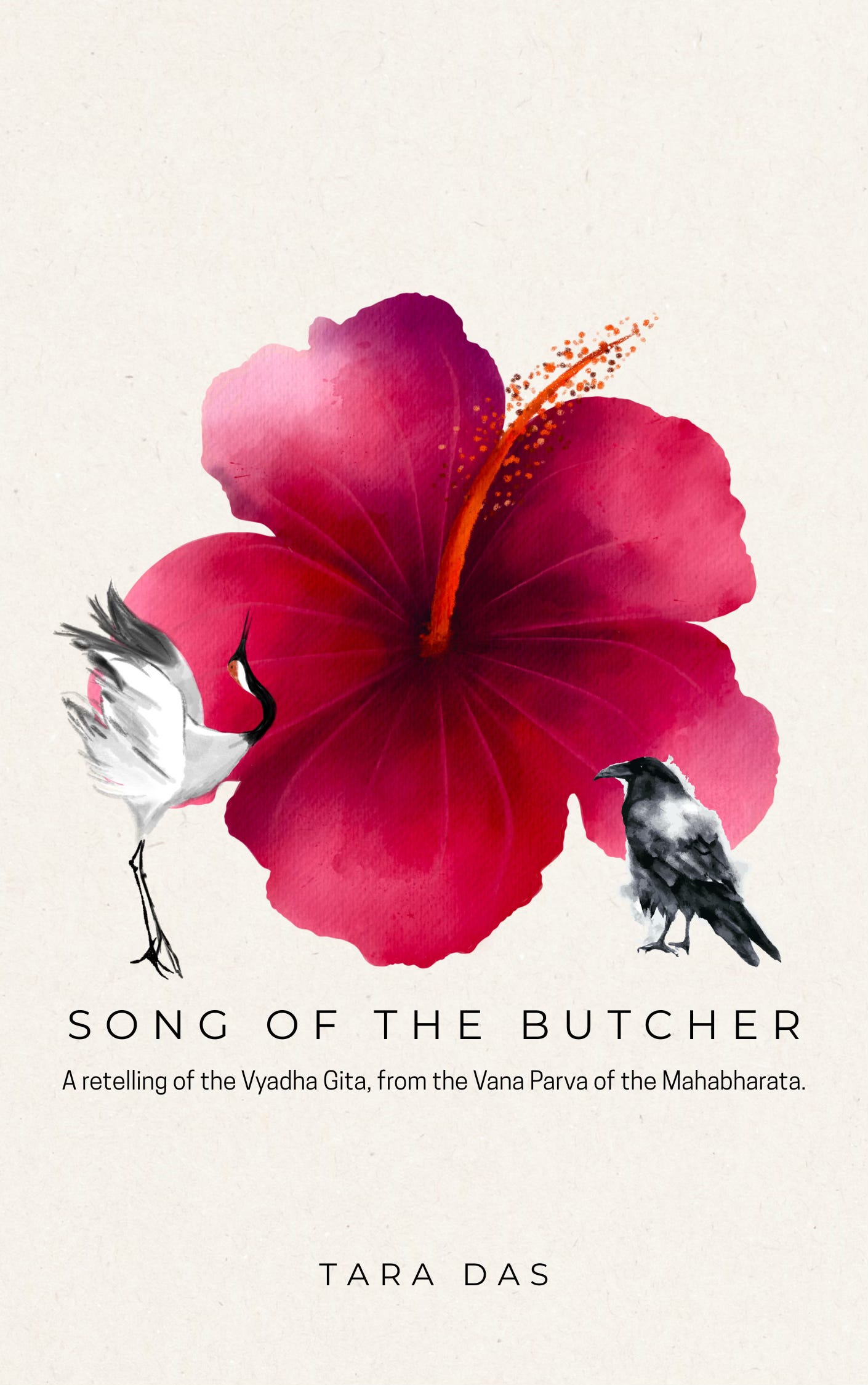
I first came across the Vyadha Gita when attending a talk on the kinds of disciples at the Ramakrishna Mission, Mysuru. Swami Vivekananda cites the song of the butcher, Dharma-Vyadha, in his ‘Karma Yoga’ as an example of how each one’s dharma is what each does, as they are. There is no expected cloak or form, class or caste, correct or incorrect way to attain realisation. Everyone will attain it in the making of who they are. The story was first narrated by Sage Markandeya to Yuddhishtira and occurs in 210 of the Vana Parva of the Mahabharata. I am using the late Bibek Debroy’s version, as well as a translation by the South Africa-born Pandit Rama Ramanujachari of the Sivananda order. The Song of the Butcher is first and foremost a lesson in humility and in recognising and respecting knowledge in whatever form it comes. It is also a necessary commentary on caste, class, and societal hierarchies. This is to my mind a vital lesser-known Gita that deserves wider reading and interpretation.
This story also reminded me of the Mahasiddha Saraha, one of the foremost exponents of the Mahamudra of the Vajrayana, the tantra order of buddhism. He was a maverick with seeming little regard for the rules, though if you know how Mahasiddhas work, they discard anything that can be discarded to arrive at undiscardable truths. Once Rahula, a student of Nalanda university, he threw out his vows and practices, to find enlightenment with the arrow-making dakini and the radish-curry dakini. The story goes he opened his eyes after 12 years of meditation to ask for radish curry that he had wanted before he began. Annoyed, she schools him, showing him his 12 years of penance were a waste.
I will be also narrating Saraha’s story in similar format after this, as part of a series called ‘Unsavoury Sages’, great teachers who have appeared in not quite the expected format.
I will upload the first book (this one below) to Amazon KDP within a couple of weeks. Alas, I have neither skills, nor knowledge, nor network, nor spiritual progress to prevail upon mainstream publishing for these works. I do however enjoy designing my own book covers. I hope you will enjoy these contemplations. I rely on you to read and share.
I have attempted to keep the language simple because I want it to reach as many readers as possible. Sometimes, I find poetry can be wantonly contrived and obtuse. I hope it conveys a rhythm to its thought. You may also find nods to other classics and texts within the lines. References are drawn from the Mahabharata, the Yogasutras, Vedic prefaces, chants and meter, and other texts that may or may not be directly aligned to the Mahabharata. I will add comprehensive footnotes and a bibliography in the book format.
For now, speak to me about whether this speaks to you.
Also, pls read, share, subscribe and buy the previous books. They’re not too bad.
buy Tender. the Notebandi Affair here
buy Terrible Loves, Tiny Tales, here
All texts are © Tara Das, 2025, Copyright Act, 1957.
A seed of a long-forgotten deed sprouted. From where it slipped into the cracks of parched earth, drinking in monsoon after monsoon, it unfurled its consequences. Now, bearing four yugas of witness, upon a wisdom-gnarled trunk the Peepal’s canopy hooded the terracotta-dappled road at village edge.
The soles of Kaushika’s feet hardened, pocked by indents of thorn, blister, and stone. This was not the student life he imagined, such a bore these ashram chores. All in exchange for never-ending verses that claimed it was futile anyway. If the grammar would not save him, why master it today?
His stomach rumbled. Hungry until the pratahsandhya done, he grumbled. A nip and a roar hinted at water nearby. Distracted from chagrin, he set down his flax upper cloth, a coconut-shell lota, and the leaves of his texts at the foot of the tree. In loin cloth, thread stirring at his chest, he walked towards the sound of the river to see.
At its bank, he found the tank. Edged with water lilies, dotted with blossoms from pregnant Pongam, sweet tamarind, and wild lemongrass, frog, crane, and common dove. His riled emotions lulled. “Some great soul has left an impression here,” he thought, as he dunked under. “May I receive his teachings,” he blessed his own inspired wonder.
Outcastes lived where others wouldn’t. The butcher, the grocer, miller, ironsmith, sweeper, cleaner, and the cemetery keeper. Beyond the screen, the scholar assumed the curtained green was abode to those who were crafted, like him, of similar school. Craft and skill, while even he struggled, surely was not of the common pool.
Upon his kusha mat, cross-legged, clad in wet-washed flax, and determined, he sat. Eyes closed to the world, engrossed in correct perspective, dodging misperception, imagination, and sleep, he summoned the yoga of vital memory. Invoking first the overseers of sacrificial fires, he began to apologise for all the mistakes he was about to make.
Overhead, two yakshas, guardians of the Peepal and its people, bristled restlessly. The brahmin had omitted prostrations to the East, where the spongy ground held a fertile feast of the roaring Kaveri when it swelled. Into this he thought it futile to pour his water offering. It is thirst that makes a yaksha mischievous. “I feel a flight coming on,” one said to the other.
A flap sent a shudder down the brahmin’s spine. Without opening his eyes or breaking rhythm, he tossed his upper cloth around his shoulders. The chants resounded through woods and banks: “I am that, I am that, I am all that.”. When he was startled by a glutinous drip down his pate. On the branch above, a pair of wily birds, the crow and crane, had quarrelled, and shat.
The furious scholar was all aquiver. He summoned the penance of ancestors flowing within this sacred river. Humiliated, he shot a single fiery glance, potent with rage. The crane convulsed and fell at his feet. The crow raised a ruckus, and he watched it flee. Overcome with momentary regret, he consoled himself: the lifeless crane’s karma, clearly, was pre-set.
He stepped into the same river twice. He washed off his gummy taint, but the guilt of impulse lingered still. He returned to his asan to bury the bird. It was nowhere to be found. Perhaps a predator made a meal of it. Disturbed, he decided to call it a day. Walking to the village, he sought a housewife with gruel to give away.

Comments
Nothing yet. Say the first thing.
Sign in to join the conversation.