
I noticed it on my own face before I fully understood it.
It was a photo. The kind someone takes of you mid-laugh from slightly below, the angle none of us would ever choose. I looked at my jaw and thought, that is not where my jawline used to be.
Now, I am not careless with my skin. This is what I do, all day, every day, for sixteen years. I take my makeup off at night. I layer in the right order. I do the devices, the actives, the sunscreen, the internal work. So my first thought was not “you got lazy.” It was the more unsettling one. I am doing everything right. How is this happening?
If you have ever stood at the mirror and thought exactly that, stay with me. Because the answer is not on your skin.
I understood it faster than most women would, and I will tell you why. Bone loss is not abstract to me. Osteoporosis runs in my family. I watched my grandmother slowly shrink over the years, her shoulders curving forward, until she was shuffling from room to room, a little smaller every time I saw her. My mom gets the Prolia shots now to hold the line.
So when I realized my own face was losing bone, it did not register as a skincare problem. It felt like the early, quiet edge of something I had already watched up close.
That is the part no one connects. The same bone loss that bent my grandmother’s spine is, in a softer and more hidden way, reshaping the face of nearly every woman in menopause.
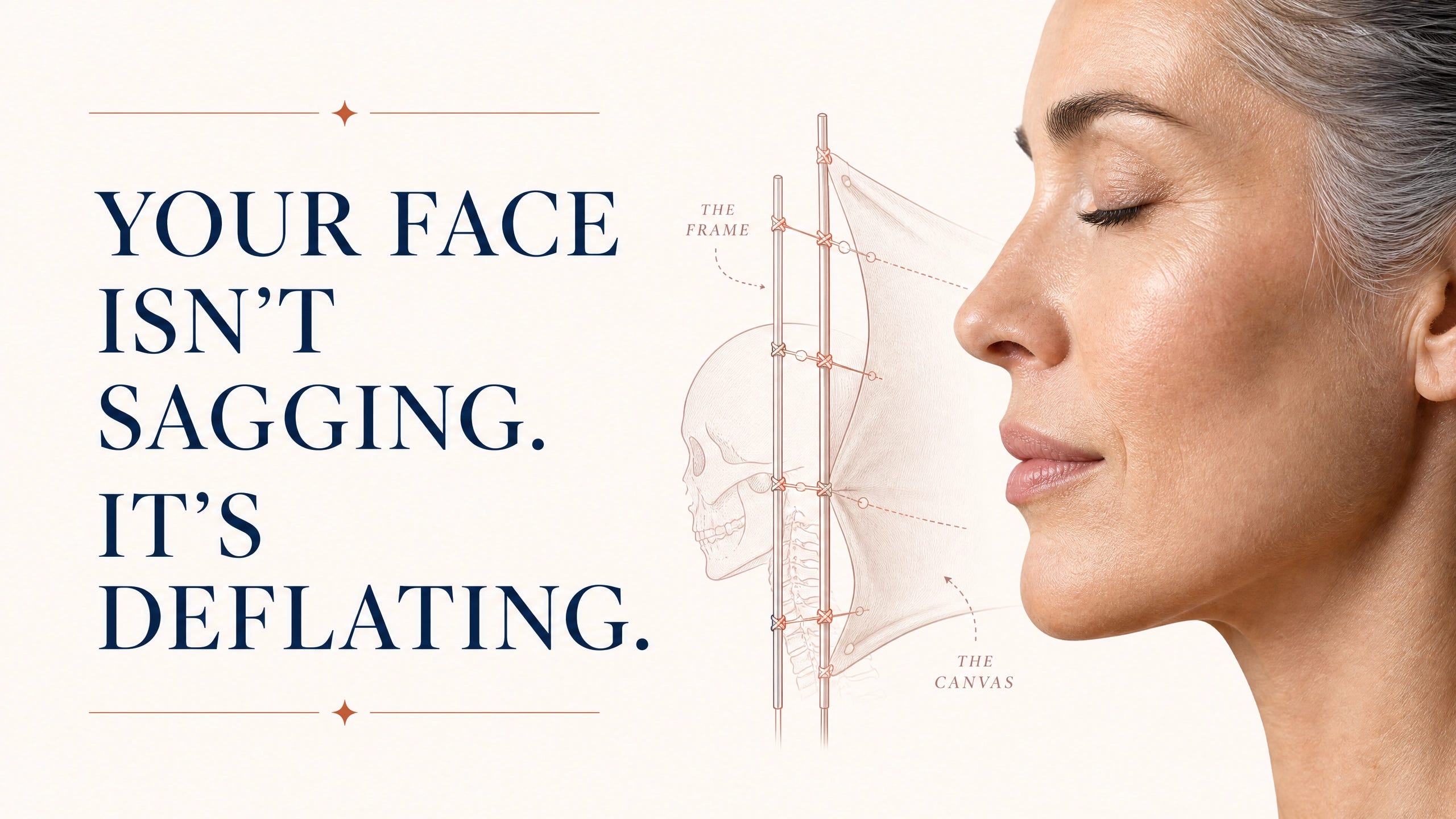
Your face is not sagging onto your bones. Your bones are receding out from under your face.
Read that twice. It is the whole insight, and it changes what you do next.
We think of the skeleton as the permanent scaffold. The one thing that holds still while the soft tissue slowly slips off it. Almost every “lift” and “tightening” promise you have ever been sold is built on that assumption.
It’s false. Bone is living tissue. It gets broken down and rebuilt your entire life by two opposing types of cells. Osteoclasts (the cells that break bone down) and osteoblasts (the cells that build it back). Clasts crush, blasts build, if that helps it stick. For most of adulthood the two stay close to even.
Estrogen is what keeps them even. Specifically, estrogen keeps the breakdown crew restrained. When estrogen falls in perimenopause and menopause, that restraint disappears, and breakdown starts to outpace rebuilding. This is the same hormone, the same decline already thinning your collagen, doing structural damage one level deeper. The collagen loss thins the canvas. The bone loss moves the frame the canvas is stretched across.
The loss is not slow and gentle. In the first several years after menopause, women can lose roughly 10 to 20% of their bone density, and the trabecular bone, the spongy inner bone that responds fastest to hormones, takes the hit earliest and hardest.
And it is not only your hips and spine. Your facial skeleton remodels too, and in key areas it recedes. It does not pull back evenly. It gives way in particular zones, in a predictable order, and each one produces a “sign of aging” you have been taught to blame on your skin.
The eye sockets widen. The bony opening around the eye enlarges with age. As the rim recedes, especially at the top-inner and bottom-outer edges, the support around the eye falls away. That is the hollowing. That is the lengthening between lid and cheek. That is the “you look tired” comment on a day you slept nine hours. The socket got bigger, and no cream reaches that.
The midface recedes. The bone beneath your cheeks loses height and pulls backward. The opening around the nose widens too. The result is a flatter midface, less cheek projection, and deeper nasolabial folds. Those folds are not the skin creasing on its own. They are soft tissue with no bony wall left to drape over.
The jaw deflates. The jawbone loses height, the angle opens up, and one specific region right in front of where jowls form goes concave. The shelf that used to hold everything taut sinks. The soft tissue slides into that hollow. That is your jowl. That is the loss of a clean jawline.
None of this means bone is the only thing changing. Fat pads shift, ligaments loosen, skin thins, and all of it stacks together. But bone is the layer underneath every one of those. It is the foundation they are all resting on, and it is the one almost nobody names.
Here is a finding that stopped me cold. In a 2019 study that mapped how women’s faces change shape after menopause, the timing of menopause itself was the strongest predictor of those structural changes, and bone loss in the jaw was a major contributor. It is one study, not a settled law, but it points at something real. The clock reshaping the structure of your face is, in meaningful part, a hormonal one.
So when you look in the mirror and think your face rearranged itself, you are not imagining it. You are reading a real structural change correctly. Trust yourself there.
Once you understand that the frame is receding, a lot of frustration starts to make sense.
If you chase the hollows and folds with volume alone, you are decorating a tent while the poles are sinking. Sometimes it works for a while. Sometimes it makes the face read heavier or oddly proportioned, because you added soft volume on top of a shrinking foundation instead of addressing the foundation. This is exactly why the facial rejuvenation field increasingly treats the bone, not the skin, as the new frontier. Correcting the structure changes the result, because ignoring it limits everything done on top.
You do not need that to be a sales pitch for anything. You need it as a lens. When the structure is the problem, structure is the answer.
The dryness is the canvas. The fine lines are the canvas. The bone is the frame.
You have been pouring your time, money, and discipline into the canvas. Reasonable, because that’s all anyone showed you. I did the same thing to my own face, remember, and I do this professionally. But the frame has been moving the whole time, quietly, and no canvas treatment will ever hold a frame still.
The good news is that bone, like skin, is responsive tissue. It is not a sculpture set in stone at thirty. It answers signals. You just have to send the right ones.
Bone builds where it is mechanically stressed and dissolves where it isn’t. The zones of the skeleton that resorb fastest are the ones under the least load. So the single most powerful thing you can do for your bone is put demand on it.
I’ll be honest about how convinced I am of this, because I lived it. After my son was born I could not lift a single pound. Not one. I started anyway, small, week after week. This morning I lifted twenty pounds on one of my arm moves and actually stopped, stunned, because I remembered where I started. My skeleton rebuilt because I loaded it. Yours runs on the same rule.
Resistance training, two to three times a week. Compound movements. Squats, presses, deadlifts, rows. You are not chasing a look. You are sending the build signal to your entire skeleton.
Weighted load while walking. A 10 to 15 pound weighted vest on a 20 to 30 minute walk adds skeletal demand to something you already do. Start lighter, build gradually, stay tall.
Impact, if your joints allow it. Even brief, gentle impact like a few sets of heel drops signals bone to reinforce.
This is the one intervention with no topical substitute and no shortcut. It is also free. Consistency beats intensity every time.
Calcium is the headline, but calcium without its cofactors is calcium in the wrong place.
Protein, 25 to 35g per meal. Bone is not just minerals. About 90% of its organic framework is type I collagen, the same protein we keep coming back to. The mineral hardens the scaffold. The collagen is the scaffold. No protein, no scaffold to harden.
Vitamin D. Required to absorb calcium at all. Standard labs call 30 ng/mL sufficient. I aim higher for skin and bone, closer to 50 to 80, which is a functional target, not the conventional cutoff, so know that is a position and not everyone shares it. Same range I use in last week’s bloodwork piece.
Vitamin K2. Thought of as the traffic director. K2 may help steer calcium into your bones rather than letting it settle in your arteries. The evidence is still evolving, but it is part of why calcium is better taken with its cofactors than on its own.
Magnesium glycinate, 300 to 400mg before bed. A cofactor in activating vitamin D, and it pulls double duty supporting sleep and lowering the cortisol that drives bone loss.
Calcium, food first. Sardines with bones, dairy if you tolerate it, leafy greens, paired with the cofactors above so it lands where you want it.
This is also where bone broth earns more than its trendy reputation. Bone broth and collagen peptides supply the glycine and proline your body uses to build that collagen scaffold, the same scaffold the minerals harden. Collagen peptides have shown modest benefit on bone markers in research, so hold this as supportive, a steady supply of raw material, not a standalone fix. The bone broth protein I stir into my coffee every single morning is doing double duty, for my skin and for the matrix underneath it. I broke that whole habit down, the brand I use and why, in [my collagen post ]. If you read one thing alongside this, read that one. They are two halves of the same structure.
Estrogen is the upstream switch on all of this. For many women, hormone replacement therapy is one of the most effective tools we have for preserving bone density through the menopause transition, and that is a conversation worth having with a knowledgeable provider rather than avoiding out of fear. I am not pushing you toward it or away from it. I am making sure you know bone is on the list of things estrogen was quietly protecting.
The standard bone density scan, a DEXA, is recommended for women at 65, and earlier only for postmenopausal women with specific risk factors that a doctor screens for with a quick tool. At 48 and likely perimenopausal, a lot of us simply are not there yet. So the move is not to march in and demand a scan. It is to have the conversation. Ask where you fall, what your risk factors actually are, and when a DEXA will make sense for you.
Bone turnover markers called CTX and PINP are blood tests that show whether you are breaking down bone faster than you are building it. They are not routine, but they are worth asking about if you are already flagged as higher risk or you just want more visibility. And the vitamin D and ferritin from last week’s bloodwork feed this same picture. Those you can check now.
You cannot recalibrate what you cannot see. But seeing your bone clearly is a timing conversation with your doctor, not a test to push for at every age. The frame is measurable. The point is measuring it when it counts, and supporting it long before then.
Everything I teach is structural support during hormonal change. With bone, that phrase stops being a metaphor and becomes literal.
The four pillars, barrier stabilization, lymphatic support, collagen signaling, and strategic device use, all work on the soft tissue. The canvas. They are real and they matter. But they all assume a frame to stretch across. Bone is that frame. Supporting it is the deepest layer of structural recalibration there is, and it is the one that asks nothing of your skincare shelf and everything of how you move and eat.
You have been supporting the canvas. Now support the pole holding it up.
Stay glowing Naturally,
Lindsey
No posts
Comments
Nothing yet. Say the first thing.
Sign in to join the conversation.