
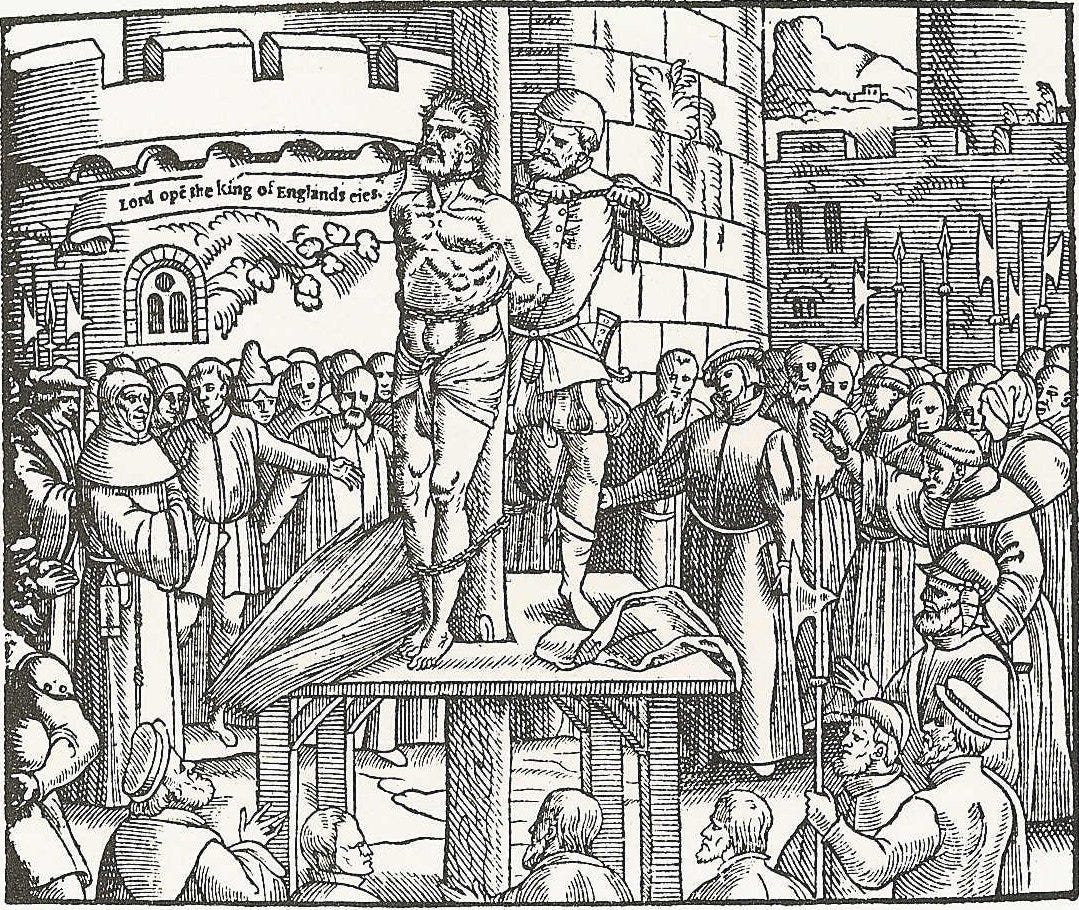
The Roman Catholic Church’s historical efforts to control access to Scripture provide critical context for evaluating the authority of the Majority Text over the Critical Text, including its influence on translations like the English Standard Version (ESV) and New International Version (NIV).
During the medieval and Reformation periods, the Catholic Church restricted vernacular Bible reading, viewing it as a threat to its ecclesiastical authority. The Council of Toulouse (1229) and the Council of Trent (1545–1563) prohibited laypeople from reading the Bible in their native languages without clerical oversight, enforcing the Latin Vulgate as the authoritative text.
This control was violently enforced through the martyrdom of Reformers like William Tyndale (executed 1536), who translated the Bible into English using Byzantine manuscripts akin to the Majority Text, and others like John Wycliffe (posthumously condemned) and Jan Hus (burned 1415), who faced persecution for promoting vernacular Scriptures.
The Westminster Confession of Faith (WCF, 1646) and Second London Baptist Confession (1689) affirm that God’s Word was “by his singular care and providence kept pure in all ages” (WCF 1.8; 1689 Confession 1.8), aligning with the Majority Text’s authority as the church’s historic text.
Against this backdrop, the Westcott-Hort Critical Text, ESV, and NIV, with their reliance on Catholic-preserved Alexandrian manuscripts and ecumenical scholarship, are clear departures from the Reformation’s commitment to a preserved, accessible Scripture.
The Influence of the Roman Catholic Church on the Westcott-Hort Critical Text
From the perspective of those who uphold the Majority Text and the confessional commitments of the WCF and 1689 Baptist Confession, the Critical Text pioneered by Westcott and Hort in 1881, and its derivatives like the ESV and NIV, represent a departure from the preserved Word of God.
Rooted in minority Alexandrian manuscripts (Codex Sinaiticus and Codex Vaticanus), these texts have been influenced by Roman Catholic traditions, undermining the Reformation’s legacy of sola scriptura. Below, I critique this influence and detail the authority and science of using the Majority Text to reproduce a faithful, accurate text, particularly from partial manuscripts.
Westcott and Hort’s Theological Leanings and Catholic Sympathies
Westcott and Hort, Anglican scholars, were influenced by the Oxford Movement, which promoted Catholic practices like apostolic succession, rejected by the WCF (Chapter 25.6) and 1689 Confession (Chapter 26.4).
Westcott admired Rome, calling Anglicanism “maimed” and endorsing prayers for the dead, conflicting with confessional worship principles (WCF 21.1; 1689 Confession 22.1).
Hort dismissed the Textus Receptus (TR) as “vile” and rejected substitutionary atonement, opposing confessional soteriology (WCF 8.5; 1689 Confession 8.5).
Their methodology—favouring “shorter readings” and dismissing the Majority Text—aligned with Catholic reliance on the Vulgate and Alexandrian texts, a clear “Romanizing” agenda at work.
Reliance on Roman Catholic-Preserved Manuscripts
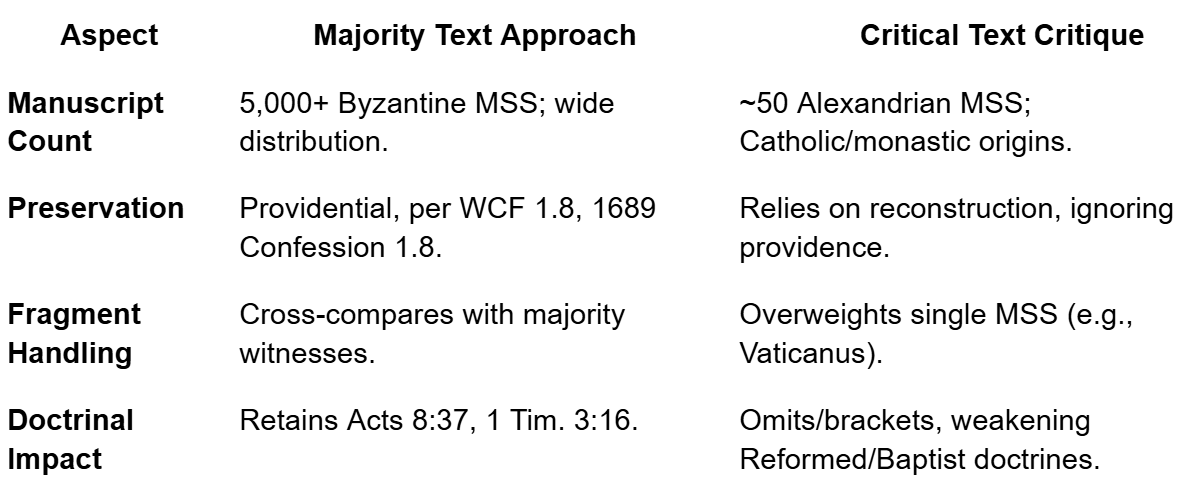
The Westcott-Hort text relies on Codex Vaticanus and Codex Sinaiticus, representing less than 5% of all manuscripts, preserved in Catholic and monastic contexts. These omit key passages like 1 Timothy 3:16 (“God was manifest” vs. “He who was manifest”) and Acts 8:37 (believer’s baptism), weakening Baptist doctrines (1689 Confession 29.2; WCF 28.1).
The confessions’ affirmation of Scripture’s purity (WCF 1.8; 1689 Confession 1.8) supports the Majority Text’s 5,000+ manuscripts, used by Reformers and Baptists.
Roman Catholic Influence on the ESV and NIV
The ESV (2001) and NIV (1978, revised 2011) rely on the Nestle-Aland/UBS Critical Texts, inheriting Westcott-Hort’s Catholic-influenced manuscript basis and ecumenical scholarship.
ESV: Uses Nestle-Aland/UBS, omitting Acts 8:37 and bracketing Mark 16:9–20. Its Catholic Edition (2017) includes deuterocanonicals and received a nihil obstat, aligning with Catholic preferences and conflicting with WCF (1.3) and 1689 Confession (1.3).
NIV: Omits 1 John 5:7 and brackets John 7:53–8:11, diluting justification by faith (WCF 11.1; 1689 Confession 11.1). Its Catholic Edition (1986) and ecumenical committee reflect Catholic influence.
Authority of the Majority Text
The authority of the Majority Text rests on theological and historical grounds, rooted in the confessional doctrine of divine preservation and supported by its manuscript evidence:
Theological Authority: The WCF (1.8) and 1689 Confession (1.8) affirm that God preserved His Word “pure in all ages” through His providence. Majority Text advocates, like Maurice Robinson, argue this preservation is evident in the Byzantine text-type’s dominance, used by the church from the 2nd century onward, including by Reformers like Calvin and Baptist forebears. This aligns with Psalm 12:6–7: “The words of the LORD are pure words… Thou shalt preserve them.”
Historical Use: The Majority Text, reflected in the TR, was the basis for Reformation-era translations (e.g., Tyndale’s Bible, KJV), contrasting with the Catholic-controlled Vulgate and Alexandrian texts. Its widespread use across Greek-speaking churches and early translations (e.g., Peshitta, Gothic) supports its authority as the church’s received text.
Confessional Alignment: The confessions reject Rome’s authority (WCF 25.6; 1689 Confession 26.4), viewing Catholic-preserved manuscripts like Vaticanus as suspect due to their isolation from the church’s common use.
Science of Using the Majority Text to Reproduce a Faithful, Accurate Text from Partial Manuscripts
The Majority Text approach leverages both quantitative and methodological principles to reconstruct a reliable text, even from partial or fragmentary manuscripts, grounded in the following scientific and textual principles:
Manuscript Quantity and Distribution:
Evidence: Over 5,000 Greek New Testament manuscripts exist, with ~90–95% classified as Byzantine (Majority Text), spanning the 2nd to 16th centuries. These include codices, minuscules, and lectionaries, widely distributed across the Greek-speaking world, unlike the Alexandrian texts (e.g., Vaticanus, Sinaiticus), which number ~50 and were geographically confined.
Application to Partial Manuscripts: Even when manuscripts are fragmentary, the sheer volume of Byzantine witnesses allows for cross-comparison. For example, a partial manuscript containing John 1:1–18 can be compared with hundreds of Byzantine manuscripts covering the same passage, ensuring accuracy through majority agreement. This contrasts with the Critical Text’s reliance on a few manuscripts, where a single error in Vaticanus or Sinaiticus can skew the text.
Textual Consistency and Conflation:
Principle: The Majority Text exhibits remarkable consistency across manuscripts, suggesting a stable transmission history. Critics like Westcott-Hort argued Byzantine texts were “conflated” (combining readings), but scholars like Zane Hodges and Harry Sturz demonstrate that alleged conflations are often early and authentic, supported by papyri like P66 (2nd century).
Partial Manuscripts: When reconstructing from fragments, the Majority Text approach prioritizes readings attested by the majority of witnesses. For instance, in Mark 16:9–20, absent in Vaticanus but present in over 1,800 Byzantine manuscripts, the Majority Text includes the passage, supported by early church citations (e.g., Irenaeus, 2nd century).
Statistical Probability and Error Correction:
Method: The Majority Text employs a “majority rule” principle: the reading found in the most manuscripts is most likely original, as copyist errors (e.g., omissions, transpositions) are less likely to propagate across thousands of independent copies. This is akin to statistical signal processing, where noise (errors) is filtered by averaging multiple sources.
Fragment Example: A partial manuscript missing parts of 1 Timothy 3:16 can be reconstructed by comparing it to the 99% of Byzantine manuscripts reading “God was manifest” versus the Alexandrian “He who was manifest.” The majority reading prevails due to its overwhelming attestation.
Historical Transmission and Church Use:
Evidence: The Byzantine text was copied and preserved by the Greek-speaking church, reflecting continuous use in worship and teaching, unlike Alexandrian texts, which were archived in monastic settings. Early papyri (e.g., P45, P75) show Byzantine readings, indicating their antiquity.
Partial Manuscripts: Fragments are contextualized within this tradition. For example, a 4th-century fragment of Acts can be aligned with Byzantine readings in later minuscules, as the church’s copying practices favoured fidelity.
Textual Criticism Principles:
Majority Text Methodology: Unlike the Critical Text’s eclectic approach (weighing manuscripts by age or “internal evidence”), the Majority Text uses a quantitative method, prioritizing readings with the widest attestation. This reduces subjectivity, as seen in Critical Text debates over “lectio difficilior” (harder reading preferred).
Fragment Reconstruction: When a manuscript is incomplete, scholars like Robinson use collations (e.g., von Soden’s apparatus) to identify the majority reading across extant Byzantine manuscripts, ensuring a text faithful to the historical norm.
Implications for Reformed and Baptist Doctrine
The Catholic influence in the Westcott-Hort text, —through Vatican-preserved manuscripts and ecumenical scholarship—contradicts the WCF (1.8) and 1689 Confession (1.8) affirmation of a preserved text.
The Majority Text’s authority, grounded in divine preservation and scientific rigour, ensures a faithful text, even from partial manuscripts, aligning with the Reformation’s rejection of Rome’s control. Reformed and Baptist believers should favor TR-based translations, trusting Psalm 12:6–7.
References
[0] Westcott and Hort’s Catholic sympathies. https://www.jesus-is-lord.com/hort.htm
[2] Westcott on Anglicanism and Rome. https://cprc.co.uk/articles/aboutwestcottandhort/
[3] Hodges & Robinson, The Greek New Testament According to the Majority Text. https://www.amazon.com/Greek-New-Testament-Majority-Text/dp/0840749635
[5] Burgon, The Revision Revised (1883). https://archive.org/details/revisionrevisedt00burg
[6] Hort’s rejection of atonement. https://www.jesus-is-lord.com/hort.htm
[9] Burgon on Romanizing agenda. https://www.chick.com/information/article?id=Westcott-and-Hort-part-1
[13] Nestle-Aland/UBS variants. https://www.nestle-aland.com/en/the-text/
[15] NABRE notes. https://www.usccb.org/bible/nabre
[17] Jerusalem Bible framework. https://en.wikipedia.org/wiki/Jerusalem_Bible
[18] Majority Text manuscript counts. https://en.wikipedia.org/wiki/Byzantine_text-type
[20] New Jerusalem Bible notes. https://en.wikipedia.org/wiki/New_Jerusalem_Bible
[21] NRSV Catholic Edition. https://www.biblegateway.com/versions/New-Revised-Standard-Version-Catholic-Edition-NRSVCE-Bible/
[22] RSV Catholic Edition. https://en.wikipedia.org/wiki/Revised_Standard_Version_Catholic_Edition
[28] NABRE’s higher criticism. https://douglasbeaumont.com/2018/11/01/critical-notes-on-the-nabres-critical-notes/
[35] Byzantine text use. https://en.wikipedia.org/wiki/Byzantine_text-type
[37] Hodges on Westcott-Hort. https://www.thegospelcoalition.org/themelios/article/the-majority-text-debate-new-form-of-an-old-issue/
[45] Critical Text omissions. https://www.textusreceptusbibles.com/Articles/Critical_Text_Omissions
[47] Erasmus and TR. https://en.wikipedia.org/wiki/Textus_Receptus
[50] Mark 16:9–20. https://sharperiron.org/article/why-i-wont-preach-mark-169-20
[51] Second London Baptist Confession (1689). https://founders.org/library/1689-confession/
[52] Westminster Confession of Faith (1646). https://www.opc.org/wcf.html
[53] Council of Toulouse. https://en.wikipedia.org/wiki/Council_of_Toulouse
[54] Council of Trent on the Vulgate. https://en.wikipedia.org/wiki/Council_of_Trent
[55] Tyndale’s mission. https://en.wikipedia.org/wiki/Tyndale_Bible
[56] Tyndale’s martyrdom. https://www.christianitytoday.com/history/people/scholarsandscientists/william-tyndale.html
[57] Wycliffe’s persecution. https://en.wikipedia.org/wiki/John_Wycliffe
[58] Hus and Anabaptist martyrdoms. https://www.plough.com/en/topics/faith/anabaptists/jan-hus-reformer-and-martyr
[59] ESV manuscript basis. https://www.esv.org/preface/
[60] ESV Catholic Edition. https://www.catholicbible.org/
[61] Critique of ESV’s Catholic ties. https://catholicbiblestudent.com/2018/03/review-esv-catholic-edition-bible-esvce.html
[62] NIV manuscript basis. https://en.wikipedia.org/wiki/New_International_Version#Textual_basis
[63] NIV ecumenical ties. https://en.wikipedia.org/wiki/New_International_Version
[64] NIV Catholic Edition. https://en.wikipedia.org/wiki/New_International_Version
[65] NIV gender-inclusive language. https://www.waynegrudem.com/wp-content/uploads/2012/02/An-Evaluation-of-Gender-Language-in-the-2011-NIV.pdf
[66] Robinson, M. A., The Case for the Byzantine Priority. https://jbtc.org/v06/Robinson2001.html
[67] Sturz, H. A., The Byzantine Text-Type and New Testament Textual Criticism. https://archive.org/details/byzantinetexttyp0000stur
Comments
Nothing yet. Say the first thing.
Sign in to join the conversation.