
The question of whether the modern State of Israel holds any legitimate claim — moral, legal, or theological — to the vast territories imagined in the so‑called “Greater Israel” project demands a rigorous and dispassionate analysis. It cannot be answered adequately through sentimental attachment to biblical imagery or uncritical acceptance of political propaganda. One must examine the roots of Zionism, the meaning of the biblical covenants, the use of prophecy in modern politics, and the principles of international law. When these are set in order, the notion that the present regime in Tel Aviv possesses God‑given entitlement to lands stretching from the Nile to the Euphrates collapses entirely.
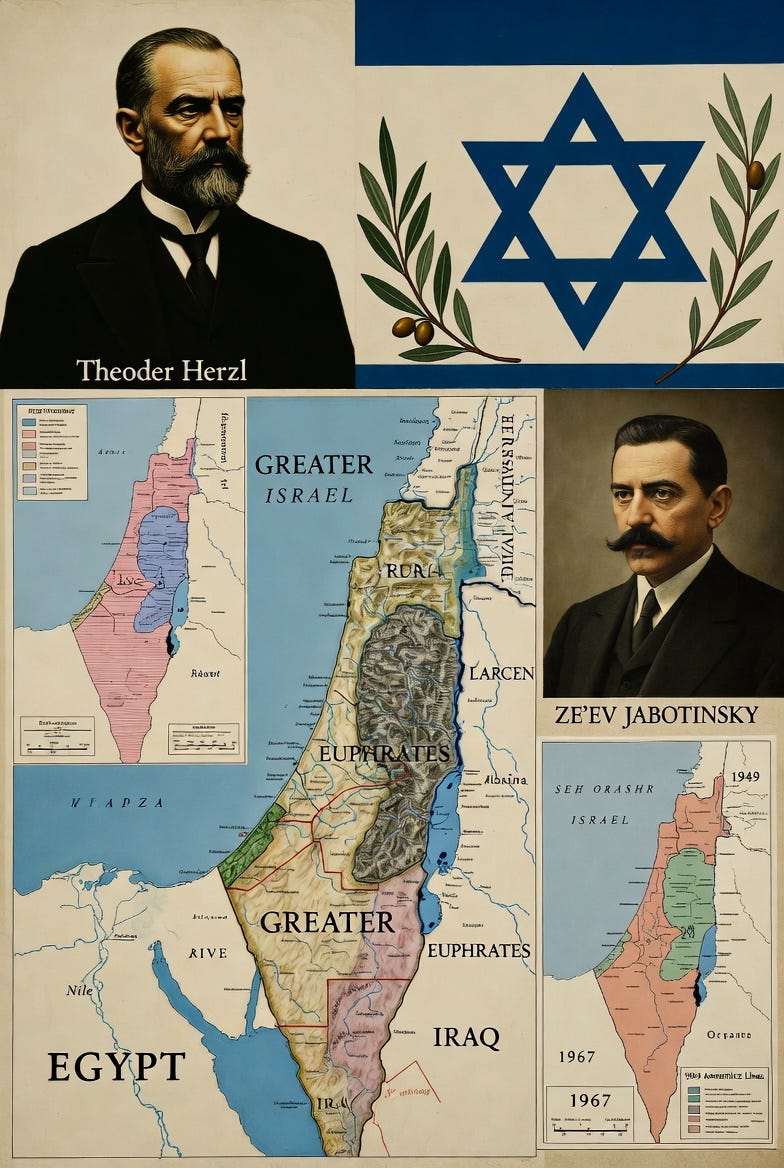
The expression “Greater Israel” refers to an expansionist vision of Zionism in which Israel’s borders would eventually encompass large portions of Lebanon, Syria, Jordan, Egypt, and even parts of Iraq and Saudi Arabia. This idea is drawn loosely from Old Testament texts such as Genesis 15:18 — “unto thy seed have I given this land, from the river of Egypt unto the great river, the river Euphrates” — and has appeared in various Zionist writings since the late nineteenth century. The concept was further popularised in Western evangelical circles during the twentieth century through the rise of dispensationalism and prophecy literalism, particularly through the Scofield Reference Bible and the ministries of figures like Darby and later Hal Lindsey.
Historically, however, the “Greater Israel” notion is primarily a political fantasy. Early secular Zionists such as Theodor Herzl and Chaim Weizmann sought a homeland for Jews, not to fulfil prophecy but to solve the problem of European antisemitism. The borders of this homeland were, from the start, negotiable and pragmatic rather than divinely revealed. The eventual establishment of the state in 1948 was achieved through a combination of British imperial facilitation, wartime agreements, and heavy financial and political influence from the Rothschild and other elite banking families, not through miraculous fulfilment of Abrahamic promises.
The theological justification for the “Greater Israel” plan is often built upon the Abrahamic covenant, in which God promised land to Abraham’s descendants. Yet the Reformed hermeneutic recognises that these promises were typological, pointing ultimately to Christ, not to perpetual territorial possession. The land, like the temple, the sacrifices, and the priesthood, was a shadow fulfilled in the substance of the New Covenant.
The New Testament makes this explicit. Hebrews 11 speaks of Abraham seeking a “better country, that is, a heavenly one.” Paul teaches in Galatians 3 that the true heirs of Abraham’s promise are those who are “in Christ,” not those with his genetic lineage. The promise of inheritance therefore expands not into a geographic empire, but into the redeemed community of faith spread throughout the world.
From this biblical perspective, modern Israel has no divine right to any territory beyond what any other temporal government might occupy under the shifting conditions of human politics. The covenant purpose has already been spiritually fulfilled. To resurrect Old Testament territorial claims under a secular Zionist government is to reject the gospel’s fulfilment in Christ and revert to carnal nationalism.
The idea that the modern State of Israel represents God’s prophetic timetable originates not in the Reformation but in the speculative dispensational theology of the 1800s. John Nelson Darby of the Plymouth Brethren systematised this framework, dividing history into distinct “dispensations” and asserting that the Church and Israel were permanently separate entities with separate destinies. His teaching crossed the Atlantic and came to dominate much of American evangelicalism through study Bibles and prophecy conferences.
Cyrus Scofield, financed by certain pro‑Zionist patrons, codified this theology in the Scofield Reference Bible (1909), embedding it into the thought of generations of American pastors. Under this lens, the modern political Israel became the linchpin of end‑times prophecy, turning American Christians into ardent supporters of Zionism — not out of compassion, but out of eschatological calculation.
This theological current served the political ambitions of the early Zionist project exceptionally well. By the mid‑twentieth century, Zionism had secured both religious and financial backing from the United States, which remains its chief protector. The “Greater Israel” dream survives largely in this nexus of dispensationalist expectation and geopolitical strategy, not in any coherent scriptural mandate.
Thanks for reading The Skeptic’s Compass! This post is public so feel free to share it.
Under modern international law, territorial rights are established through recognised boundaries, treaties, and the consent of nations — not by appeal to ancient texts or prophetic maps. The State of Israel’s attempts to continually expand its footprint through settlement building, annexation, and military occupation directly violate numerous UN resolutions and the Geneva Conventions. The displacement of Palestinians, the demolition of homes, and the resettlement policies in the West Bank stand as clear examples of territorial aggression.
One might tolerate these actions as realpolitik if they were at least open in their motivations; what makes them pernicious is the theological veneer under which they are presented. Expansionist Zionism cloaks its land‑grabbing in divine destiny, portraying secular politicians and military strategists as agents of God. In truth, the moral character of the state — promoting abortion, sexual immorality, and authoritarian control even over its own people — refutes any claim of divine authority. God does not covenant with a nation that defies his moral law.
To suggest that the current state has divine land rights is to ignore its evident apostasy. Israel today is not a theocracy governed by the Torah but a secular democracy in which God’s law is openly despised. It celebrates sodomy, funds abortions, and constitutionally defends gender confusion. During the COVID crisis it became one of the most technocratic and oppressive societies on earth, coercing vaccination and segregating its people by digital passes. If this is the covenant nation restored to divine favour, then righteousness has lost all moral meaning.
The Reformed tradition, grounded in Scripture, judges nations by their fidelity to God’s moral law. By that standard, modern Israel stands condemned among the nations, not exalted above them.
According to Scripture, the inheritance promised to Abraham and his seed finds fulfilment not in a temporal empire but in the New Creation. Christ himself embodies the true Temple and the true Land. His people — the Church, drawn from every nation — are the inheritors of the covenant blessings. Those who rest their hope in a carnal nation defile the spiritual nature of the kingdom.
Paul’s teaching is unmistakable: “If ye be Christ’s, then are ye Abraham’s seed, and heirs according to the promise.” The ultimate “Greater Israel” is not an earthly expanse ruled from Jerusalem, but the global Church living under the headship of Christ, awaiting the resurrection and the renewal of all things.
The modern State of Israel possesses no biblical, moral, or legal right to claim dominance over surrounding nations in the name of prophecy or ancestry. Its founding was a human‑political venture wrought by financiers and nationalist ideologues, not a divine act of restoration. Its continuing expansionist ambitions are crimes against both natural law and covenant theology. The “Greater Israel” narrative, whether advanced by secular Zionists or by dispensational evangelicals, is a deception that confuses the earthly with the heavenly, the flesh with the Spirit.
The inheritance of Abraham belongs to those united to Christ by faith — not by DNA, not by old borders, and certainly not by the machinations of a modern secular state. The true Promised Land is already secured in Christ, and it will be revealed not by the conquest of Middle Eastern soil, but by the return of the King over all the earth. Until then, no government has divine licence to seize territory or oppress peoples under the pretext of fulfilling prophecy. The Church is Israel, and her borders are spiritual, extending to the ends of the earth where the gospel is preached.
Comments
Nothing yet. Say the first thing.
Sign in to join the conversation.