
“A Canticle for Leibowitz” and “On the Beach” are two Cold-War era sci-fi books that I read on a recommendation from Scoot. They were absolutely wonderful reads (if dismal situations give you joy as they do me). Instead of a full book review, I'm writing some ‘snapshots’ and personal reflections on these books.
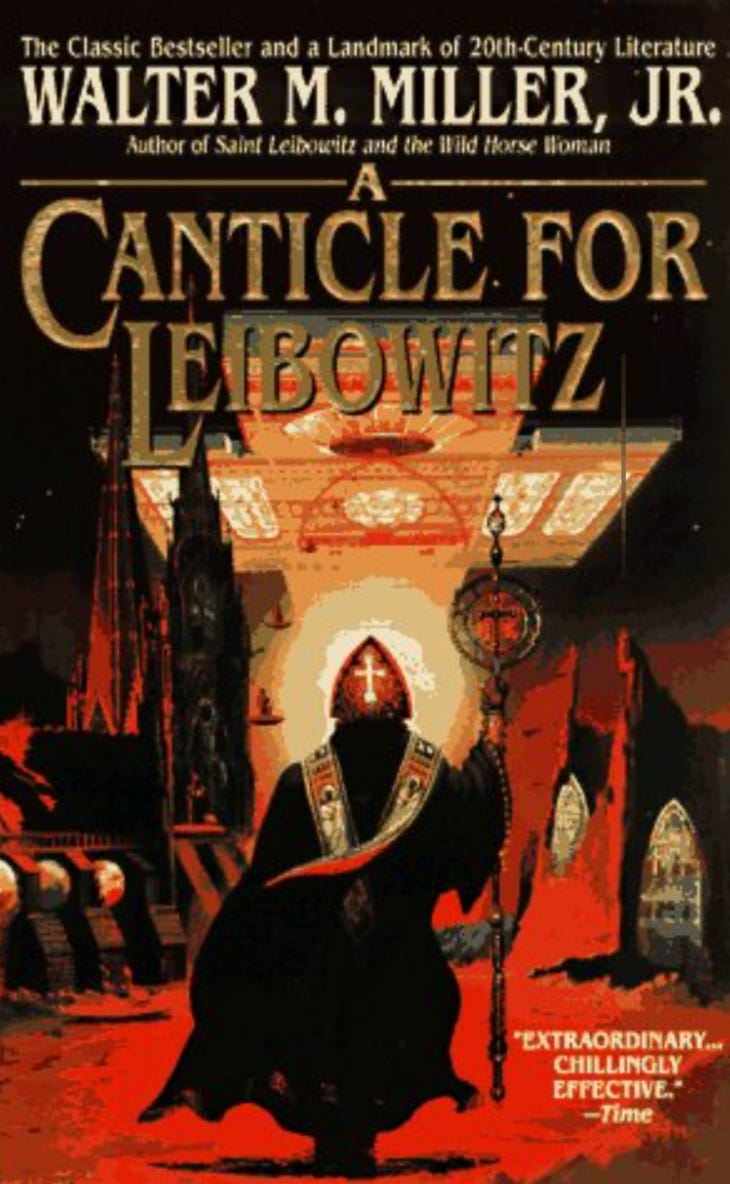
A Canticle for Leibowitz
One-sentence plot summary with spoilers:
Civilization is on the brink of extinction following nuclear war, and the Church plays a role in the preservation of historical and scientific knowledge which leads to the rebirth of civilization and another apocalyptic nuclear war.
Note on the author:
Walter M. Miller Jr. was a WWII bomber who participated in the controversial destruction of the Benedictine Abbey Monte Cassino. This bombing haunted him and contributed to his writing of “A Canticle for Leibowitz.”
This book felt like the expression of the author's personal struggle with faith and philosophical questions. Some of the faith questions the book asks are: Is God good? Is God any different from Satan or are his actions indistinguishable in essence? Is Christ's sacrifice enough to redeem humanity's evil or do we need another Eve (a new Mother to a new Savior) to break away from our present condition? Is the Church a protector of civilization or a harbinger of evil? The book appears to lean toward despair rather than hope, and veers into the heretical line of thought of Manichaeism in which God and Satan are gridlocked in an equally-matched epic battle.
Some of the philosophical questions are: Is humanity destined to repeat history? Do advancements in science and technology inevitably lead to destruction? What is the proper intersection of faith and science—or is there one?
My favorite aspect of the book was how it expressed the passage of time for individuals versus the Church. The Church is an eternal vehicle for the preservation of the “Memorabilia” and history of the “Flame Deluge.” Individuals spend a lifetime of work copying a few pages of someone else's work which they do not understand until someday someone who does understand it can utilize its potential. Individuals are tiny ants bringing in crumb after crumb to the giant anthill that is the Church. The book does a marvelous job spanning time and dwarfing the significance of the individual.
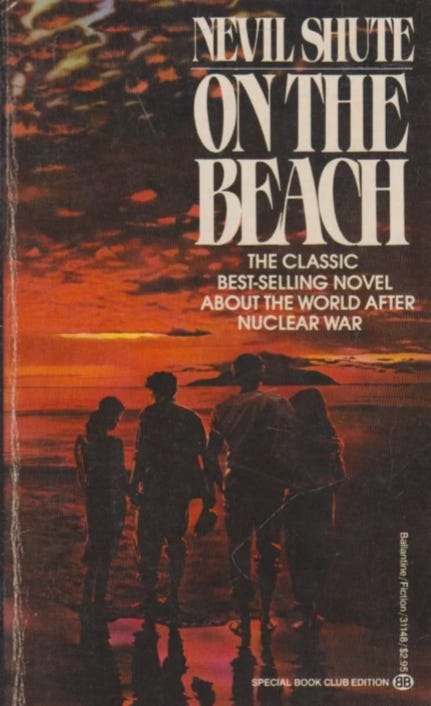
On the Beach
One-sentence plot summary with spoilers:
Though Australia was not a part of the war that devastated the earth with nuclear fallout, its inhabitants nonetheless await the arrival of the fallout cloud that will inevitably destroy all human life, and each person much decide how they will face of impending death.
This book felt less like a struggle with big questions and more like a discourse on the author's nihilistic belief system in novel format. There was no question of which wins the day, despair or hope? because it was clear throughout the story that all hope was counterfeit. Hope was not a rational human response, though it was a common response to inescapable doom. Even the counterfeit hope gave way to despair once the discomfort mounted.
Not one main character died a natural death, because each one took control of their own destiny through suicide instead of submitting to a force they could not control. On a parallel global scale, the nuclear bombs could be akin to the cyanide pills. Collective humanity died of self-inflicted radiation poisoning. Individual humans died doing things the way they wanted to, but in reality, that control over destiny is the same fearful poison that creates nuclear war.
The main philosophical question I felt the book asks was based on the premise of nihilism: if nothing matters in the end, then what is the significance of any action at all? (e g. healing from the measles when you will die the next day, giving your cows hay to eat when they will perish shortly, maintaining integrity and personal morals when you have no future). Unfortunately, this question is faulty in its premise, so it is impossible to answer it.
My favorite aspect of this book was the concept that the earth will go on without us. Humans struggled with “the end of the world,” but were reminded that it was merely the end of human life on earth. In a negative sense, this concept reflects the fundamental eternal nature of God who is transcendent above all the infinitesimally small goings on of our human lives—and He invites us to participate in that eternal reality through Christ.
No posts
Comments
Nothing yet. Say the first thing.
Sign in to join the conversation.