
Introduction
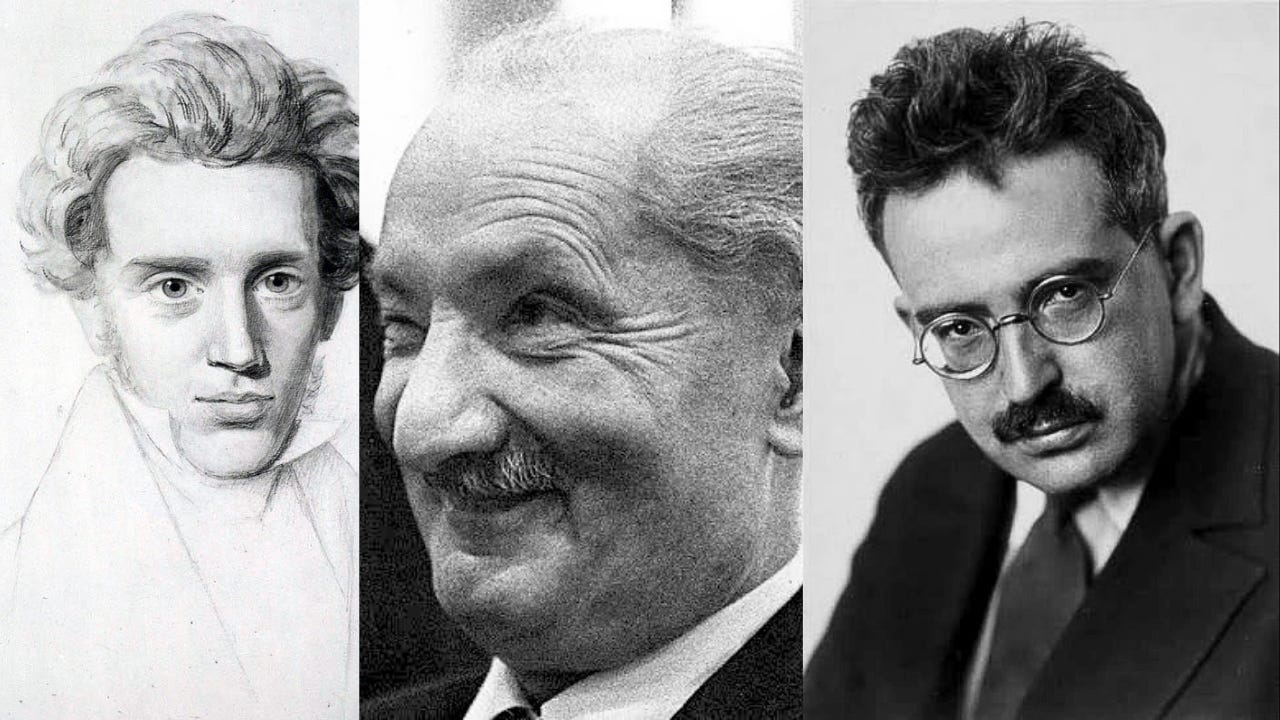
There is a peculiar untimeliness that belongs to certain thinkers: they speak from within a horizon that has, in the meantime, seemingly vanished—the smoke-choked newspaper offices of Copenhagen, the storyteller’s desk, the crowded seminar rooms of Marburg and Freiburg—and yet what they say reaches forward, uncannily, into a present they could not have foreseen. Such is the case with Søren Kierkegaard, Martin Heidegger, and Walter Benjamin. Each, writing in the shadow of an emergent technological modernity—the press, the machine, the reproducible image—diagnosed a transformation not merely in what human beings do, but in how they are:
In the mode of their being-in-the-world.
That this diagnosis should retain, indeed sharpen, its purchase in an age of algorithmically mediated existence is the wager of what follows.
Kierkegaard named the sickness of “the present age” one of reflection without action, a levelling in which the public dissolves the individual into anonymous opinion. Heidegger, radicalising and ontologising this diagnosis, shows that das Man, “the They,” is not a mere sociological phenomenon, but a constitutive existentiale of a dasein‘s everyday being—and that the essence of modern technology, far from being a neutral instrument, is a mode of world-disclosure he names Gestell, “enframing”, in which beings show up only as standing-reserve, as resource to be optimized. Benjamin, attending to the texture of lived experience itself, traces the decline of the storyteller and the rise of information, the fragmentation of Erfahrung into shock, the shortening of the very breath by which experience once accrue into wisdom.
My thesis is this:
Artificial intelligence and algorithmically mediated social media do not introduce a wholly novel danger into human existence. Rather, they intensify—with a totality and a velocity these thinkers could only partially anticipate—the very tendencies each identified:
The levelling of individuality into anonymous aggregation, the surrender of interpretive responsibility to das Man, the fragmentation of attention into discontinuous shock, and the transformation of the world, and of the human being itself, into an object of ceaseless optimisation. What is at stake, I will argue, is not whether machines will think, but whether human beings will continue to think at all—or whether they will, instead, come to think as machines think:
Computationally, reactively, without world.
§I. Kierkegaard:
—The Public and the Age of Reflection—
Kierkegaard’s diagnosis in The Present Age takes as its object, not this or that political arrangement, but a total configuration of spirit. “The present age”, he writes, “is an age of reflection without passion”—and this is decisive, for reflection, cut loose from the movement toward decisive action, does not intensify existence but dissolves it. Where a passionate age acts, the reflective age deliberates, and deliberation, endlessly reduplicated upon itself, becomes a substitute for the very commitment it defers. One reflects upon reflecting; one has an opinion about having an opinion. The result is not thoughtfulness, but a kind of ‘hollowing-out’, a talkativeness that mimes the shape of thought while evacuating its content.
The vehicle of this hollowing is, for Kierkegaard, the press—and specifically, the phenomenon he calls “the public”. The public is not a crowd, not a gathering of concrete individuals bound by a common cause; It is, on the contrary, “a monstrous nonentity,” an abstraction that exists nowhere and yet exerts a gravitational pull upon everyone. One belongs to the public precisely by not showing up: the public is constituted by non-participation, by the reader who consumes the newspaper’s verdict without ever standing accountable for a verdict of his own. And it is here that the mechanism of “levelling” [Nivellering] does its decisive work. Levelling is the process by which qualitative distinction—the distinction that would make this individual answerable, this decision costly, this commitment binding—is dissolved into the featureless medium of comparison. No one is responsible for the public’s opinion, precisely because the public has no face, no name, no standing before which it could be called to account. Responsibility, diffused across an anonymous everyone, comes to rest nowhere, which is to say, upon no one.
What must be underscored, and what makes Kierkegaard’s analysis more than a period piece of nineteenth-century cultural criticism, is his insistence that the press is not merely a technology in the trivial sense—not merely a faster way of moving information that had, before, moved more slowly. The press creates the public; It does not merely serve a public that already antecedently existed. This is to say that a new technology of communication institutes a new mode of existing altogether—a new, and newly evasive, way of being with others, in which the very structure of accountability is altered. Kierkegaard has anticipated here something that will only receive its proper ontological articulation a century later:
That the means by which beings are disclosed to one another is not indifferent to the kind of being those beings come to have. The public is not a fact about journalism. It is a fact about what it has become to exist under modern conditions of mediation, and this is the thread that leads, ineluctably, to Heidegger.
§II. Heidegger:
—From the Public to das Man—
It is in Being and Time that Kierkegaard’s descriptive, existential-psychological diagnosis receives its ontological radicalisation. Heidegger’s question is not, in the first instance, a question about society, technology, or media; It is the question of the meaning of being as such, pursued through an existential analytic of that being for whom it’s being is an issue to it— a dasein. And yet it is precisely in the course of this analytic, in the account of Dasein’s “average everydayness” [durchschnittliche Alltäglichkeit], that Heidegger arrives at a structure formally isomorphic to Kierkegaard’s public, though grounded far more deeply.
A dasein, Heidegger insists, is always already being-in-the-world, and this being-in-the-world is, “proximally and for the most part, a being-with [Mitsein] others”. But this being-with does not, in its everyday mode, take the form of authentic encounter between distinct “selves”. Rather, a dasein‘s everyday self is das Man-selbst—“the they-self”—and das Man, “the They,” is that anonymous, faceless “One“ who decides, in advance, and without anyone in particular deciding, how things are to be interpreted, what is to count as proper, what “one” does.
“We take pleasure and enjoy ourselves as one [man] takes pleasure; we read, see, and judge about literature and art as one sees and judges... we find shocking what one finds shocking.”
Das Man is not any particular person, and precisely for this reason it is everyone— or rather, in Heidegger’s exact and terrible formulation, “the ‘who’ is the neuter, the das Man.” No one is das Man, and yet das Man governs the interpretedness of everything.
The kinship with Kierkegaard’s public should now be evident:
Both structures achieve their power precisely through their facelessness. Just as the public disburdens the individual of responsibility for the opinions it circulates, das Man disburdens dasein of the burden of choosing itself. Heidegger names this disburdening explicitly:
Das Man “takes the answerability [Verantwortlichkeit] of dasein away from it.” Everyday dasein, absorbed in das Man, is relieved of the anxious task of taking a stand on its own being—and this relief, beruhigung, is not a deficiency dasein occasionally suffers, but a constitutive tendency of falling [verfallen] that belongs to dasein‘s very structure.
Heidegger elaborates this falling through three interlocking existentialia that deserve mention here, for each finds its intensification in what follows.
“Idle talk” [gerede] is discourse that has lost its primordial relation to the being it is about; it communicates not by disclosing, but by passing along, repeating, retweeting—the “groundlessness” of idle talk is not a moral failing, but a structural feature of communication once it is cut loose from the ground of genuine understanding, and idle talk, once let loose, “spreads in wider circles and takes on an authoritative character,” such that “things are so because one says so.”
“Curiosity” [neugier] is the restless seeking-out of the ever-new, not in order to understand, but merely in order to have seen; it is characterised by “not tarrying” [unverweilen], by “distraction” [zerstreuung], by a constant new possibility of distraction.
And
“Ambiguity” [zweideutigkeit] is the condition in which everything has been discussed, everything has an opinion attached to it, and yet nothing has actually been genuinely disclosed—such that one can no longer distinguish authentic understanding from idle chatter about the same.
Against this triple structure of falling stands the possibility of “authenticity” [eigentlichkeit], which is not a flight from das Man to some isolated ‘ego’, but a modified way of taking up one’s thrown possibilities as one’s own, in the resolute anticipation of one’s own being-toward-death. It would be a mistake, however, to rest content with this early, existentiell analysis and to imagine that Heidegger’s later thought on technology is merely a footnote to it. In The Question Concerning Technology, Heidegger executes a further and decisive turn:
Technology, he argues, is not dangerous because of the machines it produces, but because of the way of revealing [entbergung] that belongs to its essence, which he names gestell, “enframing”. Enframing is the mode of disclosure in which beings show up, in advance, only as “standing-reserve” [bestand]—as resource, ordered and orderable, to be extracted, stockpiled, optimised, used. The river is no longer disclosed as “river”, but as “water-power supplier”; the forest, as “timber reserve”; and—this is Heidegger’s most disquieting claim—the human being too becomes liable to disclosure as standing-reserve, as “human resources,” as a stockpile of optimisable capacity. The peril of enframing is not that it might produce catastrophe (though it may); the peril is ontological—that enframing so thoroughly saturates the field of disclosure that no other way of revealing, including the revealing proper to art and to thinking, can any longer come to appearance. Man comes to speak of being always, and only, in the mode of resource.
Here, then, is the bridge that must be built:
Algorithmic systems—the recommendation engine, the ranking function, the large language model—do not merely convey information, as though they were a faster newspaper. They organize disclosure itself. They determine, prior to any act of individual interpretation, what appears at all, in what order, with what salience, to whom. This is not a claim about content; it is a claim about the structure of world-disclosure. Where das Man once operated through the diffuse, comparatively slow mechanisms of gossip, publication, and idle talk, the algorithm operates as a formalised, automated, and continuously self-optimising das Man—one that has, moreover, dispensed with even the residual humanity of the crowd from which idle talk once arose.
What “One” thinks is no longer merely circulated by human beings talking;
It is computed.
§III. Benjamin:
—Shock, Attention, and the Loss of Experience—
If Heidegger supplies the ontological structure of this transformation, Benjamin supplies its phenomenology—its felt texture, the way it registers in the nerve and the breath of the one who lives through it. In The Storyteller, Benjamin mourns a capacity he takes to be dying:
The capacity to exchange “experience” [erfahrung]—experience understood not as mere occurrence, but as what has been worked through, integrated into the slow continuity of a life and a community, and thereby rendered transmissible as counsel. The storyteller draws his authority from this integration; his tale carries the “epic side of truth,” wisdom, because it has been lived through, and handed down, artisanally, the way a craft is handed down through the practised repetition of the hand.
What supplants this transmissible experience, in Benjamin’s account, is “information”—and information, he insists, has a structure fundamentally opposed to the story’s. Information demands to be instantly verifiable, exhausts itself in the moment of its transmission, and crucially, arrives already “shot through with explanation.” Nothing is left for the receiving mind to do; nothing is left to ripen. Where the story invites retelling, and thereby a kind of communal elaboration across time, information is consumed once and discarded, replaced immediately by the next item, in a rhythm that increasingly approximates what Benjamin, following Freud, calls “shock” [chockerlebnis]—the mode of stimulus proper to the modern city, in which consciousness must erect a protective shield precisely by refusing to let the stimulus sink into deep memory, by processing it, instead, at the surface, and moving on.
The consequence is a shortening: of the sentence, of the attention, of the very organ by which wisdom was once distilled. What Benjamin calls the “epic memory”—the capacity to weavethe isolated occurrence into the fabric of a lifetime—atrophies precisely to the degree that shock, rather than experience, becomes the dominant mode of encounter with the world. This is not merely a change in taste. It is a change in the very structure of the psyche’s relation to time:
Continuous, ripening duration is supplanted by discontinuous, immediately processed instant.
The connection to what precedes should by now announce itself without much labour. Benjamin gives us, in the register of lived sensation, what Heidegger gives us in the register of ontological structure:
If enframing is the way beings are disclosed via modern technology, shock is the way that disclosure is received—or rather, the way reception itself is reconfigured, so as to forestall the deep, ripening uptake proper to genuine experience. Together, Heidegger, Benjamin (and Kierkegaard) describe a single transformation from two directions: the world’s mode of showing-itself, and the soul’s mode of being-shown-to.
§IV. AI and Algorithmic Modernity:
—Synthesis—
We are now in a position to draw these three analyses—Kierkegaard’s public, Heidegger’s das Man and gestell, Benjamin’s shock—together into a single reading of the present technological configuration. It will be useful to proceed thematically rather than thinker by thinker, since the phenomenon to be described is, precisely, the convergence of these three diagnoses into a single structure.
A. Algorithms and Levelling. The recommendation algorithm is the public’s contemporary organ. Where Kierkegaard’s public formed slowly, through the circulation of newspapersamong readers who remained, at least, individually locatable, the algorithmic public forms in real time and at a global scale, through the aggregation of clicks, dwell-time, and engagement into metrics—”trending,” “viral”—that possess all of the public’s facelessness, and none of its friction. Virality is levelling perfected: the very mechanism by which content propagates rewards whatever most efficiently dissolves distinction into shareability, whatever travels most frictionlessly through the medium of anonymous aggregation. And because the algorithm, unlike the nineteenth-century press, adapts continuously to what has already levelled successfully, it does not merely reflect levelling—it selects for it, generation after generation of content, with a rapidity of iteration Kierkegaard could not have imagined.
Reflection, once again, comes to substitute for commitment: one reacts—a like, a share, a comment—in lieu of the costly, particular decision that would constitute genuine responsibility.
B. A.I and das Man. Large language models, recommendation systems, the algorithmically curated feed, the metrics of “personal branding,” the dashboards of productivity optimisation—all of these constitute, together, an infrastructural das Man, an anonymous “One“ that now tells daseins not only what “one” thinks, but what “one” writes, what “one” believes, how “one” works, how “one” dates, how “one” learns. It would be too easy, and would miss Heidegger’s point, to fear this development merely as a fear of replacement—the worry that AI will “take over” tasks once performed by human beings. The danger, in Heideggerian terms, is subtler and more intimate:
It is the danger of the surrender of interpretation itself.
Das Man was already, in 1927, that structure to whom a dasein hands over the task of interpreting its own possibilities to an anonymous “everyone.” What changes, with generative A.I, is that this anonymous “everyone” now speaks back in fluent, confident, endlesslyavailable prose—a das Man that no longer merely murmurs through idle talk, but answers, on demand, in the voice of authority, every question one might have posed to oneself. The peril is not the machine’s intelligence (it has nothing of the sort). The peril is the ease with which dasein, always already inclined toward falling, accepts this relief from the burden of its own responsibility.
C. A.I and Enframing. It is here, perhaps, that the analysis reaches its most severe formulation. Generative artificial intelligence discloses language, image, music, relationship, and thought itself—the very media through which world was traditionally disclosed—as data:
As corpus, as training set, as pattern to be extracted and reproduced.
What was, for the poet, the site of a world’s disclosure becomes, for the model, a statistical distribution to be sampled. And the reciprocal relation, which Heidegger’s analysis of enframing always insists upon, is this:
The one who employs such a system does not stand outside its mode of disclosure, untouched.
To interact habitually with a system that renders language as optimisable output is, gradually, to come to regard one’s own language, one’s own thinking, in the same mode—as “draft to be optimised”, as “content to be generated”, as “prompt awaiting completion”. The human being does not merely use standing-reserve; the human being risks becoming disclosed, to itself, as standing-reserve—as a stockpile of “content,” of “output,” of optimizable “productivity.” This is Heidegger’s danger [gefahr] in its most contemporary garb:
Not that the machine will overpower the human, but that the human will come to encounter its own being solely in the mode proper to the machine’s disclosure of the world.
D. Benjamin and Infinite Shock. The infinite scroll is shock rendered architectural. Where the nineteenth-century city delivered its stimuli intermittently—a crowd, a vehicle, a spectacle—to a consciousness that could, between shocks, recover some measure of continuity, the contemporary feed delivers shock without interval:
Notification upon notification, video upon video, each one demanding the same protective, surface-level uptake Benjamin ascribed to the flâneur‘s overstimulated nervous system, and each one foreclosing, by its very abbreviated duration, the possibility that any single stimulus might ripen into experience.
Storytelling required duration—the slow accretion by which a tale is absorbed, retold, transformed by its retelling. The algorithmic feed is engineered, by contrast, to eliminate duration, since duration is precisely what permits attention to disengage, and disengagement is precisely what the attention economy cannot afford. Multitasking is not an incidental symptom of this condition, but very nearly its logical fulfillment:
A mode of engagement in which no single object of attention is ever permitted the time required to become an object of experience at all.
Conclusion
It would be a misreading of the argument pursued here to conclude that Kierkegaard, Heidegger, and Benjamin predicted artificial intelligence, as though their texts contained some hidden prophecy awaiting later decryption. They did nothing of the kind, and to read them so would itself be a kind of idle talk—a curiosity that seeks the striking, rather than the true. What they did, each in his own idiom, was identify enduring structures in technology:
The levelling of the individual into anonymous public opinion, the disburdening of dasein‘s interpretive responsibility onto an anonymous “one,” the disclosure of beings as standing-reserve for optimisation, and the fragmentation of continuous experience into discontinuous shock. These structures did not originate with the silicon chip. They were already at work in the newspaper, in the factory, in the nineteenth-century metropolis. What artificial intelligence and algorithmic media contribute is not a new structure but an unprecedented intensification of these old ones—made possible by computational scale, automated adaptivity, and a velocity of iteration that leaves ever less room for the resolute, anxious,solitary confrontation with one’s own possibilities out of which alone, for Heidegger, authenticity could arise.
The real danger, then, is not artificial intelligence as such—not the machine, considered as a mere object among objects. The real danger, thought through with these three thinkers, is the form of life that algorithmic modernity quietly recommends, makes easy, and finally makes to feel inevitable:
A life of reflection without commitment, of interpretation surrendered to das Man, of world disclosed only as resource, of experience dissolved into shock.
Against this, what these thinkers offer is not a program of resistance so much as a summons to a certain vigilance—by which daseins might yet wrest its possibilities back from the anonymous “one,” and take them up, resolutely, as their own.
Let this stand, then, as the essay’s final word, as its own conclusion, arrived at by the path we have walked:
The greatest danger posed by artificial intelligence is not that machines will begin thinking like human beings, but that human beings will cease thinking—except as machines
References:
Benjamin, Walter. “On Some Motifs in Baudelaire.” In Illuminations: Essays and Reflections, edited by Hannah Arendt, translated by Harry Zohn. New York: Schocken Books, 1969.
Benjamin, Walter. “The Storyteller.” In Illuminations: Essays and Reflections, edited by Hannah Arendt, translated by Harry Zohn. New York: Schocken Books, 1969.
Heidegger, Martin. Being and Time. Translated by John Macquarrie and Edward Robinson. New York: Harper & Row, 1962.
Heidegger, Martin. “The Question Concerning Technology.” In The Question Concerning Technology and Other Essays, translated by William Lovitt, 3–35. New York: Harper & Row, 1977.
Kierkegaard, Søren. The Present Age. Translated by Alexander Dru. New York: Harper Torchbooks, 1962.
No posts
Comments
Nothing yet. Say the first thing.
Sign in to join the conversation.