
Returning from a military engagement in his imperial carriage, Tsar Alexander II made his regular Sunday journey through central St. Petersburg. Security was on high alert after several attempts had been made on his life by revolutionary organizations determined to bring down the Tsarist regime.
Alexander had ruled since 1855 and led the emancipation of Russia’s serfs in 1861. His reign also brought reforms to the courts, local government, the military and the education system. One of these reforms was the partial lowering of the barriers of the Pale of Settlement and the allowance for Jews to enter the portals of higher education.
These reforms generated hope, as well as disappointment. Peasants may have garnered freedom from economically oppressive conditions, but Russia itself remained an autocracy. There was no elected national parliament, political opposition remained severely constrained, and revolutionary organizations were wholly persecuted. By the 1870s, sections of the Russian intelligentsia began to conclude that peaceful agitation had failed.
As the Tsar’s imperial carriage made its way toward the Winter Palace along the embankment of the Catherine Canal, an explosion was detonated beside it. Several people were injured, but the Tsar survived. The attacker, Nikolai Rysakov, was immediately seized. Rather than being rushed to safety, Alexander stepped out to inspect the scene and confront the captured attacker. As he stood exposed, a second assassin, Ignacy Hryniewiecki, approached and set off another bomb at close range. The explosion mortally wounded both Hryniewiecki and the Tsar.
Rysakov and Hryniewiecki belonged to Narodnaya Volya (People’s Will), the revolutionary underground that appointed itself the executioner of Russian autocracy. The attack had been planned with other members of the group for a considerable time. And yet, the Tsarist regime chose a culprit larger than the handful of conspirators who had actually committed the crime. They laid the blame for the killing of the Tsar at the doorstep of the Jews, which manifested in the outbreak of pogroms in Kiev and Elizavetgrad and eventually to the passing of the highly discriminatory May Laws.
The pogroms produced a renewed conviction among Jews in the revolutionary movements that the overthrow of the Tsarist regime was more urgent than ever. Yet the lack of response from their comrades simultaneously raised a question: why had a movement committed to liberation remained so silent as Jews were being murdered by mobs?
The answer was, in some ways, what one would expect from a revolutionary movement. The pogroms were perceived as a true expression of popular violence. The revolutionaries believed that if this energy could only be directed at the authorities rather than the Jews, the final touchstone moment for revolution would come to fruition. More so, given the intensity of popular hostility toward the Jews among the Russian populace, they believed that, any opposition to antisemitism or the pogroms would be counterproductive in rallying these masses for their cause. The revolutionaries therefore appeased the mobs at the expense of Jewish life.
Pavel Axelrod, a Jewish intellectual caught up in this turmoil wrote on December 13, 1881 about the state of mind of many shocked Jewish revolutionaries who had begun to see that the path to assimilation was not smooth:
The Jewish socialist intelligentsia suddenly realized that the majority of Russian society did, as a matter of fact, regard the Jews as a separate nation, and that they considered all Jews – a pious Jewish worker, a petit bourgeois, a money-lender, an assimilated lawyer, a socialist prepared for prison or deportation – Yids harmful to Russia, whom Russia should get rid of by any and all means.
1881 more generally saw a shift in Jewish ideological life with assimilationists turning to Zionism. One of the reactions to the pogroms was the establishment of BILU which sought to organize young Russian Jews to become pioneers in Ottoman Palestine. The initials of BILU were taken from the Book of Isaiah and stood for Beit Ya’akov Lekhu ve-Nelkah – ‘O House of Jacob, let us rise up and go.’ Chaim Hisin, one of the first of the BILU immigrants to Palestine wrote in his diary:
The recent pogroms have violently awakened the complacent Jews from their sweet slumbers. Until now, I was uninterested in my origin. I saw myself as a faithful son of Russia which was to me my raison d’être and the very air that I breathed. Each new discovery by a Russian scientist, every classical literary work, every victory of the Russian Empire would fill my heart with pride. I wanted to devote my whole strength to the good of my homeland, and happily do my duty…... How pathetic is the position of those who advocated fusion with the Russian people through national self-abnegation. Life and the logic of events demand that the Jew define his position, for it has become impossible to occupy a seat between two chairs. Either one openly declares oneself a renegade or one decides to share the sufferings of his people.
Cultural nationalists such as Moses Leib Lilienblum eloquently described the hopelessness of the Jewish predicament and the sense of isolation and abandonment which many Russian Jews keenly felt in an article entitled The Future of Our People in 1883:
The opponents of nationalism see us as uncompromising nationalists, with a nationalist God and a nationalist Torah; the nationalists see us as cosmopolitans, whose homeland is wherever we happen to be well off. Religious gentiles say that we are devoid of any faith, and the freethinkers among them say that we are orthodox and believe in all kinds of nonsense; the liberals say we are conservative and the conservatives call us liberal. Some bureaucrats and writers see us as the root of anarchy, insurrection and revolt, and the anarchists say we are capitalists, the bearers of the biblical civilization, which is, in their view, based on slavery and parasitism. Officialdom accuses us of circumventing the laws of the land – that is, of course, the laws directed specifically against us. . . . Musicians like Richard Wagner charge us with destroying the beauty and purity of music. Even our merits are turned into shortcomings: ‘Few Jews are murderers,’ they say, ‘because Jews are cowards.’ This, however, does not prevent them from accusing us of murdering Christian children.
Not all turned to Zionism. Osip Tsederbaum, better known as Julius Martov, a personal friend of Vladimir Lenin remained committed to Marxist orthodoxy. Yet, even for him the post 1881 climate produced fissures in his vision of how best to sustain the organizational life of the Jewish worker. In a May Day speech, he strongly advocated for the creation of a separate Jewish workers’ organization. The Jews, he argued, were doubly oppressed because of their nationality and because of their class. It was important therefore to create a distinct Jewish body which would lead the Jewish proletariat. Even more remarkable was Martov’s acknowledgement that:
When the Russian proletariat is forced to sacrifice certain of its demands in order to gain something, it will first give up the demands which concern only the Jews … such as that for equal rights.
Indeed, the program's of 1881 had proven as much and the era more generally bore witness to an increasing awareness of the national consciousness of the Jewish workers. By October 1897, the foundations laid by Martov and others bore fruit in the formation of the Algemeyner Yidisher Arbeter Bund in Russland un Polin – otherwise known as the Bund.
A few weeks later, Bundist delegates became founding members of the Russian Social Democratic Labour Party (RSDLP). Both shared an opposition to Zionism which had formally been launched on the international stage by Theodor Herzl at the first Zionist congress in Basel a few months before. All three organizations competed for the Jewish soul and all wished to represent the interests of the Jewish worker.
The Bund was very clear in its opposition to rabbinical authority and the adulation surrounding Herzl. Ignoring socialist Zionism, the Bund attacked the emergence of political Zionism as a bourgeois movement with close ties to ‘clericalism’. Zionism, the Bundists argued, had no interest in improving the lot of the Jewish worker.
Rather than re-establishing a Jewish state, Martov was arging that the Bund should be solely a section of the all-Russian party and its specific task would be to specialize in work among the Jewish masses in the Pale of Settlement. The Bund moreover should not exercise a monopoly on Russia’s Jews – indeed Martov wished them to join the ranks of the RSDLP. He hoped that the Jews would move from light industry where the Bund dominated, to heavy industry where the real struggle of the Russian workers resided. To confine themselves to the provinces of Lithuania and Belarus was shortsighted, following the revolution Martov believed they would be allowed to work in all areas of Russia.
By 1901, however, the Bund was already beginning to reconsider this position, and talks of moving toward a position of greater autonomy began circulating among its members. The issue reached a breaking point when in April 1903, a pogrom was ignited in Kishinev. 49 Jews were killed, hundreds were injured, and roughly 1,500 Jewish homes and businesses were damaged or destroyed. The violence was set off by false accusations in the local press linking the death of a Christian boy with Jews.
The violence led the Bundists’ to insist that Jewish workers faced a particular oppression which could not simply be subsumed within the broader class struggle. A position the Zionists had already arrived at, albeit with a different solution to the problem.
In response, Lenin wrote four articles in Iskra in 1903 which attacked the Bund. The first foray appeared in February 1903 entitled ‘Does the Jewish Proletariat need an Independent Political Party?’ Lenin excoriated the Bund from moving from a position of autonomy within the Russian party in 1898 to a proclamation of virtual independence from it in 1903:
In matters pertaining to the struggle against autocracy, the struggle against the bourgeoisie of Russia as a whole, we must act as a single and centralized militant organization, have behind us the whole of the proletariat, without distinction of language or nationality, a proletariat whose unity is cemented by the continued joint solution of problems theory and practice, of tactics and organization; and we must not set up organizations that would march separately, each along its own track; we must not weaken the force of our offensive by breaking up into numerous independent political parties; we must not introduce estrangement and isolation and then have to heal an artificially implanted disease with the aid of these notorious ‘federation’ plasters.
The Bund in response raised the question of workers’ participation in a pogrom in Czestochowa in Poland. Lenin scoffed at the idea that this was evidence of international antisemitism, he argued that antisemitism was solely a product of the bourgeoisie and dismissed these claims as being identical with “the Zionist fable about anti-Semitism being eternal”.
Lenin also examined Zionism and whether the Jews constituted a nation in the latter section of another article. It is important to note though that Zionism was almost an incidental inclusion in the article, ‘The Position of the Bund in the Party’.
In it, Lenin famously commented that: “Absolutely untenable scientifically, the idea that the Jews form a separate nation is reactionary politically. Irrefutable practical proof of that is furnished by generally known facts of recent history and of present-day political realities. All over Europe, the decline of medievalism and development of political liberty went hand in hand with the political emancipation of the Jews…..”
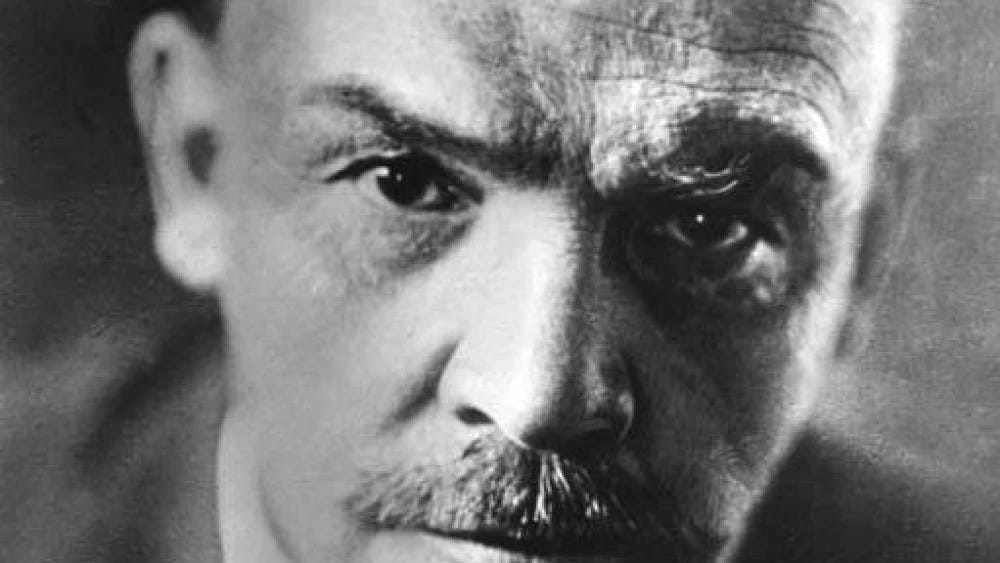
For Lenin, any attempt to preserve Jewish identity was viewed as anti-progressive and effectively counter-revolutionary. Lenin’s knowledge of Jewish history was remarkably superficial and his inability to discover flaws in the Enlightenment’s emancipation of the Jews during the nineteenth century (see part II of this series) flew in the face of reality. And so, he set off a campaign against Jewish nationalism itself, a campaign against the Zionists and the Bund, stating that “Jewish national culture”, was, the position of the bourgeoisie. He furthermore declared that “whoever, directly or indirectly, puts forward the slogan of Jewish ‘national culture’ is (whatever his good intentions may be) an enemy of the proletariat.”
Zionism had risen at virtually the same time as Russian Marxism. It was initially less attractive to the Jewish masses who preferred the ‘hereness’ of the Bund. Yet both the Zionists and Bundists were ingredients for Lenin’s drive to dominate workers politics. Due to their small numbers the Zionists were seen as politically irrelevant, but so long as they possessed the ability to attract the sympathies of the Jewish worker, they were tasked to play an important role in being depicted as an existential threat to Lenin’s revolution.
Chaim Weizmann remarked in his memoirs that while his sympathies lay with the revolutionaries, Lenin displayed a “spiritual autocratic attitude” and noted that his “resentment of Lenin” and “the arrogant Trotsky” was provoked “by the contempt with which they treated any Jew who was moved by the fate of his people and animated by a love of its history and its tradition.” The revolutionaries, he argued, had stamped as “unworthy, as intellectually backward, as chauvinistic and immoral, the desire of any Jew to occupy himself with the sufferings and destiny of Jewry.” Which meant that “any man who was both a revolutionary and a Jewish nationalist was looked upon with extreme suspicion”.
In 1913, Lenin asked Stalin to write ‘Marxism and the National Question’ which repeated many of Lenin’s arguments. He too only understood the Jews in a one-dimensional sense: “If there is anything common to them left, it is their religion, their common origin and certain relics of the national character. All this is beyond question. But how can it be seriously maintained that petrified religious rites and fading psychological relics affect the ‘destiny’ of these Jews more powerfully than the living social, economic and cultural environment that surrounds them? And it is only on this assumption that it is possible to speak of the Jews as a single nation at all.”
Ironically, the Balfour Declaration and the Bolshevik seizure of power took place within days of each other. Both events governed the political odysseys of individual Jews for the rest of the twentieth century. One promised to embed Jewishness in a sovereign nation-state, the other pledged to eradicate it in the cause of a higher universal ideal. One promised to solve the centuries old Jewish problem, the other pledged to repair the world.
By the early 1920s, the first generation of Soviet Zionists was led mainly by young Jews who now had access to institutes of higher education. Many had been unable to find employment. Others had realized the inability of the Leninist dream to deal with the reality of Jewish identity. Zionist groups split into legal and underground factions – those who accepted Soviet hegemony and those who did not. The legal organizations were able to meet Stalin and attempted to integrate their socialist Zionism into the evolving Soviet society.
However, over time, the Zionists ability to organize tens of thousands of Jews, galvanized the Soviet authorities to launch a crackdown on all Zionist activity. The Yevsektsiya, the Jewish antizionist branch of the Communist Party’s propaganda apparatus, founded in 1918 with Lenin’s approval to spread Bolshevik ideology and Marxist atheism among Soviet Jewry played a significant role in this crackdown. The Yevsektsiya, which was then made up of former revolutionaries and even Bundists, doubled their efforts in persuading the Soviet leadership to suppress any faction of Zionism, which was to be perceived as a threat to Soviet society at large.
Although this generation of Zionists was highly influenced by the Soviet experiment and knew nothing of Tsarist times, its fate was sealed. One by one Zionist organizations faced elimination. The existential threat was to be put to rest. The collective Jewish farms of He-Halutz were confiscated and turned over to the state and the rest were swept away by Stalin’s purges. In September 1934 the executive committee of Tserei Tsion, a Zionist group, was rounded up in Moscow. Its sole representative, remaining at freedom, Ben-Zion Ginsburg, survived until February 1937 when he was arrested in Proskurov and later died under torture a few months later.
The story of Zionists under Soviet rule in the twentieth century was one of persecution and liquidation. It culminated in the emergence of a Soviet Jewish national movement after 1967 that mobilized protests among Jews around the world. It was a struggle for the right to leave the USSR. It concluded in the departure of 1 million citizens for Israel in the 1990s following the fall of the Berlin Wall. With it came a freedom for the Jews both from the pathologies of Russian society, and the revolution that never freed them.
No posts
Comments
Nothing yet. Say the first thing.
Sign in to join the conversation.