
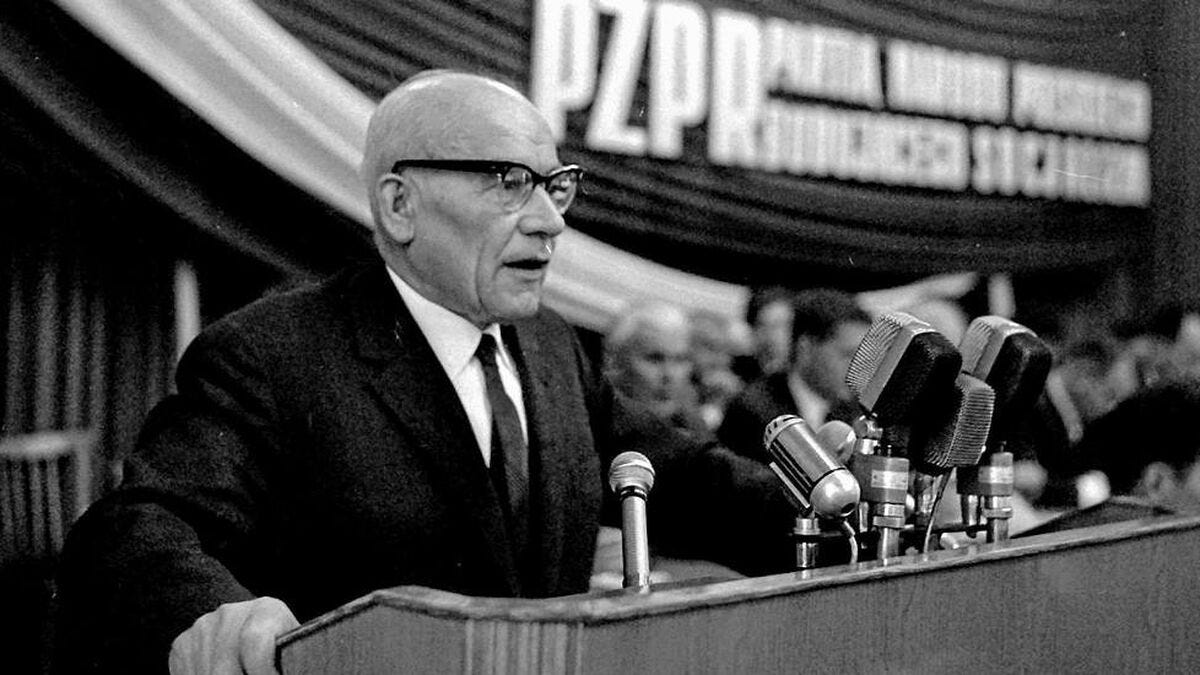
The twentieth century produced many regimes that lied about themselves. But few lied with such composure as Communist Poland. It lied not only to the world. It lied to itself. And perhaps that is always the more dangerous deception.
Poland emerged from the Second World War like a man who has survived a catastrophe only to discover that survival itself has become unbearable. Its cities were broken open. Its streets carried the odor of ruin. Beneath the rubble lay another destruction, less visible and more terrible. Before the war, Poland had contained one of the great Jewish civilizations of Europe. More than three million Jews had lived there, argued there, prayed there, laughed there. Then came the German machinery of death. Treblinka. Sobibor. Majdanek. Chełmno. Auschwitz. Names that no longer belong entirely to geography. They belong now to the conscience of mankind.
The new communist authorities understood immediately that antisemitism could no longer appear merely as a vulgar prejudice among others. After Hitler, antisemitism had become contaminated by absolute defeat. It carried the stench of the crematorium. The regime therefore condemned it in total terms and it was declared “reactionary”, “bourgeois”, and “fascist”. The socialist state presented itself as the final victory over the old European barbarism.
This conviction entered the law itself. On 31 August 1944, the communist authorities issued what became known as the August Decree, formally titled the “Decree of the Polish Committee of National Liberation on the punishment of fascist-Hitlerite criminals and traitors to the Polish Nation.” The decree established legal mechanisms for prosecuting Nazi collaborators and wartime atrocities. Antisemitic violence could now be prosecuted under the category of fascist criminality. The state believed it had performed a moral exorcism through ideology and law.
But history rarely submits to decrees. In July 1946, in the city of Kielce, forty-two Jews were murdered and many more wounded in a pogrom triggered by an accusation that Jews had kidnapped a Christian child for ritual murder. The ancient blood libel returned as though nothing had happened. Civilians, workers, militia members, soldiers descended upon Holocaust survivors living in a communal building on Planty Street. They beat them, shot them, hunted them through corridors and stairwells.
Europe had just witnessed the extermination of six million Jews. Auschwitz still stood upon Polish soil like a wound left open to the sky. The ashes of the dead had scarcely settled into the earth. And yet the oldest hallucination of the continent resurfaced within a year. The Jew again became the embodiment of some dark and metaphysical corruption.
The communist authorities interpreted the pogrom carefully, and perhaps dishonestly. Official propaganda insisted that the violence had been orchestrated primarily by fascist and anti-communist underground elements seeking to destabilize socialism. Certainly such elements existed. But this explanation concealed more than it revealed. The pogrom emerged from a broader atmosphere of panic, resentment, myth, wartime trauma, property disputes, and inherited hatred. Jews returning from the camps often discovered strangers occupying their homes or businesses. The return of the survivor became an accusation merely by existing.
There remains controversy even now over the role of the Polish security services in the pogrom. Some believe the authorities possessed prior knowledge of the violence. Others suspect political manipulation or provocation. The evidence remains uncertain. But the essential truth does not depend upon conjecture. Kielce should have revealed something deeper and more humiliating for Europe. The catastrophe of the Holocaust had not cured it of antisemitism. It had merely exhausted Europe physically.
Tens of thousands of Jews fled Poland in the aftermath of Kielce, many through clandestine Zionist escape networks. Survivors who had endured Hitler concluded that there was no future for them in the land of the dead.
And yet Communist Poland continued to insist upon its moral innocence. The 1952 Constitution of the Polish People’s Republic formally guaranteed equality regardless of religion or nationality. Antisemitic organizations were prohibited. Public expressions of antisemitism were condemned. Poland announced itself as a society that had transcended ethnic hatred through socialism. The old disease, it claimed, belonged only to capitalism and fascism.
Then came 1968, and with it one of the great moral collapses of postwar Europe. To understand what happened, one must understand the crisis consuming Communist Poland itself. By the late 1960s, the regime of Władysław Gomułka had entered a period of exhaustion. Gomułka had once appeared to many Poles as a reformer, even a communist capable of loosening the terror of Stalinism. His return to power in 1956 had produced genuine hope. For a brief moment, Poland imagined it might discover a socialism with a human face, less suffocating than the brutal orthodoxy imposed from Moscow.
But communist systems age badly. They lose conviction long before they lose power. By 1965, Poland was stagnating economically. The promises of socialism had hardened into bureaucracy, censorship, food shortages, and fear. Universities became centers of growing dissent among students and intellectuals frustrated by the paralysis of public life. Writers demanded greater freedom. Young Poles, raised after the war, no longer carried the same fear of chaos that had legitimized communist authority in earlier years.
The crisis erupted openly in 1968 after the banning of a Warsaw National Theatre production of Adam Mickiewicz’s Dziady (“Forefathers’ Eve”), a deeply symbolic work in Polish culture associated with national oppression and resistance. Demonstrations spread through Warsaw and into other cities. Police beat students in university courtyards. Intellectuals were arrested. The regime confronted not merely unrest, but a terrifying possibility for any totalitarian state: the loss of belief.
And it was here that the Jewish question once again became politically useful. Within the communist leadership itself, factions had already been maneuvering for power. One faction surrounding Interior Minister Mieczysław Moczar cultivated a form of communist nationalism steeped in resentment, populism, and implicit ethnic chauvinism. Moczar’s supporters presented themselves as authentic patriotic Poles in contrast to allegedly cosmopolitan elites. The Six-Day War of 1967 now offered the perfect opportunity.
Israel’s victory humiliated the Soviet bloc, which had armed and supported the Arab states. Moscow responded with furious antizionist propaganda across Eastern Europe. In Poland, Gomułka seized upon the atmosphere. In a speech delivered shortly after the war, he warned against what he called a “fifth column” of Zionists inside Poland.
To be sure, the state did not investigate political beliefs among the Jewish population. Jewish ancestry itself was enough. A person could be entirely assimilated, secular, loyal to Poland, even hostile toward Israel, and still become a target of the campaign. Party officials searched archives for Jewish-sounding names and careers ended overnight. Jewish university professors were dismissed. Jewish journalists were fired from newspapers. Jewish military officers were expelled from command positions and Jewish students were forced out of universities. Families who had already survived Hitler and Kielce, discovered once more that they no longer belonged to the nation around them. Jews were issued travel documents instead of passports, often stamped valid for one-way exit only. In many cases they were forced to renounce Polish citizenship before leaving.
Approximately thirteen thousand Jews were forced from the country between 1967 and 1968. The Jew was the “cosmopolitan”, the “foreign element”, the “imperialist collaborators” and most of all, the carrier of suspect loyalties to Israel.
And perhaps this is what makes Communist Poland philosophically unbearable. The regime genuinely believed itself anti-racist. There were intellectuals and politicians who participated in the purge of Jews, whom almost certainly regarded themselves as enlightened human beings serving justice. The state had outlawed antisemitism institutionally, legally and rhetorically. Yet at the first serious political crisis, Jews once again became the symbolic vessel into which national anxieties could be poured.
There is something tragic in this beyond politics. Jews who survived Hitler often turned toward communism precisely because it appeared universal. Then one morning they discovered that the socialist utopia also required its impure element.
Because every closed ideology eventually does. The error lies in believing that hatred toward Jews is merely a prejudice. Prejudice alone does not survive centuries of transformation. It survives because it has a function. It explains disorder by locating an invisible contaminant within society. It gives crisis a face.
This is why societies that imagine themselves morally perfected are often the least capable of recognizing their own hatred of the Jews. They believe evil belongs exclusively to their enemies. For the Polish communists, this was the fascists. Some genuinely believed that once they abolish the old vocabulary, they have abolished the human impulse beneath it.
But history is not so easily deceived. By 1968, many Europeans understood that communist universalism, in its Stalinist form at least, had not transcended the barbarism of Europe. It had translated it. Anti-fascism became a mask beneath which older resentments reorganized themselves. Antiracism itself became capable of reproducing racial mythologies. Antizionism became the acceptable dialect through which ancient suspicions could once again speak.
How quickly men forget that ideologies are often mirrors rather than revolutions. And perhaps this is the final lesson of Communist Poland. The greatest danger was never the obvious return of medieval hatred or crude racial doctrine. Those were already discredited to a degree by 1968. The greater danger was something colder and infinitely more dangerous: a society so morally certain of its own virtue that it could expel Jews while sincerely believing itself incapable of hatred toward Jews at all.
No posts
Comments
Nothing yet. Say the first thing.
Sign in to join the conversation.