
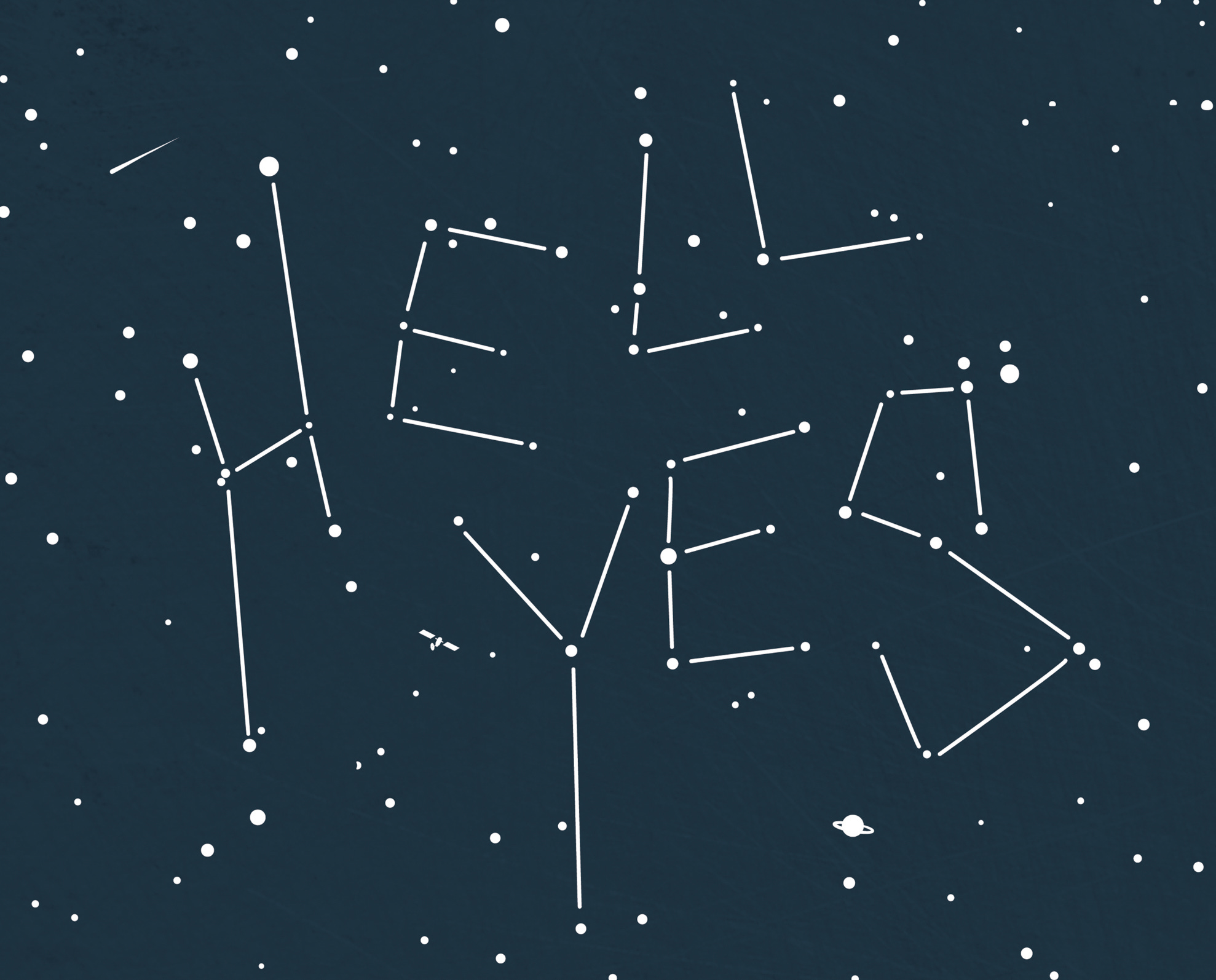
Summer is always a nostalgic time for me. Simultaneously it is my favorite season and a season I dread: I want to slurp cold watermelon, get on a lake, hunt for tomatoes and berries in the garden like precious jewels, eat frozen treats by the dozen (my favorite are mango Melona purchased in Costco quantities, and chocolate Creamies if one happens to be in Utah—both basically ice cream bars), nap in my hammock, and eat meals with fresh char-marks from the grill. I want to yap with my friends til late in the evening around a metal table until it finally gets dark and the mosquitos chase us away, play video games and read books late into the night despite still having to work the next day and push away the ennui I get every summer that re-lives some of the trauma I experienced during the summertime as a teen, unfortunately forever a monument in my brain this time of year.
My birthday is at the end of August, and as a kid was always a transition into the school year. My birthday was often the very first day of school if not the day before, the second day, or within the first week or weekend. To this day, it seems like a blink until Halloween. Another blink to Thanksgiving. A third and now it’s Christmas and the end of the year. For me, this lead up to my birthday has always been my moment of recollection of the year, as everything else just seems to fly by. I’m far from the only person to have noticed this sudden rush of time dilation in the late summer:
Suddenly, I stopped dead. I had opened my calendar to the month of August as usual, to write in the neat white box labeled with day and date, a scant summary of the activities completed in the last 12 hours. Sickened, I saw that I had unwittingly completed the last day of August.
Tomorrow would be September. God! All the quick futility of my days cascaded upon me, and I wanted to scream out in helpless fury at the hopeless inevitable going on of seconds, days and years.
- The Unabridged Journals of Sylvia Plath
In western myth, as reflected in the ancient archetypes of the Zodiac, the summertime is ruled by the moon (Cancer), the sun (Leo), and Mercury (Virgo). Cancer is known as “cardinal”, meaning it leads the decisive change from one season to another during the summer solstice, while Leo is “fixed”, the sun gaining extra power and influence as it enters into the sign of its own rulership and is particularly set in its own way, and finally Virgo, known as a “mutable” sign, being the flexible moment just before the next seasonal change. This pattern of modalities continues around the year with each equinox and solstice. Each of the seasons in the northern hemisphere have their own symbolism, but I have found it relatable that summer begins with symbology relating to emotions, memory, and yearning; which bakes into a loud, jubilant celebration of summer (also, think of any self-proclaimed Leo you know); and ends with a mindful look-over of the season as a whole while looking forward to the rest of the year and to hopefully sneak in some last-minute fun from the over-analyzer, scamp, and messenger-symbol Mercury. Thus ends summer, passing the torch to the symbolic manifestation of the equinox and balance—Libra, the scales.
I left the Church of Jesus Christ of Latter Day Saints (the Mormons) when I was 18 and moved to San Francisco for many reasons, but I mostly held heavy skepticism around anything religious, the occult, or spiritual in nature entirely after I departed for several years. I tried to not be obnoxious, but as I was in my early adulthood, I am sure I was despite my efforts. While I always found Richard Dawkins and his ilk full of condescension to be insufferable, I was and am more drawn to what Carl Sagan had to say on such things, and still enjoy his “Baloney Detection Kit” rules and try to look over logical fallacies frequently so I hopefully don’t fall prey to them.
I don’t classify myself as an atheist anymore, and I certainly don’t deem myself better than anyone for having differing beliefs for or against the belief of Deity, but at the time, it gave me comfort having black-and-white rules of life and death—no gods, no goddesses, no heaven or hell. My consciousness would end and that would be that, and I discovered what a joy it is to be alive right now, and just how precious. However, as you can likely tell, I have always been fascinated by myth, symbol, the unknown, and my own rather unexplainable experiences, and have since adopted a “we still really don’t know what’s going to happen and we know nothing really of the Universe so I’m going to go ahead and live my life as well as possible and figure it out from there, as I am just matter examining itself and maybe it’s not that serious” kind of attitude. I still like to view every moment as precious, though, just in case.
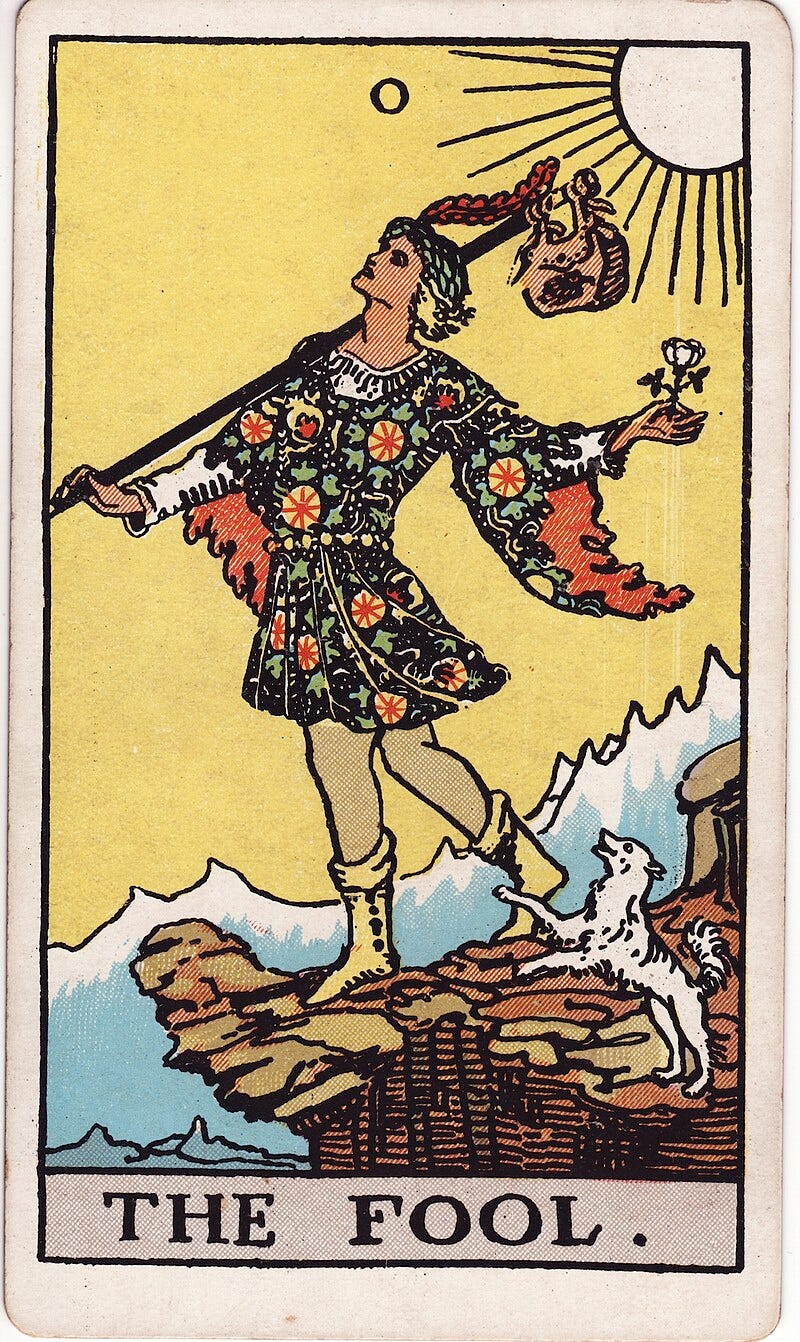
In art school, I took a course titled The Power of Myth and Symbol. We covered archetypes and the Hero’s Journey, Jungian concepts, our shadow selves, collective consciousness, unconsciousness, and more, all which expanded much of my enjoyment of art history and contemporaries when I realized just how many people have used these tie-ins in their own works, consciously or unconsciously. I found far more interest in things such as the artwork for the Tarot and where those symbols came from, back to antiquity, where astrology and astronomy were one and the same. I am not condoning a life where we must all turn to the occult to get guidance about our choices or dictate them, or to fear the passing of planets above us, but I do find it interesting that when you dig into it, the stories in these myths follow the cycles of the earth, the sun, and the moon, the harvest, gathering together in times of hardship, the human experience of growth, and the mutual aid that comes from respecting the inner-connectedness that all humans and creatures face on this planet together.
As a kid before all this, I also loved outer space. Whether it was learning of constellations and ancient Greek heroes and monsters, forever memorialized in the sky, or at the same time, poring over books and websites about quasars, the moons of Jupiter and Saturn, white dwarfs, black holes, and dark matter. Some of these themes kept me awake at night, thinking of eternity and the eventual death of of our own star in billions of years, and how not even our human bones would be spared.
One day, our boring and stable yellow sun will run out of hydrogen, be unable to keep fusion into helium continuing in its core, and the precarious balance between its own gravity pushing in and thermonuclear power pushing out will be disrupted. As the core collapses, fusion of hydrogen continues into the shallower reaches of the star, creating more heat which expands the surface of the star and cools it into what is known as a red giant. If our planet and every record of human life is not immediately consumed in this expansion that will likely reach to Earth’s orbit, it certainly will be tossed about in the aftermath of the massive supernova that will cast all the sun’s spent matter aside from its dense core (now a white dwarf) and the inner planets outward, perhaps seeding new stars and planets, for a while.
While I loved the space-equivalent ZooBooks that my parents subscribed to, it was a lot for a child to contemplate the heat death of the Universe at ten years old, and to think of the lonely Voyager probes passing beyond our solar system, slowly losing power, perhaps humanity’s actual last physical legacy in the cosmos.
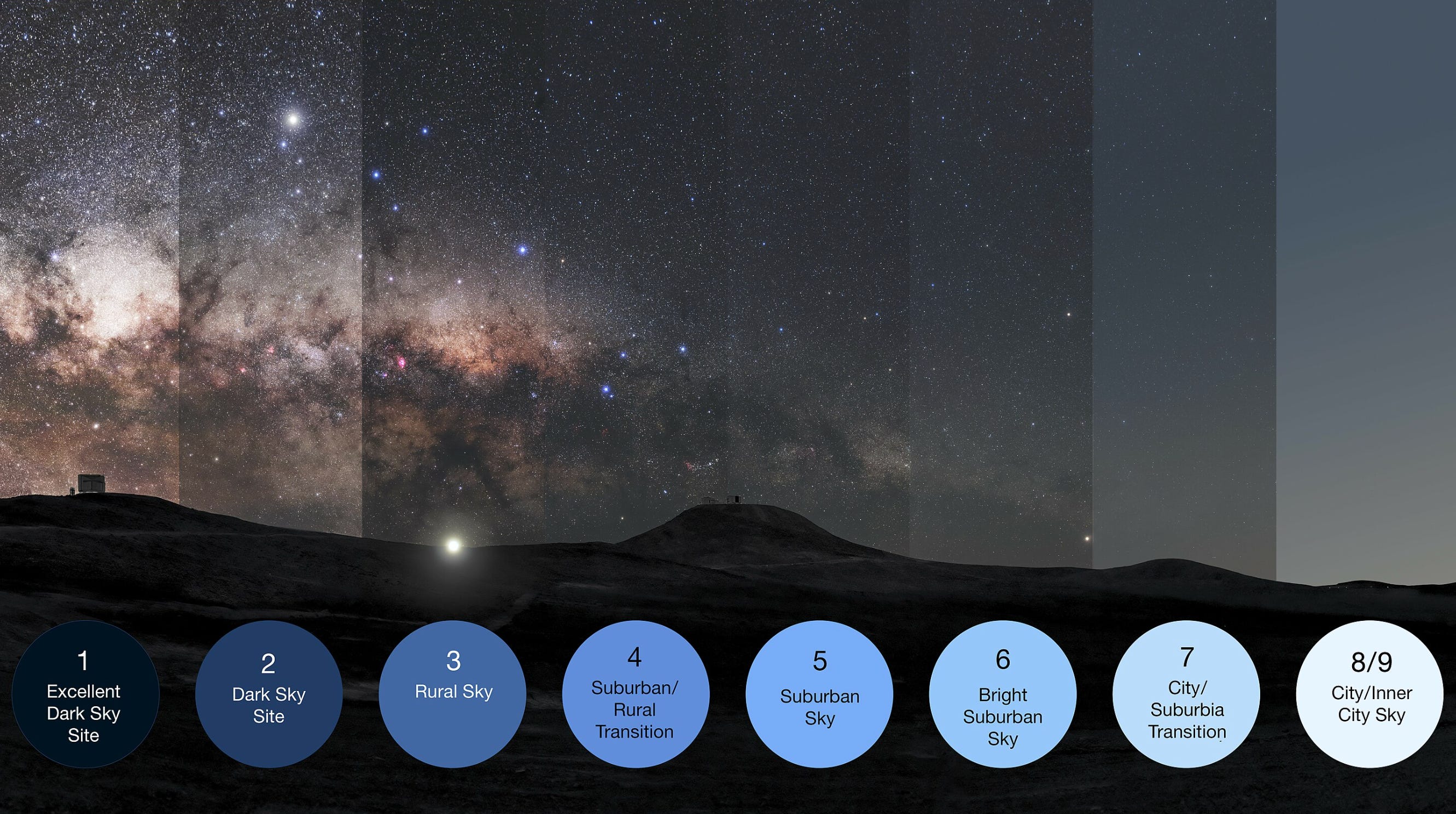
Now to not be so nihilistic (though this is coming from someone that wears a memento mori on her finger), I recently learned about something known as the Bortle Scale, and really registered how few people in our lifetime have seen a truly dark night sky. How up until the 20th century, the majority of life on our planet has looked up into a night sky that was alive with beauty and inspired migrations, progeny, human stories and myth (even similar ones!), all around the world. The moon, sun, and planets were deeply connected to our lore, our harvests, our calendars, and our connection to Earth itself. Now, most humans today live in dense cities, including myself, and I’m lucky to see a seven on the Bortle scale on clear nights here in Oakland.
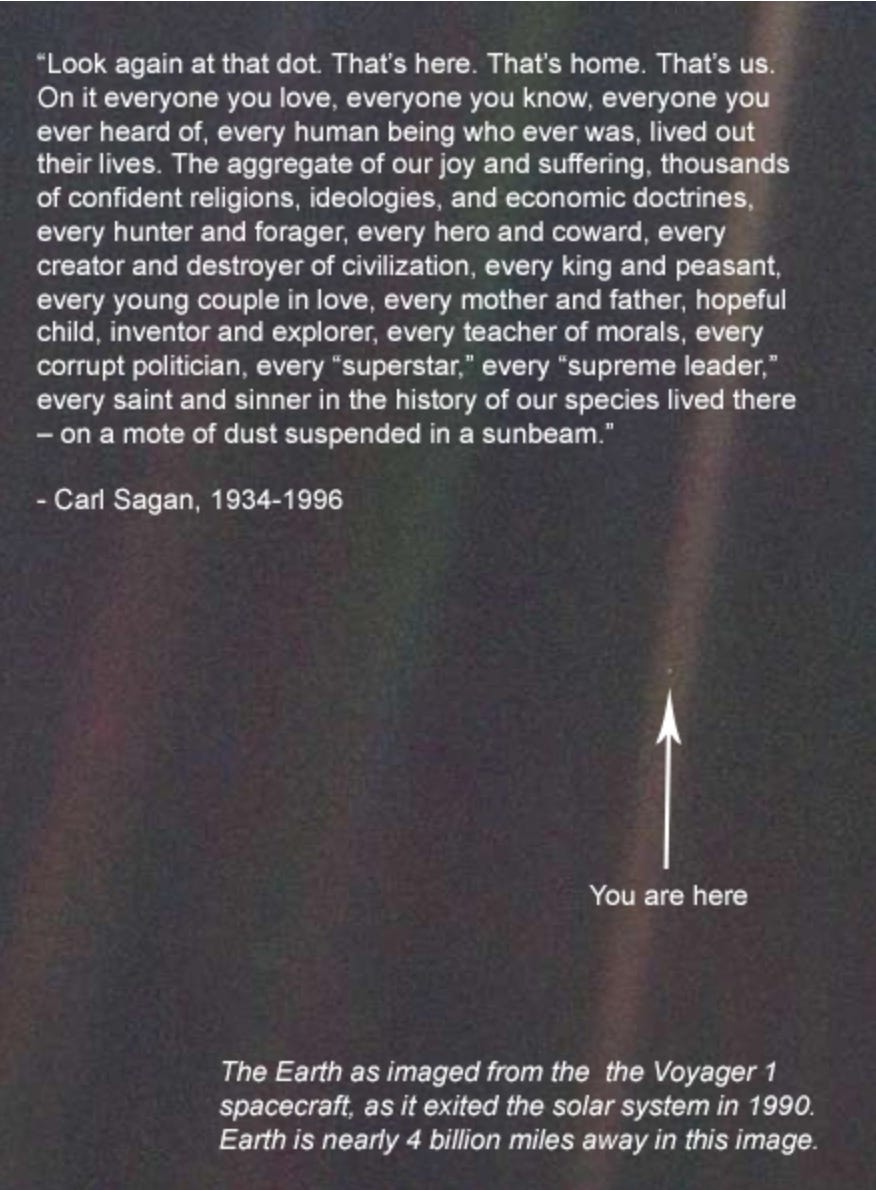
To look up and witness the Universe above and around us as it had been witnessed by our ancestors is a powerful thing. They were once beholden to the cycles of the earth for survival far more than our capitalistic society with its amenities such as refrigeration and airflight, and the movement of the heavens inspired stories and myths that still reflect in our cultures today. We look up and are reminded just how tiny we are, how insignificant. Then to realize that the stuff that is out there in that vast endless expanse is the same stuff that I am made of, that you are made of, that the plants and trees and singing crickets and droning summer cicadas are made of, and that we are made up of as many of those infinitely small particles that make up the universe as there are stars in the sky. We also have had the ability to look back. To look at our planet from far away and realize that all we have ever known is just a pale blue dot, “on a mote of dust suspended in a sunbeam”.
We have a unique perspective of the Universe, as humans. Small enough to be astounded by the light of our Milky Way, the rings of Saturn, or planetary nebulae, but large enough to see the microscopic world within and beneath us. This comprehension and straddling of the micro and macro makes me feel more spiritually connected than the words of any man or prophet I have ever experienced. We know that photons can tell if they are being observed. We know the scientific method is responsible for miracles beyond any ancient’s comprehension. And yet, we still know so very, very little. I choose to let myself be awed by it, and to enjoy the synchronicities of the mysteries of the universe when one opens yourself to both. I’ll leave you with two Carl Sagan quotes and a painting of mine.
“Science is not only compatible with spirituality; it is a profound source of spirituality. When we recognize our place in an immensity of light‐years and in the passage of ages, when we grasp the intricacy, beauty, and subtlety of life, then that soaring feeling, that sense of elation and humility combined, is surely spiritual. So are our emotions in the presence of great art or music or literature, or acts of exemplary selfless courage…The notion that science and spirituality are somehow mutually exclusive does a disservice to both.”
“At the heart of science is an essential balance between two seemingly contradictory attitudes--an openness to new ideas, no matter how bizarre or counterintuitive they may be, and the most ruthless skeptical scrutiny of all ideas, old and new. This is how deep truths are winnowed from deep nonsense.”
― Carl Sagan, The Demon-Haunted World: Science as a Candle in the Dark
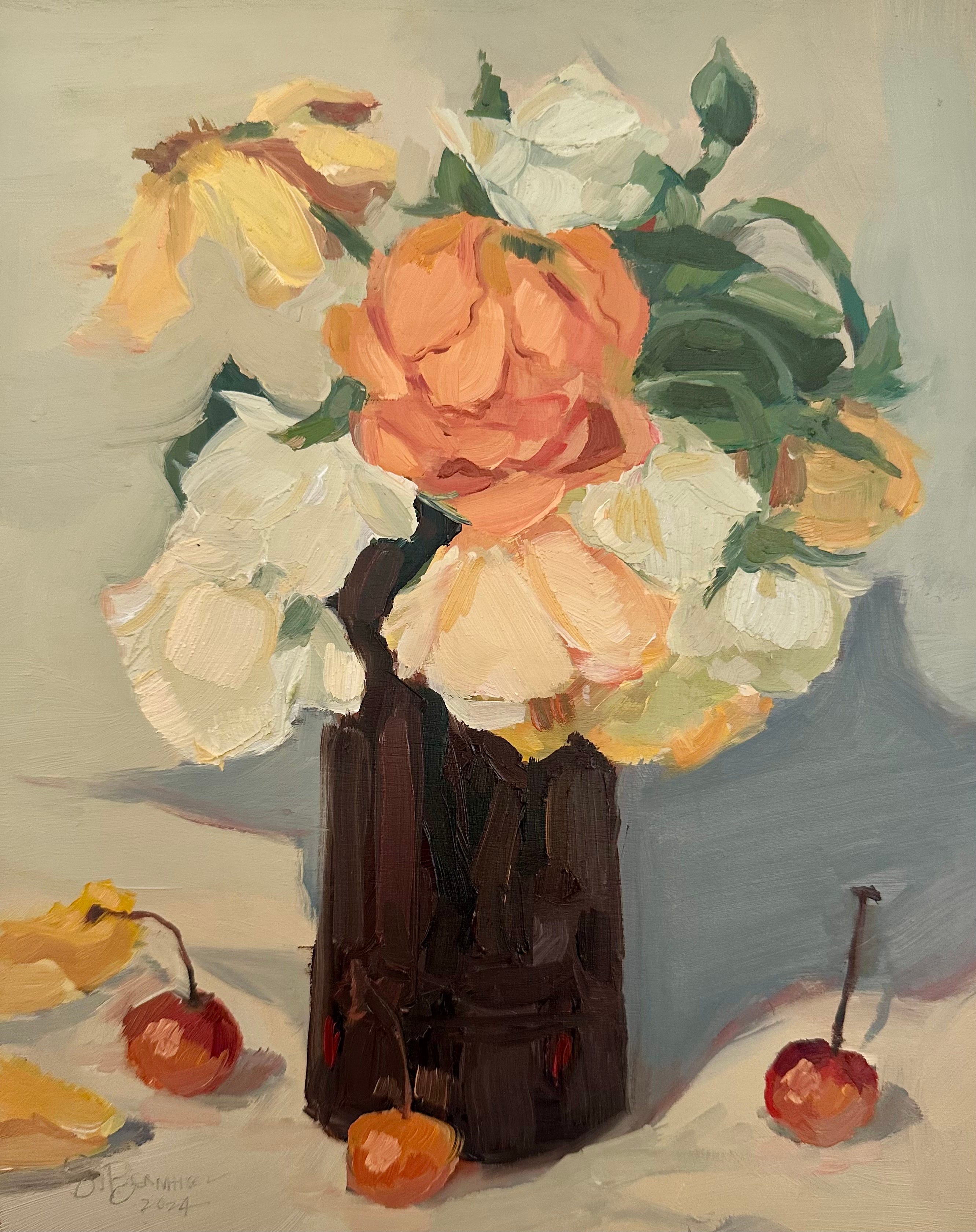
xoxo, Sarahjane.
Comments
Nothing yet. Say the first thing.
Sign in to join the conversation.