
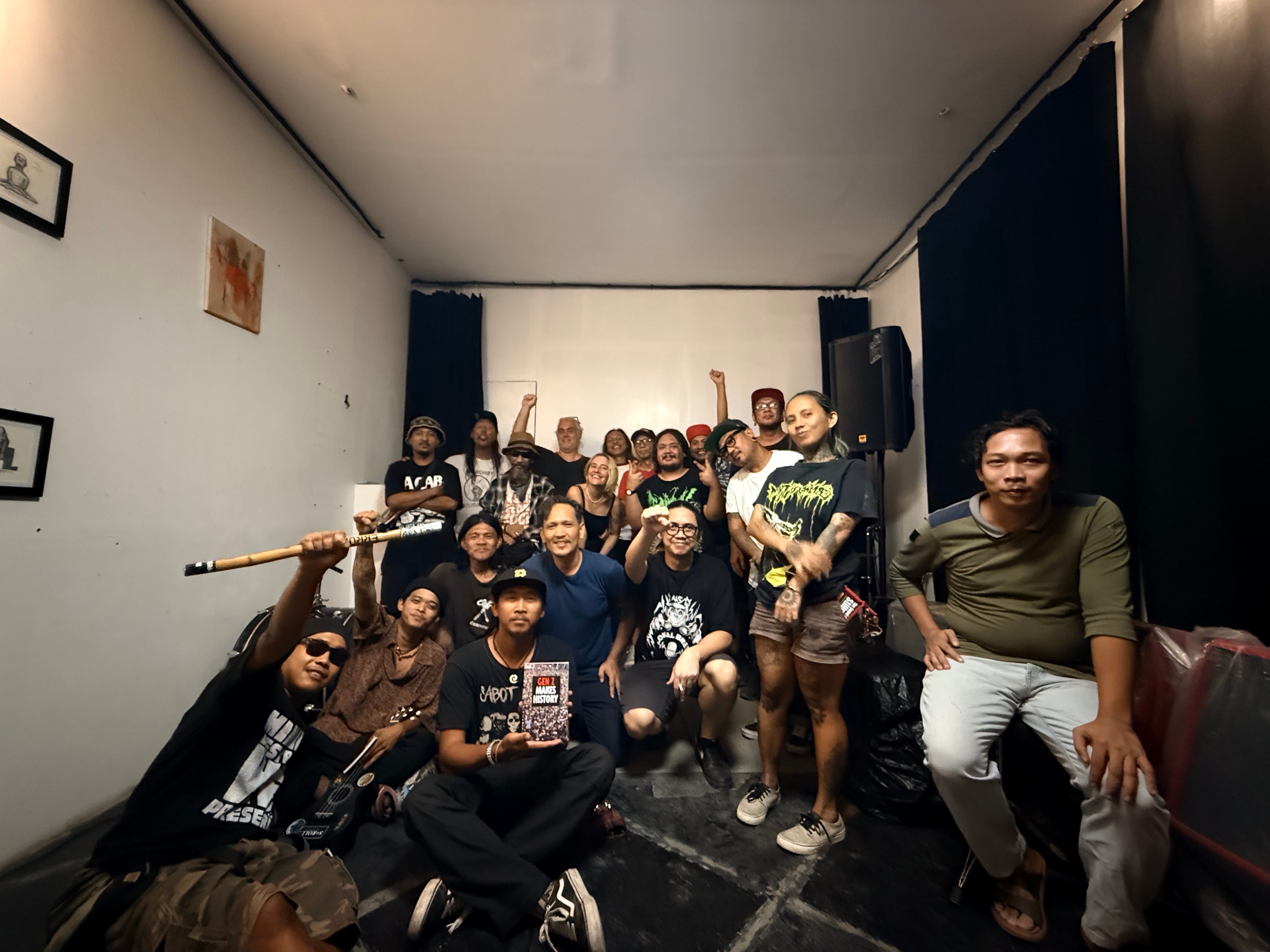
This text was written for a speaking tour in the Philippines, organized by Void Network and performed in social centres, community spaces and squats.
___
Sisters, brothers, comrades
I come here with a responsibility to listen before I speak, and to recognise that this land already has its own feminist wisdom, older, deeper, and more specific to your lives than anything I bring.
I have been reading about
, the feminist framework born here, from Filipina experience, that understands how sexism, classism, and neocolonialism are not separate systems but one interlocking architecture of power. This framework knew something that took Western feminism far too long to admit: that the fight against the landlord and the fight against the abuser are the same fight. That domination has many faces and one logic.
I am here to think together across our different geographies about what we share: a refusal to accept that hierarchy is natural or inevitable. What I offer comes from my own struggle, my own feminist group, my own experiences. I offer it in solidarity, not as a model. You have your own models. I am here to learn from them too.

What Anarchofeminism Says
I want to talk about anarchofeminism. As a way of seeing the world and refusing to accept it as it is.
There is a feminist tradition that understood something precise: women have been required to be quiet for so long that the act of speaking itself becomes revolutionary. The everyday silencing, the woman whose voice disappears, the woman whose knowledge is explained back to her, this is not a personal problem between individuals. It is a system. It is hierarchy. It is the same logic that builds armies, destroys ecosystems, and keeps the poor poor.
This is what anarchofeminism says with full clarity: the oppression of women and the oppression of the many are the same violence wearing different faces.
When we fight patriarchy, we fight the logic of domination itself. We fight the structure that says some bodies are worth more than others, some voices matter more than others, some lives are expendable.
What Patriarchy Actually Is
But let's be precise about what patriarchy is. It is not only when a man does not respect a woman. It is not only when he believes she is inferior.
Patriarchy is the system that grants men the right to control women, to own them. To decide what she does with her body, where she goes, who she sees, what she wears, whether she leaves. This is not love. This is property logic. The same logic that owns land, owns labour, owns nature — and when it is applied to a woman, it calls itself tradition, it calls itself protection, it calls itself family. Patriarchy convinces the one who is controlled that the control is natural. It convinces everyone around them to look away.
This ownership logic is what escalates. It begins with a rule, then a threat, then a hand, then a weapon. Sexism gives birth to gender violence but so does the economy that makes women financially dependent, so does the law that fails to protect them, so does the culture that romanticises possession and calls it passion. Gender violence is not an accident and it is not only sexism. It is the product of an entire culture of hierarchy that has been called natural, called sacred, called inevitable. It is none of those things.
Patriarchy does not begin with murder. It begins in the classroom, where boys are taught that tenderness is weakness. It begins at the dinner table, where girls are taught to serve the food. It begins in a culture that has never invested in emotional education that raises entire generations without teaching them how to name what they feel, how to hold pain without turning it into violence, how to love without needing to own. We do not teach children how to be in relationship. We teach them how to perform gender. And then we are surprised by the wreckage.

The Culture That Feeds the Violence
We are living inside a culture of narcissism and this is specific to our era. The relentless centering of the self. The performance of identity over the practice of relationship. The logic of competition that infiltrates not just markets but intimacy. The cult of productivity that measures human beings by their output. The nuclear family sealed shut as the only legitimate unit of belonging. Monogamy not as a conscious choice but as an unexamined default, the shape love is supposed to take, automatically, or else. The logic of possession that runs underneath all of it: you are mine, therefore I define you.
The problem is not monogamy. The problem is monogamy when it is not working — and we hide it. When desire moves elsewhere and we cannot say so. When the relationship has become a contract of silence, of performance, of fear. When we do not have the language, the permission, or the courage to say: this is not enough for me, or I want something else, or I do not know what I want. We were never taught how to navigate desire honestly. We were never given tools to speak about sex, about longing, about the complexity of loving more than one person, or differently, or outside the expected form. So instead we lie. We cheat. We possess more tightly. We mistake jealousy for love and control for loyalty. And sometimes that unspoken truth becomes violence.
The question is not whether to be monogamous or not. The question is whether we are honest. Whether we have built enough trust, enough language, enough safety to say what is actually happening inside us — without the other person becoming a target for what we cannot face in ourselves.
Feminism Belongs to All of Us
Feminism is not the responsibility of women alone. It never was. The liberation of women is not a women's issue — it is a human issue, a collective issue, a revolutionary issue. Men are also deformed by patriarchy. They are taught to suppress tenderness, to perform dominance, to compete rather than connect. This wounds them too, differently, but deeply. LGBTQI people know better than anyone how violently the gender order punishes those who refuse to fit inside it. Their struggle is inseparable from ours — because what we are all fighting is the same rigid, violent system that decides who is legitimate and who is not.
Feminism is for men who are willing to examine their privilege and dismantle it. It is for queer and trans people who have been resisting the gender binary long before it became a mainstream conversation. It is for anyone who understands that a world free from domination must be free from all its forms. If your feminism excludes, it is not yet anarchofeminism. Anarchofeminism is radical precisely because it is for everyone who has been told they are less.
The Weight of Numbers
These are not abstract arguments. They have names and dates and addresses.
Here, in the Philippines, nearly 1 in 5 women has experienced physical, sexual, or emotional violence at the hands of a partner or family member. And the Philippines has no official femicide count. The country does not track how many women are killed because of their gender.
Across Asia: 17,400 women killed by a partner or family member in 2024. Globally 137 every single day. In the United States, over 600 in 2024. In Greece, a country of 10 million people, we had 15 femicides in 2024 the highest rate of men killing women in all of Europe. And femicide is still not recognised as a crime.
These are not statistics. These are names. These are women who woke up one morning and did not survive the day because the world they lived in had decided their lives were secondary. We must say it plainly: femicide is the extreme end of a continuum that begins with control.
Something Is Moving
In South Korea, Gen Z revived radicalised feminist activism online and in the streets. In the Philippines, Gen Z has been struggling against authoritarian political dynasties. In September 2025, tens of thousands of young Filipinos took to the streets demanding accountability, demonstrating growing impatience with systemic corruption and entrenched power. This wave of youth uprisings, leaderless, transnational has been described as the Asian Spring, spreading from Asia to Africa to the whole planet.
This generation is not apathetic. This generation is awake. And our task is to ensure that this awakening includes the feminist question. That these movements against corruption, inequality, and domination also name gender as a site of domination. That when we say system change, we mean the dismantling of every hierarchy — including the one inside the home, inside the bed, inside the silences we have been taught to keep.
The Answer Begins Here
The answer to gender violence is not only law and policy though we need both, urgently, and we will fight for both. But the deeper answer begins somewhere more intimate. It begins with care. Real care not performance, not obligation, not the care that expects something in return. The care that sees another person as fully real, as fully present, as mattering entirely.
It begins with love that is not ownership but attention. Love that does not need to possess in order to feel secure. Love that can hold the other person's difference without turning it into a threat.
It begins with acceptance of complexity, of imperfection, of the fact that another human being will never be exactly what we imagined. With kindness as a daily practice, not a gesture for good days only. With the ability to sit inside disagreement without it becoming a war to understand that conflict is not the end of a relationship but sometimes the most honest part of it.
It begins with the effort of communication. The hard, unglamorous work of saying what we actually feel, of asking what the other person actually needs, of staying in the conversation when everything in us wants to flee or to fight.
And it begins with the three words that our culture has made almost impossible to say: I was wrong. Not as defeat. Not as humiliation. As the first act of change. Because behavior can change. We can change. But only when we stop defending ourselves long enough to actually look at what we have done and decide to become otherwise.
The structures must change. The laws must change. The institutions must change. But none of that will be enough without this: a culture that teaches us how to be with each other. How to love without owning. How to disagree without destroying. How to want without taking.
Hope Is a Muscle to Exercise
Hope is not optimism. Hope is work. Hope is the radical act of continuing to build a different world while the old one insists on its permanence.
We need a feminism that is connected with social struggles, not a feminism outside of the movement. As our life is interconnected with social phenomena, our struggles have to be interconnected. The fight against the landlord and the fight against the abuser are the same fight. The fight against the state and the fight against the one who silences women at the table are the same fight. The misery of this planet — its wars, its poverty, its ecological collapse — is rooted in the same logic that teaches that domination is natural. Pull that root out.
Anarchofeminism does not ask for a seat at the table of power. It asks why the table is arranged this way at all. It asks who built it, and who was never invited, and what it would mean to tear it down and sit on the ground together as equals.
The Practice Begins Today
In a world shaped by such profound inequality, what we need is not only theory we need practical solidarity. We need social spaces where people can actually meet, actually listen, actually show up for one another. We need to shrink our egos and expand our capacity to hear. We need to offer what is most rare in activist movements and most abundant in human potential: our time. Time given freely to our communities. Time to build the spaces where we do not just survive but live with conscious joy where we can name our pain clearly, understand its roots together, and reach toward solutions not as leaders and followers, but as equals sitting in the same circle.
This is not a utopia. This is a practice.
We are here because we believe the world can be otherwise. But that world cannot be built by leaving half of humanity behind.
You are already doing it.
Keep going.
Comments
Nothing yet. Say the first thing.
Sign in to join the conversation.